Showing posts with label Wolf's Head. Show all posts

Thursday, 3 November 2016

Sharon reviews Blood of the Wolf

The author is giving away a signed copy of the book to one lucky winner. To be in with the chance of winning this fabulous novel, simply leave a comment below or on our Facebook page.
The winner will be drawn on 10th November 2016. Good Luck!


 ROBIN HOOD RETURNS! And this time the legendary wolf’s head is working for the sheriff... After winning his freedom in Rise of the Wolf, Robin – with his faithful lieutenant John Little at his side – now spends his days travelling around northern England dispensing King Edward II’s justice. When a new band of outlaws appears in Barnsdale, Sheriff Henry de Faucumberg sends Robin and John to deal with them. Before the lawmen can track them down though, Will Scaflock is attacked and another of their old companions murdered in his own home by the outlaws whose leader seems to have only one thing on his mind: Bloody vengeance! Will Robin’s reunited gang be enough to defeat this savage new threat that seeks to wipe them out one by one? Or will another old foe provide the final twist that sees England’s greatest longbowman dead and buried?
With Blood of the Wolf, Steven A McKay has definitely saved the best to last! The fourth and concluding part of his fabulous Forest Lord series sees Robin and his band of Merry Men reunited and embarking on one final adventure together, facing a most formidable foe; a new and particularly vicious band of outlaws. This book has everything: suspense, action and enduring friendships that are tested to their limits. Old and new enemies make the reader eager to see Robin win through, and a few surprises along the way make this a thoroughly entertaining and gripping novel.
It leads you on a desperate chase through  the forests, in the halls of the Sheriff's castles and into the villages of England in the time of Edward II.


The story develops quickly and Robin and his men, pardoned by the king three years ago, soon find themselves outlaws again - and facing the nastiest outlaw imaginable. The easy camaraderie of Robin's merry men in previous books is lacking at the beginning and a great part of the story and atmosphere of the book depends on the men rebuilding their relationship.

Robin knew he needed to make a statement here, so , when they locked arms, straining against one another, he wasted no time in the usual staring-out contest that started such a fight. With lightning speed, he brought his hands inside Arthur's grip and broke it, knocking the other man's arms away, then he simply stepped past Arthur, set his foot, and used his shoulder to trip the smaller man.
"Wahey!" someone cheered and there were a few laughs but Arthur rolled and jumped back to his feet instantly. He was breathing harder than he should have been though and Robin could see his opponent really did need practise. He'd never have been winded at this stage of a wrestling match four years ago.
Without waiting for that "come on, then" gesture, Robin came forward again, and again, they grabbed hold of one another. This time Arthur was more careful, and also even more irritated, and he tried to spin around Robin so he could lock his arms around him and haul him down but, as he moved, Robin grabbed his hand and twisted. The move ended with Arthur's arm locked agonisingly behind his back.
Normally, Robin would have left it at that and let his opponent tap to concede but not this time.
Pulling up even further on his arm, he forced Arthur onto his knees on the grass and held him there for longer than was really needed.
He was sending a message though, wasn't he?
"Enough," Arthur shouted through gritted teeth, trying to offset his humiliation by laughing through the pain. "I yield. You win!"
Still Robin held him and turned to stare at the onlooking men. They looked back at him and he was sure they understood what was happening.
They remembered why he was their leader....


The first book in the series, Wolf's Head, recounted the story of the young and adventurous, 18-yeear-old Robin Hood. Rise of the Wolf and The Wolf and the Raven continued the adventures of Robin and his band. By Blood of the Wolf Robin is older, wiser and a little more jaded by time and experience. But, deep down, he still has a sense of adventure and a desperate desire for justice. Robin is still the flawed hero, driven by his sense of justice and a love for friends and family. Although a little more cynical, Robin's relationship with Little John is constant and solid, but in Blood of the Wolf other friendships are strained and Robin has to work hard to repair the damage done by recent actions and the passage of time. Will Scarlet is as headstrong as ever, but approaching middle age, it takes him a while to get back to his old feisty self. But once they're working as a team again, it's the bad guys who have to watch out! As for the Sheriff of Nottingham - well, you'll have to read the book....

While the action is never-ending, it is the underlying story of personal relationships and friendships that make the book; they dictate the actions and reactions of the main characters and give this novel a deeper story than its predecessors.
Set in Barnsdale Forest during the reign of Edward II, Steven A. McKay's Forest Lord series have been a refreshing new take on the Robin Hood legend and Blood of the Wolf  continued this fabulous idea. At the end of the day, Robin has to face old and new adversaries, and in the dark woods of Barnsdale Forest and the desperate poverty of its surrounding villages he has to face the fight of his life.
The book is incredibly well written, the fight scenes expertly choreographed and the storyline exquisite, with several twists and turns along the way, leaving the reader entranced to the very end.


Steven McKay was born in 1977 near Glasgow in Scotland. He live in Old Kilpatrick with his wife and two young children. After obtaining his Bachelor of Arts degree with the Open University he decided to follow his life-long ambition and write a historical novel.
He plays guitar and sings in a heavy metal band when they can find the time to meet up.
Website
Amazon Author page
Twitter
Facebook

Sharon Bennett Connolly has been a Review reviewer for over a year. She writes a popular history blog entitled History...the Interesting Bits and is currently working on her first book, Heroines of the Medieval World, which will be published by Amberley in the summer of 2017. You can find her on Facebook and Twitter.

Tuesday, 14 October 2014

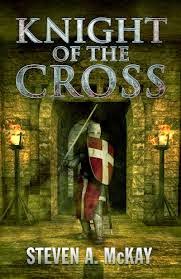
Review of Knight of the Cross by Steven A. McKay

Knight of the Cross by Steven A. McKay
Review by Stuart Laing

Please see below for details about the giveaway!

Scottish author Steven A. McKay has quickly established himself as one of the rising stars in the ranks of British independent authors with his Forest Lord series portraying a fresh new vision on the timeless story of Robin Hood.

The two novels he has published, Wolf's Head and The Wolf and The Raven, swept the reader on fast paced, tautly woven plotlines through the towns and forests of medieval England. Familiar names mix smoothly with new characters in adventures aimed at mature readers where the language can be as robust as the action. Life was cheap at times in 14th century England and the books reflect that fact with an unflinching portrayal of a grim past. However, McKay does not allow the gritty violence to bog the stories down in a relentless recital of death and suffering; there is love, laughter, music and the enduring qualities of true friendship which triumph for our heroes. It is this smooth combination of light and dark which makes the Forest Lord series so enjoyable and it is a combination which he brings to the novella Knight of the Cross.

The story opens in 1309 on the Greek island of Rhodes where the Knights Hospitallers are investigating the disappearance of three of their numbers. Sir Richard-at-Lees, a name familiar to those who have read the Forest Lord series, is ordered by Foulques de Villaret, Grand Master of the Order, to travel to the village of Sgourou with only his trusted sergeant-at-arms Jacob by his side. Together they must get to the bottom of what has happened to their missing brothers in arms and also discover if there is any truth to the rumours of dark deeds which surround the area.

Sir Richard quickly realises that many villagers have also vanished without trace but the surviving locals are clearly too terrified to reveal what is going on. Their silence only spurs him on to find answers and his investigation soon leads him to the tiny village of Krymmeni Thesi where blank stares and an aggressive welcome await them.

Steven A. McKay skilfully builds a rising sense of danger as Sir Richard and Jacob discover that the enemy they face is not of this earth. Deep below the cursed village of Krymmeni Thesi unspeakable acts are being performed and when the fate of the missing Hospitallers is discovered, the two warriors witness human sacrifice being performed before they are forced to flee to seek reinforcements.

Even with a full troop of warriors though Sir Richard discovers that the devil worshippers in the bowels of the earth are not an easy enemy to defeat...

I don't want to give away any more about the plot than that. To discover what happens next then I recommend you grab yourself a copy as soon as possible.

While this is a novella and the paperback version comes in at just short of 100 pages, it packs the cunning, tightly-woven plot we have come to expect from Steven A. McKay who has the knack of packing great characters, memorable scenes (the underground chamber with the chanting crowds will haunt your dreams) alongside a story that races along like a knight's destrier carrying you ever onwards.

One aspect of this book which is wonderfully refreshing is how McKay uses modern folklore, created by the Internet generation, in such a way that it feels like genuine legends from the medieval age. Just as our ancestors once gathered around their fire-pits in roundhouses to tell stories through the long, dark winter nights, the Internet has become its modern equivalent where 21st century folklore is spawned and spread until it becomes familiar to many. 

Here Steven A. McKay takes sources as diverse as death metal bands to Internet-generated myths to create a death-cult on a 14th century island in the Mediterranean which not only feels like it once existed, but actually leaves you believing it once existed.

The Kindle version of Knight of the Cross is cheaper than a four-pack of superstore-own brand lager but leaves a much better taste in the mouth. Even the paperback is cheaper than a pint down your local. It is a book which I read in one sitting and it is a book which I can only heartily recommend to one and all. 

Once again I doff my cap to a writer who never fails to deliver.

Steven A. McKay has so graciously offered a free paperback copy of Knight of the Cross for one lucky winner. To get your name in the hat, simply comment below or at this post's associated Facebook thread

Purchase links...

Steven's bio from Amazon - "My second book, The Wolf and the Raven was released on April 7th, at the London Book Fair where I was part of the Amazon KDP/Createspace/ACX stand. My debut novel, Wolf's Head, was also released the same day as an audiobook.
My latest work is a novella, Knight of the Cross, and that too will be available as an audiobook so look out for that.

I was born in 1977, near Glasgow in Scotland. I live in Old Kilpatrick with my wife and two young children. After obtaining my Bachelor of Arts degree I decided to follow my life-long ambition and write a historical novel.

Bernard Cornwell's King Arthur series was my biggest influence in writing Wolf's Head, and The Wolf and the Raven, but I've also really enjoyed recent books by guys like Ben Kane, Glyn Iliffe, Douglas Jackson and Anthony Riches.

I play lead/acoustic guitars and sing in a heavy metal band when we can find the time to meet up."

Reviewed by Stuart S. Laing, author of the Robert Young of Newbiggin Mysteries.

Wednesday, 30 July 2014

Audio Book Review: Legionary by Gordon Doherty

Be sure to see below for giveaway info!

Legionary by Gordon Doherty, audiobook review


by Steven A. McKay


I'm sure many of you reading this are sceptical about audiobooks. When I read a novel I like to do it at my own pace, providing the narrator and characters with my own internal voices. The idea of someone else providing those voices, especially for a book I've already read before, didn't seem like a good one.


So, when Gordon Doherty released his excellent Legionary in audio format I decided to sign up to Audible and give it a try. I'd read the Kindle version a year or so before – it was, in fact, my first ever ebook purchase if I remember correctly – and I knew it was a good read, so I wondered how this Roman historical fiction would translate to the new medium.


I'm happy to say it works a treat.


The narrator, Simon Whistler, is good, reading at a natural, relaxed pace, building tension or bringing a light touch when it's required. I wasn't 100% sold on the dialogue, as some of it came across as a little old-fashioned or even twee but that's just me – I like my soldiers to swear like, well, troopers, but other people won't care or actually prefer the lack of earthy language. It's just a matter of personal taste.


The action moves from place to place and is most effective when the main character, Pavo, is around. The political sections without him can move a little slowly, as they did in the ebook, but there's always the option to speed up the reading so if certain parts aren't as exciting as you'd like you can raise the reading speed to x1.5 without losing too much of the atmosphere. 


Overall, this audiobook is a great listen. I do a lot of driving at work and sometimes I get sick of hearing Radio 5 Live or Slayer or Jethro Tull CDs, so it was a very welcome change of pace to have this on as I drove around the west of Scotland every day. It's also good value, lasting for quite a few hours, so don't let the price tag of these things put you off – a lot of work goes into this!


Whether you've read this book before or not, you won't be disappointed when you download the audio version. Give it a try. Doherty's writing has improved since this, his debut novel, so future audio versions of his books will be even better. I've just completed Legionary 3 – Land of the Sacred Fire and I'm looking forward to hearing it read by Simon Whistler, so...bring it on Gordon, we're waiting!


Gordon Doherty has so graciously offered a free copy to gift one lucky readerer, listener!! For your chance in the draw, simply comment below or at our associated Facebook thread.


Buy the Legionary audiobook here.


Steven A. McKay is the bestselling author of Wolf's Head and The Wolf and the Raven. You can find more about him at his Amazon author page and blog/official website

Sunday, 27 July 2014

Sunday Wrap Up: Week ending July 27, 2014

Be sure to see below for details on this week's giveaway!

Above the Fray by Kris Jackson. A Review by Rob Bayliss

Part One – The Ascent  


Battle lines are being drawn as the Union and Confederacy square up to one another. A young Virginian telegrapher, called Nathaniel Curry, leaves his native Richmond to view a balloon flight in Washington. Without realising the implications, and with a youthful sense of adventure, he joins Professor Thaddeus Lowe aboard a balloon that rises to greet the dawn. As an experiment he transmits instructions and coordinates, inadvertently directing artillery fire on a Confederacy position. in his own country. When word leaks out that he was implicated in this attack he is denounced as a traitor and disowned by his own brother. Forced to leave his home, family and sweetheart he seeks employment with Professor Lowe who is putting together a Balloon Corps to assist the Union cause.

Part Two – The Descent


As the war drags on the Confederacy becomes more and more desperate. It becomes clear that they cannot win; the Union has more men, greater industry and better equipment but perhaps lesser generals.


Losses and shortages caused by the Union's blockade stiffens the resolve of the Confederacy.  Nathaniel Curry finds himself being drawn more into espionage, while the Balloon Corps struggles to retain its funding, looked upon by the military as an unnecessary financial drain. In the end it is forced to cease operations.


Above the Fray is really an extraordinary book. It is meticulously well researched from the science of ballooning to the topographic description of the Civil War battlefields. I found myself totally absorbed in the life of Nathaniel Curry. There is humour here and there, but it is the humour of the gallows, as the war brutalises everyone and everything it touches.

It is a wonderfully written story; the language so fully evokes the lost world of the Confederate States of America, that even I, an Englishman, could hear the different accents in the dialogue. I learnt much about the American Civil War that I never knew before. It almost reminded me of the film Forrest Gump (albeit a very much darker tale), the way young Curry lives through major battles, crucial events and the individuals he meets (even a young Count Ferdinand von Zeppelin). Being in the Balloon Corps surrounded by scientists he is even exposed to the science of the age, able to discuss Darwin's Origin of Species and its implications for religion. Through Curry's eyes we can see the old order being swept away as the modern USA evolves.


The story of Above the Fray will stay with me for some time. I can't reccommend it highly enough and I would urge that you should read it, too.

Like this excerpt? Like to get your name in the hat for a free copy? See the rest of the review!

*********

Louise E. Rule Interviews D. W. Wilkin for The Review's Author Interview

Welcome, David, I would like to thank you for taking the time to speak with me today.


For those who haven't yet read your book, Beggars Can't Be Choosier, would you like to give an outline of the story David?

Sure. Beggars is the story of the Earl of Aftlake who is born with a title, but with very little in the way of money. He has about 100 pounds a year which is near poverty for a titled lord. And it is the story of Miss Katherine Chandler who finds that society snubs her for the low birth of her father and his far too rapid rise to wealth and riches. She needs a husband with stature and Lord Brian needs an heiress. An arrangement is made, though not with a typical stipulation, and they are united. He can use the wealth to build a career for himself in politics and reacquire possession to all the properties of his family that have been mortgaged. She can find a place in society that will allow her to have stature and find perhaps some revenge against those who have snubbed her. As a Regency, though, when such a thing is arranged, the road that the two take to fall in love will twist and turn, but it is inevitable that they will fall in love.

Did you already have a title in place for your book, or is it something that evolved as you wrote the story?

Actually no. I considered it another of my Regency projects, but the title did suggest itself to me as more of the story developed. I started the first draft in April of 2010, so not sure when I actually titled it. I do like that I could play upon the words and take a common cliché, twist it a bit, and see that it worked.

Research is, of course, imperative for an historical fiction novel. How much research did you have to do, and did you travel to the UK to visit the places that feature in your book?

I've been to the UK several times. My grandfather was an Englishman, and had started the old Millet chain of what was first Army surplus and became better known as camping goods. the depression and marrying my American grandmother, had them do what I find many couples do, move close to the wife's family, and so we live over the pond. but with many English relatives, I have travelled often to the isles.

I do less research now on a Regency novel I am working on, than my earlier works. I have it in my veins now, but I still add to my research daily. I have a degree in history from UCLA, and add to my extensive collection of history on the era all the time. I also post every day a biography of a Regency era person at my blog: http://thethingsthatcatchmyeye.wordpress.com 

There's loads more to Louise's interview, so come check it out!

*********

Feature Post by Paula Lofting: An Investigation into the Parentage of Hereward (the Wake) 


As an author writing in the 11thc, at some point I knew that the heroic character of Hereward, wrongly known as "The Wake", would have to make his entrance upon the stage. So I wanted to sift through the information there is about him and separate the myth from the fact. Whist doing a book search about him, I came upon a recent work by Peter Rex that features Hereward and other English rebels who fought to retain their lands from the grasping Normans who had invaded in 1066. The first was The English Resistance: The Underground War Against the Normans by Peter RexThis book was a great starting point in learning the facts around the events that were the rebellion years. The Conquest only began in 1066; it took roughly more than six years before England was well and truly subjugated.This book included Hereward and his men along with many others such as Eadric the Wild, Earls Waltheof, Morcar and Edwin, as well as Edgar the Atheling. Then I got my hands on Rex's book about Hereward in which he seeks to discover who this man was and what the facts are that are known about him, plucking him out of the mists of legend and giving us the man that belongs to what is known about the history of the time.  Like the French resistance in the Second World War, the English fought back to rid their land of the invaders, unfortunately they hadn't bargained on the Conqueror's determination, or the ruthlessness of their overlords.  Still, the bravery of such men as Hereward and Eadric the Wild would go down in history and mythology. But just who was this man whose  'a brief life in history and a long one in romance' (Charles Plummer, Oxford Scholar)? Let's take a look at what the evidence actually turns up.

Have a look indeed~~let's go see what else Paula finds for us

*********

Louise E. Rule Reviews The Audible Version of Wolf's Head: The Forest Lord by Steven A. McKay


Audible Cover

In April of this year, Steven asked me if I would review his book, Wolf's Head, on the Audible format. I was very keen to do this as I had already enjoyed reading Steven's book very much. I try to get all my favourite books in paper/hardback as well as Kindle and Audible, if they are available. This is so that I can read/listen to my books wherever I am.


A narrator has to possess skills of reading a story without the listener being aware of the narrator him/herself. Some narrators, I have found, sound as though they are just reading out loud rather than telling a story, while others transport the listener within the very realms of the story, where it is possible to be submerged within it without being aware of its telling.

When one reads one gives each character a voice of their own, and the more the story progresses, the more permanent those voice characterisations become. This is why I think that it is important, no, imperative, that the narrator of an audio book should be well attuned to the story being read. For example, once a certain voice has been given to a character it must be maintained throughout the reading. It is only in this way that the listener can truly become engrossed in the story.


With this in mind, I was really looking forward to listening to the audio version of Steven's book.


With all my expectations, I had great hopes, but at first I felt a wee bit disappointed. I restarted the book several times because it took me a little while to get used to the narrator's performance. I felt that he needed to put more feeling, more humanity into it. As the story went on, however, the narrator settled into his stride, and then I enjoyed the performance more. He conveyed the female voice quite well, which must be difficult for a male narrator. Overdoing the female register can sound like the ubiquitous Pantomime Dame. There is an element of skill in getting this right so as not to reduce the authenticity of the story being read, and by so doing, carry the story forward without the listener being aware of the narrator.


Find out if Louse's experience with an audio book compares to your own by clicking right here.


Last week's Wrap Up.

Thursday, 5 June 2014

The Wolf and The Raven

The Wolf and The Raven 
by Steven A. McKay


Scottish author Steven A. McKay first came to my attention with his version of the Robin Hood legend in his excellent and hugely entertaining book Wolf's Head: The Forest Lord, which put a wonderfully refreshing spin on the classic tale by relocating the outlaw from Sherwood Forest in Nottinghamshire to Barnsdale Forest in Yorkshire and has breathed new life into an old story.
The first book ended with Robin and his band of outlaws being offered the chance to earn a pardon for their crimes which would allow them to reclaim their former lives, a prospect they are all keen to grasp with both hands. The attractions of sleeping rough week after week far from home and loved ones had paled, and with Robin's young wife Matilda (not Maid Marion) heavily pregnant with their first child he is desperate to cast off his mantle of outlaw and return home to create the family life he craves. This book, The Wolf and The Raven, continues that story.

From the very first line the reader is plunged headlong into the carnage and chaos of medieval warfare as Robert and his men (lovers of the legend can rest assured that they will find all the regular characters here: Little John, Will Scarlet, Friar Tuck, Much the Millar's son et al.) find themselves fighting for their lives in the service of Thomas Plantagenet, Earl of Lancaster at the battle of Boroughbridge on the 16th of March 1322. The battle, part of a rebellion of various Marcher Lords led by Lancaster against King Edward II, ends in disaster for the rebels and Robin and his band are forced to flee for their lives once more. Back in the forests they are forced to face the realisation that their hoped for pardons are gone like chaff on the wind while Edward II takes his bloody revenge on those who dared challenge him.

That revenge is not only focused on those who were in command but extends to take in the poor serfs and tenants who were forced to take part in war through circumstance and fealty to various landowners. To find and crush these broken men Edward calls on the services of a man who will become Robin's nemesis. His name: Sir Guy of Gisbourne.

The Gisbourne of this book quickly becomes one of the great villains of fiction: a man of twisted desires and dreams who has suffered heartbreak and betrayal himself through the actions of his adulterous wife. Her betrayal coupled with his childhood fascination with the tales of King Arthur have convinced him he is almost the reincarnation of Lancelot and while he is a brutal, ruthless killer you can't help but feel that there is a weird sort of chivalry at the dark heart of everything Gisbourne does. Women are to be protected (despite his wife's adultery) while the enemies of the king can be killed without thought or mercy!

As though the worry of being pursued by this sinister figure, quickly nicknamed The Raven by intimidated commoners for his black clothing and armour, wasn't enough of a problem, Robin and his men also have to deal with other bands of broken men who haunt the forest and create fresh worries for them by preying on the villagers which they depend upon for support and supplies. Indeed Robin has to spend as much time fighting these bands as he does the king's men! Blood is spilled on all sides and not everyone will emerge unscathed from the carnage which ensues. Add to this the constant risk of betrayal and you have a tense atmosphere which pervades the whole book.

One aspect of this book which I particularly enjoyed is that the author allows the scope to spread beyond the narrow confines of the outlaw camp to take in aspects of the lives of both the common folk in the villages and also those who live in castles. Indeed, a large part of the book is taken up with the story of Robin's friend and ally Sir Richard-at-Lees who, along with his loyal sergeant Stephen, become larger characters who bring fresh breadth to the tale. Sir Richard, besieged by Royalist forces, sends Stephen to the head of his Hospitaller order at Clerkenwell for assistance but any notion of loyalty between these knights of the Black Cross is in vain. Foul murder is ordered and carried out only for the killer to be betrayed by the very man who gave the order. Everyone, it becomes clear, is looking after number one and the lives of friends and brothers in arms can be thrown away to protect dark secrets. I have a feeling these dark secrets may play a further role in future books. I hope so as I do want to see the Grand Prior of Clerkenwell on the end of something sharp!

While The Wolf and The Raven can be at times a dark and violent read with language which some may find a little strong, it is not without humour, such as the barber/surgeon in the village of Penyston who may have just invented Buckfast (a drink much beloved by modern day serfs and villiens in today's broken Britain) and Friar Tuck's unusual suggestion on the best way to distract guards on a city gate! The humour is welcome as Robin faces his darkest fears and feels crushed by self doubt after an awful experience at the hands of Gisbourne while prisoner in Nottingham Castle. This is as close as our hero will ever come to absolute despair and self pity, which threatens to drag the entire band of outlaws down into his malaise with him. It is only tough love from old friends which forces Robin to face the future and regain his old heart and courage. He will need both before the end.

The climatic scene of this book is almost Arthurian itself as Robin faces Gisbourne, a self-created modern Black Knight in single combat on a bridge. Blood will be shed and the result is not what most will hope for but does leave things wide open for the story to continue in book three. 

This is a recommended read for all those who enjoy a grown-up tale of adventure and daring-do with an unflinching approach to medieval life and death.

Personally I cannot wait to discover what delights Steven A. McKay will deliver next time.

Steven A. McKay
His second book, The Wolf and the Raven, was released on April 7th, at the London Book Fair where he was part of the Amazon KDP/Createspace/ACX stand. His debut novel, Wolf's Head, was also released the same day as an audiobook.
He was born in 1977, near Glasgow in Scotland. He lives in Old Kilpatrick with his wife and two young children. After obtaining his Bachelor of Arts degree he decided to follow his life-long ambition and write a novel.
Historical fiction is his favourite genre, but he also enjoys old science-fiction and some fantasy.
Bernard Cornwell's King Arthur series was the biggest influence in writing Wolf's Head, and now The Wolf and the Raven, but he has also really enjoyed recent books by guys like Ben Kane, Glyn Iliffe, Douglas Jackson and Anthony Riches.
Steven plays lead/acoustic guitars (and occasional bass/vocals) in a heavy metal band when they can find the time to meet up.

Stuart Laing is the author of the Robert Young of Newbiggin Mysteries.

Update: We are thrilled to announce there will be a freebie copy of The Wolf and the Raven to be gifted to a reader whose name is drawn at random. To get your name in the hat, please comment below or at our Facebook thread here. Readers who commented below or at the FB thread before the announcement are automatically entered.