Showing posts with label Norman Conquest. Show all posts

Sunday, 27 July 2014

Sunday Wrap Up: Week ending July 27, 2014

Be sure to see below for details on this week's giveaway!

Above the Fray by Kris Jackson. A Review by Rob Bayliss

Part One – The Ascent  


Battle lines are being drawn as the Union and Confederacy square up to one another. A young Virginian telegrapher, called Nathaniel Curry, leaves his native Richmond to view a balloon flight in Washington. Without realising the implications, and with a youthful sense of adventure, he joins Professor Thaddeus Lowe aboard a balloon that rises to greet the dawn. As an experiment he transmits instructions and coordinates, inadvertently directing artillery fire on a Confederacy position. in his own country. When word leaks out that he was implicated in this attack he is denounced as a traitor and disowned by his own brother. Forced to leave his home, family and sweetheart he seeks employment with Professor Lowe who is putting together a Balloon Corps to assist the Union cause.

Part Two – The Descent


As the war drags on the Confederacy becomes more and more desperate. It becomes clear that they cannot win; the Union has more men, greater industry and better equipment but perhaps lesser generals.


Losses and shortages caused by the Union's blockade stiffens the resolve of the Confederacy.  Nathaniel Curry finds himself being drawn more into espionage, while the Balloon Corps struggles to retain its funding, looked upon by the military as an unnecessary financial drain. In the end it is forced to cease operations.


Above the Fray is really an extraordinary book. It is meticulously well researched from the science of ballooning to the topographic description of the Civil War battlefields. I found myself totally absorbed in the life of Nathaniel Curry. There is humour here and there, but it is the humour of the gallows, as the war brutalises everyone and everything it touches.

It is a wonderfully written story; the language so fully evokes the lost world of the Confederate States of America, that even I, an Englishman, could hear the different accents in the dialogue. I learnt much about the American Civil War that I never knew before. It almost reminded me of the film Forrest Gump (albeit a very much darker tale), the way young Curry lives through major battles, crucial events and the individuals he meets (even a young Count Ferdinand von Zeppelin). Being in the Balloon Corps surrounded by scientists he is even exposed to the science of the age, able to discuss Darwin's Origin of Species and its implications for religion. Through Curry's eyes we can see the old order being swept away as the modern USA evolves.


The story of Above the Fray will stay with me for some time. I can't reccommend it highly enough and I would urge that you should read it, too.

Like this excerpt? Like to get your name in the hat for a free copy? See the rest of the review!

*********

Louise E. Rule Interviews D. W. Wilkin for The Review's Author Interview

Welcome, David, I would like to thank you for taking the time to speak with me today.


For those who haven't yet read your book, Beggars Can't Be Choosier, would you like to give an outline of the story David?

Sure. Beggars is the story of the Earl of Aftlake who is born with a title, but with very little in the way of money. He has about 100 pounds a year which is near poverty for a titled lord. And it is the story of Miss Katherine Chandler who finds that society snubs her for the low birth of her father and his far too rapid rise to wealth and riches. She needs a husband with stature and Lord Brian needs an heiress. An arrangement is made, though not with a typical stipulation, and they are united. He can use the wealth to build a career for himself in politics and reacquire possession to all the properties of his family that have been mortgaged. She can find a place in society that will allow her to have stature and find perhaps some revenge against those who have snubbed her. As a Regency, though, when such a thing is arranged, the road that the two take to fall in love will twist and turn, but it is inevitable that they will fall in love.

Did you already have a title in place for your book, or is it something that evolved as you wrote the story?

Actually no. I considered it another of my Regency projects, but the title did suggest itself to me as more of the story developed. I started the first draft in April of 2010, so not sure when I actually titled it. I do like that I could play upon the words and take a common cliché, twist it a bit, and see that it worked.

Research is, of course, imperative for an historical fiction novel. How much research did you have to do, and did you travel to the UK to visit the places that feature in your book?

I've been to the UK several times. My grandfather was an Englishman, and had started the old Millet chain of what was first Army surplus and became better known as camping goods. the depression and marrying my American grandmother, had them do what I find many couples do, move close to the wife's family, and so we live over the pond. but with many English relatives, I have travelled often to the isles.

I do less research now on a Regency novel I am working on, than my earlier works. I have it in my veins now, but I still add to my research daily. I have a degree in history from UCLA, and add to my extensive collection of history on the era all the time. I also post every day a biography of a Regency era person at my blog: http://thethingsthatcatchmyeye.wordpress.com 

There's loads more to Louise's interview, so come check it out!

*********

Feature Post by Paula Lofting: An Investigation into the Parentage of Hereward (the Wake) 


As an author writing in the 11thc, at some point I knew that the heroic character of Hereward, wrongly known as "The Wake", would have to make his entrance upon the stage. So I wanted to sift through the information there is about him and separate the myth from the fact. Whist doing a book search about him, I came upon a recent work by Peter Rex that features Hereward and other English rebels who fought to retain their lands from the grasping Normans who had invaded in 1066. The first was The English Resistance: The Underground War Against the Normans by Peter RexThis book was a great starting point in learning the facts around the events that were the rebellion years. The Conquest only began in 1066; it took roughly more than six years before England was well and truly subjugated.This book included Hereward and his men along with many others such as Eadric the Wild, Earls Waltheof, Morcar and Edwin, as well as Edgar the Atheling. Then I got my hands on Rex's book about Hereward in which he seeks to discover who this man was and what the facts are that are known about him, plucking him out of the mists of legend and giving us the man that belongs to what is known about the history of the time.  Like the French resistance in the Second World War, the English fought back to rid their land of the invaders, unfortunately they hadn't bargained on the Conqueror's determination, or the ruthlessness of their overlords.  Still, the bravery of such men as Hereward and Eadric the Wild would go down in history and mythology. But just who was this man whose  'a brief life in history and a long one in romance' (Charles Plummer, Oxford Scholar)? Let's take a look at what the evidence actually turns up.

Have a look indeed~~let's go see what else Paula finds for us

*********

Louise E. Rule Reviews The Audible Version of Wolf's Head: The Forest Lord by Steven A. McKay


Audible Cover

In April of this year, Steven asked me if I would review his book, Wolf's Head, on the Audible format. I was very keen to do this as I had already enjoyed reading Steven's book very much. I try to get all my favourite books in paper/hardback as well as Kindle and Audible, if they are available. This is so that I can read/listen to my books wherever I am.


A narrator has to possess skills of reading a story without the listener being aware of the narrator him/herself. Some narrators, I have found, sound as though they are just reading out loud rather than telling a story, while others transport the listener within the very realms of the story, where it is possible to be submerged within it without being aware of its telling.

When one reads one gives each character a voice of their own, and the more the story progresses, the more permanent those voice characterisations become. This is why I think that it is important, no, imperative, that the narrator of an audio book should be well attuned to the story being read. For example, once a certain voice has been given to a character it must be maintained throughout the reading. It is only in this way that the listener can truly become engrossed in the story.


With this in mind, I was really looking forward to listening to the audio version of Steven's book.


With all my expectations, I had great hopes, but at first I felt a wee bit disappointed. I restarted the book several times because it took me a little while to get used to the narrator's performance. I felt that he needed to put more feeling, more humanity into it. As the story went on, however, the narrator settled into his stride, and then I enjoyed the performance more. He conveyed the female voice quite well, which must be difficult for a male narrator. Overdoing the female register can sound like the ubiquitous Pantomime Dame. There is an element of skill in getting this right so as not to reduce the authenticity of the story being read, and by so doing, carry the story forward without the listener being aware of the narrator.


Find out if Louse's experience with an audio book compares to your own by clicking right here.


Last week's Wrap Up.

Sunday, 11 May 2014

Sunday Wrap Up: Week ending May 11, 2014

Here at The Review we have a bit of a trend going on this week, what with reviews and interviews--and give aways! Our friend Anna has two of them, and she and our fearless leader Paula both sit down to chat a bit with a couple of our authors. It's been a busy week and we're certain you'll be glad you checked in!

*********

Anna's review for Fractured is out of this world!

"When seventeen-year-old Lisen Holt decides to go down to the beach at night, little does she know that life as she knows it is about to change forever. One moment she’s in Malibu, watching the waves crash in under the weak light of a slivered moon, the next an eerie appearance in grey robes has her flat on her back while doing some sort of magic over her. And when Lisen next regains full consciousness, she is no longer on Earth; she is in the haven of Solsta, an isolated outpost of learning and healing in a world known as Garla.

The story revolves around Lisen, Ms. Hart St. Martin’s very likeable protagonist. More than bewildered by the turns her life has taken, Lisen proves herself courageous and intrepid, handling one stranger situation after the other with aplomb. Her confusion, her grief over her lost life on Earth, her fear of this destiny suddenly shoved down her throat – all of this is well-described. Add to this Lisen’s engaging capacity to be self-deprecating, and we have a heroine it is very easy to root for.

Fractured has its fair share of magic, starting with the initial chapter when Lisen is spirited back to her real world. I’m a sucker for well-described magic, and one of the more fascinating passages in the book is when Lisen is possessed by a soul she tries to guide to the afterlife. Lisen’s self is threatened by this unwelcome guest, and the author does a great job of portraying the borderline schizophrenia that afflicts Lisen – and the utter relief she feels when she is back to being alone in her head again."

To read the rest of the review and comment for chance at a FREE copy, simply click here!

*********

Anna doesn't take a break this week! Back in this galaxy, now time travelling (it's in her blood) to medieval Italy, she introduces us to a woman with no ordinary story...

"From the moment I first meet Aurelia Rubbini, I am entranced by this girl-woman, all the way from her tawny hair to her mild demeanour. Set in 14th century Italy, The Slave portrays Aurelia’s life, from the momentous meeting with Batu, a slave from foreign lands that her father has brought home, to her arranged marriage and its subsequent consequences.

The day Batu enters Aurelia’s life, she is awaiting her father’s return home after months on the road. Not that her father does more than throw his daughter a cursory glance, reminding her indirectly just how disappointing it is that she lives when her brother died. Aurelia, however, is more interested in the dark stranger that follows her father into the courtyard. Dirty and dishevelled, with his hands tied and with eyes that regard his new surroundings with apprehension, Batu touches Aurelia’s heart already then. When the newcomer is locked in alone in the cellar, Aurelia braves her fear of the dark to bring him food and a candle. Eyes meet, fingers graze and a tentative friendship is formed.

Before going any further, I must applaud Ms. Montagna for giving us a heroine that comes across as very true to her times. Aurelia is raised to be dutiful and obedient, and for most of the book she remains just that, no matter the rather forced circumstances she finds herself in. Only when she can no longer survive by being compliant does Aurelia rebel – quietly – and reinvent herself.


Where Aurelia is all soft graces and submissiveness, Batu, the slave, is not. Sloe-eyes and black-haired, he stems from somewhere in the east, from the grass-covered steppes that link Europe and Asia. Personally, I would have wanted to know more of Batu’s backstory; as it is he remains something of an enigma. Why, for example, does he never express a desire to go home, not even when Aurelia offers him his freedom?"

Why indeed? Well…I can't tell you! You know you want to read the book, and Anna's got a chance for you to do it for FREE! Click ---> here <---- (there) and hop on over to get the goods (as much as our reviewer will give away, that is) on this terrific-sounding novel and get your name in the hat for a chance to win a copy.

*********

Paula takes over as she talks shop with author and historian Marc Morris. Let's listen in...

"I have the privilege of interviewing historian Marc Morris. Marc is the author of The Norman ConquestCastleA Great and Terrible King. All books come highly recommended! Here Marc speaks to me about all of them."

You say yourself that you cut your teeth on studying and writing about the 13th century; what then drew you to the Conquest and what were the differences you found in studying each period?

Well, although my thesis was on the thirteenth century, I'd define my specialism as 1066-1307 - that's the period I taught for a few terms in Oxford and London. So it was a case of looking for a large topic within that time period, and the Conquest seemed the obvious choice.

The differences were considerable, for reasons I touch upon at the top of the Conquest book, and boil down to the massive amount of evidence that survives for the thirteenth century, compared to the little that survives from the eleventh. Sometimes I found the secondary material for the Conquest period frustrating, because once you scratched it and looked at the evidence for a particular argument, often it was flimsy or non-existent. It meant that I spent more time analysing the evidence with the reader in the Conquest book than I did in A Great and Terrible King.

Many people believe Edward I to have been a rotten king, cruel and vicious. How would you describe him having written a biography of him?

Well, I'd certainly reject that description. He was considered by his contemporaries - and not just his English subjects - to be one of the greatest kings that had ever reigned. I don't even think that in the first half of his reign he showed himself to be particularly cruel and vicious - no more so than any other contemporary ruler, and certainly not as cruel as, say, King John, or Henry I, or William the Conqueror. One of the most significant judgements on Edward's character comes from the author of the 'Song of Lewes', written in the wake of the Battle of Lewes, and - crucially - written by his enemies. It praises his valour and commends his conduct in the battle. What it condemns him for is duplicity, and that was a charge repeated by others throughout his life. The Welsh complained of it, and so did the Scots. In the case of Scotland, the charge is hard to throw out. Edward resorted to some fairly low chicanery and bullying to get the Scots to admit he was their overlord. In the end, of course, these tactics came back to bite him, and the Scots vindicated their right to independence. It was only during the last couple of years of his life, fighting final campaign in Scotland, that his actions can be considered truly cruel and vicious.

Would like to read the rest of the interview? (Of course you would.) As you like, kind readers! Here you go!


*********

Not stopping for a rest, Paula turns to her musings of Morris's The Norman Conquest.

"The opening pages of this book show useful maps of England and Normandy at the time of the Conquest and there are also family trees to assist the reader in knowing who is who. Mr Morris shows no preference for either side, in his introduction he states that he has tried to be as balanced and fair as he possibly can. He himself states that he has no particular fondness for either side, choosing to describe the Normans as coming across as "arrogant, warlike, inordinately pleased with themselves and holier than thou." He also calls the 11th century English as binge drinking slavers and political murderers.

I found it difficult, however, not to be moved especially when reading about the plight of the Northerners who were left with no means of feeding themselves after William's Harrying of the North.

If you asked me what I like most about this book," Paula continues...


*********

Back to you, Anna! (She's always got such great tea spreads…) A chat with Pauline opens up her world to us and indeed, it is of great fun and interest to learn about it!

Hi, Pauline, how nice to have you visiting us here at The Review! Before we start things off, let’s get nice and comfy in The Review’s generous leather sofa. So, do you want tea or coffee? Do you have hot chocolate? If not I’ll have a herbal tea.    

Some chocolate cake? Or I do have a very nice apple crumble instead. I’m supposed to be losing weight, but a slice of virtual chocolate cake won’t do me any harm.

There, all settled then, so let’s start by you telling us a bit about yourself. I am especially interested in hearing how a French major ended up working as an accountant…

I’m not a professional accountant. I’m actually a bookkeeper, a skill I learnt on the job. But it is a sad and funny story. Back when I was in university in the 1970s there was very little offered in the way of career counselling. The so-called Careers Counsellors seemed to have only one function – to hand out application forms for the state and Commonwealth public services. (So different to today, but in a lot of ways I come from a different era.) Consequently, anyone doing a Bachelor of Arts was given two choices – teaching or the public service.

Having decided against teaching, I found myself accepted into the Commonwealth public service. I was given an eight page questionnaire about which department I wanted to serve in. Hoping to use my languages I asked for Foreign Affairs or Immigration. At the interview I was asked what I had been doing for the last few years. I answered, ‘Studying French’ and I was told I had a job in the Finance Section of the Department of Social Security. (I guess there is some similarity between the words France and Finance.) To demonstrate how good the public service was in fitting round pegs into square holes, I started work with an English Honours graduate. They were fortunate that I happened to have a good head for figures. (I’m one of those rare people who can do both maths and languages.) As you can imagine, I didn’t last long in the Department of Social Security, and only stayed long enough to save up for my first trip to Europe. However, when I got back I couldn’t settle back into a permanent position and soon began a career as an office temp, building on my accounting knowledge as I went. It has made me that strange hybrid, a practically-minded writer.

In The Slave, the annual feast of the local Madonna plays an important role in that it allows Aurelia to escape the constraints of her normal life to breathe somewhat more freely out in the country. What is the background to the feast of the Madonna? Have you ever participated in a similar celebration?

The culture of the village Aurelia visits is based on that of my mother’s native village in southern Italy where every village has its own Madonna festival. These festivals are so important that the emigrants from those villages continue to celebrate them in their new countries, so I grew up knowing the importance of the Madonna. When I was in Italy last year, I happened to be in my mother’s village in time to participate in two such celebrations. One Madonna is purely Christian, celebrating a miracle attributed to her centuries ago. The other, though, the Madonna of the Grain, is much older and has its true origins back in pre-Christian times when it was the festival of Ceres, the goddess of the grain. There are two precessions for this Madonna. In the spring, her statue is carried to a mountain-top chapel. At the end of summer it is carried back down to the village church. This symbolises the grain being buried in spring and sprouting in summer.

You'll want to get to know this book and author more--and this interview is a fantastic read. Click here to join Pauline and Anna on The Review sofa and settle into a lovely cup of tea right in this spot.


In the rare event you might have missed last week's Wrap-up, never fear! Here you go!                                           

Wednesday, 7 May 2014

PAULA'S PEOPLE: INTERVIEW WITH HISTORIAN AND AUTHOR MARC MORRIS

I have the privilege of interviewing historian Marc Morris. Marc is the author of The Norman ConquestCastleA Great and Terrible King . All books come highly recommended! Here Marc speaks to me about all of them. 


You say yourself that you cut your teeth on studying and writing about the 13th century; what then drew you to the Conquest and what were the differences you found in studying each period?

Well, although my thesis was on the thirteenth century, I'd define my specialism as 1066-1307 - that's the period I taught for a few terms in Oxford and London. So it was a case of looking for a large topic within that time period, and the Conquest seemed the obvious choice.

The differences were considerable, for reasons I touch upon at the top of the Conquest book, and boil down to the massive amount of evidence that survives for the thirteenth century, compared to the little that survives from the eleventh. Sometimes I found the secondary material for the Conquest period frustrating, because once you scratched it and looked at the evidence for a particular argument, often it was flimsy or non-existent. It meant that I spent more time analysing the evidence with the reader in the Conquest book than I did in A Great and Terrible King.


I have read your book about the Norman Conquest and I noticed that you say in your intro that you were neither pro English nor pro Norman. When I read the account of William’s Harrying in the North, I couldn’t help but be affected emotionally by the brutality of his actions. Did this change your feelings toward either side or did you manage to still remain impartial to either side?

I don't think my feelings towards either side changed greatly during the writing of the book. I don't feel particularly strongly disposed either way, because I don't identify particularly with either the English or the Normans - these were people from a thousand years ago, so it's possible to view their lives more dispassionately than say, the lives of one's grandparents. The Harrying was a terribly brutal episode, and it seems clear that, although historians will rightly point out harrying was standard practice in medieval warfare, the scale of the suffering in 1069-70 shocked some contemporaries. I gave the last word to Orderic Vitalis, who condemned William for the Harrying, because I think his reaction is a fair one.

Was there anything about the two protagonists, William and Harold, that you admired or disliked?

Again, not really. I don't think in the eleventh century it's really possible to reveal the true characters of these individuals, so judging them or developing feelings for them seems fairly redundant. What we think we know of Harold is based on the description of him in a book commissioned by his sister; what we think we know of William is written by his sycophantic chaplain, William of Poitiers. Both should be taken with a large dollop of salt.

If you had to pick a side, which one would it have been and why?

I say in the introduction to the Conquest book that I'd pick the Normans, but only because I know they're going to win. I don't think if I'd lined up with Harold it would have made much different to the result.


Many people believe Edward I to have been a rotten king, cruel and vicious. How would you describe him having written a biography of him?

Well, I'd certainly reject that description. He was considered by his contemporaries - and not just his English subjects - to be one of the greatest kings that had ever reigned. I don't even think that in the first half of his reign he showed himself to be particularly cruel and vicious - no more so than any other contemporary ruler, and certainly not as cruel as, say, King John, or Henry I, or William the Conqueror. One of the most significant judgements on Edward's character comes from the author of the 'Song of Lewes', written in the wake of the Battle of Lewes, and - crucially - written by his enemies. It praises his valour and commends his conduct in the battle. What it condemns him for is duplicity, and that was a charge repeated by others throughout his life. The Welsh complained of it, and so did the Scots. In the case of Scotland, the charge is hard to throw out. Edward resorted to some fairly low chicanery and bullying to get the Scots to admit he was their overlord. In the end, of course, these tactics came back to bite him, and the Scots vindicated their right to independence. It was only during the last couple of years of his life, fighting final campaign in Scotland, that his actions can be considered truly cruel and vicious.

What is it about the 13th century that drew you to study that period?

My A Level history was fifteenth and sixteenth century England, beginning with the Wars of the Roses. Those wars of course are the prequel to the Tudor period, but to me they always felt like the end of story, and I wanted to know the beginning. I kept reading passing references to Magna Carta, Simon de Montfort and so on, and thinking, 'I'd like to know more about that'. There was a big gap in my knowledge after the Norman Conquest, which I'd done in my early teens. When I got to university I was delighted to discover that there was a course that covered the period 1066-1400.

The other reason was good teachers. In London I was taught by David Carpenter, who is one of the leading experts on the thirteenth century, with a great skill in communicating with his students and enthusing them to learn.


When researching for your debut book Castle, what was the most enjoyable aspect? 

Spending a lot of time in the castles themselves. That book was written to accompany a TV series, so the research had mostly been done before I sat down to write. I'd been shut up in the Bodleian Library and the National Archives for several years, so it was very liberating to be taken around the country to all these spectacular buildings and asked lots of questions by an enthusiastic bunch of TV people. The collaborative aspect of making a TV programme was fun, and very productive in terms of ideas.

Do you have a favourite castle and why?

Yes, Dover. I would not have said that five years ago, but since then English Heritage have completely transformed the visitor experience there by fitting out the Great Tower so it looks like a twelfth century royal palace. They have taken an empty building and made it magical. My two sons (aged 5 and 3) love going there, and since we live not far away, we're there almost every other week.


Tell us briefly about the Bigod family and what fascinated you about them?

I think there you've made an a priori assumption! There was plenty about the Bigods that singularly failed to fascinate me - not least spending months tracing their debts to the crown in royal financial accounts. The Bigods were earls of Norfolk in the twelfth and thirteenth centuries, one of the most powerful families in England, and as such major players in national politics. So part of the 'fun' (perhaps too strong a word) of studying them was the ability to look at those politics in detail from a particular point of view. I think the bit I enjoyed the most was researching their affairs in Wales and Ireland, where they also acquired major estates in the thirteenth century. I knew very little about Welsh and Irish society, so this opened up new topics to me.

Which of your books gave you the most of a headache to write and which the most enjoyment?

They seem to be getting progressively harder. Castle was the most fun to write - it was my first, and I had to write it quite quickly to coincide with the TV series. I also remember enjoying writing Edward I, though it involved a lot more work. With The Norman Conquest it was very difficult to find a way to sustain the narrative beyond the Harrying of the North, and the last chapters didn't come together until quite late.

And what now for you?

I'm working on a biography of King John. It's an even bigger headache than The Norman Conquest...

You can find all Marc's books on amazon and other leading book sites. 
You can follow Marc on Facebook and Twitter.

Tuesday, 14 January 2014

PAULA'S PEOPLE: AN INTERVIEW WITH AUTHOR JAMES AITCHESON

Welcome to Paula's People, James, thanks so much for coming along today and for allowing me to interview you. First off...  


What influenced you to write from the invader’s point of view; was it a conscious decision? And what made you decide to write in the first person?

It was very much a conscious decision to write from the point of view of the invaders. There is a tendency nowadays in England to identify with the Anglo-Saxons, and to cast the Normans universally as villains. I wanted to show the Conquest in a new light and escape the traditional distinction that’s often drawn between the valorous English and the repressive Normans. In reality there was good and evil to be found on both sides of the conflict.
To begin with I experimented with writing in both the third and the first person, but the latter just felt right. The first person allowed me to get more completely inside the head of my narrator, Tancred. Once I saw the world through his eyes and inhabited his thought-world, a distinctive voice very quickly emerged. After that I didn’t look back.

Sworn Sword is your first novel in the series about the Breton knight Tancred.  What made you choose a Breton for your main protagonist?

I wanted a character who was seen as something of an outsider even among the invaders themselves. Bretons and Normans had historically not always got along with each other, and even though many of the former took part in the Norman-led invasion of England in 1066 and were generously rewarded by King William for their services, they were nevertheless viewed with suspicion in many quarters. So Tancred is always struggling to achieve the recognition and respect that he feels he deserves, and along the way he makes a number of enemies among the Normans as well as the English.

What preparations did you make in creating Sworn Sword? Did you do a lot of research and what type of research did you use? 

When I first started to work on the novel that later became Sworn Sword, I’d already completed a large amount of research. I’d just graduated from Cambridge where I studied history, and my final-year dissertation had been on the Norman Conquest, so I was already very familiar with the period. As I began to write, however, I quickly discovered there was lots more that I needed to know, about aspects of eleventh-century life that I hadn’t previously explored. And so over the course of the next few years, I read up on everything from the design of Norman longships to the practice of medieval medicine, and even mundane things such as food and drink.

Each new project now begins with a visit to the University Library in Cambridge, where I spend several days absorbing  the latest scholarship, making notes and laying the essential groundwork, in order to gain a firm grasp of the historical context. I also visit many of the locations that feature in my novels, such as the sites of the various battles, to get a feel for the lie of the land. But I also learn as I go along, investigating particular topics as and when they become important, and talking to re-enactors about specific topics. Research is very much a continual process.

William Malet is an interesting character in the book. I was intrigued by the little hints of his closeness to Harold Godwinson. I hope that we see his character develop further in the series. Can you tell us whether or not he appears again and in what role?

William Malet is one of my favourite characters in Sworn Sword, and does indeed reappear later in the series, although the focus shifts to the other principal members of his family, particularly his adult children Robert and Beatrice. Tancred’s fortunes in the first three books are closely tied with those of the Malet clan, and their rise and fall has a direct bearing on his own journey.

What are your earliest influences in historical fiction? Do you style yourself on any of them?

I wouldn’t say that I style myself on any authors in particular, although the historical novelists who particularly inspired me when I first started out include (in no particular order) Robert Harris, C. J. Sansom, Bernard Cornwell, Barry Unsworth and Kevin Crossley-Holland. They all write about different periods, and each has a unique style and voice, but they’re all equally effective at evoking a time and place very different to our own.

What is your favourite genre to read? Do you prefer historical fiction or are you not averse to other genres?

My reading tastes have always been very varied, and I wouldn’t say that I have a particular preference for any one genre. In the past year I’ve enjoyed historical, contemporary and science fiction, and have also been introduced for the first time to the works of John le Carré, which I’ve been reading voraciously.

Is there a book that has made a lasting impression on you and why? 

The Handmaid’s Tale by Margaret Atwood. A wonderfully complex novel, depicting a dystopian world that is both frightening and all too plausible. Its effect on me was such that, after finishing it, I couldn’t bear to leave it behind, but had to go back to the beginning and read it all over again. It’s the only time I’ve ever done that. Atwood does with the English language what few other writers can; her mastery of prose and her breadth of vision never ceases to amaze me. 

Do you have a favourite historical epic film?

The obvious choice (and I know it’s a favourite of many) is Gladiator (2000), which to my mind remains unsurpassed among recent historical epics, and I’ve lost track of how many times I’ve watched it now. Other recent historical films that I rate very highly include Quentin Tarantino’s latest, Django Unchained (2012), as well as Ben Wheatley’s psychedelic A Field in England (2013), set during the English Civil War.


Even though it’s a TV series rather than a film, I also have to mention Band of Brothers (2000), the ten-part HBO miniseries charting the exploits of a company in the US Army, from D-Day to victory in  Europe. Epic in scope, and with real insight into the psychology of those who make it their business to fight, it’s a series that I keep returning to. A genuine classic.

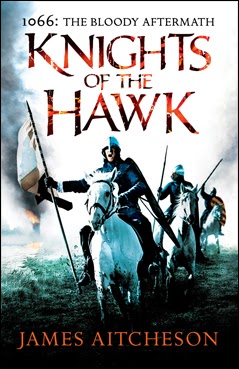
The Splintered Kingdom is the follow up to Sworn Sword. Is there a third in the pipeline? 

The third book, Knights of the Hawk, is in fact already out in the UK, having been published in October last year. Set in the autumn of 1071, it opens during King William's campaign in the Fens against the outlaw Hereward and his band of rebels, who are holding out at Ely in a desperate last-ditch stand. As the campaign grinds to a halt and the king grows increasingly frustrated, he looks to Tancred to deliver him the victory that will bring an end to the rebellions once and for all.

How many books do you intend to have in the series?

To be honest, I’m not really sure! One thing I do know is that Tancred will be riding again in the not too distant future. Although Knights of the Hawk brings to a close one particular arc of his saga, it’s not the end of his story by any means, and I’ve got plenty more ideas for where his travels will take him in future. The Normans sought adventure all across Europe in this period, including in Italy and in the Byzantine Empire, so the next instalment could well see him seeking his fortune beyond the British Isles. In the long term I’d very much like to take Tancred on the First Crusade, although that’s still some way off yet. By that point he’d be in his mid-fifties, so perhaps a little bit old for front-line fighting!

What’s next?

I’m currently working on my fourth novel – again historical, and set in the Middle Ages. It's still in its early stages, so I can't say too much about it yet, but the ideas are flowing and needless to say I'm very excited about it. I'll be revealing a little bit more about it over the course of 2014, so keep a look out for for further details in a few months' time. 


Now just for fun, what are your preferences

Tea? Coffee?
Coffee

Savouries? Sweet?
Savoury

Wine? Beer?
Wine

Meat? Veg?
Meat

Dogs Cats?
Neither


I for one will be looking forward to reading more from James. If you would like to read a sample of James Aithcheson's book Sworn Sword, you can download a chapter by going to his website


*********FACEBOOK READERS MAY ALSO COMMENT HERE*********