Showing posts with label Jacqueline Reiter. Show all posts

Wednesday, 14 November 2018

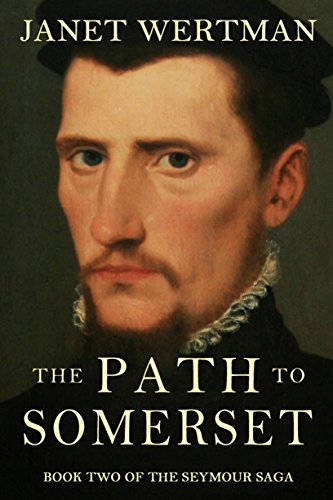
Today Jacqueline Reiter reviews The Path to Somerset by Janet Wertman. The author has very kindly offered a giveaway - US residents may choose between a paperback or an ebook while an ebook will be sent to a winner from anywhere else in the world.  To be in with a chance of winning this wonderful prize, simply leave a comment below or on our Facebook page.

Good luck!


After the tragic romance of Jane the Quene, the second book in The Seymour Saga trilogy, The Path to Somerset, takes a dark turn through an era in which King Henry VIII descends into cynicism, suspicion and fits of madness – and in which mistakes mean death.

Edward Seymour’s future is uncertain. Although his sister Jane bore Henry the son he’d sought for twenty years, when she died in childbirth, Henry’s good nature died with her. Now the fiercely ambitious Edward must carve a difficult path through Henry’s shifting principles and wives. Challenged at every turn by his nemesis, Bishop Stephen Gardiner, Edward must embrace ruthlessness in order to safeguard not only his own future but England’s as well.

This is the account of Henry’s tumultuous reign, as seen through the eyes of two opponents whose fierce disagreements over religion and common decency fuel epic struggles for the soul of the nation. And for power.


Death, and the fear of death, runs through The Path to Somerset like a black vein. The main character Edward Seymour, Earl of Hertford, is painfully conscious that he owes his prominence at Henry VIII’s court to his sister, Jane, who died giving the King an heir. The novel opens with Edward attending an execution at the Tower of London; he reflects how easily he could be next, for all he is currently in favour: “Edward felt a shattering rush of life as the axe rose, glinting in the light, then a sudden void when the weapon struck with a dull thud. He hid his flinch by scratching at an itch in his beard, trimmed to match the King’s.” Right from the start, Edward’s desire to hold onto the King’s goodwill governs every moment of his existence.

Edward knows his life depends on keeping in the King’s good books – and the spate of executions that follows the opening scene only drives in the point. There are four high-profile deaths in the first half of the book alone. In one particularly grim scene, a victim lays their head on a block still dripping with blood from an execution that took place only moments previously. Edward’s ambition, therefore – which grows steadily as the book follows him on his “path” to becoming the Duke of Somerset, Lord Protector under Edward VI – is strongly conditioned by his desire to keep his head firmly on his shoulders. His enemies, particularly the Duke of Norfolk and Stephen Gardiner, Bishop of Winchester, have the same aim. The novel depicts their deadly battle of wits to remain in favour, to gain power and (above all) to survive.

Every character is skilfully depicted, and a tremendous amount of research on the political and religious background of the last years of Henry VIII’s life must have gone into this book. Above it all stands the character of the King himself, the charm of his youth long gone and replaced by the terror and awe he inspires in all who surround him, which Henry seems to have grown to confuse with love and respect. Wertman ably depicts him as an aging tyrant who plays mind-games with his courtiers, and who is quite literally rotting on his throne (the stench from the ulcers on his leg is a running theme). In a more figurative sense, this rot has travelled to the core of Henry’s court, and qualities such as loyalty and trust are in very short supply: “It was an effective strategy at court, to place people in your debt. Proclaim your own friendship before asking for evidence of theirs.

What will happen when Henry dies, therefore, dominates the decisions Edward and his enemies make. Unsurprisingly, very few of the characters are in any way sympathetic, and Edward himself (particularly in his emotional reliance on his wife, Anne, who spurs him on in his ambition) reminded me a little bit of Shakespeare’s Macbeth. If you’re looking for an easy read with likeable characters and maybe even a love story, this is certainly not the book for you. But if you are after a tense, grisly and highly realistic depiction of the manoeuvrings heralding the power void after the death of Henry VIII, then this book is a must read. It certainly kept me turning the pages and I highly recommend it.

About the Author

By day, Janet Ambrosi Wertman is a freelance grantwriter for impactful nonprofits. By night she blogs and writes historical fiction, indulging a passion for the Tudor era she has harbored since she was eight years old and her parents let her stay up late to watch The Six Wives of Henry VIII and Elizabeth R. Janet lives in Los Angeles with her husband and dog, and is happy to be within driving distance of her three grown children. Find out more about Janet – and the Tudors – at her website, https://janetwertman.com.
Social shares:

Twitter - @JaneTheQuene (that’s where all the Tudor stuff goes - she also tweets herself under @JanetWertman)

Buy links!!


About the reviewer

Jacqueline Reiter has a PhD in late 18th century history from the University of Cambridge. She is the author of The Late Lord: the life of John Pitt, 2nd Earl of Chatham (Pen and Sword, 2017) and a novel, Earl of Shadows (Endeavour Press, 2017). She has written for History Today and the Journal of the Society for Army Historical Research, and is co-writing a chapter for the forthcoming Cambridge History of the Napoleonic Wars. She lives in Cambridge with her husband and two children. You can find out more about her research and writing through her blog, Facebook or Twitter.

Wednesday, 18 April 2018

Review of By Love Divided by Elizabeth St John


 Today Jacqueline Reiter reviews By Love Divided by Elizabeth St John. The author has very kindly offered ebooks of By Love Divided and the 1st book in the series, The Lady of the Tower as a giveaway. If you would like to be in with the chance of winning your very own copies of these wonderful books, simply leave a comment below or on our Facebook page.
Good luck!


Fiercely independent, Luce Apsley rejects the dazzling English court and an entitled marriage arranged by her aristocratic family, and falls in love with a Roundhead soldier. Her mother follows the Puritan cause and yet her beloved brother, Sir Allen Apsley chooses to fight for king and country. As England falls into bloody civil war, Luce embraces Parliament's radical views and confronts the very core of the family's beliefs. And when their influential Villiers cousins raise the stakes, King Charles demands loyalty. Allen and Luce face a devastating challenge. Will war unite or divide them? In the dawn of rebellion, love is the final battleground. Based on surviving memoirs, court papers and letters of Elizabeth St.John's family, By Love Divided continues the story of Lucy St.John, The Lady of the Tower. This powerfully emotional novel tells of England's great divide, and the heart-wrenching choices one family faces.


By Love Divided is the aptly-titled chronicle of the Apsley family between 1631 and 1646, through family tribulations, peace, and war. The protagonists are Lucy, Lady Apsley, who at the beginning of the book is freshly widowed and petitioning the Crown to release funds her husband invested in a failed military expedition; her daughter, Luce, eccentric, erudite, and unswerving in her loyalty to those she loves; and Luce's brother Allen, eager to restore his family name, whatever the cost. The story also involves characters from their extended family – Lucy's brother John St John and his sons, and her well-connected sister Barbara Villiers, with whom Lucy is engaged in a bitter feud.
This is a sequel to a previous novel, which I confess I have not read, and it took me a little while to sort out the convoluted family alliances. I do not, however, think that it is necessary to read the first book to understand the second, although it would probably help. All necessary information is given, and prior conflicts dealt with in the first book are sufficiently hinted at without giving too much away.
The story is what I would describe as a "slow burn", and the first quarter of the novel dealing with Lucy Apsley's legal fights to release her husband's funds is complicated, but well worth sticking with. Lucy's struggle is a civil war in microcosm: Lucy and her family stand for an England wronged by the King's arbitrary despotism, and her quarrels with her brother and sister hint at the deeper divisions that will become obvious later. This is very much a character-driven book, and the characters are so masterfully drawn that I was deeply attached to all of them by the time the political divisions of the 1640s hit them like a ton of bricks. I felt I was experiencing their inner struggles with them, and by the novel's climax – set, symbolically enough, overlooking a family home destroyed by war – I honestly felt I had gone through everything the characters had experienced.
I would especially like to congratulate the author on the way in which she deals with her themes. Divided loyalties can become hackneyed in the wrong hands; these are very much the right hands. Each of the characters follows their own journey, and they all change profoundly as the novel progresses – but their hearts do not. Allen was probably my favourite. An immature teenager at the beginning of the novel, he ends the novel a very different man from the boy he was at the start. I think I was a little in love with him, actually.
Although the Wars of the Three Kingdoms forms the backdrop for this splendid novel, the events of the war are never allowed to take over. There are some extremely vivid battle scenes, including a sequence set at Edgehill, but most of the major battles (such as Marston Moor and Naseby) are barely mentioned. This is not a book about battles; nor is it an attempt to moralise, or to paint Roundheads and Cavaliers as right or wrong. It is simply a book about the tragedy of war, and its effect on the people who fight them. In that respect the book pulls absolutely no punches.
I challenge anyone to finish reading it with dry eyes. I certainly couldn't; and I am now going to read the author's first book (while eagerly awaiting the last wing in what I believe is a projected trilogy).
I heartily recommend By Love Divided to everyone, as a thoroughly-researched tribute to family history, as an achingly beautiful character study, and as a masterly exposition of the maxim that in a civil war there are no winners, only losers. 

About the author:

Elizabeth St.John was brought up in England and lives in California. To inform her writing, she has tracked down family papers and residences from Nottingham Castle, Lydiard Park, and Castle Fonmon to the Tower of London. Although the family sold a few castles and country homes along the way (it's hard to keep a good castle going these days), Elizabeth's family still occupy them - in the form of portraits, memoirs, and gardens that carry their imprint. And the occasional ghost. But that's a different story...

Elizabeth's Historical Fiction series "The Lydiard Chronicles" follows the fortunes of the 17th Century St.John family through royal favor and civil war. Her latest novel, By Love Divided, continues the story of Lucy St.John, The Lady of the Tower. This powerfully emotional novel tells of England's great divide, and the heart-wrenching choices one family faces.


www.ElizabethJStJohn.com

About the reviewer:

Jacqueline Reiter has a PhD in late 18th century history from the University of Cambridge. She is the author of The Late Lord: the life of John Pitt, 2nd Earl of Chatham (Pen and Sword, 2017) and a novel, Earl of Shadows (Endeavour Press, 2017). She has also written several articles for the Journal of the Society for Army Historical Research, and is co-writing a chapter for the forthcoming Cambridge History of the Napoleonic Wars. She lives in Cambridge with her husband and two children. You can find out more about her research and writing through her blog, Facebook or Twitter.