Showing posts with label Wessex. Show all posts

Wednesday, 22 March 2017

Sharon Reviews: To Be A Queen by Annie Whitehead

Today Sharon reviews To Be A Queen by Annie Whitehead. The author has kindly offered a paperback copy as a giveaway. To be in with the chance of winning this amazing book, simply leave a comment below, or on our Facebook page. The draw will be made on Wednesday 29th March. Good luck!!!

 One family, two kingdoms, one common enemy ...
This is the true story of Aethelflaed, the ‘Lady of the Mercians’, daughter of Alfred the Great. She was the only female leader of an Anglo-Saxon kingdom.
Born into the royal house of Wessex at the height of the Viking wars, she is sent to her aunt in Mercia as a foster-child, only to return home when the Vikings overrun Mercia. In Wessex, she witnesses another Viking attack and this compounds her fear of the enemy.
She falls in love with a Mercian lord but is heartbroken to be given as bride to the ruler of Mercia to seal the alliance between the two Anglo-Saxon kingdoms.
She must learn to subjugate her feelings for her first love, overcome her indifference to her husband and win the hearts of the Mercians who despise her as a foreigner and twice make an attempt on her life.
When her husband falls ill and is incapacitated, she has to learn to rule and lead an army in his stead. Eventually she must fight to save her adopted Mercia from the Vikings and, ultimately, her own brother.


Written by Annie Whitehead, To Be A Queen, is the fascinating story of the most remarkable of Saxon women, Aethelflaed, Lady of the Mercians and daughter of Alfred the Great. The novel leads us through Aethelflaed's personal journey, from a sheltered childhood in the heart of Wessex to marriage, motherhood, and a remarkable partnership with her brother Edward, who succeeded their father as King of Wessex. Aethelflaed and Edward spearhead the fight against the Danes and the struggle to unite England under one ruler.

A thoroughly enjoyable book, To Be A Queen, draws the reader in from the very first sentence,  recounting the story of Aethelflaed's life while telling you the bigger story that is the making of England. Many readers may be familiar with Aethelflaed from the Bernard Cornwell The Last Kingdom series, but Annie Whitehead develops the Lady of Mercia to even greater depths, getting under the skin and into the heart of this amazing woman.
The story moves at an incredible pace, examining all aspects of Aethelflaed's personal and public life. Where this book shines is in the personal relationships that Aethelflaed develops through the years. In her teen years, she is sent to Mercia, to a loveless marriage and an older husband, Ethelred, a stranger who himself is  unsure how to treat this teenage girl, his wife. Aethelflaed is always close to her brother, Edward, from childhood playmate to fellow warrior and overlord.

He [Edward] raised his eyebrows. "Hate? Not I. I will not cower before him nor cringe when he rants, that is all. You are kinder to him than I, it is true, but I do not hate him. I have no time for things like that." 
She nudged him. "Feelings, do you mean?"
"Waste of time. They are not real."
"Well, if it was not feelings that drove you to fish me from the water, I thank whatever it was."
"I am here to look after you while my father cannot. As one day I will look after Wessex as my father has not. You are my sister. What else is there to know about why I saved you from drowning?"
She was not persuaded and carried on as if he had not interrupted. "And whatever it was, it must be akin to the thing that drives you to giddiness every time that Gwen walks by."
"Ah, Gwen." he lay down on the grass and put his hands behind his head. "You have hit upon something there."
Teasel nudged him. "So you are not always thinking only of kingship. Not when your thoughts are on Gwen. But beware; Mother will not like it if she hears what you are about."


To Be A Queen has you hooked from the very beginning. Aethelflaed is a strong, sympathetic character, whose life and loves - and sense of adventure - make for some fascinating reading. She is all-too-human, struggling through misunderstandings, making mistakes and suffering insecurities; attributes which make her all the more endearing to the reader. She does, however, have an admirable inner strength, which drives her to carry on even under the direst circumstances.
The story stays true to the historical fact, filling in the details where the historical record is lacking. The incredible depth of research that has been done by the author shines through on every page, from the building of burhs, through the battles and to the advance of the Danes and alliances of the Saxons and Welsh. Such research helps to transport the reader back in time, to the sights, sounds and smells of Anglo-Saxon England. Mercia, Wessex and even Wales, are described in great detail, the difference in landscapes flashing by as we ride from Winchester, to London, to the mountains of Wales.


Annie Whitehead has managed to tell one of the greatest stories in English history, that of the making of England, from the point of view of one who was there, Aethelflaed was right in the middle of the decision-making and the action. To Be A Queen tells the story of how she grew from being a young, teenage bride, to a formidable and confident opponent of the Danes. It is a story that is gripping to the very end, it will have you in tears at one moment, while egging the Saxons on to victory at the next.
It is, quite simply, a book that is not to be missed.


About the author: Annie Whitehead is a history graduate and prize-winning author. To Be A Queen was her first novel, and was long-listed for HNS Book of the Year 2016, awarded an IndieBRAG Medallion and a Chill Books’ Readers’ Award. Her second, Alvar the Kingmaker, is also a true story, and concentrates on a little-known period of history which begins with the king being caught in bed with his wife and her mother, and ends with the murder of another king, a crime attributed to his stepmother, the queen. Central to the story is Alvar, Earl of Mercia. Having helped King Edgar to secure the throne, amid great unrest he then fights to clear the queen’s name, bring the country back from the brink of civil war, and stabilise the monarchy for Edgar’s son, Aethelred the Unready. He does this at great personal cost, and he soon finds that his enemies will stop at little, and that not even his loved ones are safe… The book has an IndieBRAG Medallion, was awarded a Discovering Diamonds Award, and was chosen as Chill Books’ Book of the Month for Jan 2017. Annie was a contributor to the anthology of short stories, 1066 Turned Upside Down, in which nine authors re-imagine the events of 1066, and which has just been awarded HNS Editors’ choice and long-listed for Book of the Year 2017. She is a member of the Royal Historical Society, and is currently working on a contribution to a non-fiction book to be published by Pen & Sword Books in the summer of 2017.


Amazon author page;Website; Blog; Twitter; Facebook; @anniewhiteheadauthor; To Be A Queen; Alvar the Kingmaker; 1066 Turned Upside Down


About the The Reviewer: Sharon Bennett Connolly has been fascinated by history for over 30 years. She has studied it at university and worked as a tour guide at several historic sites.
Sharon has been writing a blog entitled 'History...the Interesting Bits' for a little over 2 years and has just finished her first non-fiction work, 'Heroines of the Medieval World', which looks into the lives of some of the most fascinating women from medieval history and will be published by Amberley in September 2017. It is now available for pre-order from Amazon.

Thursday, 10 March 2016

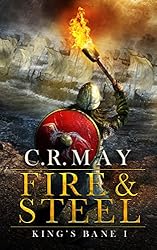
Fire & Steel - King's Bane 1 by C R May - Reviewed by Rob Bayliss


The author has kindly offered a paperback copy for the draw and an ebook copy for the runner-up. To enter please leave a comment below or on our Facebook page.


Cerdic chuckled. “I think you underestimate your influence, all men of worth have heard the tale of Eofer king’s bane. Tell your prince of my plans here and remember,” he said, “there is always a place for you among us.” The Briton laid a hand on Eofer’s sleeve and fixed him with his gaze. “I offer you good land and honour, king’s bane. Dark soil in which to sink your roots. Settle your family here among us and I will make you one of my most powerful lords.”
 Since reading Brennus – Terror Gallicus for the Review by this author, and thoroughly enjoying his style of blending the fantastic and historical accuracy I went on to read his Beowulf -Sword of Woden trilogy and was awestruck by them. Indeed I nominated Sorrow Hill (Book 1) as my Book of the Month last year. So when the author, Mr May, mentioned that he was developing a historical fiction series using Eofer Kingsbane, a minor but nonetheless heroic character from his Beowulf books, I was intrigued. With Beowulf of course we have the tap root of English fantasy literature, and Mr May made full use of the fantastic enabling gods to walk the earth. How was the author going to use the king’s bane and where would his tale take us?
Firstly, who is Eofer King's bane? He is a warrior, renowned in the north for slaying the Swedish king Ongentheow at the battle of Ravenswood. Eofer is of the Engles (Angles) whose homeland is in modern Denmark; sandwiched between the Jutes to the north, the Saxons to the south and threatened by the expansionist Danes to the east. The Angles, Jutes and Saxons, since Roman times, have long been involved in the politics of Britannia to the west. They have sailed there as mercenaries, traders and lately as settlers. The exploits of the British warlord Arthur put paid to further expansion in these fertile lands; but since his recent death, civil war has rent the old Romano-British land and opportunities are rising once more.

C6th Century Saxon Warriors. Painting by Angus McBride.

It is the early C6th and we first meet Thegn Eofer and his ship’s crew plying the German Sea and the Mare Britannicum. He and his hearth warriors are hired by a British chief Cerdic to take him and his small war band of exiles from Brittany back to Britannia. Eofer and his warriors assist Cerdic in defeating an ambush set against their advance. Impressed by his ally’s martial prowess Cerdic, has a sense of destiny and offers Eofer lands and position should he chose to accept them. Eofer is not only given this offer but also increases his retinue by adding the shield maiden Spearhafoc- a young British archer - into his hearth troop. With the loss of his ships to Cerdic’s enemies, Eofer and his comrades travel overland to Anglia in the east, where the Englisc have a tenuous foothold. On their way they pass The Ringing Stones (Stonehenge) where  the superstitious Spearhafoc performs a ritual and becomes convinced that Eofer has a destiny to carve in Britannia. Eofer, already persuaded by Cerdic's offer takes this as a further sign that his Wyrd (fate) will lead him back to Britannia; that the future of his people does indeed lay in this fertile land. But first he must convey his belief to his king and there are the not so small matters of honour that must be settled in old Engeln….
 Scholars of the period will recognise the name Cerdic as the founder of the Cerdicings - the House of Wessex - and will have pondered why the royal house of an Anglo-Saxon “invader” would have a British name. Some historians, such as Peter Beresford Ellis in his informative, but politically biased, book called Celt & Saxon took the traditional picture of warlike and expansionist Englisc invaders to the next level of being genocidal, ethnic-cleansing invaders. Certainly there was bloody warfare between Englisc and Wealisc (both were hero societies after all) but many place names in England carry a Brittonic root describing a geographical feature suggesting a continuity. It is difficult to believe, considering the population levels of the time, that these invaders could arrive in such vast numbers to utterly overrun and replace existing, established populations. 

Cerdic - from John Speed's 1611 "Saxon Heptarchy"

That England is essentially an Anglo-Celtic land has since been borne out by recent genetic studies that indicate an intermingling, rather than replacement. This suggests that the change from Celtic to Anglo-Saxon was more of a gradual cultural and language metamorphosis than one born by the sword alone. Indeed the C7th laws of King Ine indicate that distinct Wealisc communities in the Wessex of his time still thrived and were under the king’s protection as were his Englisc subjects.
Fire & Steel is a beautifully crafted tale and in this humble reviewer’s opinion is nothing short of a work of genius: linking the legend of Beowulf to the creation of the Kingdom of Wessex. The details are well researched and there are some beautifully illustrated maps to trace the journey undertaken by the protagonist and his followers.
The prose is exquisite, combining modern English with Old English terms or equivalents. Within a few pages this language becomes as second nature to the reader. The land of old Engeln has anglicised place names making them very familiar and recognisable to the reader. Suddenly these lands aren’t Scandinavian, they’re distinctly English.  But as the Engles prepare for a new life in Britannia they take care to conceal the tombs of their ancestors lest invaders rob them. Indeed in modern Denmark there is barely a trace of the people that once held sway there, as if they had never been. There is a wonderfully described scene when the tomb of Eofer's grandfather is opened and the veil between the living and the dead is as gossamer:
Gleaming , the ancestral sword of their clan lay across the lap of the long dead earldorman and Wonred  spoke as he moved forward to lift it with reverence from the lap of his father.
“Father, this is your grandson, Eofer, called king’s bane. Slayer of Ongentheow, king of Swedes, hall burner of the king of the Danes… The Allfather has guided us to another land, a better land where the people can grow, prosper and bring the worship of the real gods to the people there. Before we leave these Wolds we will move to smite our enemies. Your grandson Eofer will carry Gleaming to Anglia so that it will remain in the clan always…”


Pattern welded Saxon sword - Thegns of Mercia blog


 The author skilfully weaves the religion and spirituality of his characters into the tale and makes it tangible and perfectly believable.  It is a great gift that this author has, that as a reader, you become fully immersed in this world that is both strange and yet eerily familiar. It is not an easy book to put down and it will take you a while to return to the C21st; whereas moments before you would have been tasting the salt tang spray as Eofer's Snaca rides mountainous waves, or the mounting tension before shieldwalls clash.
There are some wonderful characters in this novel: the superstitious Spearhafoc, like a woodland sprite dedicated to her thegn.  Oswin Word-Poor, a would be scop who’s poor verse causes his comrades to cringe at first but we watch amd listen as he hones his craft. Brave Imma Gold and Thrush Hemming, a pair of Eofer’s most trusted warriors. And Eofer king's bane himself of course; brave, honourable yet concerned that his fame- wealth endangers those around him, both from fiend (enemy) and perhaps friend alike.
I was swept along to the last page, which I regretfully turned, but fear not, for the saga of Eofer king’s bane has only begun. So don your helm, heft your shield and grasp your ashen spear for, as in the much improved wordcraeft of Oswin Silk-Tongue :
“Battle-play befits a thegn,
Bravery belongs to an eorle.
Heft Gleaming, bear your shield forward,
Under steep helms in the press of enemies,
Slayer of warlords, doomed leaders…”


C.R. May was born in Bow, East London before his family moved to South Ockendon, Essex. After hearing that Ockendon translated as Wocca's Hill in Saxon, a lifelong passion in history was kindled, which has taken him from Berlin to the site of the battle of Little Big Horn (via Erik the Red's Icelandic hall!). The influx of Germanic adventurers was recorded in the place names around him and, inspired one day, he decided to weave his own stories into this history. You can read and discover more information at his blog and the author may be found at Facebook. 

*********


Rob Bayliss is a reviewer at The Review and is currently writing his own fantasy series. Information on his writing projects can be found at Flint & Steel, Fire & Shadow.


Saturday, 21 June 2014

Tales of Olde Somerset by Rob Bayliss


Think of Somerset and you probably think of Cheddar cheese, strong cider (scrumpy), straw munching yokels with broad unintelligible dialects, oh, and the Wurzels (for readers beyond these shores they can delightfully be described as a "scrumpy and western" band)… Now I’m not knocking any of these things; I love cheese (I  actually used to be a cheesemaker), I’m more than partial to a glass or three of cider, I even talk like a yokel if I’ve drunk enough of them and, if you ever happen to see them, you will have a good evening's entertainment watching the Wurzels. But there’s so much more to my home county….


Somerset is a rural county framed by rolling hills; the Brendons leading to the wilds of Exmoor to the West, the Blackdowns to the South, the Quantocks and Mendips to the North, while to the east, the land gradually climbs towards the high plateau of Salisbury Plain in Wiltshire. In between are the fertile  lowlands, known as the Levels, where a constant battle has been waged over the centuries to claim the land from its natural state of lazy waterways and swamp. In neolithic times lakeland villages were built on stilts to cope with the rising waters. The remains of  "roads" across the marshes have been found; one such example is called the Sweet Track. It is a 2km causeway made of planks of oak, ash and lime and is some 6,000 years old.


At the time of the Roman invasion of Britain in 43AD, Somerset was split between three Celtic tribes; the Domnonii, Duroriges and Dubunni. After pacifying the southeast corner of Britain, Vespasian and the 2nd Augusta invaded the future county from the south east in 47AD, taking the great hillforts of Ham Hill and Cadbury Castle. Mass graves at Cadbury show the tell-tale injuries caused by ballista bolts and pila.
The Romans moved north ensuring that the Mendips were secured, due to the lead and silver mines that were already being worked there. Indeed the promise of Britannia's metal resources may have been one of the reasons for the invasion of Britain in the first place. Rome had an appetite for lead,  which it was used for aqueducts and plumbing. It wouldn't be until the 18th century that lead extraction matched the levels  of production achieved in the Roman Empire. By 70AD the new province of Britannia was the biggest producer of this metal in the Roman world. Production reached such a high level that the province of Hispania (also a lead supplier) appealed directly to the Emperor Claudius, complaining that they were losing business to the newly aquired province.

The mines at Charterhouse, on the Mendips, were kept under Roman military control in order to stave off corruption. During the Iceni revolt of 61AD, there is evidence that there may have been a slave rebellion at the mines, one of the many wild fires that broke out in the province as word of Boudicca's initial success spread. With Boudicca's eventual defeat rebellions such as those at Charterhouse were brutally crushed by the legions. Such events don't carry the fame and romance of Boudicca, yet they were equally desperate. Who were these slaves who dared to defy Rome? Unlike Boudicca their deeds and names are lost forever in the mists of time; perhaps on purpose, as Rome set about imposing its order on a rebellious province.

Such was the need for lead in the empire that in order to prevent future loss of production, due to slave unrest under the strict military regime, the mines were leased out to private companies. But even after this privatisation mining was still the work of criminals and slaves. It was dangerous work, with a loss of  up to 12% of the workforce each year.

A major Roman road, the Fosse Way was a major Roman military and commercial arterial route across the country. In its course, it linked Bath (Aqua Sulis) continuing to Ilchester and then on southwest to Isca (Exeter) in Devon. Around this road, villas were built as the population became increasingly Romanised. A beautiful mosaic was found in the remains of a villa at Low Ham, near Langport, on the southeastern edge of the Levels.


By 410AD the empire was in decline, under pressure from within and without. Emperor Honorius instructed Britain to "look to its own defence". This the Romano British did with some success. The southwest retained its independence from the advancing Saxons for many years. It appears that some of the old hill forts were reoccupied during this period. (Not to mention the legend of Arthur and Avalon - Glastonbury- which surely deserve a post of its own!) Eventually however the Angles and Saxons broke the land link between the southwest and Wales and they began to encroach onto the lands of the Romano-British successor kingdom of Dumnonia.
Unusually for a county in the southwest of England, Somerset does not derive its name from a Brythonic (Celtic) origin, unlike its neighbours to the west and south, which are named after the old Celtic tribes of the region: Dumnonii (Devon) and Durotiges (Dorset) respectively, and further west still in Cornwall ( a mixture of the tribe Cornovii and the old English for foreigner - Wealas). Instead Somerset’s name derives from the Anglo-Saxon Somersaete, meaning “land of the summer settlers”. The reason for this term became all too evident during last winter’s floods, when huge tracts of the Levels were underwater for weeks on end. As the winter floods receded, rich pasture became accessible to these “summer settlers” and their herds.


The name Somersaete was first recorded in the laws of King Ine, the Saxon king of Wessex 688-726AD, when its boundaries were first set as an administrative region. King Ine’s predecessor, Caedwalla, had gained overlordship over the south and east Saxons but these gains were lost during a sustained period of Mercian hegemony, with a continuous line of Mercian kings being recognised as Bretwalda (high king or Britain ruler). Under pressure from Mercia, Wessex looked westward and advanced towards Dumnonia. Avoiding the swamps of the Levels, Ine pushed through Dorset and along the Blackdown Hills. Around 700AD local legend has it that he fought a battle at Buckland Hill (a hill whose slopes I used to live on!), possibly against King Gerren of Dumnonia. Like all Dark Age battles it was savage; the blood flowed down the hillsides like water, according to legend. Although victorious Ine lost many warriors, including his brother, Noon, whose barrow was said to have once stood on the site.To secure these hard won lands he established my current home town of Taunton as a burh (a fortified settlement) around the same time. In 722AD the town was besieged and destroyed by King Ine's formidable wife, Queen Æthelburg, in a civil war against rebels led by Ealdbert (perhaps Ine's son from a previous marriage). Alas the facts of this internal strife in Wessex have been lost and only hints remain. Ine later brought Earlbert to battle in 725AD and the rebel lost his life. Ine, who was then in his sixties, had clearly suffered greatly through this struggle and abdicated the following year. He and Æthelburg left Wessex to live out their remaining years in Rome.
It appears that Ine had striven to absorb his new British subjects into his kingdom, he drew up laws that allowed for weregelds (financial compensation) to be paid for Wealas as well as Englisc families who had lost a member due to murder (although more was paid if the victim was Englisc!).


Place names in Somerset are usually English in origin, but geographical features usually carry a Celtic element showing a degree of mixture between the cultures. It is interesting to note that the Wessex royal house itself was said to have been founded by Cerdic, Cerdic being a Celtic name. Maybe this mix is reflected in the very Welsh looking county flag of a red dragon on a gold field? 


There was a Saxon royal palace at Cheddar on the Mendips that hosted various Witangemots, but arguably perhaps the most important place in Somerset (and English) history would prove to be an insignificant little hunting lodge set a few miles east of Taunton in the swamps of the Somerset Levels.
A new invader was abroad in England. The Great Heathen Army of Vikings had destroyed the Angle powers of Northumbria, East Anglia and Mercia. During their campaigns they had slain the captured King Edmund of East Anglia with arrows and subjected King Aelle of Northumbria to the particularly gruesome death of the Blood Eagle. Not wishing to suffer a similar grisly fate, King Burgred of Mercia fled to exile in Rome. Only Wessex and the house of Cerdic remained. The future of England looked decidedly Danish.


That insignificant hunting lodge was located at Athelney (Isle of the Princes). It was here that Alfred found refuge from the Danish army of Guthrum, after the Vikings mounted a surprise winter attack in January 878AD on the royal stronghold at Chippenham. Amid the impenetrable marshes Alfred built a fort, licked his wounds and rebuilt his forces. Alfred must have been aware of Athelney to choose it as a base. (It would be here, or nearabouts, where he is famously supposed to have burnt some cakes!) Indeed there is some evidence that there had been an Iron Age fort there which Alfred rebuilt and strengthened. Only a simple memorial on a broad low hill marks this crucial place now.
Recent archaeological digs have shown that metal working was carried out here as Alfred rebuilt and equipped his army. Around Easter 878AD Alfred summoned the Fyrds of Somerset, Wiltshire and Hampshire and went on to defeat Guthrum at the Battle of Edington.
There is a reason why Alfred is the only English monarch to be called "the Great". Alfred had won the war but knew he had to win the peace as well. To that end the defeated Guthrum was forced to accept the Treaty of Wedmore (a village near Glastonbury on the eastern Levels) whereby England was split between the eastern Danelaw and Wessex and Western Mercia. As well as strengthening border defences, Alfred actively promoted an inclusive national identity of Englishness, whereas before there had been seperate kingdoms. His descendents went on to reconquer those lands lost to the Danelaw and thus, from near extinction, the kingdom of England was born. The rest, as they say, is history.
Now our English may sometimes sound unintelligible, but ‘tweren’t vur Zummzet, oi wuzn’t be talkin’ it to ‘ee now, young ‘un!

Rob is currently working on his Flint and Steel, Fire and Shadow fantasy series. Part one, The Sun Shard is available at Amazon.