Showing posts with label Somerset. Show all posts

Saturday, 21 March 2015

Rob's Tales of Olde Somerset -The Duking Days

After the austere puritanism of Cromwell’s ten-year rule, Charles II was looked upon as a breath of fresh air; he was known as the Merry Monarch due to the atmosphere of hedonism at court. Invited to restore the monarchy in 1660, the three kingdoms of England, Scotland and Ireland began to return to the normality of the ancient regime. After the Commonwealth regime Charles was forgiven of much, such as his leanings both to Roman Catholicism and France. His marriage to Catherine of Braganza failed to produce an heir but his numerous affairs produced at least 12 children that he acknowledged, including a certain James Scott, born in Rotterdam during Charles’ exile.


Young James came to England at the age of 14 in 1663 and was awarded with the title of Duke of Monmouth. He became quite the dashing prince, earning a reputation as a competent military commander serving both abroad, in wars against the Netherlands and France, and at home, defeating a larger force of Scottish Covenanters at Bothwell Bridge in 1679, the irony of which would become clearer later. After such victories Monmouth grew ever more popular; crucially he was a Protestant but despite everything he achieved he was the illegitimate son of a king. As Charles II aged, the only legitimate heir to the three kingdoms was his brother the Catholic James. Amongst the Protestant establishment plots were hatched and a sense of paranoia gripped the kingdoms about the succession. Monmouth sought exile in the Dutch Republic after being implicated in the Rye House Plot which sought to kill both the king and his brother.

After a short illness Charles died in February 1685 and was succeeded by his brother James II of England and VII of Scotland. He soon faced two coordinated rebellions from Holland in opposing ends of the country that summer. Archibald Campbell, the earl of Argyll, landed in Scotland, while in predominately Protestant South West England Monmouth, in three ships, made land fall at Lyme Regis with 82 followers, four light field guns and 1500 muskets. The Duking Days had begun!

As Monmouth came ashore the mayor of Lyme fled to Exeter, alerting the militia and sending word to London. In a matter of days Monmouth had gathered a thousand men to his cause and fought two inconclusive skirmishes with the local militia. Some militia men defected to his cause. Monmouth received word that Royalist forces were converging on Lyme, and he pressed north. He captured Axminster as the Somerset militia sent to oppose him broke under his advance. He moved on to the Somerset towns of Ilminster and Chard where he denounced the king, gathering men to his cause, typically artisans, non-conformists and farm workers grabbing what weapons were to hand; hence the episode became known as the Pitchfork Rebellion. Now, with a force some 6,000 strong, he moved on to Taunton. Retreat was no longer possible as word reached him that Royalist forces had retaken Lyme and captured his ships.


Taunton was planned to be his centre of operations but on arrival the town corporation, wealthier townsfolk and clergy opposed him. But among the clothworkers and the poor  he found enthusiastic support and raised a regiment. Outside the White Hart Inn, local school girls presented him with a flag, and at sword point, the corporation members were forced to observe Monmouth being crowned king. Any celebration was short lived however, as in nearby Ashill Royalist forces defeated one of Monmouth’s patrols. The lack of guns and horses at his command was beginning to tell. Monmouth marched north with Bristol in his sights.

He moved through Bridgwater, gathering more men amid worsening weather. Meanwhile Royalist forces began to choke off support from neighbouring counties, tightening a noose around Somerset.
Mindful of Bristol’s southern defences Monmouth resolved to cross the Avon and attack from the East from Gloucestershire. Royalist cavalry harassed the rebels and stopped them forming up at Keynsham; in heavy rain the rebels turned back to Somerset. Without taking Bristol chances of success were becoming increasingly slim. Finding Bath fortified against them, Monmouth camped at nearby Norton St Philip. Royalist forces launched an attack but, much to their surprise, were quite effectively repulsed. There was no doubting their bravery, but however impressive as the rebels spirit was, it was clear that the Royalist forces were getting ever stronger and Monmouth’s ragtag forces could not hope to fight a conventional battle in the open against cannon and trained musket men.

Monmouth withdrew to Frome with the intent of heading into Wiltshire but found their path blocked by a now fully reinforced Royalist army. Morale began to collapse as news spread of the defeat of the Earl of Argyll. Emulating Alfred the Great, the rebels fell back to the Somerset Levels and found themselves hemmed in at Bridgwater.


Monmouth considered his options; without taking Bristol all hope for the rebellion would be lost. He fortified his position and sent men to Minehead where six cannon were known to be kept. From the church tower of St Mary's in Bridgwater, Monmouth saw the Royalist shadowing force of some 1,500 regulars and 500 cavalry camped at Westonzoyland on Sedgemoor. They had to be defeated to open the way east; a desperate plan took shape, which would be the last set piece battle to be fought on English soil.

Monmouth’s army left Bridgwater and marched along Marsh Lane to the village of Bawdrip in the dead of night. To get to grips with the Royalist army they needed to navigate the network of deep drainage ditches (rhynes). Coming across a Royalist patrol a shot was fired and the Royalist army was called to arms. Gripping scythes and farm tools and shouting, “Come over and fight!” the rebels trapped behind a rhyne were exposed to volley after volley of muskets and cannon. There could be only one result; the rebels broke, to be hunted down mercilessly by the victorious troops, especially the Queen’s Regiment recently returned from Tangier, hanging suspects without trial.
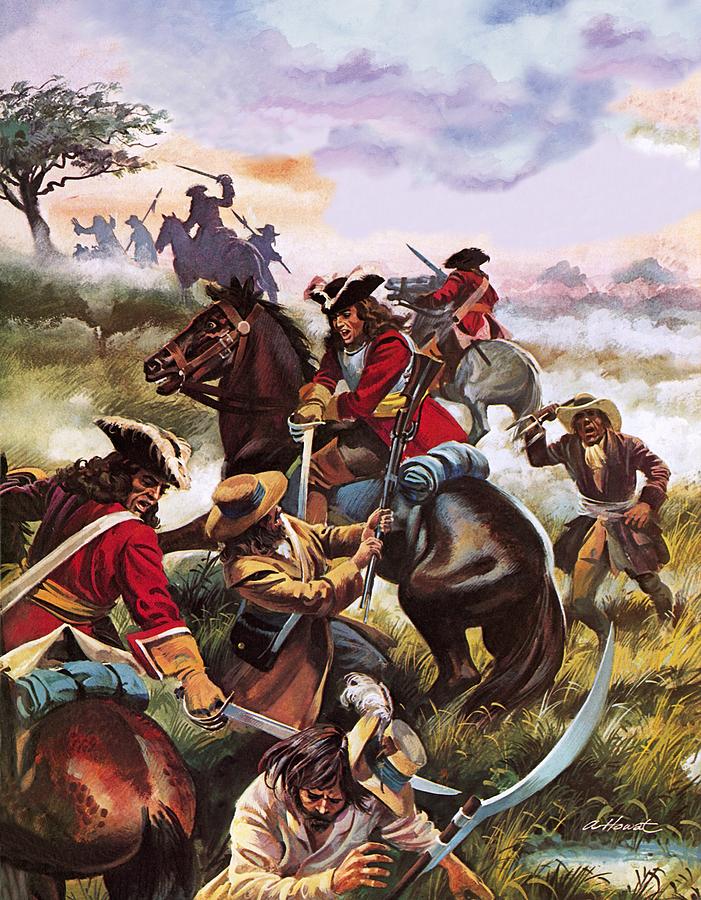


Monmouth fled to Dorset but a price was on his head. He was soon captured and taken to London. It was said that he faced his end bravely, beheaded by multiple axe blows.

His supporters now faced the notorious Judge Jeffreys and his Bloody Assize. He cut a bloody swathe through the West Country and especially Somerset. Some 350 were hung while 800 were transported to the West Indies to work the plantations. His name became a curse and people questioned the cruelty of the hanging judge, although James rewarded him with the position of Lord Chancellor.

King James used the defeat of the rebellion as a chance to consolidate his power, bringing to reality the claims made against him by the rebels, even disbanding Parliament and threatening a return to the absolute monarchy that had sparked the Civil War a generation before. Only three years later, amid growing resentment, another invasion from Holland took place. The Glorious Revolution of 1688 led by William of Orange began in the West Country, readily gathering support among the people who looked on James with bitterness and hatred, recalling the Duking Days of 1685. Fittingly enough Judge Jeffreys himself was incarcerated and would die in in the Tower of London. It was said that he begged his captors for protection from a vengeful mob as he tried to follow King James, fleeing the approaching William III.

                                                                  ***

A couple of years ago driving across the Somerset Levels from a band practice I passed a sign indicating the battle site. As I drove on the lyrics of a song began to form...


We crowned our king in the Duking Days

and the county burst aflame.
We beat ploughshares into weapons.
And we swore to Monmouth's name.
We never lacked for courage.
But with pitchforks against guns.
On the bloody field of Sedgemoor
Our plans they came undone.

A Monmouth boys, a Monmouth
Monmouth is our man
A Monmouth boys, a Monmouth
Let’s win for him this land.


We crept along the Sedgemoor rhynes
On a moonlit summer's night.
To surprise the royal army
and bring them to a fight.
Was it just a horses neigh
or a musket's chance discharge?
Their cannon reaped a harvest.
As their camp was called to arms.


A Monmouth boys, a Monmouth
The man who would be king
A Monmouth boys, a Monmouth
We fight and die for him.


Our forces broke and scattered
The duke he fled the field.
Kingsmen swept the county.
Demanding all to yield.
The king sent for Judge Jeffreys
and by his bloody hand,
Eight hundreds sent to slavery.
Three hundred cruelly hanged.


A Monmouth boys, a Monmouth
That was our battle cry
A Monmouth boys, a Monmouth
Now the bloody assize.


As for our Duke of Monmouth,
three days he went to ground.
Cold and hungry in a ditch
their quarry was then found.
They dragged him back to London
to stand before the king.
He wept and begged for his own life.
Five axe blows finished him.


A Monmouth boys, a Monmouth
King James upon the throne
A Monmouth boys, a Monmouth
No mercy there was shown.
Oh we crowned him king in the Duking Days…


Rob Bayliss


Rob Bayliss is a reviewer at The Review and is currently writing his own fantasy series. Information on his writing projects can be found at Flint & Steel, Fire & Shadow.

Sunday, 22 June 2014

Sunday Wrap Up: Week ending June 22, 2014

Sunday Wrap Up: Week ending June 22, 2014

Please be sure to see below for the giveaway!

Louise E. Rule interviews Bobbie Coelho for The Review's Author Interview


Bobbie Coelho has written a beautiful poetry book called Finding the Light. When you open the book the first thing that you read is her short biography:


Bobbie Coehlo
[B]obbie Coelho was  born near Norwich and now lives in Hampshire with her husband and two stepsons. She has always enjoyed poetry, but after being diagnosed with Parkinson's disease in 2002, she was particularly compelled to write as a way of putting things into perspective. Bobbie is a great fan of Forces Poetry (flowforall.org), and has had work published in two of their anthologies, Voices of the Poppies and Poems of the Poppie[s.]

"My wish is that when people read this book, it will make them think a little more and reflect on their journey."


Welcome to The Review's Author Interview Bobbie.


You say on your Amazon Author's Page that writing poetry has saved you from negative thoughts and that you feel that, in these difficult times it could be a route for others too. Would you like to tell the readers why writing poetry has saved you from negative thoughts?


I found that poetry helped me to put words to my feelings; not only that, but I could use the poems to hopefully give people a way of empathising with me. Parkinson's Disease is very misunderstood, poetry has also helped me explain what it is like.


On your Goodreads Page you say that your favourite poem from Finding the Light is The Essence of Me. It is an extremely profound poem Bobbie, If I may quote a small portion:


[M]y spirit could last evermore
But my body is not playing - you know the score
Many a person has written me off
But no one can make me sto[p]


All your poems seem to have a statement or message regarding determination of some kind. Would you agree with this?

I think a lot of them strike a chord with some people; it makes them think. Most of my poems have a story behind them, but the main message is; it is always later than you think. Don't put off doing things - do them now. Enjoy life, every day is a blessing.


Check out what else Bobbie has to say right here.

*********


Please welcome Carol McGrath and Rebecca Hazell to the Review! Take it away ladies!


Today I am interviewing Rebecca Hazell, who lives and works in Canada, and who is the author of a superb trilogy set in the 13th century, a story of adventure and a superb heroine as Russia is invaded by the Mongol hoards. If you enjoy big novels such as The Game of Thrones you will love her books. They are my great discovery this year. We both read Russian literature and history at university, Rebecca in the US and myself at Queens University, Belfast, so it is no surprise that I love these novels. In fact, I enjoyed the first two so much I asked Rebecca for an interview, and here it is.

What inspired your trilogy The Tiger and the Dove?

I wasn't so much inspired as gripped by the scruff of the neck by its plot when I was about 20. That was 40 plus years ago, and I finally had to give in, do the extensive research, and then write the three novels. When I began, I thought only of one book, but it would have weighed more than A Suitable Boy.

Tell us a little about it.

The three novels are three sections of a memoir written by the heroine, Sofia, a former princess of Kyiv (Kiev) in 13th century Russia. They are more or less intended for her daughter, but they are also a form of catharsis for Sofia, who has led a most unusual life that mirrors the many significant events of her era. The first novel, The Grip of God, begins with her capture and enslavement during the Mongol invasions. The second novel, Solomon's Bride, covers both the final years of the so-called Assassins, who were devoted to overthrowing both the Mongols and the Sunni Islamic establishment, and King Louis IX's first disastrous crusade. And the final novel, Consolamentum, carries her from Antioch to a ruined Constantinople, and then west into France where the Inquisition is burning Cathar heretics at the stake. All this is merely the background for a dramatic plot with many fully fleshed characters; in fact, the plot is driven as much by character as by event. 
 

Can you give us a quick snapshot of your writing day?

My writing day has been a mix of researching in libraries, and online once the Internet became available, contemplating how to say things in a manner reflecting those times, and writing, setting said writing aside, revising, and then revising some more!


You know you want to read more about these fascinating books! Go for it!

*********


Here's an excerpt from Carol's review of The Grip of God


Set in the 13th century as the Mongols sweep across the Russian steppe and beyond, The Grip of God, the first novel in a brilliant epic trilogy, is one of the most interesting historical novels I have read in 2014.

Princess Sophia is placed in danger when the invaders threaten Kiev, the greatest Rus stronghold and cultural Mecca as The Rus Golden Age fades. The reason for this is internal division amongst Rus princes and the Mongol threat as this very united disciplined warrior people sweep across Asia into 13th century Europe.

Once Kiev is threatened Sophia’s merchant prince father sends her to safety in Constantinople. When her party is attacked by Mongol raiders she is spared because of a strange prophecy. She becomes a slave and concubine to Argamon, the teenage warrior son of a great leader. She will bring good fortune according to legend. This is the fabled princess with golden red hair. But hers is no fairy tale. Only twelve years old, she is thrust into a violent world always on the move and as a consequence she and the reader are hurtled breathlessly through events and episodes of exceptional physical and emotional danger.

…and one from Solomon's Bride


The second novel in Rebecca Hazell's trilogy, The Tiger and the Dove, set in the thirteenth century, fulfils its promise of great characterisation and a wonderful historical adventure. Helped by Arab merchant trader, Selim, Sophia has escaped her Mongol captors along with her handmaiden Anna. This time there is a third important female character, Maryam, significant too symbolically since she is a Jewess living in a Muslim world. All three women are beautifully developed rounded characters with their own narratives.


The story opens evocatively with the words, 'One morning I woke to the muezzin's call and began to steel myself for another long day of questioning.' Instantly the reader is drawn to the excitement of a distant world and an exciting journey. 

To read the rest, and get your name in the hat for a free copy of The Grip of God, follow this link to comment.


Tales of Olde Somerset by Rob Bayliss

Think of Somerset and you probably think of Cheddar cheese, strong cider (scrumpy), straw munching yokels with broad unintelligible dialects, oh, and the Wurzels (for readers beyond these shores they can delightfully be described as a "scrumpy and western" band)… Now I’m not knocking any of these things; I love cheese (I  actually used to be a cheesemaker), I’m more than partial to a glass or three of cider, I even talk like a yokel if I’ve drunk enough of them and, if you ever happen to see them, you will have a good evening's entertainment watching the Wurzels. But there’s so much more to my home county….

Somerset is a rural county framed by rolling hills; the Brendons leading to the wilds of Exmoor to the West, the Blackdowns to the South, the Quantocks and Mendips to the North, while to the east, the land gradually climbs towards the high plateau of Salisbury Plain in Wiltshire. In between are the fertile  lowlands, known as the Levels, where a constant battle has been waged over the centuries to claim the land from its natural state of lazy waterways and swamp. In neolithic times lakeland villages were built on stilts to cope with the rising waters. The remains of  "roads" across the marshes have been found; one such example is called the Sweet Track. It is a 2km causeway made of planks of oak, ash and lime and is some 6,000 years old.


At the time of the Roman invasion of Britain in 43AD, Somerset was split between three Celtic tribes; the Domnonii, Duroriges and Dubunni. After pacifying the southeast corner of Britain, Vespasian and the 2nd Augusta invaded the future county from the south east in 47AD, taking the great hillforts of Ham Hill and Cadbury Castle. Mass graves at Cadbury show the tell-tale injuries caused by ballista bolts and pila.
The Romans moved north ensuring that the Mendips were secured, due to the lead and silver mines that
were already being worked there. Indeed the promise of Britannia's metal resources may have been one of the reasons for the invasion of Britain in the first place. Rome had an appetite for lead,  which it was used for aqueducts and plumbing. It wouldn't be until the 18th century that lead extraction matched the levels  of production achieved in the Roman Empire. By 70AD the new province of Britannia was the biggest producer of this metal in the Roman world. Production reached such a high level that the province of Hispania (also a lead supplier) appealed directly to the Emperor Claudius, complaining that they were losing business to the newly aquired province.

The mines at Charterhouse, on the Mendips, were kept under Roman military control in order to stave off corruption. During the Iceni revolt of 61AD, there is evidence that there may have been a slave rebellion at the mines, one of the many wild fires that broke out in the province as word of Boudicca's initial success spread. With Boudicca's eventual defeat rebellions such as those at Charterhouse were brutally crushed by the legions. Such events don't carry the fame and romance of Boudicca, yet they were equally desperate. Who were these slaves who dared to defy Rome? Unlike Boudicca their deeds and names are lost forever in the mists of time; perhaps on purpose, as Rome set about imposing its order on a rebellious province.


To read more of Rob's spectacular recounting of history in his homeland, click here.


Go here for last week's wrap up!

Saturday, 21 June 2014

Tales of Olde Somerset by Rob Bayliss


Think of Somerset and you probably think of Cheddar cheese, strong cider (scrumpy), straw munching yokels with broad unintelligible dialects, oh, and the Wurzels (for readers beyond these shores they can delightfully be described as a "scrumpy and western" band)… Now I’m not knocking any of these things; I love cheese (I  actually used to be a cheesemaker), I’m more than partial to a glass or three of cider, I even talk like a yokel if I’ve drunk enough of them and, if you ever happen to see them, you will have a good evening's entertainment watching the Wurzels. But there’s so much more to my home county….


Somerset is a rural county framed by rolling hills; the Brendons leading to the wilds of Exmoor to the West, the Blackdowns to the South, the Quantocks and Mendips to the North, while to the east, the land gradually climbs towards the high plateau of Salisbury Plain in Wiltshire. In between are the fertile  lowlands, known as the Levels, where a constant battle has been waged over the centuries to claim the land from its natural state of lazy waterways and swamp. In neolithic times lakeland villages were built on stilts to cope with the rising waters. The remains of  "roads" across the marshes have been found; one such example is called the Sweet Track. It is a 2km causeway made of planks of oak, ash and lime and is some 6,000 years old.


At the time of the Roman invasion of Britain in 43AD, Somerset was split between three Celtic tribes; the Domnonii, Duroriges and Dubunni. After pacifying the southeast corner of Britain, Vespasian and the 2nd Augusta invaded the future county from the south east in 47AD, taking the great hillforts of Ham Hill and Cadbury Castle. Mass graves at Cadbury show the tell-tale injuries caused by ballista bolts and pila.
The Romans moved north ensuring that the Mendips were secured, due to the lead and silver mines that were already being worked there. Indeed the promise of Britannia's metal resources may have been one of the reasons for the invasion of Britain in the first place. Rome had an appetite for lead,  which it was used for aqueducts and plumbing. It wouldn't be until the 18th century that lead extraction matched the levels  of production achieved in the Roman Empire. By 70AD the new province of Britannia was the biggest producer of this metal in the Roman world. Production reached such a high level that the province of Hispania (also a lead supplier) appealed directly to the Emperor Claudius, complaining that they were losing business to the newly aquired province.

The mines at Charterhouse, on the Mendips, were kept under Roman military control in order to stave off corruption. During the Iceni revolt of 61AD, there is evidence that there may have been a slave rebellion at the mines, one of the many wild fires that broke out in the province as word of Boudicca's initial success spread. With Boudicca's eventual defeat rebellions such as those at Charterhouse were brutally crushed by the legions. Such events don't carry the fame and romance of Boudicca, yet they were equally desperate. Who were these slaves who dared to defy Rome? Unlike Boudicca their deeds and names are lost forever in the mists of time; perhaps on purpose, as Rome set about imposing its order on a rebellious province.

Such was the need for lead in the empire that in order to prevent future loss of production, due to slave unrest under the strict military regime, the mines were leased out to private companies. But even after this privatisation mining was still the work of criminals and slaves. It was dangerous work, with a loss of  up to 12% of the workforce each year.

A major Roman road, the Fosse Way was a major Roman military and commercial arterial route across the country. In its course, it linked Bath (Aqua Sulis) continuing to Ilchester and then on southwest to Isca (Exeter) in Devon. Around this road, villas were built as the population became increasingly Romanised. A beautiful mosaic was found in the remains of a villa at Low Ham, near Langport, on the southeastern edge of the Levels.


By 410AD the empire was in decline, under pressure from within and without. Emperor Honorius instructed Britain to "look to its own defence". This the Romano British did with some success. The southwest retained its independence from the advancing Saxons for many years. It appears that some of the old hill forts were reoccupied during this period. (Not to mention the legend of Arthur and Avalon - Glastonbury- which surely deserve a post of its own!) Eventually however the Angles and Saxons broke the land link between the southwest and Wales and they began to encroach onto the lands of the Romano-British successor kingdom of Dumnonia.
Unusually for a county in the southwest of England, Somerset does not derive its name from a Brythonic (Celtic) origin, unlike its neighbours to the west and south, which are named after the old Celtic tribes of the region: Dumnonii (Devon) and Durotiges (Dorset) respectively, and further west still in Cornwall ( a mixture of the tribe Cornovii and the old English for foreigner - Wealas). Instead Somerset’s name derives from the Anglo-Saxon Somersaete, meaning “land of the summer settlers”. The reason for this term became all too evident during last winter’s floods, when huge tracts of the Levels were underwater for weeks on end. As the winter floods receded, rich pasture became accessible to these “summer settlers” and their herds.


The name Somersaete was first recorded in the laws of King Ine, the Saxon king of Wessex 688-726AD, when its boundaries were first set as an administrative region. King Ine’s predecessor, Caedwalla, had gained overlordship over the south and east Saxons but these gains were lost during a sustained period of Mercian hegemony, with a continuous line of Mercian kings being recognised as Bretwalda (high king or Britain ruler). Under pressure from Mercia, Wessex looked westward and advanced towards Dumnonia. Avoiding the swamps of the Levels, Ine pushed through Dorset and along the Blackdown Hills. Around 700AD local legend has it that he fought a battle at Buckland Hill (a hill whose slopes I used to live on!), possibly against King Gerren of Dumnonia. Like all Dark Age battles it was savage; the blood flowed down the hillsides like water, according to legend. Although victorious Ine lost many warriors, including his brother, Noon, whose barrow was said to have once stood on the site.To secure these hard won lands he established my current home town of Taunton as a burh (a fortified settlement) around the same time. In 722AD the town was besieged and destroyed by King Ine's formidable wife, Queen Æthelburg, in a civil war against rebels led by Ealdbert (perhaps Ine's son from a previous marriage). Alas the facts of this internal strife in Wessex have been lost and only hints remain. Ine later brought Earlbert to battle in 725AD and the rebel lost his life. Ine, who was then in his sixties, had clearly suffered greatly through this struggle and abdicated the following year. He and Æthelburg left Wessex to live out their remaining years in Rome.
It appears that Ine had striven to absorb his new British subjects into his kingdom, he drew up laws that allowed for weregelds (financial compensation) to be paid for Wealas as well as Englisc families who had lost a member due to murder (although more was paid if the victim was Englisc!).


Place names in Somerset are usually English in origin, but geographical features usually carry a Celtic element showing a degree of mixture between the cultures. It is interesting to note that the Wessex royal house itself was said to have been founded by Cerdic, Cerdic being a Celtic name. Maybe this mix is reflected in the very Welsh looking county flag of a red dragon on a gold field? 


There was a Saxon royal palace at Cheddar on the Mendips that hosted various Witangemots, but arguably perhaps the most important place in Somerset (and English) history would prove to be an insignificant little hunting lodge set a few miles east of Taunton in the swamps of the Somerset Levels.
A new invader was abroad in England. The Great Heathen Army of Vikings had destroyed the Angle powers of Northumbria, East Anglia and Mercia. During their campaigns they had slain the captured King Edmund of East Anglia with arrows and subjected King Aelle of Northumbria to the particularly gruesome death of the Blood Eagle. Not wishing to suffer a similar grisly fate, King Burgred of Mercia fled to exile in Rome. Only Wessex and the house of Cerdic remained. The future of England looked decidedly Danish.


That insignificant hunting lodge was located at Athelney (Isle of the Princes). It was here that Alfred found refuge from the Danish army of Guthrum, after the Vikings mounted a surprise winter attack in January 878AD on the royal stronghold at Chippenham. Amid the impenetrable marshes Alfred built a fort, licked his wounds and rebuilt his forces. Alfred must have been aware of Athelney to choose it as a base. (It would be here, or nearabouts, where he is famously supposed to have burnt some cakes!) Indeed there is some evidence that there had been an Iron Age fort there which Alfred rebuilt and strengthened. Only a simple memorial on a broad low hill marks this crucial place now.
Recent archaeological digs have shown that metal working was carried out here as Alfred rebuilt and equipped his army. Around Easter 878AD Alfred summoned the Fyrds of Somerset, Wiltshire and Hampshire and went on to defeat Guthrum at the Battle of Edington.
There is a reason why Alfred is the only English monarch to be called "the Great". Alfred had won the war but knew he had to win the peace as well. To that end the defeated Guthrum was forced to accept the Treaty of Wedmore (a village near Glastonbury on the eastern Levels) whereby England was split between the eastern Danelaw and Wessex and Western Mercia. As well as strengthening border defences, Alfred actively promoted an inclusive national identity of Englishness, whereas before there had been seperate kingdoms. His descendents went on to reconquer those lands lost to the Danelaw and thus, from near extinction, the kingdom of England was born. The rest, as they say, is history.
Now our English may sometimes sound unintelligible, but ‘tweren’t vur Zummzet, oi wuzn’t be talkin’ it to ‘ee now, young ‘un!

Rob is currently working on his Flint and Steel, Fire and Shadow fantasy series. Part one, The Sun Shard is available at Amazon.