Showing posts with label Nicky Moxey. Show all posts

Wednesday, 7 February 2018

Nicky Moxey reviews Perception and Illusions by Catherine Kullman

 Today at The Review, Nicky Moxey reviews Catherine Kullman's Perception and Illusions. The author is giving away a paperback copy - to anywhere in the world - as a prize. To win your very own copy, simply leave a comment below or on our Facebook page. The winner will be drawn on 14th February 2018. Good luck!
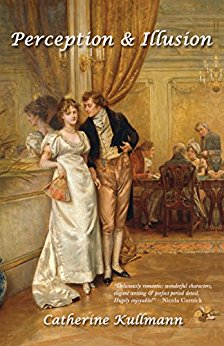


Perception and Illlusions by Catherine Kullman –.

“England 1814: Brought up by her late grandparents after the death of her mother, Lallie Grey is unaware that she is their heiress. When her father realises that he will soon lose control of his daughter’s income, he conspires to marry her off to his crony, Frederick Malvin in exchange for a share of her capital. But Lallie has fallen in love with Hugo Tamrisk, heir to one of the oldest titles in England. When Hugo not only comes to her aid as she flees the arranged marriage, but later proposes to her, all Lallie’s dreams have come true.”

This book – Catherine’s second – was published in March 2017, and I was delighted to have been given a copy of this book.

“Perception and Illusions” is a lovely, gentle love story, using the classic girl-meets-boy, girl-loses-boy, girl-gets-boy-back theme – but it’s very cleverly done. I pretty much devoured this book, in 3 sittings, I think; and given that neither romantic novels, nor this period, are my usual fare, that gives you an impression of the quality of the writing! The central character, Lallie, is sympathetically drawn, and her character arc is believable and engaging. The secondary characters are well-rounded and appealing too; in particular Hugo’s thoughts and motivations make you like him very much.
I loved the language and the way the book is structured- both very much of the period. There’s a clever device for introducing the chapters, which was a particular favourite of mine; it both sets the tone of the chapter, gives you a hint of the content, and added together describes quite neatly the course and hazards involved in falling in love!

Here’s Chapter Sixteen’s:
“The Island of Perseverance, on the opposite side, is good if the travellers be on a right course; further lies the Island of Obstinacy.” Should be part of every divorce counsellor’s toolkit…
The author has the knack of allowing you inside first one character’s head, then another – so it was possible to follow along with every twist of the all-too-familiar comedy of errors that the lovers managed to achieve – and then to sigh with relief as they finally managed to start unpicking all the things unsaid and assumed, and get their relationship back on course! I was very impressed with the delicacy of the love scenes. Poor old Lallie has had the worst kind of birds-and-bees advice – and this is Hugo’s thoughts on the matter…
“Lallie vielded sweetly to him in bed, it was true, but, in the depths of his heart, he must admit that she did not respond as ardently as he would like and always at the end there was that little sigh, as if she was glad that he had finished. So what have you to complain about, he asked himself savagely. That your wife is not as fond as you would wish? You can hardly tell her you wish she were less inanimate…”

As well as the bedchamber, we are transported to some sumptuous Regency feasts and balls. The author’s descriptions of each, along with the complicated rules of politesse involved, are delightful, and add a great deal to the atmosphere of the book. It’s here that the quality of Ms Kullman’s research is clearest – but never heavy. She concludes the book with one of my favourite things – a Historical Note that clearly explains what is real and what is not, and what accommodations have been made to the story.

Very few, it turns out!

I thoroughly enjoyed this book, for a number of reasons; I loved the period accuracy, the skill with which the author engages the reader, and the delicacy of the love story itself. I’d definitely recommend it - having finished this one, I’ve bought her first – this is an author with an effortlessly beautiful voice, and I want to read more.


About the authorCatherine Kullman was born and educated in Dublin. Following a three-year courtship conducted mostly by letter, she moved to Germany where she lived for over twenty-five years before returning to Ireland. She has worked in the Irish and New Zealand public services and in the private sector. She has a keen sense of history and of connection with the past which so often determines the present. Fascinated by people, she loves a good story, especially when characters come to life in a book.
She has always enjoyed writing, loves the fall of words, the shaping of an expressive phrase, the satisfaction when a sentence conveys my meaning exactly. She enjoys plotting and revels in the challenge of evoking a historic era for characters who behave authentically in their period while making their actions and decisions plausible and sympathetic to a modern reader. In addition, she is fanatical about language, especially using the right language as it would have been used during the period about which she is writing. But rewarding as all this craft is, she says there is nothing to match the moment when a book takes flight, when your characters suddenly determine the route of their journey.
Catherine's novels are set in the newly created United Kingdom of Great Britain and Ireland during the extended Regency period. The Act of Union between Great Britain and Ireland of 1800, the Anglo-American war of 1812 and more than a decade of war that ended in the final defeat of Napoleon at Waterloo in 1815 are all events that continue to shape our modern world. It was a time of revolution and inspiration, still a patriarchal world where women had few or no rights, but they lived and loved and died, making the best lives they could for themselves and their children. And they began to raise their voices, demanding equality and emancipation.
At the same time, the aristocracy-led society was under attack from those who demanded social and political reform, while the industrial revolution saw the beginning of the transfer of wealth and ultimately power to those who knew how to exploit the new technologies.
Links: Amazon US; Amazon UK; Facebook; website.


About the reviewer: Nicky Moxey lives in the middle of rural Suffolk, UK, and is owned by a slinky black cat who's far too clever for her own good. In her spare time, she is an amateur historian/archaeologist, and in non-work daylight hours is usually out on a field somewhere with a metal detector and/or a trowel. She has added quite a few things to the Heritage England Record and the Portable Antiquities Scheme; but what really fascinates her is the stories behind the artefacts. Her first historical novel is about the story of a local boy made good - Wimer the Chaplain was born in Dodnash in Suffolk of a poor Saxon family, but made it to be a confidant of Henry ll, holding down the job of High Sheriff for all Norfolk and Suffolk. Then he gave it all up and came home to found a Priory... finding the original site of that Priory (not where it's shown on the map) is still one of Nicky's proudest discoveries. This should be published in the second half of 2017, touch wood. She also has a self-published series of children’s’ short stories about Henry Baker, a boy who finds a magic pencil on the way to school - she has no idea where these come from, but enjoys writing them immensely! 
Nicky's website can be found at nickymoxey.com

Saturday, 28 October 2017

Diana talks to Nicky Moxey


Hello Nicky. Let's see if I can ask you some unusual questions today!! So.... ask your own question and answer it!

Why do you write?
Because these characters in my head insist I do! Honestly, Doctor, I know the voices are from the 12thC…

If your latest book Sheriff and Priest was adapted into a TV show or a film, who would you like to play the lead role?
Hmmm - well I rather fancy the guy who’s on the cover, if he’s an actor! 


What made you choose this genre?
I’ve always loved the sort of historical fiction which fleshes out the bones of history – which allows you a possible glimpse into the motivation and thought processes behind the bare facts.
But the bulk of my books at home are science fiction; I’m also attracted to the complete freedom of that genre. Maybe I ought to start writing alternate history!

How do you get ideas for plots and characters?
I stand in the corner with a baseball bat and try and fight them off – when I started writing, I used to write every interesting idea down on an index card. I gave up when the piles of shoeboxes started to get in the way…I think I’m up to 8 books waiting to be written, and I’ve lost count of short stories. My problem is too many ideas, not too few!

Favourite picture or work of art?
Only one?! <wibbles chin> - that’s HARD. I own a seal matrix that was last used in 1236 by an Abbot of Coggeshall called Geoffrey; the art work in that is stunning, it’s beautifully carved and gilded bronze in a piece about an inch and a half high. But as usual, it’s the story that grabs me – poor old Geoffrey was in his early 80s; I think he was making for an abbey the other side of Woodbridge in Suffolk, and was heading for Wimer’s priory to break his journey in the middle and get a night’s rest. I found his seal no more than a quarter of a mile away from my Priory; I think the poor old boy had a heart attack or a stroke, and his people were far more interested in getting him to help, than in worrying about where his personal seal went. It would have been destroyed on his death, probably; it’s a most wonderful happenstance that it ended up in my hands.

If, as a one off, (and you could guarantee publication!) you could write anything you wanted, is there another genre you would love to work with and do you already have a budding plot line in mind?
Oh yes. If I write something that diverges from historical fact, I shall call it science fiction; and I really want to write my father’s story as a novel, which I guess will be contemporary fiction.

Was becoming a writer a conscious decision or something that you drifted into (or even something so compelling that it could not be denied?) How old were you when you first started to write seriously.
I’ve always written; and I’ve always been a storyteller. I remember telling stories well after lights out at boarding school, taking things to one ending after another, desperate to get to sleep, and the audience demanding “just one more bit!”, lol – but I decided to write a novel when I was 50. It seemed to be a good time to decide what I wanted to do when I grew up!

Marmite? Love it or hate it?
Love J

I promise I won’t tell them the answer to this, but when you are writing, who is more important, your family or your characters?
I live alone J

Other than writing full time, what would be your dream job?
Archaeologist. Or archivist. Or chocolate tester J

Coffee or tea? Red or white?
Coffee – with cream if it’s “real” coffee, please, otherwise with milk. Red wine, always! And a drop of whisky, if you’re asking.

How much of your work is planned before you start? Do you have a full draft or let it find its way?
I sit down and write a skeleton plot. I intend to carry it everywhere… but life intervenes, and the book gets written in notebooks or scraps of paper with no reference to the plot. Then at some point in the editing process, I go back and see what I’ve actually written, as compared to Plan A, and use the strongest elements from both.

If you had free choice over the font your book is printed in, what font/fonts would you choose?
I read somewhere that Georgia makes everything more believable… but I’d like to ask YOU that question! Answer from Diana with her letterpress seller's hat on. I am totally with you on Georgia. Failing that I like good old fashioned Times Roman. I genuinely don't think they can be beaten by any of the other fonts. 

Imagine that you could get hold of any original source document. What would it be?
Oooo. Great question! I’m still hunting for several of the Dodnash Priory charters, they would be nice. But I’d LOVE to see William the Bastard’s journal from the last period when he hosted Harold Godwineson, to see how much he manipulated that encounter, and how much he took advantage of later events. In fact, pretty much any journal from, say, the 6th-13th centuries would be good, especially if it were written by a non-royal woman. WHAT a source!

Have any of your characters ever shocked you and gone off on their own adventure leaving you scratching your head??? If so how did you cope with that!?
They all do, don’t they? Once you breathe life into them, they do their own thing! My job is then to make sure they stick to what actually happened, instead of seizing their chance for a second go!

How much research do you do and do you ever go on research trips?
Well, I think my archaeology counts as research; and spending time in the archives definitely does. I think, all told, Sheriff and Priest probably took 4 years to research. And because it’s based in Suffolk, where I live, I’ve visited every place in the book – I know some of the fields down to the division between clay and sandy soil; I’ve metal detected them systematically, reading the history literally inch by inch.

Are you prepared to go away from the known facts for the sake of the story and if so how do you get around this?
Pretty much no. At least not if I’m writing HISTORICAL fiction. Unless the story demands it, anyway – but then I think I’d prefer to write a different story than bend the facts significantly. I rather like taking the strictures of known fact and wrapping those bones in the story – but then I write in eras where there aren’t too many inconvenient facts around to complicate things!

Have you ever totally hated or fallen in love with one of your characters?
Wimer. I’ve spent so much time with him! On the hill overlooking the original priory, there’s an old oak stump, which in the right light looks like a monk with his hood up. When I’m upset, I go and tell that monk all my troubles…

What do you enjoy reading for pleasure?
Anything with print on J I always have 3 or 4 books on the go at any one time. Which is a good job, given the size of my TBR…

Last but not least... favourite author?
No WAY can I choose!

About Nicky:


I live in the middle of rural Suffolk, UK, and am owned by a slinky black cat who's far too clever for her own good.

In my spare time, I'm an amateur historian/archaeologist, and in non-work daylight hours am usually out on a field somewhere with a metal detector and/or a trowel. I've added quite a few things to the Heritage England Record and the Portable Antiquities Scheme; but what really fascinates me is the stories behind the artefacts.

My first historical novel, Sheriff and Priest, is about the story of a local boy made good - Wimer the Chaplain was born in Dodnash in Suffolk of a poor Saxon family, but made it to be a confidant of Henry ll, holding down the job of High Sheriff for all Norfolk and Suffolk. Then he gave it all up and came home to found a Priory... finding the original site of that Priory (not where it's shown on the map) is still one of my proudest discoveries.

I also have a series of short stories about Henry Baker, a boy who finds a magic pencil on the way to school - I have no idea where these come from, but I enjoy writing them :)

I hope you find as much pleasure in my books as I get from creating them. I've added my Twitter account so you can contact me; I also have a Facebook page under my name. I also have an Etsy account - MagpiesRevenge - where I showcase the lovely flints I pick up whilst fieldwalking.

Thanks for reading!
Nicky.


Author Sharon Bennett Connolly recently reviewed Nicky's book. You can read her excellent review here, but please note the competition is now closed. Sharon Reviews The Sheriff and the Priest.

© Diana Milne January 2017 © Nicola Moxey 2017


Saturday, 7 October 2017

Sharon reviews Sheriff and Priest by Nicky Moxey

Today Sharon Bennett Connolly reviews Sheriff and priest, the fabulous new release from Nicky Moxey. The author has kindly offered an ebook as a giveaway. To be in with a chance of winning this fabulous story, simply leave a comment below of on our Facebook Page.
The winner will be drawn on 14th October 2017.
Good luck!


Wimer could have become a monk. Instead, his decision to become a Chaplain – to make his way in the wider world of men – has put his soul in mortal danger.

In 12th Century East Anglia, poor Saxon boys stay poor. It takes an exceptional one to win Henry II's friendship, and to rise to the job of High Sheriff of all Norfolk and Suffolk. Falling foul of the stormy relationship between Henry and his Archbishop, he is excommunicated three times, twice by Thomas a'Becket, and once by the Pope.

He also falls in love with the King's Ward, Ida. Before he plucks up the courage to do anything about it, the King takes her as his mistress, and Ida needs Wimer's support to survive that dangerous liaison.

Although he is eventually reinstated in the Church, his problems with his religious superiors, and his love for Ida, will guarantee him a place in Hell, unless he can find land and resources to do something spectacular in the way of penance...


Sheriff and Priest by Nicky Moxey is refreshingly original historical fiction novel, based on the story of Wimer, a chaplain who rose to become sheriff during the reign of Henry II. Well written, entertaining and informative, it is almost impossible to put down. Wimer is a lovable character with many foibles, who, as a friend of Henry II, finds himself a casualty of the growing conflict between the king and his stubborn archbishop of Canterbury, Thomas Becket.

The facts behind the story are true, with fabulous literary embellishment making this an extraordinary novel and engaging read. It provides a fascinating portrayal of the final years of the Anarchy - the dispute between Stephen and the Empress Matilda - and the subsequent reign of Henry II from a unique viewpoint. There is a wonderful interweaving of local plots and national politics, with the author demonstrating an extensive knowledge of the period. History and fiction are expertly drawn together to create an engaging story, with events of the time, such as Hugh Bigod's feud with William of Blois over Surrey lands and Henry II's feud with Becket over the church both being drawn into the plot.

The whitewashed cob was warm and comfortable against Wimer's back. He re-read the last sentence again; the finer points of canon law just weren't sinking in today. He was finding the silence from Jean deafening. All these years, he'd had Jean's stream of consciousness as a constant background; now there was no chatter, the silence hurt like a missing tooth. Finally he gave up, carefully re-wrapped the book in its kid leather cover, and put it on top of the low wall. Jean was picking bits of straw apart with a determination bordering on manic.
"Come on, tell me what's wrong. You're so quiet it's hurting my ears."
 Jean threw down his handful of chaff and sighed. "It's my brother. I got a letter from him this morning. He says that it's time I stopped spending his money getting an education, he's got a business trip to Ipswich planned in September, and we're to go home to Rouen together. Oh, Wimer! He wants me to keep his accounts! What am I to do?"
"Well, you'd better write back and tell him that you can't add two numbers together the same way twice! He'll see for himself how dire your Latin is. Maybe he'll beg Bishop William to make you a monk and throw away the key to your hermitage."
Jean brightened. "Hey! Maybe I could become a monk. Then -"
He stopped, affronted, as Wimer fell over sideways laughing. "What's wrong with you? I could easily be a monk?"
"Jean - have you ever read the Rule of St Benedict? Especially the bit where he says that leave to talk should be given as infrequently as possible? You'd burst, the first day!"
From castle building to the inner workings of the office of sheriff, to the fickleness of kings and archbishops, and even the working theories behind trial by ordeal,  Sheriff and Priest is chock full of detail within the fascinating storyline. The wide fields of medieval England seamlessly give way to the corridors of power as Wimer negotiates his way through local and national politics. It's like having a peephole to the past, and being able to peer for a few hours into a world now lost.

In Sheriff and Priest the author has created a sympathetic character in Wimer, displaying his human frailties and fears which are heightened by the time period in which he lives. Wimer is fully conscious of the dreadful penalty of excommunication, both to his own soul and those who consort with excommunicates. Wimer is faced with the task of performing his secular job of sheriff, while reconciling it with his vocation as a priest. Unfortunately for him, his friendship with King Henry means he falls foul of Becket and has to come to terms with his unjust excommunication.


And while Wimer is the lead character, and a master creation by Nicky Moxey, he is ably supported in the story by the enigmatic Henry II himself, the wonderful Ida de Tosny, sometime lover of Henry II and later Countess of Norfolk, and a host of other characters, all exceptional in their depth and individuality.

Nicky Moxey has expertly recreated the medieval world to its smallest detail, drawing the reader in to its depths and taking them on a journey through Norfolk and the wider stage of England during the reign of one of England's most enigmatic kings. I cannot recommend  Sheriff and Priest highly enough, both for its entertainment value, its fascinating insight into the inner workings of the role of sheriff and the deeply personal connection that the reader develops with these vivid, wonderful characters.


About the Author: Nicky lives in the middle of rural Suffolk, UK, and is currently owned by a slinky black cat who's far too clever for her own good.  In her spare time, she's an amateur historian/archaeologist, and in non-work daylight hours is usually out on a field somewhere with a metal detector and/or a trowel. She has added quite a few things to the Heritage England Record and the Portable Antiquities Scheme; but what really fascinates her is the stories behind the artefacts.
She loves writing a series of short stories about Henry Baker, a boy who finds a magic pencil on the way to school - and who has lots of adventures as the pencil makes anything he draws, become real! He draws some historical artefacts, as well as things to get him out of the sort of trouble any 9 year old boy can find.
Her first historical novel is about the story of a local boy made good - Wimer the Chaplain was born in Dodnash in Suffolk of a poor Saxon family, but made it to be a confidant of Henry ll, holding down the job of High Sheriff for all Norfolk and Suffolk. Then he gave it all up and came home to found a Priory... finding the original site of that Priory (not where it's shown on the map) is still one of my proudest discoveries.
Sheriff and Priest is available from Amazon from 15th October 2017.


About the Reviewer: Sharon Bennett Connolly has been fascinated by history for over 30 years.
She has studied history at university and worked as a tour guide at several historic sites. She has lived in Paris and London before settling down back in a little village in her native Yorkshire, with husband James and their soon-to-be-teenage son.
Sharon has been writing a blog entitled 'History...the Interesting Bits' for a little over 2 years and has just finished her first non-fiction work, 'Heroines of the Medieval World'. The book looks at the lives of the women – some well known and some almost forgotten to history – who broke the mould; those who defied social norms and made their own future, consequently changing lives, society and even the course of history. It was published by Amberley on 15th September 2017. It is now available from Amberley, Book Depository and  Amazon.
Sharon can also be found on Facebook and Twitter.

Wednesday, 24 May 2017

Nicky Moxey reviews Fortune's Wheel by Caroline Hughes


Today Nicky Moxey gives her debut review for the Review with Fortune's Wheel by Carolyn Hughes. The author has kindly offered a signed paperback giveaway if the winner is in the UK or an e-book if the winner is elsewhere in the world. The draw being made on Wednesday 31st May. To be in with the chance of winning a copy, simply comment below or on our Facebook page. 
Good luck!


 “Many folk no longer trusted the Church: angry that Meonbridge was left without a priest for two whole months, they didn’t understand why God’s ministers on earth couldn’t prevent the mortality’s terrible spread. …When … it was clear it made no distinction between those who might be considered sinful and those who were entirely innocent, and especially when it took even God’s own servants... while they were ministering to their flock, it was beyond anyone’s comprehension why God reviled his people so much that he would allow, or even demand, such suffering.”


Meonbridge is a village reeling from the savage onslaught of the “Mortality”, plague. Every family has been devastated. The old 14thC order has broken down - nothing will ever be the same again. There isn’t even the comfort of knowing that a loved one’s soul has gone to Heaven; the Church is preaching that the plague is a punishment for sins committed, and as the priests were often amongst the first to die, people died not only in agony, but unshrived.

Alice att Wode loses her husband and one of her sons to the plague, but her other son, John, survives. In fact, he gets chosen to be the village reeve, charged with making sure that the villagers pay their dues of farm labour to the Manor – much easier said than done, when the villagers know the value of their suddenly scarce labour! 

The story is told from the viewpoints of Alice and John, and Eleanor, the lady who hopes he will court her. Carolyn Hughes writes excellently strong female characters, and the depth of period research is clear without ever being in your face. This is a tour de force for a first novel, with a rich plot full of interesting little side stories, illustrating beautifully what life was like for both the Lord of the Manor, and the villeins and cottars who were not permitted to leave the land. Alice and her family are somewhere in the middle of the hierarchy, freemen, able to talk to both ends of the social spectrum.

The only quarrel I had with the plot is the search for Alice’s daughter Agnes, who runs away just before the Mortality strikes, and then reappears towards the end. I’m afraid I would have been just as happy if she had died; you have no opportunity to get to empathise with her, and she seems to have no real role to play in the new village order, other than her baby turning out to be the by-blow of the heir to the Manor – now dead; so the babe is accepted with open arms.

This book is about humanity’s resilience in the face of terrible disaster. I’d like to leave you with this affirmation of life:


“I’ve hardly time to kiss my wife with all the flour I’ve got to grind for the feast.’ Susanna giggled and Henry planted on her cheek a light, moist and dusty kiss. Alice smiled at them both. The mill had at last returned to a place where laughter was heard daily, where the gossip was once more of betrothals and rumours of scandal and news from abroad. She was willing to believe God was once more smiling upon Meonbridge.”

About the author:

Carolyn Hughes was born in London, but has lived most of her life in Hampshire. After a first degree in Classics and English, she started her working life as a computer programmer, in those days a very new profession. It was fun for a few years, but she left to become a school careers officer in Dorset. But it was when she discovered technical authoring that she knew she had found her vocation. She spent the next few decades writing and editing all sorts of material, some fascinating, some dull, for a wide variety of clients, including an international hotel group, medical instrument manufacturers and the Government. She has written creatively for most of her adult life, but it was not until her children grew up and flew the nest, several years ago, that creative writing and, especially, writing historical fiction, took centre stage in her life. She has a Masters in Creative Writing from Portsmouth University and a PhD from the University of Southampton.
Fortune’s Wheel, the first of the “Meonbridge Chronicles”, is her first published novel, and a sequel is under way.
Links: Facebook: CarolynHughesAuthor; Goodreads; Website and Blog; Fortune’s Wheel available on Amazon.


About the reviewer: Nicky Moxey lives in the middle of rural Suffolk, UK, and is owned by a slinky black cat who's far too clever for her own good. In her spare time, she is an amateur historian/archaeologist, and in non-work daylight hours is usually out on a field somewhere with a metal detector and/or a trowel. She has added quite a few things to the Heritage England Record and the Portable Antiquities Scheme; but what really fascinates her is the stories behind the artefacts. Her first historical novel is about the story of a local boy made good - Wimer the Chaplain was born in Dodnash in Suffolk of a poor Saxon family, but made it to be a confidant of Henry ll, holding down the job of High Sheriff for all Norfolk and Suffolk. Then he gave it all up and came home to found a Priory... finding the original site of that Priory (not where it's shown on the map) is still one of Nicky's proudest discoveries. This should be published in the second half of 2017, touch wood. SheI also has a self-published series of children’s’ short stories about Henry Baker, a boy who finds a magic pencil on the way to school - she has no idea where these come from, but enjoys writing them immensely! 
Nicky's website can be found at nickymoxey.com