Showing posts with label C W Lovatt. Show all posts

Sunday, 20 May 2018

Today I welcome C. W. Lovatt to *Diana Talks... *

Today I welcome C. W. Lovatt to *Diana Talks... *

On 25th May,  C W Lovatt is releasing a new book, The Little Mouse, a complete change from his usual genre, with illustrations by Angel Rose. Two days before, on Wednesday 23rd May, the Review is hosting my in depth review of this charming and life affirming book. I won't give any spoilers now, but watch the Review Blog for the post on Wednesday.


*

The Hi Chuck. It is a real pleasure to talk to you here. Not only do I consider you a friend, I consider you an exceptionally talented writer. I am delighted to have the opportunity to see  a little of what goes on inside that formidably intelligent brain of yours ...

Are you sitting comfortably.

No??

Well, never mind... (sigh) ... wriggle around a bit then and let's just get on with the talk ...

First things first I am sure there is a question that you have always longed to be asked. Now is the chance. Ask your own question and answer it!


My own question, eh? Hmm, that is different! Let’s see, I’m going to go with ‘what’s it like being a writer?’

Well, it’s not as glamorous as I thought it would be, but remember I’ve dreamed of becoming a writer almost as soon as I learned how to read. As a consequence, there’s been plenty of time for that dream to grow to surpass all reason. For instance, I was going to own a tropical island and live in a house that opened up like a clam shell – you know, glamorous stuff like that. It’s laughable now, even risible, but that dream stood me in good stead over the years, through some really bleak times. When others (ie sane people) had nothing at all, I would always have that dream to sustain me. So when that long awaited first royalty cheque arrived and that dream vanished with an almost audible ‘pop,’ I couldn’t really begrudge its leaving, because it had already served me so well.

If your latest book, “Interim,” the second book of the Josiah Stubb trilogy, was adapted into a TV show or a film, who would you like to play the lead role?

I had to get some help with this one as I’m not as up on film actors as I used to be. A friend suggested Tom Hardy, so let’s go with him to play Josiah Stubb.


What made you choose this genre?

Historical Fiction appeals to me, so I figured that, if I’m going to sit down and write something as lengthy as a novel – to dedicate so much of myself, pouring my heart and guts out onto the page - it had better be about something that I’m interested in.

How do you get ideas for plots and characters?

Plots and characters are what make writing such a joy. Plots are usually the product of a ‘eureka’ moment I often have when something triggers the kernel of an idea. As far as characters go, I’ve never written any with a preconceived idea in mind, just as I’ve never had a preconceived idea about meeting a person. We introduce ourselves as would anyone else, and get to know one another over the course of time.

If, as a one off, (and you could guarantee publication!)  you could write anything you wanted, is there another genre you would love to work with and do you already have a budding plot line in mind?

I began my career writing short stories, with some success, winning awards and so on. During that time there can’t have been too many genres that I didn’t explore. In that light, I’m not afraid of other genres, in fact we’re old friends, and many examples can be found in in an eclectic anthology I’m very proud of entitled “And Then It Rained.”  (Note from Diana: If "And Then It Rained" is not my favourite book of all time, it certainly is there in the top three. Heck! What am I saying?? Thinking of the title story again and others that I love with a passion bordering on insanity for a story, yep, it has just been promoted to definitely my favourite book of all time!)

Was becoming a writer a conscious decision or something that you drifted into (or even something so compelling that it could not be denied?) How old were you when you first started to write seriously.

I would have to say that it was compelling. Why, I’ve no idea, it’s just something that I’ve come to accept over time. I wrote my first novel, longhand, back in my mid to late twenties, and you have to be serious to tackle a project like that.

Marmite? Love it or hate it?
Erm...it's an acquired taste...

Do you have any rituals and routines when writing? Your favourite cup for example or ‘that’ piece of music...??

I suppose my greatest ritual is to try to clear my desk before starting a new project. I need to keep distractions to a minimum, so that finding that ‘centre’ is more achievable. After that, it’s pretty much whatever works. I’ve written with the music on and with it off, in my office, in front of the television, out on my deck at night, or in the morning (summer and winter,) and out under the giant cottonwoods in my yard. Each novel has had its own routine, and I’m rather curious what it will be for my next one. Really, I’m a bit like a cat before taking a nap, turning and turning, before finally finding the place where I’m most comfortable.
(Note from Diana: Hmm. Clear? Desk? Clear desk?  Nope. I don't understand those words put together in that format!)

I promise I won’t tell them the answer to this, but when you are writing, who is more important, your family or your characters?

That’s a very good question and I’m glad you asked it! Next question, please…
((Laughing. Loudly!!))

Other than writing full time, what would be your dream job?

I always wanted to be the next Neil Young.
(Note from Diana: Well, you can't. End of.)

Coffee or tea? Red or white?

Ooo, herbal tea, please (don’t judge,) and red.

How much of your work is planned before you start? Do you have a full draft or let it find its way?

I don’t have a plan, and that includes not having a plan to not having a plan. Sometimes I’ll write at least a partial outline, and sometimes I won’t write one at all. It depends on the project and (I’m coming to suspect) the phase of the moon.  ðŸ˜‚

If you had free choice over the font your book is printed in, what font/fonts would you choose?

Trust YOU to ask this one! Okay then, let’s see: so far Times New Roman is working for me, but you never know what the future holds. What I can tell you is that I’m not a fan of Helvetica.
(Everyone hates Helvetica! Printers hated Helvetica. It was the 'new big thing and everyone wanted it', but it was expensive and hard to get hold of.)

Imagine that you could get hold of any original source document. What would it be?

The note that Lord Raglan scribbled to Lord Lucan, that caused the The Charge of the Light Brigade.

Have any of your characters ever shocked you and gone off on their own adventure leaving you scratching your head??? If so how did you cope with that!?

Oh those characters! When haven’t they shocked me? But the thing to remember about writing is that it’s not about you, it’s about the story – always the story – and the thing to remember about the story is that it’s the characters who are telling it, the writer is merely the chronicler. So in answer to your question I pretty much give them their head, and try to keep up.

How much research do you do and do you ever go on research trips?

Writing Historical Fiction requires extensive research…that is if you don’t want to look like an absolute fool. Nothing drives me around the bend more than to read such a work and find that it is riddled with inaccuracies. Further, I feel strongly that a work of Historical Fiction should be seen as an alternate reference book – something that takes those dry old textbooks, that we’ve all had to endure in school, and makes them interesting by weaving a tale through the facts.

As for research trips, I often travel to where the story is taking place, but not always. For the first book of the Josiah Stubb trilogy I went to see the fortress of Louisbourg for myself, and then on to St. John’s Newfoundland. For the second and third books, I travelled to Quebec City, and then drove the length of the Gaspé Peninsula. In 2015 I flew down to Australia and drove across the Nullarbor Plain while researching for “Adventures Downunder” – the latest in the Charlie Smithers Collection.

Fiction authors have to contend with real characters invading our stories. Are there any ‘real’ characters you have been tempted to prematurely kill off or ignore because you just don’t like them or they spoil the plot?

Good lord no! If they spoil the plot, then it’s the plot that’s at fault. Create another one, by all means, but if you value your credibility, don’t alter the facts by one iota.

Are you prepared to go away from the known facts for the sake of the story and if so how do you get around this?

See above. Blasphemy!

Do you find that the lines between fact and fiction sometimes become blurred?

I certainly hope so; it’s my business to do just that.

Have you ever totally hated or fallen in love with one of your characters?
Loiyan, my first leading lady, I loved her desperately.

(Note from Diana: We, the readers, could tell the depth of feeling with which this wonderful woman was written. It shone throughout the pages of not just the first book, but the second and third. I will never forget her plaintive cry of Charleeeee.)


What do you enjoy reading for pleasure?
Anything, as long as it’s well written.

What drink would you recommend drinking whilst reading your latest book?

A good stiff tot of something distilled. The action gets a bit intense at times.

Last but not least... favourite author?

My idol, George MacDonald Fraser, the author of the Flashman books.

Thank you, Chuck. That was a wonderful talk. 

You can read C W Lovatt's blog and find out more about him at Story River

He lives in Canada, where it is cold, and is the self-appointed Writer-In-Residence of Carroll, Manitoba, (population +/- 20).

This tree was upright before being leaned on by our author! Vandal!!
 C. W. (Chuck) Lovatt, is the author of the

Charlie Smithers Collection;

And then it Rained and currently the first two parts in the on going Josiah Stubb series, the second one of which, the excellent

Josiah Stubb: Interim,


was released to great excitement on 14th April last year by Wild Wolf Publishing.

© Diana Milne January 2017 © C W Lovatt April 2017


Wednesday, 13 September 2017

Charlie Smithers: Adventures Downunder (The Charlie Smithers Collection Book 3) - a review by Diana Milne


Flashman never experienced anything like this, not even remotely!

Whether it’s because of his gift of the ‘sight,’ inherited from his dour old Hebridean mum, or simply a sorely battered noggin (a result of his master’s appalling aim)the Australias hold one of Charlie Smithers’ most intriguing adventures to date.
Pirates, great white sharks, mermaids, scorching deserts, cannibals and a small army of sadistic bushrangers are only part of the story. A mysterious gunslinging sheila with emerald green eyes, and a shocking vocabulary, is another adventure all on its own.

And throughout the tale there is the innocuous message from a ghost from Charlie’s past: “You must learn to forgive…”


Charlie Smithers, or should I say C W Lovatt? has done it again, bringing us the best adventure yet in the series about this remarkable and lovable character. Following a raid by pirates and a serious wound from the ever helpful, but sadly unskilled marksman, Lord Brampton, Smithers finds himself washed up and stranded in a place that he later knows to be Australia. The story follows his rescue and travels with a foul mouthed and enigmatic woman, who he comes to respect and love, and is held together by a tune that haunts him throughout the narrative.

Written in a friendly first person, the book grabs hold of its readers and lures them from page to page, tugging at the edges of the consciousness whilst one is not reading, urging one to go back. Lovatt’s skilled narrative and exceptional story telling ensure that no reader gets away without this book becoming a part of themselves. It is, to me, a mark of true genius, when a character becomes so important that the reader becomes slightly infatuated with them, and this is true of Charlie. I cared, and cared deeply, what happened to him.

The amount of research that the author has accomplished to ensure every facet of this story is accurate is phenomenal, ranging from the flora and fauna of the Antipodes, through Waler horses, to folk history, Aboriginal people and traditions and that most elusive of Australian native phenomenon, ‘Dream Time’.

Smithers is his usual very British, stiff upper lip self, where fair play rules, right is right and wrong is everything else. His sense of indignity when confronted by someone who did not play by the unwritten British rule book, is so funny, and yet not too out of the ordinary for a certain type of Englishman – (think Jacob Rees-Mogg or Boris Johnson!) :


“Well, something had to be done, and no error. This was really too bad, but there was nothing else for it. My defiant glare transformed into an indignant frown. 


Gasping, I managed to wheeze, “Hold on,” spluttering out a mouthful of the ocean, “this ain’t cricket!” 


When this failed to stop him, or indeed, slow him down one iota, my indignation became quite severe, let me tell you, and I declared, “You, sir, are not a gentleman!” 

No doubt your surprise is as great as mine, upon finding that this also produced no effect, and I could see that things were looking pretty grim. 

“But dammit, you’re British!” I cried. 

Then, with a final gasp, I took what little air that I could swallow into my poor starving lungs, and sank beneath the waves. I could hear his enraged fists pummelling the spot ...” 

In this adventure, Smithers, whether as a result of a greater maturity or as a result of a severe bang on the head, begins to experience the gift of ‘sight’, inherited from his mother, which has been touched on in previous works, but never thoroughly examined. In this place, where real time and dream time go hand in hand, he finds a perfect avenue to get to know this other side of his psyche and a lot of the book is about the metaphysical, within the context of Charlie’s own exploration and experience of the theme. This is a brave undertaking for any author and CW Lovatt accomplishes this with exceptional understanding and tact and manages to explain paranormal events in a way that the lay person can understand and which would also be recognisable to a practitioner.

Dream Time is an anomaly in the space time continuum that is experienced by Aboriginal people and it is a subject that I have tried to understand in greater depth since the 1970s. Although this quote comes from the previous book in the series, it more than sums up Charlie’s tentative grasping at the subject: "There was more to our existence than met the eye. Whether it was through some sort of deity, or something else, there was a force at work beyond our capabilities of reckoning, and it defied reason."

This book stretches Charlie as a character and stretches the CW Lovatt as an author, to new levels of greatness and storytelling, weaving a magic spell around Smithers and Mattie as they dance to their music of time, that maybe, just maybe, only they can hear. Charlie probably will never get better from the loss of his wife Loiyan, but he has become better at it and is now able to confidently move on and face his life in all its dimensions. 


With his exceptional use of words, Lovatt paints pictures of the mysterious and beautiful land that is Australia, getting under the skin of the country to its very soul and carrying the reader along in his wake. Whilst on the subject of the author's exceptional use of words, the book contains my favourite quote of all time:
"I bowed my head, wondering yet again, how something so pitifully shallow as my body, could endure something so deep as my grief, and yet live?" Every time I read this I not only relate to it, but get tears in my eyes. 

And in an after word, the author posits a possible explanation for the lilting music that Charlie hears throughout the adventure tying the story together very cleverly, combining fact, folklore and fiction, a skill at which Lovatt excels.

And did Charlie learn to forgive? Read the book and find out! You won’t be disappointed.


About the author:


Image of the author in Australia researching 'Downunder'.
(The image is shared with permission from absolutely no one, having been blatantly stolen by Diana from the author's Face Book page.)

CW Lovatt is the award winning author of the best selling Charlie Smithers Collection, the short story anthology, “And Then It Rained,” and the critically acclaimed “Josiah Stubb: The Siege of Louisbourg.” His latest release,“Interim,” is the second book of the Josiah Stubb trilogy.  
You may read his blog here at Story River
and do read even more about him in this wonderful interview 
Diana talks to CW Lovatt.

© Diana Milne September 2017

Saturday, 15 April 2017

Diana talks to C W Lovatt

Today I welcome C. W. Lovatt to *Diana Talks... *

C. W. (Chuck) Lovatt, is the author of the

Charlie Smithers Collection;

And then it Rained and currently the first two parts in the on going Josiah Stubb series, the second one of which, the excellent

Josiah Stubb: Interim,


was released to great excitement on 14th April, by Wild Wolf Publishing.


The Hi Chuck. It is a real pleasure to talk to you here. Not only do I consider you a friend, I consider you an exceptionally talented writer. I am delighted to have the opportunity to see  a little of what goes on inside that formidably intelligent brain of yours ...

Are you sitting comfortably.

No??

Well, never mind... (sigh) ... let's just get on with the talk ...

First things first I am sure there is a question that you have always longed to be asked. Now is the chance. Ask your own question and answer it!

My own question, eh? Hmm, that is different! Let’s see, I’m going to go with ‘what’s it like being a writer?’

Well, it’s not as glamorous as I thought it would be, but remember I’ve dreamed of becoming a writer almost as soon as I learned how to read. As a consequence, there’s been plenty of time for that dream to grow to surpass all reason. For instance, I was going to own a tropical island and live in a house that opened up like a clam shell – you know, glamorous stuff like that. It’s laughable now, even risible, but that dream stood me in good stead over the years, through some really bleak times. When others (ie sane people) had nothing at all, I would always have that dream to sustain me. So when that long awaited first royalty cheque arrived and that dream vanished with an almost audible ‘pop,’ I couldn’t really begrudge its leaving, because it had already served me so well.

If your latest book, “Interim,” the second book of the Josiah Stubb trilogy, was adapted into a TV show or a film, who would you like to play the lead role?

I had to get some help with this one as I’m not as up on film actors as I used to be. A friend suggested Tom Hardy, so let’s go with him to play Josiah Stubb.

What made you choose this genre?

Historical Fiction appeals to me, so I figured that, if I’m going to sit down and write something as lengthy as a novel – to dedicate so much of myself, pouring my heart and guts out onto the page - it had better be about something that I’m interested in.

How do you get ideas for plots and characters?

Plots and characters are what make writing such a joy. Plots are usually the product of a ‘eureka’ moment I often have when something triggers the kernel of an idea. As far as characters go, I’ve never written any with a preconceived idea in mind, just as I’ve never had a preconceived idea about meeting a person. We introduce ourselves as would anyone else, and get to know one another over the course of time.

If, as a one off, (and you could guarantee publication!)  you could write anything you wanted, is there another genre you would love to work with and do you already have a budding plot line in mind?

I began my career writing short stories, with some success, winning awards and so on. During that time there can’t have been too many genres that I didn’t explore. In that light, I’m not afraid of other genres, in fact we’re old friends, and many examples can be found in in an eclectic anthology I’m very proud of entitled “And Then It Rained.”  (Note from Diana: If "And Then It Rained" is not my favourite book of all time, it certainly is there in the top three. Heck! What am I saying?? Thinking of the title story again and others that I love with a passion bordering on insanity for a story, yep, it has just been promoted to definitely my favourite book of all time!)

Was becoming a writer a conscious decision or something that you drifted into (or even something so compelling that it could not be denied?) How old were you when you first started to write seriously.

I would have to say that it was compelling. Why, I’ve no idea, it’s just something that I’ve come to accept over time. I wrote my first novel, longhand, back in my mid to late twenties, and you have to be serious to tackle a project like that.

Marmite? Love it or hate it?
Erm...it's an acquired taste...

Do you have any rituals and routines when writing? Your favourite cup for example or ‘that’ piece of music...??

I suppose my greatest ritual is to try to clear my desk before starting a new project. I need to keep distractions to a minimum, so that finding that ‘centre’ is more achievable. After that, it’s pretty much whatever works. I’ve written with the music on and with it off, in my office, in front of the television, out on my deck at night, or in the morning (summer and winter,) and out under the giant cottonwoods in my yard. Each novel has had its own routine, and I’m rather curious what it will be for my next one. Really, I’m a bit like a cat before taking a nap, turning and turning, before finally finding the place where I’m most comfortable.
(Note from Diana: Hmm. Clear? Desk? Clear desk?  Nope. I don't understand those words put together in that format!)

I promise I won’t tell them the answer to this, but when you are writing, who is more important, your family or your characters?

That’s a very good question and I’m glad you asked it! Next question, please…
((Laughing. Loudly!!))

Other than writing full time, what would be your dream job?

I always wanted to be the next Neal Young.
(Note from Diana: Well, you can't. End of.)

Coffee or tea? Red or white?

Ooo, herbal tea, please (don’t judge,) and red.

How much of your work is planned before you start? Do you have a full draft or let it find its way?

I don’t have a plan, and that includes not having a plan to not having a plan. Sometimes I’ll write at least a partial outline, and sometimes I won’t write one at all. It depends on the project and (I’m coming to suspect) the phase of the moon.  😂

If you had free choice over the font your book is printed in, what font/fonts would you choose?

Trust YOU to ask this one! Okay then, let’s see: so far Times New Roman is working for me, but you never know what the future holds. What I can tell you is that I’m not a fan of Helvetica.
(Everyone hates Helvetica! Printers hated Helvetica. It was the 'new big thing and everyone wanted it', but it was expensive and hard to get hold of.)

Imagine that you could get hold of any original source document. What would it be?

The note that Lord Raglan scribbled to Lord Lucan, that caused the The Charge of the Light Brigade.

Have any of your characters ever shocked you and gone off on their own adventure leaving you scratching your head??? If so how did you cope with that!?

Oh those characters! When haven’t they shocked me? But the thing to remember about writing is that it’s not about you, it’s about the story – always the story – and the thing to remember about the story is that it’s the characters who are telling it, the writer is merely the chronicler. So in answer to your question I pretty much give them their head, and try to keep up.

How much research do you do and do you ever go on research trips?

Writing Historical Fiction requires extensive research…that is if you don’t want to look like an absolute fool. Nothing drives me around the bend more than to read such a work and find that it is riddled with inaccuracies. Further, I feel strongly that a work of Historical Fiction should be seen as an alternate reference book – something that takes those dry old textbooks, that we’ve all had to endure in school, and makes them interesting by weaving a tale through the facts.

As for research trips, I often travel to where the story is taking place, but not always. For the first book of the Josiah Stubb trilogy I went to see the fortress of Louisbourg for myself, and then on to St. John’s Newfoundland. For the second and third books, I travelled to Quebec City, and then drove the length of the Gaspé Peninsula. In 2015 I flew down to Australia and drove across the Nullarbor Plain while researching for “Adventures Downunder” – the latest in the Charlie Smithers Collection.

Fiction authors have to contend with real characters invading our stories. Are there any ‘real’ characters you have been tempted to prematurely kill off or ignore because you just don’t like them or they spoil the plot?

Good lord no! If they spoil the plot, then it’s the plot that’s at fault. Create another one, by all means, but if you value your credibility, don’t alter the facts by one iota.

Are you prepared to go away from the known facts for the sake of the story and if so how do you get around this?

See above. Blasphemy!

Do you find that the lines between fact and fiction sometimes become blurred?

I certainly hope so; it’s my business to do just that.

Have you ever totally hated or fallen in love with one of your characters?
Loiyan, my first leading lady, I loved her desperately.

(Note from Diana: We, the readers, could tell the depth of feeling with which this wonderful woman was written. It shone throughout the pages of not just the first book, but the second and third. I will never forget her plaintive cry of Charleeeee.)


What do you enjoy reading for pleasure?
Anything, as long as it’s well written.

What drink would you recommend drinking whilst reading your latest book?

A good stiff tot of something distilled. The action gets a bit intense at times.

Last but not least... favourite author?

My idol, George MacDonald Fraser, the author of the Flashman books.

Thank you, Chuck. That was a wonderful talk. On Wednesday 19th April, Rob Bayliss is reviewing Interim, here on the blog.
 
You can read C W Lovatt's blog and find out more about him at Story River
He lives in Canada, where it is cold, and is the self-appointed Writer-In-Residence of Carroll, Manitoba, (population +/- 20).

This tree was upright before being leaned on by our author! Vandal!!


© Diana Milne January 2017 © C W Lovatt April 2017


Monday, 9 May 2016

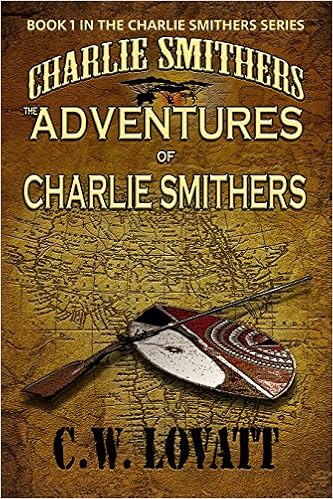
The Adventures of Charlie Smithers by C W Lovatt - Reviewed by Rob Bayliss

The author of this book has kindly offered a copy of the book to one lucky reader. To be in with a chance to win, just leave a comment below or on our Facebook page. The winner will be drawn on Monday the 16th May


Back in the 70’s whenever I was at my grandparent’s house I was always drawn to my granddad’s book collection. There could be found proper old hard backs, beautifully bound with that distinctive old book smell. There were old science books (probably even then incredibly dated but with amazing black & white photographs) a whole set of fascinating books on the Gallipoli campaign with pictures of old dreadnoughts, and another certain book which is the cause of this reminiscence. I can’t remember its title but I remember it had a picture of Gordon of Khartoum on the cover and it was full of tales of heroic derring do, written during the height of Empire. It was proper Boys Own stuff and was probably intended to inspire young folk to go out into the world and ensure the sun never set on  Britannia’s empire: the days when great swathes of the world were coloured pink in atlases.
But set the sun did, and even at the young age that I was it was clear that the book, with its fine line drawings and subjective narrative, was describing an altogether foreign country of the past. If this was standard reading matter once upon a time, it explains why Monty Python’s Flying Circus and the Ripping Yarns TV series very often parodied this old colonial mind-set.


When the author, Mr Lovatt, asked me to review The Adventures of Charlie Smithers I wondered whether I would enjoy it. True I had enjoyed his Seven Years War based novel, Josiah Stubb, but a book of derring do? I need not have worried. Within a few pages, a broad smile began to stretch across my face. 
We are first introduced to the titular hero as the servant of the bumbling Lord Brampton. Charlie has served (or should say that be suffered) in the company of Lord Brampton through the Crimean War and now on safari in Africa on a fruitless attempt at claiming trophies for the gun room at Brampton Manor. In an effort to save his master from an enraged charging rhino he leads the beast away and only escapes himself by leaping off a cliff to a river below. Alas it is the dry season and upon landing in the shallow river breaks both his ankles.
Around him a new threat appears in the river as crocodiles advance upon the hapless Smithers. To his pleasant surprise he finds himself rescued by Musa, a chief of the Masai. Musa speaks some English and wishes to use Smithers as a symbol of divine blessing… and thereby acquire more cattle. At the Masai village the local shaman has other ideas, perceiving Smithers as the embodiment of evil. It soon becomes apparent that there is a power play afoot in the village between the Chief and the Shaman. Fearing that Charlie will be killed before his ankles are healed Musa sends him away in the company of two trusted warriors an old female slave and one of his wives, Loiyan, who has healing skills. On the journey Charlie makes sure that he retrieves his Lordship’s prized elephant gun from where he had dropped it fending off crocodiles.
Charlie instantly takes a shine to the graceful Loiyan and as his party make their escape a relationship between the two blossoms into love. They are pursued by hunters sent by the shaman and the two bodyguards begin to tire of their charges and begin to become a threat. Charlie and Loiyan escape by boat on a vast lake. Charlie suspects that a river may lead from this vast body of water to the north and may lead to Cairo. But what does a return to England really offer him? He has all he’d ever want on the shores of Lake Ukerewe - what will become known as Lake Victoria - yet fate is not done with Charlie Smithers…

The Adventures of Charlie Smithers is written as a first person narrative in a humorous and highly entertaining style:


“Missed by God!” Lord Brampton roared, affronted.
“Oh hell!” quoth I, to no one but myself.
The rhinoceros had increased speed at an alarming rate. In fact, the way he was eating up the distance between us was quite impressive.
Here we bloody go again.
Now a word of warning: Charlie Smithers is a man of his time and his description of his adventures sound decidedly un-pc to our modern ears but please don’t let that put you off a thoroughly enjoyable read, which has some rip roaring adventure, laugh out load moments of comedic genius, as well as heart rending pathos. Smithers inadvertently discovers the source of the Nile but history of course records John Speke as having that accomplishment. I wonder if Mr Lovatt once read that Gordon of Khartoum book… because I very much suspect he’s watched Ripping Yarns!

Let this Speke fellow have the plaudits. Let him have the knighthood, too, if that’s what it came to. What worth had they beside memories like mine?


This is only the beginning for Charlie Smithers, I wonder where in the world Lord Brampton will lead our hero next?


The Adventures of Charlie Smithers is available at Amazon


Author Biography

C. W. Lovatt lives in Manitoba in Canada; the author of the best selling Charlie Smithers Collection, and the critically acclaimed "Josiah Stubb," he began his writing career in the short story field. Some of these have been included in his latest release, "And Then It Rained," an eclectic collection of novellas and award winning tales. For more news on his writing projects see his Story River blog Page


Rob Bayliss is a reviewer at The Review and is currently writing his own fantasy series. Information on his writing projects can be found at Flint & Steel, Fire & Shadow.