I was lucky enough to chat with Antoine over far too many olives at the HNS16 conference in September. What a charming man he is! I took the opportunity to ask him a few questions...
Antoine's latest book came out on 20th October and has received some wonderful reviews. You may buy the book here .
Alternatively, Antoine is very generously donating a copy of the book as a prize!!! To be in with a chance to win a paper copy of this book, please leave a comment here on the blog, or on our Review page. The names will all go into the hat and the first one drawn on 27th November will be the winner!!

Q. Antoine, if your latest book, Britannia’s Amazon, was adapted into a TV show or a film, who would you like to play the lead role?
Antoine's latest book came out on 20th October and has received some wonderful reviews. You may buy the book here .
Alternatively, Antoine is very generously donating a copy of the book as a prize!!! To be in with a chance to win a paper copy of this book, please leave a comment here on the blog, or on our Review page. The names will all go into the hat and the first one drawn on 27th November will be the winner!!

Q. Antoine, if your latest book, Britannia’s Amazon, was adapted into a TV show or a film, who would you like to play the lead role?
A. You’re putting me in an embarrassing
position here! Florence Dawlish is the wife of Royal Navy captain Nicholas
Dawlish, who had played the lead in four previous books. Florence played major
roles in two of them – Britannia’s Wolf
and Britannia’s Shark – but now, in Britannia’s Amazon, set in 1882, she has
a whole book to herself. She’s the type of woman I admire – clever, courageous,
loyal, compassionate and resourceful. She is however not a beauty and she knows
it. In Britannia’s Amazon, in which
she has to adopt another persona, “it was somehow disappointing when she saw her reflection in the wardrobe
mirror and recognised that it had been so easy to transform herself into what
she had so fortuitously escaped becoming, a frugally respectable working woman.
For all Nicholas’s assurances, she knew that she was not beautiful – her face
was too bony, her mouth was too large – and it was sobering to realise how it
was prosperity alone that helped disguise the fact.” With a description like that I suspect that
I’d earn the undying enmity of any actress I’d name as suitable for the part.
So I’m keeping my head down and am dodging this question!
Q. If, as a one-off,
you could write anything you want, is there another genre you would love to
work with and do you already have a budding plot line in mind?
A. The time-demand would be beyond me but
I’d enjoy researching and writing a narrative history about a single historical
event or campaign of relatively short duration – rather in the style of the excellent
James Holland. A few nights ago I watched the new movie “The Siege of Jadotville”, about an Irish Army unit on UN service
which was plunged into a nightmarish Rorke’s Drift-type situation in Katanga in
1961. There’s been one book about it already but it represents the type of
event I’d choose to write a book about if I could afford the time.
Q. Do you have any
rituals and routines in your writing? Your favourite cup, for example, or your
favourite piece of music?
A. Writing is only half the process –
the other half is “living” scenes in my head, and for this afternoon walks with
my dog Rufus are essential. I go back over what I’ve written in the morning – I
sometimes get insights on how to improve it – and I think through, indeed feel
through and live through, what will follow.
My characters are real to me and they get more real still as I visualise
what they’ll say and do, and how they’ll feel, in the following scenes and
chapters.
Q. Other than writing
full time, what would be your dream job?
A. An astronaut! Even one orbit would be
worth diamonds! I think that the saddest thing about our mortality is that we
don’t know exactly where the future will take Humanity. I’m pretty sure however
that it’s going to take us beyond Earth – how far, I can’t imagine – and I’d
love to be on the front line in this.
Q. Coffee or tea, red
or white?
A. For anybody with Dutch connections it
can only be coffee – and black!
(I love that answer!)
(I love that answer!)
Q. Imagine you could
get hold of any source document. What would it be?
A. I’m fascinated by the geometric
progression in numbers of ancestors as we work backwards through time. Assuming
three generations per century, we each had 512 ancestors three centuries ago –
though I guess the actual number may have been considerably less as a fair
number of them might have been ancestors through different descendants. There
must have been a lot of distant cousins marrying distant cousins a few
generations further on. But it’s impossible to visualise the probably very
disparate lives of so many eight-times grandparents who were alive in the time
of Marlborough, Peter the Great, Louis XIV. I’d love to get my hands on even
one document that could give me an insight on how those people lived and loved,
what joys and sorrows they knew, what perceptions they had of the world, what
passions and concerns and ideals motivated them, what expectations they might
have had of the future.
Q. Historical fiction
authors have to contend with real characters invading our stories. Are there
any real characters you have been tempted to kill off prematurely or ignore
just because you don’t like them, or they spoil the plot?
A. Historical figures are opportunities
– and in some cases are catalysts for the plot. When they’re introduced they’ve
got to act in character, even if the incidents they’re involved with are
fictional. I prefer to keep my plots within the framework of actual events so killing
off a real character would destroy this – it would indeed be an instance of “the
butterfly effect” changing history. That isn’t to say that there aren’t real-life
figures in my books whom I’d like to have seen come to more unpleasant ends
than they did – or indeed whom I’d like not to have been born in the first
place. The example that comes to mind is the Ottoman Sultan Abdul-Hamid II ––
who plays an important role in Britannia’s
Wolf. But I’ve had to leave him to live out his long shameful life and be
remembered with loathing today as “Abdul the Damned”.
Q. Are you prepared to
go away from the known facts for the sake of the story and if so how do you get
around that?
A. This relates to some extent to the
previous question. All “Historical Fiction” is to some “Alternative History”
and there’s some point of departure from what really happened. The story
develops from that point. In my books the plots fit into real-life timelines,
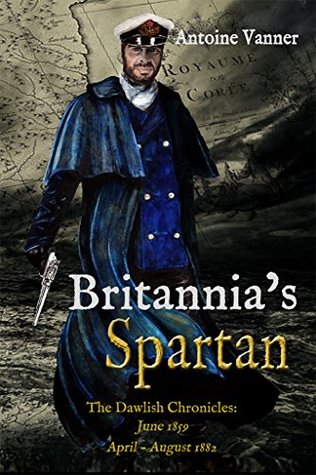
especially in Britannia’s Wolf and Britannia’s Spartan in which much of the
action is integrated with what really did happen on a day-by-day basis. Where
historical fiction such as my own differs from the best alternative history
fiction is that by the end of my books we’re back in the world as it really was
and subsequent history has not been changed.
Q. Have you ever
totally hated or fallen in love with one of our characters?
A. I’m definitely in love with Florence
Dawlish – what man wouldn’t be? But I’ve also got a sneaking liking for some of
my shades-of-grey villains: Silas Culbertson, the ruthless, cunning and brutal
ex-Confederate colonel who is also courageous; Fred Kung, the Chinese
power-broker who was mutilated during construction of the Central Pacific
railroad through the Sierra Nevada and who made a fortune thereafter through
shipping corpses back to China; Shimazu Hirosato, a captain of the Japanese
Navy who is cruel and pitiless, but is unswerving in his dedication to his
Samurai code of honour. And I can’t but love a character who was in fact a
real-life one: Adam Worth, a.k.a. Henry Raymond, who was described by Scotland
Yard as “The Napoleon of Crime” and
who was the inspiration for Sherlock Holmes’ adversary, Professor Moriarty. He
was a key player in Britannia’s Shark
and Florence encounters him again in the new novel, Britannia’s Amazon.
Q. What do you enjoy
reading for pleasure?
A. I love narrative history and we’re in
somewhat of a golden age of it. The late Shelby Foote’s superb The Civil War would be my desert-island
book and more recently James D. Hornfischer, Nathaniel Philbrick and Hampton
Sides in the United States, and James Holland, Simon Sebag Montefiore and Tom
Holland in Britain, have been setting a very high standard. I can’t recommend
these authors highly enough.
Q. Last but not least
… who is your favourite historical author?
A. Without hesitation – Zoë Oldenbourg.
I know of no other author who has entered into the minds of people whose values
and outlook – and world – were so different to our own, and who makes them come
alive so movingly and so convincingly. Her masterpiece, Destiny of Fire, is almost unbearably painful to read but it says
so much about what is truly valuable in Humanity that I’ve
returned to it again and again over the last forty years. It has had a massive
effect on my own values and outlook – literally a life-changing book. Oldenbourg’s histories have the same quality
of bringing lost societies poignantly alive.
 |
| Antoine and Rufus. |
A potted biography: Antoine Vanner writes historical naval fiction. He found himself flattered when nautical novelist Joan Druett described him as the "The Tom Clancy of historic naval fiction".
He says: "I find the late Victorian era, roughly 1870 to 1900, fascinating because for my baby-boomer generation it's 'the day before yesterday'. It's history that you can almost touch. Our grandparents grew up in that period and you heard a lot from them about it. So much in that time was so similar to what we still have today that you feel you could live easily in it, and then you hit some aspects - especially those associated with social conventions and attitudes - that make it seem wholly alien. It was a time of change on every front - intellectual, scientific, medical, social, political and technological - and yet people seem to have accommodated to these rapid changes very well." He had had an adventurous life in international business and also travelled extensively on a private basis. He survived military coups, guerrilla warfare, a militia attack, storms at sea and life in mangrove swamps, tropical forest, offshore platforms and the boardroom. Antoine’s knowledge of human nature, passion for nineteenth-century political and military history and first-hand experience of their locales provide the background to his historical novels centred on the lives of Royal Navy officer Nicholas Dawlish and his wife Florence. The five volumes published so far are all linked to actual historical events and are set in locales as various as the Black Sea and the Balkans in winter, a river-system in the heart of South America, the luxury and squalor of the United States' Gilded Age, Cuba in revolt, Korea as it emerges from centuries of isolation and - not the least deadly - the corrupt and brutal underside of the complacent and outwardly respectable society of Late-Victorian Britain
He says: "I find the late Victorian era, roughly 1870 to 1900, fascinating because for my baby-boomer generation it's 'the day before yesterday'. It's history that you can almost touch. Our grandparents grew up in that period and you heard a lot from them about it. So much in that time was so similar to what we still have today that you feel you could live easily in it, and then you hit some aspects - especially those associated with social conventions and attitudes - that make it seem wholly alien. It was a time of change on every front - intellectual, scientific, medical, social, political and technological - and yet people seem to have accommodated to these rapid changes very well." He had had an adventurous life in international business and also travelled extensively on a private basis. He survived military coups, guerrilla warfare, a militia attack, storms at sea and life in mangrove swamps, tropical forest, offshore platforms and the boardroom. Antoine’s knowledge of human nature, passion for nineteenth-century political and military history and first-hand experience of their locales provide the background to his historical novels centred on the lives of Royal Navy officer Nicholas Dawlish and his wife Florence. The five volumes published so far are all linked to actual historical events and are set in locales as various as the Black Sea and the Balkans in winter, a river-system in the heart of South America, the luxury and squalor of the United States' Gilded Age, Cuba in revolt, Korea as it emerges from centuries of isolation and - not the least deadly - the corrupt and brutal underside of the complacent and outwardly respectable society of Late-Victorian Britain
See more at The Dawlish Chronicles
To see a video of Antoine talking about his latest book and the challenges it presented click here
Britannia’s Amazon: http://amzn.to/2eZurBM
Interview with Antoine
Vanner: http://bit.ly/2fEMzm3Blog Link: http://bit.ly/15f20oy