Showing posts with label Rob Bayliss. Show all posts

Saturday, 13 May 2017

Diana talks to Paul Bennett, author of "Clash of Empires" - book one of The Mallory Saga.


Author’s interview – 2017. Diana talks to...Paul Bennett


Thanks so much Diana for inviting me to answer some very intriguing questions. It was a lot of fun.

It is my real pleasure, Paul.

First things first I am sure there is a question that you have always longed to be asked. Now is the chance. Ask your own question and answer it!

Is it really possible for any citizen of the US to grow up to be President?

Sure is…look at who we have now.  L

If your latest book (Clash of Empires) was adapted into a TV show or a film, who would you like to play the lead role?


I’m going to glean from Lonesome Dove and choose Tommy Lee Jones and Robert Duvall, younger versions mind you than the characters of Call and McRae.  Tommy for Liam and Duvall for Daniel.  For Liza again from Lonesome Dove, Diane Lane. 

(You may read Rob Bayliss's review of this excellent book here but please note the competition is now closed.)

What made you choose this genre?

Firstly my love of history.  All through my educational phases up through 3 years of college, I was far more interested in history classes or other classes that delved into our past.  At Wayne State University in Detroit, MI, I majored in Classical Civilization, basically the study of ancient cultures form the Mesopotamian Crescent through the Roman Empire.  I also minored in Physical Anthropology.  After I left college, needing a break from 18+ years of school the last 5 of which included working full time, I found myself free to read what I wanted.  Mary Renault got me hooked on historical fiction and later Colleen McCullough’s First Man in Rome series sent me searching for more.  Boy what a treasure trove of books to choose from.

How do you get ideas for plots and characters?

Surprisingly perhaps, while driving to and from work.  My commute is a lengthy one, and the Boston area traffic is always a challenge.  So I have at least an hour and a half for my Muse to do her stuff on my way to work and then again on the way home.  Mostly that is plot related ideas but sometimes specific narrative or conversations find their way to the surface.  I’ve even had to a couple times tell Wanda, that’s her name, to slow down.  Sometimes she starts giving me ideas for book 4 or 5.  Let me get done with number 2 first, please.  J 

If, as a one off, (and you could guarantee publication!)  you could write anything you wanted, is there another genre you would love to work with and do you already have a budding plot line in mind?

Either humor or fantasy.  I write journals of an annual golf trip I make with 3 or 4 of my buddies and they are rather humorous in content.  But I think I would do fantasy.  I have a few tales about a group of warriors that are stuck in some kind of time travel existence and are transported to various historical battles such as Gettysburg where they play prominent roles in the outcomes.  It’s fun playing with history.  In the Gettysburg story, Lee doesn’t make the mistake of trying to take the Round Tops, and the Confederates win at Gettysburg, due in some small part by my group of warriors.

Was becoming a writer a conscious decision or something that you drifted into (or even something so compelling that it could not be denied?) How old were you when you first started to write seriously.

I’ve dabbled with writing most of my life, doing the odd short story and trip journals/stories but I didn’t take on a full length novel until "Clash".  I am indebted to many people for encouraging me write "Clash", among them SJA Turney, the author of the excellent Marius Mules series (among others as well).  He and the others who read my first attempts saw something they liked and that reinforcement kicked me into gear, so to speak.  So much so that I’m making Clash the first story in The Mallory Saga – I will follow the family through the course of the history of the USA.  Right now I plan to finish the saga with the end of the Plains Indian Wars in the late 19th Century.

Marmite? Love it or hate it?

First I have to Google it.  J (Laughing here.)

Do you have any rituals and routines when writing? Your favourite cup for example or ‘that’ piece of music...??

I do most of my writing in the pre-dawn hours partly because my three night/12 hour shifts at work has wreaked havoc on my sleep patterns, but also partly because I’ve always loved the early morning.  Accompanied by cups of good, strong coffee – freshly ground and as freshly roasted as possible – and with one of my playlists blaring in my headphones, I wait for Wanda and when she is ready, my fingers start dancing along the keyboard.  The playlist I am listening to as I write this includes a mixture of goth bands such as Within Temptation, Nightwish, Leaves Eyes etc and the angelic, mystical Loreena McKennitt. (NICE)

I promise I won’t tell them the answer to this, but when you are writing, who is more important, your family or your characters?

Since I write mostly when everyone else is asleep I rarely have to make that choice but if I’m in the throes of Wanda’s ministrations, I’ll finish what I’m writing and then address my 4 ½ year old granddaughter’s request for food or to have her tablet recharged.  J

Other than writing full time, what would be your dream job?

I am 65 – my dream job is to not have to need one.  J  A short jaunt down memory lane: when I was in my early 20’s I was what you might call a hippie.  A young man just discovering what the world was really like and trying to figure out my part in it.  I would often comment that all I wanted to be was a Forest Ranger assigned to some fire tower in the mountains where I could spend my time writing the great American novel.  Of course that didn’t happen and I have spent the last 40 years working as a computer professional.  (What a wonderful dream...)

Coffee or tea? Red or white?

Coffee – but only really good coffee, like I get from my friends at Thanksgiving Coffee. J  Red or White – that would be better phrased Ale or Stout.  Not a wine drinker but do enjoy fine ales, stouts and porters.

How much of your work is planned before you start? Do you have a full draft or let it find its way?

I’m not much of a plotter, more of a seat of the pants approach.  Of course, I have a basic idea in my head for the foundation of the story.  I have a notebook in which I jot down ideas, dialogue etc, but most of the work is done when I am hovering over the keyboard.  It amazes me when I have a sudden epiphany; a thought just hits out of the blue and when I look back at what I’ve just typed I often remark I didn’t see that coming. 
I would be guilty of a heinous sin if I didn’t at this point sing the praises of my editor, Marguerite Walker II.  She takes those amazing epiphanies and coaxes even better ones out of me.

If you had free choice over the font your book is printed in, what font/fonts would you choose?

I did Clash in Georgia 12…the aforementioned MW found an article on good fonts for books and we went with Georgia. (My favourite serif font.)

Imagine that you could get hold of any original source document. What would it be?

The scorecard from a Detroit Tiger game on which I had gotten the autograph of my favorite ball player, Al Kaline.  It regretfully was stolen roughly 50 years ago.  (Very cross and unhappy face.)
 
Have any of your characters ever shocked you and gone off on their own adventure leaving you scratching your head??? If so how did you cope with that!?

Not yet…but it’s early in my writing career.  I have characters who demanded larger roles, however.  J

How much research do you do and do you ever go on research trips?

Most of my research is online or by reading books about the subject in hand.  I do love road trips though so for Clash I did visit Forts Ticonderoga and William Henry.  The next couple books in the Mallory Saga take place during the American Revolution.  I am fortunate in that I live 20 miles north of Boston so don’t have to travel too far to follow along, say, the Battle of Lexington and Concord or Bunker Hill.

Fiction authors have to contend with real characters invading our stories. Are there any ‘real’ characters you have been tempted to prematurely kill off or ignore because you just don’t like them or they spoil the plot?

The one who springs to mind is George Armstrong Custer.  Since this isn’t in Clash I don’t mind this little spoiler…in my Gettysburg story, I kill off Custer.  J

Are you prepared to go away from the known facts for the sake of the story and if so how do you get around this?

To the best of my knowledge, I stayed true to the historical facts in Clash.  My only deviation was changing the date of a battle by a couple days.

Have you ever totally hated or fallen in love with one of your characters?

My editor would argue that I like Liam more than his siblings, Daniel and Liza.  Methinks she may be right.  As far as hating a character, there are a couple of them, but one dies early on.  The Shawnee nemesis of the Mallory’s, especially Liam, is a warrior named Huritt.  I don’t want to say too much, suffice that Huritt is a good example of his culture; one that could be brutally violent. 

There are a couple characters in Clash who end up playing a much larger role than I had originally intended, but I had so much fun with them, I couldn’t say no when they requested more face time.  Wahta is a Mohawk, his name means Maple Tree and he is built along those lines.  He becomes a good friend of Sergeant Glyn Mulhern, an Irishman serving in the British Army under a Scottish Colonel.  I loved writing the byplay between the two of them.

What do you enjoy reading for pleasure?

I read quite a bit, I’ve done close to 200 reviews in 4 years.  Most of them are historical fiction from various periods of history.  I’ve learned more about the history of Britain the last couple of years than I had in the prior 63. J  I must admit that my favourite periods are ancient Greece and Rome.

What drink would you recommend drinking whilst reading your latest book?

Ale – there’s a good bit of ale drinking in Clash of Empires.  Might as well join them for a pint or two.

Last but not least... favourite author?

A question that is difficult to answer given the number of authors who I count as friends, so, I am going to try to offend no one by choosing an author not of the historical fiction world.  Kurt Vonnegut gets my vote with Mark Twain a close second.  J

About the Author

Paul’s education was of the public variety and when he reached Junior High he discovered that his future did not include the fields of mathematics or science. This was generally the case throughout his years in school as he focused more on his interest in history; not just the rote version of names and dates but the causes.

Paul studied Classical Civilization at Wayne State University with a smattering of Physical Anthropology thrown in for good measure. Logically, of course, Paul spent the next four decades drawing upon that vast store of knowledge working in large, multi-platform data centers, and is considered in the industry as a bona fide IBM Mainframe dinosaur heading for extinction.

Paul currently resides in the quaint New England town of Salem, Massachusetts with his wife, Daryl. The three children have all grown, in the process turning Paul’s beard gray, and have now provided four grandchildren; the author is now going bald!


You can find Paul:

His Facebook page


On Twitter

Email: mallorysaga@gmail.com


© Diana Milne January 2017 © Paul Bennett 03/27/17


Monday, 10 April 2017

Josiah Stubb: The Siege of Louisbouurg, by CW Lovatt; reviewed by Rob Bayliss

On April 14th the second in this outstanding trilogy is released. This review of the first book is to introduce you to the story and concept, and let you get a chance to get to know Josiah Stubb.

You can preorder the book here at Amazon.

Trust me. It is worth it!


That solid mass of men appeard unstoppable, and indeed, there was many a nervous glance between us, as we knew that our numbers would be insufficent for the task; still we proceeded with all possible haste through the thick undergrowth when the order for double-time was given, for the enemy's goal could not be more clear.

We are introduced to Josiah Stubb and his comrades of the 51st regiment of Grenadiers as they prepare to make a hazardous amphibious landing. It is 1758 and we are in the midst of the Seven Years' War, a global conflict, now that the major powers have colonial interests, lasting from 1754 until 1763. In Anglophone North America the struggle is known as the French and Indian War and had started two years previously.


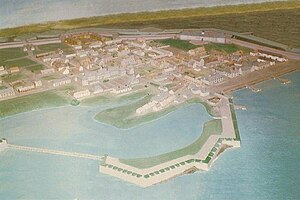
The French fortress of Louisbourg was, up to 1758, the most expensive stronghold in North America. With its harbour, it dominated the approaches to the Gulf of St. Lawrence and the heartland of Arcadia and New France while its naval squadron was a constant threat to British maritime supply lines.


Thus Josiah Stubb finds himself in boat striving for shore with his best friend Daniel Hawthorne on one side and the perverse and mannerless Ben Stokingdale on the other.  Before them the muskets and cannon of the French open fire. Their fire is so intense that the attack is almost called off until a sheltered, undefended, cove is discovered.


Josiah and his comrades find themselves in the first wave, stealth fully creating a perimeter while the rest of the attacking units land. Josiah is ordered to watch the unsuspecting enemy who think they have repelled the British. Josiah’s mind drifts off recalling the events that have brought him to this juncture: his humble origins as a son of a whore, his abused upbringing in St. Johns and the love of his life, Elizabeth. Daydreaming, he allows the enemy to gain knowledge of the tenuous British defences; his punishable laxness is noted by his superior, the popular Captain Beaumont.  Soon Monsieur is launching a ferocious counterattack on the British position. In the ensuing struggle young Stubb and his comrades give a good account of themselves and, with British reinforcements arriving, the French are forced back, yielding their outer defences.  The night after the battle Josiah is summoned to the Captain to face judgement for his misdemeanour; his history comes back to haunt him in a most terrible and humiliating way.


It is during lulls in the fighting that Josiah is able to reminisce and we learn of his abusive upbringing, by his mother and her plans for him. She does however ensure that he is literate and Josiah is determined on bettering his future and uses his skills to this end. It is then that he falls in love with Elizabeth. They are forced apart by circumstance and the machinations of others, but can he win her back?

These reminisce scenes are cleverly woven into the novel's progression by the author, so in effect we have two timelines to the story running parallel. It could almost be said the book ends at the beginning! The dialogue has C18th century accents running through it; the down at heel Stockingdale sounds exactly as the reader would expect!


Mr. Lovatt has certainly done some meticulous research into this siege, which proved to be one of the most decisive engagements of the war. The military engagements are well described and as a reader I was there as well, desperately trying to load my musket as the French advanced. I enjoyed the little details, such as having to clean the musket of powder residue, and the description of the siege lines and the effort taken in digging them.
 
The author's prose is brilliantly descriptive; we are learning of this crucial siege, but at the same time the character of Josiah is fleshed out, complete with his dreams and his demons. Josiah Stubb is a believable character; the reader feels for his attempt to come to terms with his abusive past and tortured present. He is a true child of his time, as the Age of Reason begins to change the world around him and he grasps the opportunity to better himself, driven by his love of his soul mate, Elizabeth, although he feels his romance is doomed from the onset. In the background we are viewing the birthing pains of modern Canada and see the shooting star of General Wolfe beginning to burn bright.


Only at the close  of the novel do we really learn how he first met his comrades and even who his father may be. Josiah Stubb could easily be a stand-alone book; however all is set up quite nicely for a sequel. I sincerely hope that is the case as I thoroughly enjoyed this book, which I found to be a
real page turner.


C.W. Lovatt lives in Manitoba, Canada. Josiah Stubb: The Siege of Louisbourg is his third novel. It is available at Amazon.


This review was written by Rob Bayliss. Rob is currently working on his Flint and Steel, Fire and Shadow fantasy series. Part one, The Sun Shard is available at Amazon. You can find out more about him here

Wednesday, 1 October 2014

Tales of Old Somerset - Mud, Blood, Oil and Dragons - by Rob Bayliss


Unlike its neighbouring West Country counties (with the possible exception of Weston-Super-Mare and Burnham-on-Sea) Somerset isn’t renowned for its beaches. Not until Minehead, and beyond, do we find the beloved golden sands we always picture in our mind's eye. For most of the coast there are
darker and redder beaches leading to treacherous mud flats extending some distance from the shore. This stretch of sea is the Bristol Channel, which has the second largest tidal range in the world. The water is coloured brown with silt from the outflow of the great river Severn from the topper most end of the Bristol Channel, not to mention the River Parrett that drains the levels, Somerset’s marshy heart. Not until you travel west to Porlock, below Exmoor, does the sea finally lose its muddy colouring and the sand become yellow, as it meets the Atlantic.

Looking across the waves you can see the coast of Wales and in the Bristol Channel you can see the two islands: Steep Holm, as the name suggests a tall island of cliffs and, the equally descriptive Flat Holm (in Welsh: Ynys Echni), the most southerly part of Wales. Both islands were once used as religious retreats. St. Cadoc lived as a hermit on Flat Holm for seven years while his friend St. Gildas found refuge from the world on Steep Holm, prior to later founding Glastonbury Abbey.


The river Parrett lazily meanders into the sea, forming the Steart Peninsula, now a major nature reserve for the birds that wade in the rich silts of Bridgwater Bay. Looking westward from here along the coast can be seen Hinkley Point nuclear power station. Whereas looking inland are the tall Quantock Hills. A short distance southward along the Parrett lies the village and port of Combwich. Prior to the construction of the M5 motorway, it was here that building materials were landing for the construction of Hinkley Point.

Combwich itself has a little known place in history: in 878AD the Viking Ubba, brother of Ivar the Boneless and Halfdan Ragnarsson, landed here with 23 ships and some 1,200 warriors. In a stronghold called Cynwit, possibly in the nearby village of Cannington, the king’s representative Odda and local thegns took refuge, forcing the Vikings to attack them. The Wessex forces overcame the Norsemen and even captured Ubba’s raven banner. It was a remarkable victory, all the more so as it was one of the few that was achieved without the presence of Alfred the Great. Ubba’s campaign seems to have been coordinated with that of Guthrum’s. If it had succeeded Alfred’s lines of supply and communication as he gathered his forces at nearby Athelney would have been fatally exposed. On such throws of the dice are kingdoms won and lost.

Following the coast westward from Bridgwater Bay the Quantock Hills fall towards the sea. At Kilve compressed layers of limestone and shale are clearly visible in crumbling cliffs. The village of Kilve consists of three original settlements, centred around the original hamlet of Putsham, that follow Holford stream down to the sea. On the way can be found the ruins of Kilve Chantry, founded in 1329. It fell into disrepair long before the Dissolution of the Monasteries and was later used as a barn and even as a smugglers' store, prior to it being consumed by fire in 1848. Legend has it that this fire was deliberate, consuming barrels of contraband spirits as the revenue men drew near.


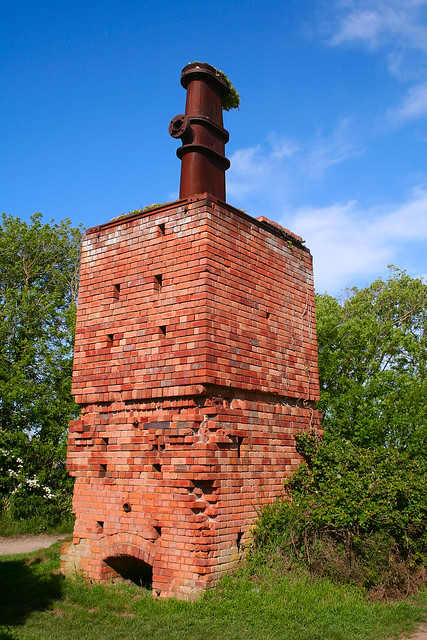
Further downstream is a brick resort, a relic of the expected Somerset oil boom of the 1920s that never was, extracting oil from the local shale rocks. Kilve Pill marks the point where the stream reaches the sea. It was used as a tiny port importing Culm (an inferior coal) to be used in lime kilns.


Below 40-feet-high cliffs the more resilient stratas of rock stretch out into the sea in pavements, revealing fossils of amonites. These causeways carry an interesting local legend. Within Putsham Hill there once lived a particularly fiery dragon called Blue Ben. He used to emerge from a tunnel between Kilve and Putsham so as to swim in the sea and cool himself down. He built the causeway in order to avoid the mudflats. The devil watched Blue Ben and, discovering his lair, harnessed him and rode him along the streets of Hell. Poor Blue Ben suffered terribly with the heat of the hellfires and, after being released after one such sortie, hurried along his causeway in order to cool off. Too eager, he slipped off it, fell into the mud and drowned. 


Obviously Blue Ben was an attempt to explain the geography of the causeways, but perhaps the legend of a fiery dragon who lived under the local hill contained some folk knowledge of the oil in the shale rocks as well? (Especially as the shale has a blue tinge!) The legend of Blue Ben may well have faded from folk memory, but enjoyed a revival in the 1800s when an Ichthyosaur was discovered at nearby Glastonbury. You can imagine the scene when a local heard of the discovery:  "One of they ancient reptiles, that them scientists talk about, you say? Don't be daft; 'tis obvious, 'tis the remains of Blue Ben himself!"


Rob Bayliss is an admin with The Review and author of the Flint and Steel, Fire and Shadow series. Book one, The Sun Shard, can be purchased from Amazon and Amazon UK. He is also a contributor to Felinity, a collection of cat-inspired flash-fiction stories. If you would like Rob to review your book, please see our submissions tab above.

*********

Rob is very generously offering a paperback copy of Felinity for one lucky winner! To get your name in the hat, simply comment below. Facebook users may also comment at this blog's associated thread. 


Thursday, 20 March 2014

Rob reviews Troll by Richard Sutton

Troll by Richard Sutton 

Reviewed by Rob Bayliss

Please see below for giveaway details!


Troll begins in a high valley in present day Norway. An excavation of a cave has yielded an archaeological anomaly. What this anomaly is, and how it has occurred, we won’t discover until the very end; to do so we must travel back thousands of years to a prehistoric time, when there were more than one species of hominid walking the earth.

We are introduced to the clan who once dwelt in the cave. A young clan member called Mokolo is mourning the death of his father, a renowned hunter called Slatolo. Mokolo is clever and dextrous and has the task of crafting traditional hunting spears with fire hardened points. We learn of the ways of the clan: a highly organised matriarchal society, dominated by the elderly Clan Mother, a skilled healer, oral archivist and seer who never leaves the ancestral cave.


The clan are hunters and gatherers living in a dangerous world. They have to contend with predatory cats with huge knife-like teeth and have an uneasy truce with the Great Cave Bears who they fought with long ago in order to claim the cave as their own. Lately however, a new and more dangerous enemy has entered the valley below. They are men, but not like the Clan. We learn that Slatolo himself was slain by these other men, using tiny feathered spears, with flint blades. The Clan is greatly troubled and the Clan Mother wishes for the Clan to discover the secrets of these “arrows”. Mokolo is charged with copying this new technology, which he does, but the new spears seem useless when thrown, even when using spear throwers. It is known that the newcomers can “throw” them accurately and at great speed.


To have any hope of successfully resisting the newcomers the Clan Mother insists that the secret of launching these tiny spears must be learnt. The Clan Chief, Datolo, takes Mokolo and the Clan Mother’s granddaughter and acolyte, Anas’kala, to spy on the newcomers. The spies watch a hunting party of strange fair men launch the arrows using bent sticks strung with sinew. They return to the cave to report their findings and Mokolo is put to work reproducing what he has seen. Successfully learning the craft of bow making and archery, through trial and error, the scouts are sent out again to ascertain the newcomers’ numbers. The Clan Mother fears the newcomers and their intentions, knowing from oral tradition that they have always exterminated clan folk in the past.


However, the spies do not go unnoticed by the tribe of newcomers. The Tribal Seer convinces the Chief that the Clan is a direct threat to all of them and demands, that as the tribe's best hunter, Anson lead an expedition of eradication to the Clan's high valley. But Anson's daughter is gravely ill and the only cure available forces him to question where his tribal and individual loyalties lie. 


Troll is a beautifully written book. Mr Sutton has done a great job in creating and describing the Neanderthal culture and society, at once similar yet different to our own. I found myself completely absorbed by the story, with its undercurrents of racism, ethnic cleansing, fear and ignorance of the “other”. Personally I found the idea that the mythology of trolls, with their coarse features, could be an ancient folk memory of earlier hominids a wonderful notion. It has always been supposed, from previous studies of the fossil record, that the distinct Neanderthal culture was pushed to the periphery of their ancient hunting grounds by technologically superior modern humans and were subject to genetic bottlenecks as advancing ice packs isolated them further, pushed in fact, to extinction. But was this truly the case?
 New research sheds light on these tough evolutionary brothers of ours. They had elaborate funeral ceremonies; this suggests a spiritual belief system. Therefore, like us, they most probably looked at the stars and philosophised about their existence. They lasted 200 millennia and survived numerous ice ages. They invented tanning, to waterproof their leathers. They wore beads and jewelry and shared their caves with body lice which indicates that they wore clothes. It suggests that modern humans actually copied the Neanderthals’ wisdom and technology to a great extent. We intermingled then, and as modern Europeans share 
1-4% DNA with Neanderthals such intermingling may have got very passionate indeed!
These were not simply the brutish fur clad cavemen of popular myth; it may well be they were and are us!


Troll is available for Kindle and as paperback at Amazon. There is also a free copy up for grabs---from Smashwords for an eBook format--and all you do to get your name in the hat is comment below! Facebook users may also comment here


This review was written by Rob Bayliss. Rob is currently working on his Flint and Steel, Fire and Shadow fantasy series. Part one, The Sun Shard is available at Amazon.


If you would like Rob or any of The Review Group team to review your book, please check out the submissions tab above.

Friday, 7 February 2014

Rob Bayliss reviews Plague Seed


Plague Seed - Book One of The Plague Fall Trilogy by Wade Alan Steele
Reviewed by Rob Bayliss


See below for details on the prize draw

The Plague Seed is a high fantasy novel for both young adults and the not so young. Put it this way: if you spent your formative years immersed in fantasy role playing games, killing orcs and trolls, (hands up, I admit that I’m guilty!) then you will thoroughly enjoy this rollercoaster of pure escapism.

Welcome to Western Talandria: a world shared by men, some civilised and some savage cannibals, drunken dwarves and aloof elves. The book is written as a letter written by an elf to his infant son. The epistle chronicles the history of he Plague War from the perspective of one of its heroes, an exiled elf of many names. We are introduced to him as Seligre, the Firebrand, posing as a merchant, attempting to mingle with the patrons in a high-end den of ill repute, in the mountain town of Colton’s End. It becomes clear in a brawl that Seligre is no mere merchant; he is a member of the Sword of Silence, a criminal guild centred in the nearby town of Dentim. In a local establishment he becomes enamoured by a beautiful human dancer called Katelyn. Katelyn is no mere dancer however; she is the wife of Raymuz, the headman of Colton’s End.

Raymuz mistakes Seligre for Dockra, Katelyn’s one-time elf lover, and orders his arrest. Katelyn and Seligre escape Raymuz's men and team up with Tahlkin the dwarf, an ale-brewing priest of the drunken deity, Rold.

As the companions desperately evade capture, or worse, all hell is breaking loose at Colton’s End. Gathering in the Faylin Mountains, a great northern army is composed of disaffected humans, goblins and lumbering troll like creatures, the Grumach. Raymuz is in league with the army bent on conquering Talandria. Carrying a message from Dokra to the High Council of Elves, Katelyn hires Seligre to take her to the Blessed Forest of Oldenhome to the south. Oldenhome is the impregnable homeland of the elves, where they live in splendid isolation from the troubles of those they view as lesser folk. Tahlkin joins them in their journey south, as Colton’s End is no longer the place to open a temple of Rold and sell beer, and the roads are now dangerous to travel alone.

They journey south but there are enemies everywhere, not only Raymuz’s men but also the one time friends of Seligre’s old guild. Treachery abounds across Talandria as the lands yield to the great northern army. Only Oldenhome stands untouched, as aloof as ever. Facing many dangers Seligre and Katelyn eventually become lovers. As the companions draw closer to Seligre’s homeland we learn of the reasons for his banishment from Oldenhome, and his true name, Drayvus Varden, a one-time Knight of the Blessed Forest.

With more of the tale to be told there will be no happy ever after for Seligre and Katelyn, as Oldenhome is forced to interact with the outside world. In an interesting twist we see that all is not as it appeared to be. Seligre has unwittingly become a conduit to bring about the downfall of the Blessed Forest.

A consummate Dungeon Master, the author has done a fine job in creating a world with different races, deities and mythologies. The dialogue is refreshingly modern, at times humorous but not overly vulgar, and I really enjoyed the descriptive prose and turn of phrase that Mr Steele has written. I look forward to reacquainting myself with Seligre/Drayvus in the continuing history of the Plague War.


Now then, what to do until Book Two is released; I wonder if I still have those old twenty-sided dice?


Plague Seed is available as an ebook on Amazon.

This review was written by Rob Bayliss. Rob is currently working on his Flint and Steel, Fire and Shadow fantasy series. Part One, The Sun Shard is out on Kindle.

 If you would like Rob or any of the Review Group team to review your book, please check out the submissions tab above.


Wade Alan Steele is also offering an ebook copy of Plague Seed to one lucky draw winner! To get your name in the hat for a FREE ebook, simply comment on the blog below. 

Facebook readers may also comment here.