Showing posts with label Agincourt. Show all posts

Sunday, 25 October 2015

Commemorating Agincourt 600 years - The Battle - by Rob Bayliss

We few, we happy few, we band of brothers;
For he to-day that sheds his blood with me
Shall be my brother; be he ne’er so vile,
This day shall gentle his condition;
And gentlemen in England now-a-bed
Shall think themselves accurs’d they were not here,
And hold their manhoods cheap whiles any speaks
That fought with us upon Saint Crispin’s day.
Henry V – William Shakespeare

In  13th August 1415 Henry V, with 12,000 men, landed in France to further his claim to the French crown and lands through his Great Grandfather, Edward III. His claim to the throne of France was a tenuous casus belli for Henry, but in truth the Hundred Years War had always been about territory.
The Norman Conquest of England had created the strange situation that a supposed subject of the French Throne (Duke of Normandy) now had lands and military power equal or exceeding that of his liege lord. Subsequently the French Crown had long endeavoured to conquer French lands ruled by the English monarchy such as Aquitaine, Normandy, Brittany and Flanders.  By 1415 only Aquitaine and Calais remained under English rule but France itself was riven by civil war between Charles VI and John the Fearless, Duke of Burgundy. Seeing a chance to rebuild the Angevin Empire Henry V resumed the Hundred Years War.
   The siege of the port Harfleur lasted until 22nd September and took its toll on Henry’s forces as disease thinned his ranks, but he waited for the Dauphin - the heir apparent to the French Crown, to respond. By October the campaigning season was coming to an end and a costly expedition had only yielded one town. The French had so far failed to challenge Henry militarily. Therefore, in order to ensure his claim to Normandy and Flanders more substantial than merely historical, he chose to march to Calais, rather than retire directly overseas to England for the winter.


   Biding their time the Dauphin had gathered an army around Rouen. They shadowed the English, blockading crossings of the river Somme and forcing Henry south to find a ford.  Finding a crossing at Peronne he resumed his march northwards. The French followed but without the protection of the river hesitated to give battle. Yet all the time the French were growing stronger as reinforcements arrived. In contrast, after a 16 day march of 260 miles, the English were in a pitiful state; wracked by disease and short of supplies. On 24th October both armies faced each other across a narrow strip of freshly ploughed open ground between the woods of Agincourt and Tramecourt.  The English were at the south while the French positioned themselves at the north, barring the road to Calais. Throughout the night it rained. Cold, wet and hungry the English settled as best they could, for what many considered would be their last night on earth.
On 25th Henry, fearing further French reinforcements, arrayed his forces for battle. He positioned his English and Welsh longbowmen on his flanks behind sharpened stakes, angled so as to create an enfilade killing ground. In the centre he placed his heavily armoured men at arms, in three battles, behind more archers. The French clearly outnumbered the English force. We only have estimates but the English now ranged from 6-9000, 5/6ths being commoner archers, the rest being heavy infantry. The French had anything 12-36,000, some 10,000 being men-at-arms, with 1200 mounted knights. The rest would be other infantry consisting of crossbowmen and archers.
Despite this clear numerical advantage the French sat awaiting further reinforcements. Perhaps  they expected the English to retreat at the sight of so many enemies? If defeated the English men at arms could expect to be captured and ransomed, whereas the archers would be killed outright. Henry knew his men were in a poor state, with hunger beginning to afflict them; he therefore took a gamble and advanced closer to the French. If the French had attacked at this point before the English had reset their anti-cavalry stakes the result would have been a slaughter, but for some reason no action was taken. Impatient for battle, with the French at 300 yards, Henry’s longbowmen released a volley. The air turned dark with arrows, that made a sound like rushing water. The sheer numbers of arrows meant that some were bound to find exposed areas of flesh amid the opposing ranks. Incensed and stung into action, instead of answering with their own archers and crossbowmen, the French cavalry charged.
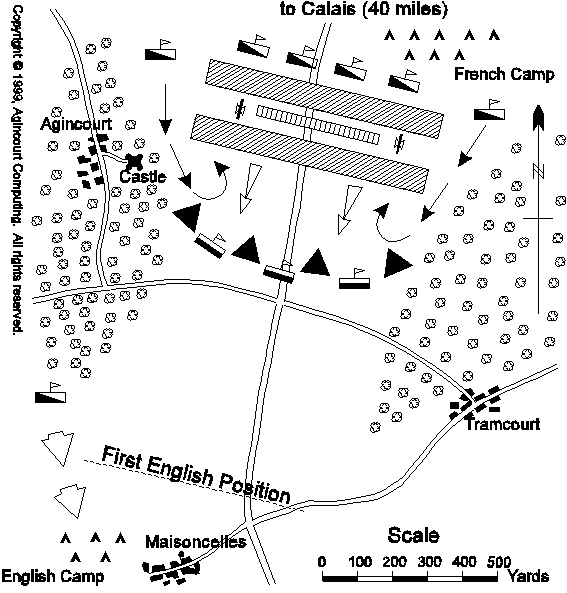
   The charge was a disorganised disaster; many were still feeding or watering their mounts. The cavalry were unable to outflank the archers, protected as they were by the woods behind them and the forest of spikes in front of them. Instead they were funnelled into the killing ground where arrows pierced the horses’ unprotected flanks. Those horses that completed the nightmare journey found themselves impaled on the fence of sharpened stakes. Soon all was a chaos of maddened horses and thrashing limbs. Expecting to mop up after the shock of the cavalry charge 5000 French men-at-arms began their advance, only to face retreating horsemen and stampeding arrow maddened horses. In full plate armour they faced an energy sapping 300 yard slog through the now hoof-churned mud and the shambles of fallen comrades. All the time a deadly storm of arrows rained on them. They had to bend their heads down to protect the eye slits in their visors and yet they made it to the English line and by weight of numbers managed to push the English men-at-arms back.

  Their arrows spent and needing to retrieve usable ammunition, the longbowmen took up swords, hatchets and mallets and attacked from the flanks. The French men-at -arms were exhausted and were butchered by the manoeuvrable light infantry. Many were knocked over, too exhausted to defend themselves or rise again. It is very possible that many suffocated in the shambles of mud and bodies. The French second line advanced but merely disappeared in the crush making it increasingly impossible for those at the front to fight or manoeuvre. For three hours the slaughter continued; men were killed or captured in their thousands. It was said that great heaps of dead began to mount up in front of the three English battle standards, both French lines utterly defeated. Thousands of French nobles were disarmed it was said they actually outnumbered their captors.
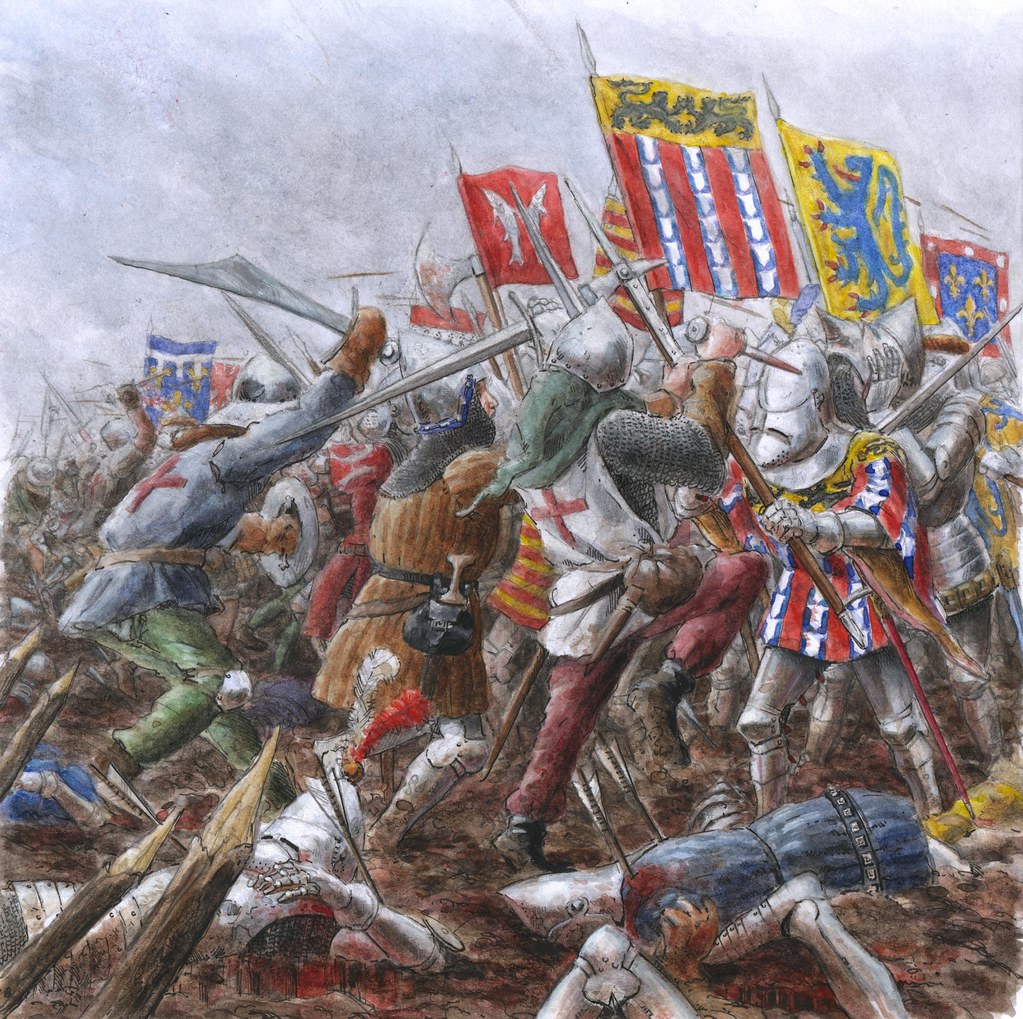

   Looking up from the slaughter the tired English army saw the French still gathered at the north with reinforcements still arriving, they seemed to be forming up for another attack. These reserves still outnumbered Henry’s forces and were fresh. Screams were heard behind them as French forces had rounded their position to attack Henry’s baggage train. Despite all their valiant efforts, defeat was still a real possibility for the English; those taken prisoner could easily snatch an abandoned weapon and join in the fray. Not prepared to accept such an outcome Henry ruthlessly ordered the prisoners to be killed.
  Such an act of terror is still controversial, many of Henry’s knights refused to embark on such an unchivalrous act and most of the archers had returned to their defensive positions seeing the French to the north preparing to advance. Those killed at this time would have probably gone into the hundreds, but it had the desired effect. The French reserve saw the captured nobles being slaughtered and, deciding that the battle was truly lost, fled the field.

  Seldom are victories so crushing and decisive, the ratios of those killed is astonishing. Some sources list 4-11,000 French dead to 1600 English and Welsh, others 7-10,000 to little over 100. It was a classic battle using the longbow and is rightly remembered as the epitome of English tactics of the period, perhaps more so than the similarly fought battles of Crecy and Poitiers. It also shows that overwhelming numbers do not necessarily ensure victory. The French allowed Henry to manipulate them into attacking him recklessly over terrain that suited a defensive posture. Thanks to Shakespeare of course the battle has entered the national psyche, a symbol of backs to the wall defiance; how stirring words can bolster fear-filled hearts.

Rob Bayliss is a reviewer at The Review and is currently writing his own fantasy series. Information on his writing projects can be found at Flint & Steel, Fire & Shadow.

Saturday, 24 October 2015

Commemorating Agincourt: The Hundred Years War and The Road to Agincourt
by Sharon Bennett Connolly


The Battle of Agincourt
This Sunday, 25th of October 2015, marks the 600th anniversary of the Battle of Agincourt. One of the greatest battles in English history, it epitomises the pinnacle of English successes against their traditional enemy, France, during the epic struggle of the Hundred Years War. But what started it all?

The origins of the Hundred Years War go back 200 years before its outbreak, to Henry II. His marriage to Eleanor of Aquitaine meant he was not only Duke of Normandy in the north of France, but Duke of Aquitaine in the south. And his accession to the English throne in 1154 brought all these French possessions to the crown of England. This made for the awkward position that the sovereign of England was technically a vassal of the King of France, causing no end of squabbles and friction for years to come.

Wars broke out frequently and the French gradually ate away at England's French possessions.

It all came to a head with a crisis in the French monarchy. When Philip IV, the Fair, of France, died in 1314, he was successively succeeded by each of his 3 sons; Louis X, Philip V and Charles IV. Only one of these kings produced a son, King John the Posthumous was born 5 months after the death of Louis X, his father, and lived - and ruled - for only 5 days. Following the death of the baby king Philip V seized the crown, effectively disinheriting Louis X's daughter, Jeanne.

Although Salic Law was known in France, it generally related to property and had never actually been used to decide the succession to the crown. However, Philip V made certain that it would be from now on, by having the Estates General declare that women were not eligible to succeed to the throne of France.

Unfortunately for the French royal family, both Philip V and his successor, his brother, Charles IV, only had daughters. Charles IV died in 1328, leaving his wife, Jeanne d'Evreux, pregnant; a regency council was set up to rule the country, until the child's birth. However, Jeanne gave birth to a daughter, Blanche, and France had to find a new king.


Edward III King of England


One candidate was Edward III of England. Edward was the oldest grandson of Philip IV through his daughter Isabella of France, Queen of Edward II of England. However, Edward III was only 15 years old and England - and Edward - were controlled by Edward's mother, Isabella of France, and her lover, Roger Mortimer, who had deposed and possibly murdered Edward's father, Edward II. Edward's claim came through his mother - and he was English.

The assembly of French notables, convened to decide who should be king, declared: "It had never been seen or known that the kingdom of France should be subject to the government of the King of England."

As a result, they chose another as their king; the nephew of Philip IV, Philip of Valois, Count of Anjou and Maine. Philip was in his thirties, with a 9-year-old son, and had been Regent during Jeanne's pregnancy.

Edward III initially agreed to pay homage to Philip VI, who was crowned in 1329, for his French possessions. However, he was still a minor and under the tutelage of his mother and Mortimer. When Edward took control of his kingdom, in 1330, he had a change of heart. Irked by Philip's support for the Scots, and encouraged by local conflicts in Guyenne, Edward questioned the validity of his oath to Philip, made while he was still a minor. And in 1337 Edward III declared war.


Battle of Crecy, 1346
Initial English successes devastated France: the  French fleet was destroyed at Sluys in 1340, and Edward III ravaged the French countryside, in a great chevauchee. In an attempt to bring the French to battle Edward's 'scorched-earth' policy saw towns besieged, convents and monasteries ransacked and the people displaced. The French were eventually brought to battle at Crecy in 1346, where their cavalry was destroyed. The fall of Calais followed in 1347

In 1356, at the Battle of Poitiers, the English, under the Black Prince (Edward, Prince of Wales) captured France's king, John II the Good. John was sent to England - where he died in 1364, still awaiting the payment of his vast ransom.

The 1360 Treaty of Bretigny was the crowning success of England's war, with Edward III taking possession of almost a third of France.

Although technically at peace, the two countries kept picking at each other - each supporting opposing factions in places of mutual interest, such as Brittany. In then end, with the failing health of the Black Prince, and and aging Edward III, a resurgent France emerged under Charles V; which saw English possessions reduced to a few ports and their environs by 1380.

After 1389 truces between France and England were almost continuous. Richard II married Isabella of Valois, daughter of Charles VI, in 1396, as part of a 28 year truce.

Charles VI had suffered from madness since 1392 and France had started to implode. The king was surrounded by bad councillors and factions, such as the Armagnacs and Burgundians, had riven the country apart with their in-fighting. Many parts of France were ruled almost totally independent of central government.

However, with the turn of the century, the English had problems of their own and were unable to take advantage of France's woes. Richard II was imprisoned and, later, murdered by the usurping Henry IV, who spent his reign preoccupied by troubles and rebellions in England.
Henry V


Henry IV and his son, the future Henry V were divided as to which French factions they should support; Henry IV preferred the Armagnacs, while the Prince of Wales supported the Burgundians.

With the death of Henry IV, and the accession of Henry V, English ambitions turned to France yet again. Almost immediately, Henry laid claim to his inheritance in France. he made a pretense of negotiating for peace, while preparing for war. He would accept nothing less than the total reinstatement of the Plantagenet possessions in France.

There is an, almost certainly, apocryphal story  of Henry V taking up arms against the French after they jokingly sent him a set of tennis balls, suggesting that he stick to such 'childish' occupations, for which he had established a reputation during his father's reign.

Henry saw war with France as a way of diverting the interests of the great nobles away from internal conflicts, thus restoring and maintaining order at home. With peace negotiations faltering, and having dealt with several plots to displace him from his throne - the last of which, the Southampton Plot was foiled in the first week of August 1415 - Henry V and his army  arrived in Normandy on 13th August 1415 and laid siege to Harfleur.

Harfleur held until 23rd September, by which time Henry's army of about 10,000 was greatly depleted by dysentery. He was making for Calais - and England - when, on 25th October, he came face-to-face with the French.

At Agincourt.
Sir John Gilbert's "Morning of the Battle of Agincourt, 25th October 1415"

Pictures courtesy of Wikipedia 

Bibliography: The Perfect King, the Life of Edward III by Ian Mortimer; The Life and Time of Edward III by Paul Johnson; The Reign of Edward III  by WM Ormrod; The Mammoth Book of British kings & Queens by Mike Ashley; Britain’s’ Royal Families, the Complete Genealogy by Alison Weir; Brewer’s British Royalty by David Williamson; The Plantagenets, the Kings Who Made Britain by Dan Jones; englishmonarchs.co.uk; The Oxford Companion to British History edited by John Cannon; Chronicles of the Age of Chivalry Edited by Elizabeth Hallam; Agincourt, My Family, the Battle and the Fight for France by Ranulph Fiennes; The Course of French History by pierrre Goubert; The History Today Companion to British History Edited by Juliet Gardiner & Neil Wenborn; The Plantagenets by Derek Wilson.


Sharon Bennett Connolly has been fascinated by history for over 30 years. She has studied history academically and just for the joy of it – even working as a tour guide at historical sites. She is now having great fun passing on that love of the past to her 10-year-old son. Having received a blog,  History...The Interesting Bits as a present for Christmas 2014 she is also enjoying sharing her obsession of history with her readers.


Friday, 23 October 2015

Commemorating Agincourt: The History of the Bow, contributed by Richard Abbott

The historical period I know most about is the ancient world, so the Battle of Agincourt is rather over two thousand years in my characters' future. Nevertheless, there are some interesting parallels. The main thing I knew about Agincourt - other than that it took place 600 years ago in 1415 - was that longbows had won the day. Sure enough, a poster I saw on the London Underground last week confirmed this by showing a rather dogged, defiant man, bow at full stretch, to symbolise the whole battle.
Smithsonian image -
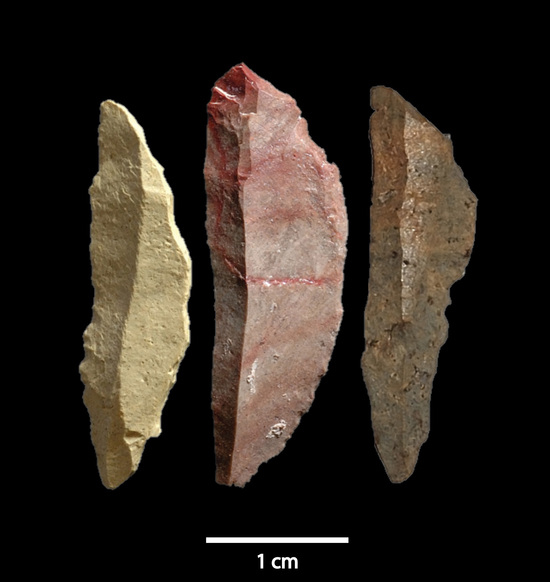
possible early arrow heads

The bow is at least 10,000 years old - some evidence suggests over 70,000 - and through all that time has served as both hunting tool and weapon of war. Early arrow heads are found quite often, but bows are less long lived, and the earliest European bow discovered so far dates from around 6000BC. The technological challenge in all that time has been how to gain more power. More power equals more range, or more destructive effect at the same range. But the basic design has remained the same.

Now, bowmakers have achieved more power either by careful choice of wood, skilled use of the grain, physical size, or careful splicing of the wood with other materials such as horn to give a composite bow. All of the above have to be combined with training, so that the user develops the physical strength and steady aim to make effective use of the weapon. Back in Medieval times, such training was compulsory, and the many streets called The Butts up and down the country recall that training.

In the Late Bronze Age, a typical composite bow might have a range of over 300 metres, with effective range against protected troops of about half that. Many cultures, from Egypt across to North India, used lightly built chariots as missile platforms, manoeuvring rapidly ahead of enemy formations to disorganise and weaken them. Other groups, chiefly those living on the steppe or the plains, used mounted archers for a similar purpose. Oddly, the Romans seemed not to rate bows highly, preferring to recruit auxiliaries for this purpose, but every other ancient culture I know of regarded them highly - numerous deities were closely linked to archery, so the skill had divine sanction.

Wikipedia image, English longbow 6'6" in length
Back at Agincourt and other battles of the age, a longbow in the hands of a skilled man had a maximum range of up to 400m, and was reputed to penetrate armour at half that. Moreover, the firing rate was immense - it is said that at Crecy, 6000 archers launched 42,000 arrows per minute. Against a slow moving or closely packed group of enemies, the effect was murderous. Keeping up such a rapid rate of fire was exhausting, however, and should be likened to a sprint rather than a distance run.

The interesting parallel to the Late Bronze Age is that in both cases, changes in military technology are linked to social transformation. In both cases, the dominance of a settled elite group - the mounted knight or the charioteer - was broken by the innovative use of simple weapons. Noble birth and heritage was no guarantee of survival, and a process of social levelling took place.

So what led to the decline of the bow? Quite simply, the gun. Early guns were certainly inaccurate and risky to use, but they had a longer range than a bow, needed no particular strength to use as weapon, and could be put in the hands of comparatively unskilled soldiers. By around 1600, bows had essentially disappeared from the battlefield except for isolated unusual cases. 

They emerged again, and have survived until now, as a sporting piece. Regency and early Victorian writings tell us that archery was considered an entirely suitable sport for a woman, and archery clubs had members of both sexes. A far cry from the battlefields of the Hundred Years' War perhaps, but probably a whole lot more fun as well!

From Agincourt600 web site
Richard Abbott lives in London, England. He writes about the ancient Middle East - Egypt, Canaan and Israel - and when not writing words or computer code, he enjoys spending time with family, walking, and wildlife, ideally combining all three pursuits in the English Lake District. He is the author of In a Milk and Honeyed Land, Scenes From a Life and The Flame Before Us. He can be found at his website or blog, on Google+, Goodreads, Facebook and Twitter.