Monday, 20 April 2015

Stuart Interviews Book of the Month Award winner author Alison J. Butler

Interview: Stuart Laing and Alison J. Butler
The Hanging of Margaret Dickson
April 2015 Book of the Month Award

It is my very great pleasure to welcome Alison J. Butler to The Review. First of all, allow me to congratulate you on The Hanging of Margaret Dickson; it is a great book and fully deserving of being selected as The Review's Book of the Month for April. For those who don't know, you have had an interesting journey to become an author--tell me a little bit more about yourself...

Alison in her modelling days
Hi, Stuart, thanks for the congrats, I really appreciate your kind words. My journey becoming an author? It certainly didn't happen overnight, that's for sure. From a small child I read voraciously. My mum introduced me to Daphne DuMaurier at a very young age, so in short, I've always loved literature. Reading is just as important to me as writing. 

But back to becoming an author...writing did not occur to me for many years; I was born into a musical family, and for many years I worked as a professional singer. This career choice did not bring me any sense of pride or self worth, however, so while working as a singer (and rearing my four children) I returned to college. First I took A levels, then I studied for a degree in social sciences, and then while researching the history of crime and punishment, I stumbled across a small excerpt about a woman who survived a hanging. This true tale inspired me to write my first novel...but first I had to learn the craft of writing, which I'm still learning today! 
  
And of course, Margaret Dickson herself is an equally interesting woman. How would you describe her? 
  
Maggie was a true survivor - literally (she survived a hanging). She had grit and true spirit. Her job as a fishwife afforded her much freedom as her husband was constantly at sea...basically, Maggie could do as she pleased. During the 18th century in Scotland there was strict Kirk control, but fishwives and street hawkers such as Maggie tended to get away with such scandalous behaviour, as their job required them to be loud, bawdy, anything to sell their wares! 

However, there are some things even the fishwives and street hawkers could not get away with, and so when Maggie's promiscuous behaviour led her to the path of ruin, her fate was sealed. Maggie was human, flawed, a woman who loved and embraced her wild and reckless impulses, and could not be reformed - even after she was hanged.  I admire her for that. It's also worth mentioning that if Maggie had not been a peasant and a lady of quality, she would never have been hanged. Her true tale is a prime example of the 18th century's practice of 'punishing the poor.' 
  
Of course Maggie is just one great character in the book; did you have any other favourites from the rich and varied cast you presented to the reader? And was there any one thing about Maggie's story that grabbed you and made you want to tell her tale? 

The fishwives of Musselburgh
Most of the characters in my novel are indeed real people relevant to Maggie's story. Patrick Spence, Maggie's husband...the surgeon Munro, Bonaloy - the assistant minister, are all well documented in 18th century records. Also, in the course of my research, I discovered that William Bell, Maggie's lover, was in fact much younger than Maggie - and her 'toy boy'.  One of my favourite characters in the novel is in fact one of my only fictional characters, Widow Arrock - the reason I like her is because she's grumpy and a bit of a battle axe.

In terms of what grabbed me regarding Maggie's tale, and compelled to write her story was the sheer incredulity of it. Not only did Maggie survive her hanging; her husband, despite her many infidelities, forgave her. I thought that was amazing.

Also, in the course of my research, I discovered that Maggie gave birth to a son - James Spence, 10 months after her hanging

The Hanging of Margaret Dickson is a book rich in detail of Scotland in the early 18th century; how much time did you spend researching the history and the people? I know you were permitted to hold the final verdict of the jury during her trial which was still sealed. How tempted were you to open it and take a look?
  
In short, I spent many many years researching Scottish history before putting pen to paper. I also studied 18th century social history, crime and punishment and maritime history. I have a keen interest in the lives of peasant folk and don't care much for the aristocracy and ruling classes of bygone times. In truth, I would never invest so many years to researching a novel again, but it hasn't been time wasted. The judicial court records at the National Archives of Scotland? I was NOT tempted to open the sealed verdict envelope with wax seal intact; I was astonished that the staff asked me if I wanted to. It had remained like that for 300 years. How could I? We all know she was hanged anyway! 

Getting back to the writing itself if I may, tell me a little about how you write. Is there a particular time of the day that you prefer, or is it simply a case of just writing whenever the mood takes you? I know several authors who can just sit down and rattle off several thousand words at the drop of a hat but personally I need to give myself a long run-up to a writing session. How hard, or easy, do you find the writing process?

Writing in general...I wish I had some sort of structure, but I don't. I write in fits and bursts, anything from 500 to 10,000 words. I edit previous chapters constantly, probably too much...but luckily I never suffer from writer's block. With lots of kids in a house, I recently bought sound cancelling headphones, as I prefer to write in silence - they were a good investment!

One unusual result of your book is that you have been immortalised on a huge mural depicting the execution of Maggie Dickson. I saw the mural while it was still a work in progress last August on the Grassmarket in Edinburgh. Do you know if it will be back on public display in the future? Was posing for the painting like travelling back in time to your modelling days again?

The mural on display in the Grassmarket: Alison can be on the left as Maggie by the gallows. 

Posing for the Grassmarket mural was a huge honour and not at all reminiscent of my modelling days. (Hair modelling was very boring.) Meeting the artist, Chris Rutterford, who is a lovely man, was so exciting, as was chatting with passersby who wanted to know more about Maggie's incredible tale. The 32-foot mural was split up after completion, and sections of it are in shops on the Westbow and CandleMaker Row to be viewed by anyone. I suppose the real buzz for me is that Maggie 
Work in progress taken by myself last August
(Photo courtesy Stuart Laing)

Dickson was once again resurrected in the Grassmarket, and I had become a part of that...Maggie is very dear to me. And for obvious reasons, so is the Grassmarket and Musselburgh.


What would you say is the best thing about being an author? And of course, the flip side of that particular coin...the worst thing about it! Is there any advice you wish you had been given before you started writing? And is there anything you would advise to a new writer yourself after your own experiences?


The best thing about being an author, for me, is the ability to create something from nothing...plots, characters, twists, conversations, fantasies ...the list is endless. Also, it's such a wonderful thing to know that my novel or stories give readers (hopefully) pleasure. My novels , if I'm fortunate, will live on after I have passed; this gives me such a sense of pride, something I never had while singing - even when being praised. In truth, I still don't think myself worthy of the label 'author' - it's almost as though I haven't earned that honour yet.

Downsides to writing ... of course writing is solitary, and can take you away from family. I do find myself withdrawing from people, and wishing that I could become a hermit (mainly so I'd get more done.) Also, jealous reviewers, Internet trolls, they can be a real pain. My view on reviews is if you want to leave a review and be critical, don't be nasty; constructive criticism is fine, as are negative reviews - of course we cannot be expected to be liked by everyone. I've learned to ignore nasty reviews that only serve to hurt and humiliate. One more downside is in my case, having too many story ideas buzzing in my head, I would do well to concentrate on one project at a time.

Finally, and this is what I personally really want to know: what is next from Alison Butler? Thank you so much for taking the time to talk with me today.

What's next? I'm aiming to release books two and three this year, and my debut novel has been optioned for a TV series or film. So hopefully The Hanging of Margaret Dickson will be on the big screen soon, fingers crossed.

Advice to new writers... write about what you are passionate about, because it will show in your writing. Also, never give up  no matter what folk say - if you truly want to become a writer, nothing will prevent you ...develop a thick skin and learn to take criticism. Be meticulous with research and READ, READ, READ, aspire to be as good as your literary influences. I wish you the best of luck. Alison Butler XXX 

Many thanks to you for taking the time to chat with us today. I am sure that more people will be keen to learn all about Maggie's amazing story. And I look forward to reading more from you in the future.

*********

Be sure to see Stuart's review of The Hanging of Margaret Dickson located here, and comment there for your chance to win a free copy!


Friday, 17 April 2015

Stuart Reviews: April Book of the Month: The Hanging of Margaret Dickson

The Hanging of Margaret Dickson
by Alison J. Butler
Reviewed by Stuart S. Laing


I approached this story thinking I knew the rough background to the legend of Half Hangit Maggie, the poor woman who died on the gallows of Edinburgh's Grassmarket only to be found alive in her coffin a few hours later. Alison Butler has done a simply wonderful job of adding flesh, blood and bones to that famous story. Her writing breathes life into a fantastic array of characters who bring real colour and drama to the book, and it is easy to lose yourself in the rich reek of the harbour at Musselburgh as fishwives clean their catch amid the jumble of creels and nets, or the heady stink of Edinburgh where thousands live cheek by jowl in a city with little or no sanitation.

Narrow Wynd in Old Edinburgh
The woman with the basket on her back
is a fishwife as Maggie was.
I found myself being drawn deeper and deeper into the story by the skilful use of fact and fiction to create a satisfying whole. Butler's research and deep love of the story shines through and adds real depth to the book along with a plethora of details, which just adds to the overall picture. Wonder no more why women go out on hen nights before their weddings! Or why sailors don't wish to be between the Devil and the deep blue sea!

From Maggie's childhood, the loss of her mother, her wild, rebellious teenage years and her marriage, at the age of only 17, which brings more disappointment than pleasure for the headstrong Maggie, we follow her life through its ups and downs. It is her undoubted desire to enjoy the finer things in life which leads her into flirtations with prostitution but through it all she always finds herself going back to her husband. It is to Butler's credit that she still manages to have you rooting for Maggie despite her wilful and wild ways. It would be so easy to view her as a deeply unsympathetic character who thinks only of herself without consideration for her husband or children. And there are times as you read the book that you find yourself shaking your head at her behaviour wishing she could just be satisfied with her lot, but that is not Maggie's way. Yet through it all Alison Butler paints her protagonist so well that you still fall for her charms and faults that could so easily have made her a deeply unlikeable character.

When her husband is press-ganged into the Royal Navy, it is Maggie's turn to believe she has been abandoned. Her journey southward with the intention of looking for him in Newcastle will prove to be her undoing. The events which follow will give birth to both a sickly infant destined to a short life and the start of Maggie Dickson's place in Edinburgh's folklore and history.

Edinburgh Tolbooth by St Giles on the Royal Mile. It was here Maggie awaited execution.

Even though the book is moving towards the inevitable date with the gallows of the Grassmarket you find yourself hoping that somehow Maggie will mend her ways. Unfortunately, history cannot be changed and the descriptions of the Tolbooths in Kelso and Edinburgh will leave you scratching yourself at the image of bodies crawling with filth and lice and chained in unlit, stinking cells.

Eighteenth-century Scotland lives and breathes through the pages of this book. From the stink of the midden to the tantalising aroma of French perfume this a book which fills your senses, and like a rich broth leaves you satisfied.

Bravo to Alison Butler for a job well done.

*********

About the Author:

Alison Butler was born in Liverpool, England in the 1970s. She's worked as a checkout girl, bar-maid, model and singer. Alison is married to Dave Butler and has four children - Whitney, Belinda, Isabella and Oliver.

Alison worked for over ten years in the entertainment industry, working as a professional singer. Following the birth of her fourth child she gave up singing to study for a social sciences degree.

While researching for her dissertation, Alison stumbled across a small excerpt in a history of crime and punishment book. It briefly described the true story of a woman named Margaret Dickson who survived a public execution. This incredible story inspired Alison to write her debut novel, using 18th century judicial court court records, broadsheets and marriage/birth certificates.

She can be followed on Twitter here.

*********

Alison J. Butler has very kindly agreed to gift a kindle copy of   The Hanging of Margaret Dickson to one lucky winner. To be entered into the draw just leave a comment below OR at this review's Facebook thread, located here.

The Hanging of Margaret Dickson may also be purchased at Amazon  and Amazon UK

*********

Stuart S. Laing is the author of The Robert Young of Newbiggin MysteriesHe can be found on Facebook and Twitter.


Wednesday, 15 April 2015

Stuart Reveals His Choice for Book of the Month

Stuart Reveals: The Review's April 2015 Book of the Month goes to...


When I was first asked to select just one book by an indie author to be awarded with The Review's Book of the Month medal I knew at once which one I wanted to select. But before I reveal what that book is I think I should put down on record some of the things that I look for in a book, things that set it apart from so many other excellent books I have read and enjoyed over the past twelve months. For me it has to be a subject that I can lose myself in. I enjoy science-fiction, I love trashy zombie apocalypse stories, and a good comedy can keep me giggling for hours. My first love remains historical fiction though, particularly Scottish HF for the simple reason that I know more about that than I do about Anglo-Saxon or medieval England, although that is not to say that I don't thoroughly enjoy stories set in those periods as well. I do. But my first love will always take me back to Scotland and the rich tapestry of her history. From the ancient Picts resisting the advance of Rome's rapacious legions, to the unification of the various old Pictish kingdoms into one under Malcolm Mac Alpin to form in 843 the nation we now know

Growing up in the 1970s I became fascinated by the struggles of the Wars of Independence, of William Wallace (the true story and not the Hollywood hokum), of Robert Bruce and Bannockburn. The Declaration of Arbroath and on to tragic Mary Stuart and her death at the hands of the beastly English queen!

John Knox and the Scottish Reformation, the National Covenant and the blood soaked Killing Times when Scots fought and slaughtered their traditional enemy, other Scots! Learning about the English Civil War, as it was still called way back then, only became interesting when I discovered that my own hometown on the coast of Fife had been occupied by the tyrant Cromwell for ten long years. The Restoration of the Monarchy and the Glorious Revolution were mere background to the things that truly fascinated me, the massacre of Glencoe and the Jacobite Rebellions of the 18th century.

Discovering the stories of Robert Louis Stevenson sealed the deal for me. Kidnapped was the first book I truly fell in love with. Here, finally, was a book set in places I knew. Edinburgh, Queensferry and the Highlands leapt from the page and straight into my heart. After that I knew that I had found home. It is a love that continues to this day and I love anything set in that period. Which brings me nicely to naming the book I have selected for the Book of the Month Award. That book is...

The Hanging of Margaret Dickson by Alison J. Butler


The reasons I chose this particular book over so many others which could have been  selected are quite simple. First of all, and most importantly, it is a great story! The characters are believable, the dialogue zips along with a convincing tone, no small feat when you consider that Alison Butler is not Scottish but she gives an authentic voice to her cast that fits them beautifully.

Being set in my beloved Edinburgh and East Lothian also helped, although it takes more than setting to make a good story. A tourist guide to the Old Town is set in Edinburgh after all but wouldn't make many Top Ten lists of Books You Must Read Before Death! No, what makes the difference is the story, and this is a story that blends fact and fiction so seamlessly that you cannot tell where one begins and the other ends.

Stay tuned for my review of The Hanging of Margaret Dickson later this week.


Stuart S. Laing is the author of the Robert Young of Newbiggin Mysteries set in 1740s Edinburgh.


Monday, 13 April 2015

Rob Reviews: Brennus: Terror Gallicus

Brennus: Terror Gallicus by C.R. May
Review by Rob Bayliss


Please see below for information about a giveaway copy!


Over his head is shrieking a lean hag, quickly hopping.

Over the points of weapons and shields.

She is the grey haired Morrigan.


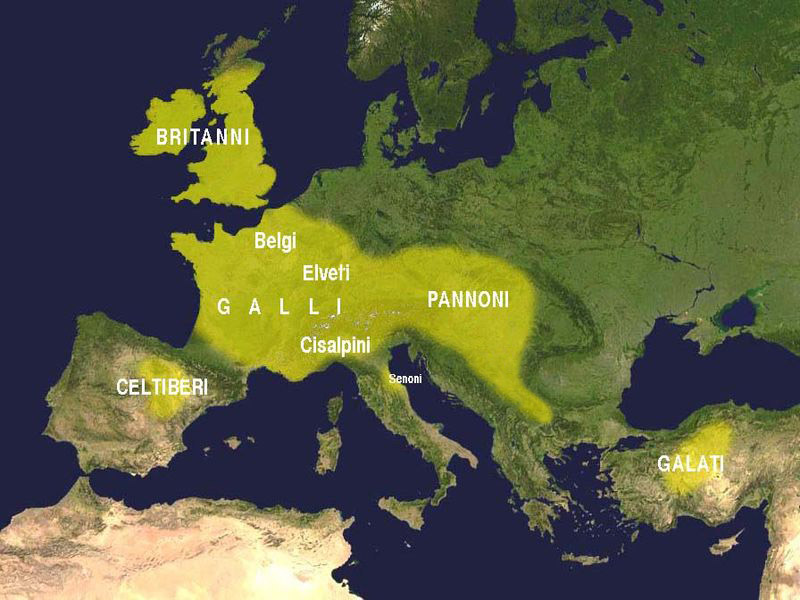
In this brilliantly compelling book, Brennus: Terror Gallicus,  C.R. May takes us back to a time when Rome is but one small city competing with others, both in Italy and around the Mediterranean Sea. But what of Barbaricum to the north?


We are taught from an early age of the glory of Rome; we find its echoes in the modern world all around us. The tactics of its generals are still taught to military students now, its politics studied by those who would aspire to be politicians. It was a literate empire, its generals and emperors obsessed with leaving a legacy to reach beyond the count of their mortal years. Thus we have  records and biographies that are still studied to this day. Scratch beneath our society’s modern, political, veneer and there is the Roman world with all its lusts for wealth and power, its machinations of bread and circuses and its politics of divide and rule.

It is looked upon as the epitome of order; since its fall many is the king or emperor who has tried to unite Europe as Rome once did. Empires come and go, yet Roman architecture and symbolism is more often than not chosen to proclaim their greatness, whether it be Pax Britannica, Pax Americana, Napoleonic laurel leaves or would-be Caesars called kaisers and tsars.

But what drove a city state on the edge of the Greek cultural world to become this template?

Before Rome rose to bestride Europe there was another power, a power that was technologically sophisticated, with an intricate network of trade routes, both within and without. It was an empire, yet not an empire. It was a federation of nations, yet each fiercely independent and sometimes openly bellicose towards each other. From Ireland to Turkey a single culture with similar languages held sway. The Greeks had traded with these people for many years, naming them the Keltoi and noting their love of war and wine.

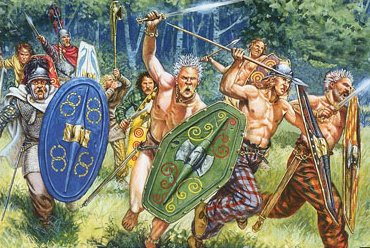
C.R. May takes us to this world, a world somewhat belittled and denied us by history’s victors, a Europe-wide culture that, unlike Rome, didn't write. It was from Celtica that the Romans copied mail armour, long inter-lockable shields and even the Gallic helmet which seems now so typically Roman. It was by the Celts that Rome received its first real taste of defeat that almost extinguished it. Perhaps this is why, of all peoples, it was the Celts that Rome seemed to wish to subdue and defeat more than all others.


It is the 4th century B.C. and this is the Celtica of legend, a society of heroes, warriors and druids. Where gods and goddesses are embodied in the earth and the sky, where kings willingly sacrifice themselves to be at one with the goddess of the earth and ensure her blessings upon the tribe. As is the custom children are sent to be fostered with other tribes to learn the ways of others; so it is that Solemis, a young warrior of the Gaulish Senone tribe, finds himself in the land of the Trinobante tribe in Albion. While he is there he swears blood brotherhood to Catumanda, a trainee female druid who has the questionable gift of prophetic dreams, and Albiomaros who becomes his most trusted friend.

Years have passed and Catumanda, troubled by dreams, has completed her training while Albiomarus has accompanied Solemis back to the lands of the Senones. These are turbulent times; to ensure that the lands are not stripped of their fertility by overpopulation, a tribe has been chosen to migrate out of Celtica and settle new lands beyond the Alps. Thus it is that Catubaros, chieftain of the Senones, willingly sacrifices himself to seek approval from Sequana, the goddess river Seine, for this enterprise as the tribe prepares to migrate en masse.


Engineering a coup and the mysterious disappearance of Catubaros' son,  the great Senone warrior Brennus is elected as chieftain. Brennus has a vision to carve his people a land, and unlike the deposed son of Catubaros has the military prowess to succeed as they will invade the territory of the Etruscan city states of northern Italy.


But other forces are at work here, families eager for the betterment of their house and city playing faction against faction. To these factions the Gauls are just ignorant barbarians, but they underestimate Brennus and his clan chiefs such as Solemis at their peril. 

Mr. May's attention to detail in descriptions of landscapes, down to seasonal plants, transports the reader into the world he weaves. In some quite beautiful passages you can smell the heady scents, hear the buzzing of insects and be dazzled by the reflected sunlight on the fen waters. The dialogue is realistic, effortlessly weaving in Celtic words and quite cynical at times, as in the passage when Connos teaches his son, Solemis, a lesson in politics.

"I arrived too late to hear the beginning of the fun. Tell me; who proposed that Brennus should become war leader, just until Maros returns?"

Solemis cast his mind back.

"Crixos."

Connos snorted and stared straight ahead. His warriors were just leading the families of the clan safely out on to the plain. Albiomaros saw Solemis and Connos and waved happily from the flank. Solemis was about to return the gesture when his father asked another question.

"And who was closest to Brennus when he went to have his acclamation approved by Devorix?"
Solemis' cheeks flushed as he realised he had been as easily manipulated as the others. He sighed but answered truthfully.

"Crixos."
At his side Connos hawked and spat.

"As I said. Men are sheep."

I thoroughly enjoyed this book; the author paints such a vivid picture of Celtic society and their beliefs that I just got swept away in it. It mainly alternates between two story lines: the battles and migration of the Senones with Solemis and Albiomarus, and also the journey undertaken by Catumunda across Albion--both spiritual and physical. The description of her journey across a familiar yet ancient landscape was enthralling and equally as exciting as Solemis’ story-line, and his growing reputation as a warrior and clan chief. The author was able to describe the fantastical magic of druidic practices, its visions and portents, and yet make them appear wholly believable.

All men, but perhaps warriors in particular knew to fear the appearance of the Morrigan. Accompanied by her sisters Madness and Violence, the shape shifting goddesses often took the form of three huge crows, soaring over the battlefield as they waited to convey the souls of the dead to the Underworld.


The dreams lead Catumunda on beyond the shores of Albion; they indicate she will see her blood brothers, Solemis and Albiomarus, again. Meanwhile, as trusted warriors of Brennus, they have a score to settle and Woe to the conquered.


*********

C.R. May has so graciously offered a FREE COPY of Brennus: Terror Gallicus for one lucky winner. To get your name in the draw, simply comment below OR at this review's Facebook thread, located here.

*********


About the Author
C.R. May was born in Bow, East London before his family moved to South Ockendon, Essex. After hearing that Ockendon translated as Wocca's Hill in Saxon, a lifelong passion in history was kindled, which has taken him from Berlin to the site of the battle of Little Big Horn (via Erik the Red's Icelandic hall!). The influx of Germanic adventurers was recorded in the place names around him and, inspired one day, he decided to weave his own stories into this history. You can read and discover more information at his blog and the author may be found at Facebook

*********

Rob Bayliss is a reviewer at The Review and is currently writing his own fantasy series. Information on his writing projects can be found at Flint & Steel, Fire & Shadow.

Sunday, 12 April 2015

PAULA READS: MARGUERITE

Marguerite (Book I in The Merencourt Saga) by Carol Edgerley
Review by Paula Lofting

This review is written in conjunction with our Facebook event for the official release of Carol Edgerley's books Marguerite and Claire. Please click here to read a review for Claire.

Please note that the giveaway is no longer valid for Marguerite.

How often do women take for granted our relative equality and freedom to live as an independent citizens without a man to sustain us? Today there are still some who demand more liberty from society-- not that I would begrudge them, as I too often believe that as emancipated as we are we still have a long way to go; however, if we dare to look back across the span of more than a hundred years, we would be hard pushed to find many women able to stand on their own two feet, totally dependent on themselves. Times have changed and attitudes to women in the West have also. We no longer are beholden to men for our food, comfort and emotional needs. Women today are unbound from the constraints that women of the fifties had to endure, for whom advice was given such as this website proclaims, on how to be the perfect housewife. And if you think that was rich, imagine what it was like to be a woman of the Edwardian era.

Marguerite is a recipient of the
B.R.A.G. Medallion
But for the memories that live on in these women's  daughters and granddaughters, we may know very little about the emotions of women, how they truly felt, how they viewed life as it was for them then, and how they might have longed to be free, throw away their corsets and ride a great steed with their long hair blowing freely in the wind. And thanks to author Carol Edgerley, we learn of one such woman who did this very thing - Edgerley's very own great grandmother - whose remarkable journey across two continents we follow in Marguerite, the book she wrote for her. It is worth knowing that Marguerite and its sister book Claire were written many years after their tales had been told to Edgerley by  kindly old Aunt Christina. She kept them in her head for generations before she was encouraged to write them down in the form of a fictionalised account of their lives. Nonetheless, Edgerley informs us that she has portrayed the stories of both women as accurately as possible, although there are some details conjectured and fleshed out with the use of her own imagination.

Marguerite's story begins at the very beginning of her existence. We first meet her as a newborn in her noble family's beautiful chateau in the Dordogne, the very day she is birthed into the world. Her mother, the Marquise de Merencourt, takes an immediate dislike to her baby daughter and sadly from then on it is all downhill for the little girl whom her mother, Francine, refers to as 'it'.
"Take it away! I said take it away!" screeched the woman on the bed, shrinking away from the infant lying beside her. "Oh I cannot bear it! How can something so ... so hideous be mine? Oh, someone just take the horrid thing away!"
The reason for this intense dislike of a tiny human being who cannot possibly have done any ill to the woman is a mystery, though there are hints throughout the book as to the reason why Francine favours her boys over her little daughter. Perhaps one of them is that Marguerite, whom her father refers to as Minette, becomes the apple of her father's eye. Unloved by her mother, but favoured by her doting father, whom she resembles in far more ways than she does her mother, Minette grows into a wonderful but headstrong young lady despite the absence of a caring, loving maman. Sadly too, her elder brother Jerome also becomes her mother's accomplice and torments her day and night, playing a huge part in pushing her away from her family.

The beautiful Dordogne
This story is written as a semi-biography of the author, Carol Edgerley's great grandmother, who cleverly puts together for us a wonderfully engaging story about a rich young girl's journey into a world of love, hardship and abuse. From noble beginnings, she chooses a path that sees her become disinherited and banished from French high society, all for the love of a charming Irish doctor, a love that conversely becomes an anathema for Minette. But things don't go smoothly for our headstrong heroine and we see her grow from the naive young 17-year-old into a mother of five children who meets tragedy and loss with great courage and fortitude. As I followed Marguerite's story, I was gripped as I swam through the tides of time with her, experiencing her emotions of love, despair and loathing, and of excitement and adventure as she embarks on a life that she believes will save her from a fate worse than death. All in all, I was enamoured by our tres chic blue-eyed heroine, with her black tresses and olive-skinned beauty. I was aghast when she cast her eyes against taking the path that might have led her to a better life and infuriated by her refusal to marry the man who adored her. Such is Edgerley's gift to us, that we are  imbued with her spirit, and we desire to shout across the pages at her and warn her of danger, such is the emotion it invokes in us.


A French family on a day out in 1880s


Thank Heaven for little girls


Minette, as she is mostly referred to throughout the book, was born in 1875. At this time in France it was the wonderful era known later as La Belle Epoque - the beautiful era. A gay time, full of sanguinity and hopefulness, when the arts flourished and certain creations of literature and music were upheld as magnificent masterpieces. It was also a time when science and technology came into its own and for those women living in the heady decadent quarters of Paris, were most likely to have experienced a world of liberality - a stark contrast to the kind of world that Minette was to be brought up in. For her world, though indeed she was able to enjoy such liberties of riding astride a horse with her hair flowing free in the wind, was one of restriction and containment. But the free spirit that she possessed within her soul was to be horribly and unfairly mistaken for unruliness, harlotry and selfishness.

How Minette should have ridden
Sadly unbeknownst to her awful mother, who could see no good in her daughter whatsoever, no matter how hard the girl tried to please her, Minette's innocence was in her so-called 'wildness'. Her ability to treat people with respect, whatever their station in life, was seen by those rich enough to view life through the splendour of money and titles, as vulgar, improper mixing with those below her station as we see those spiteful snobs belittling her and her children both in India and Ireland. Minette's ability to rise above such treatment and denigration takes force within her from her innocence which  has been tainted by the cruelty of the world as she passes through it, surging from one disastrous encounter to another, none of which her fault. It is just the world as it is. The world that she longs to be no part of. The following passage shows us just the sort of attitude that Marguerite was expected to put up with from the other officers' wives in India:

"Mrs O'Hara, most reluctantly I am taking it upon myself to warn you about  over -familiarity with servants," the lady began with all due pomposity. "You are seen laughing and conversing with your ayah, just as though you considered her your equal. I'm afraid it simply will not do, Mrs O'Hara! Especially in your condition..."

Minette, who was heavily pregnant at the time, is not deterred and she gives the woman a very large piece of her mind. This is just one example of the type of harassment and snide remarks Minette has to put up with, not just in India, but from her husband's Irish relations also.

Marguerite is not just a victim of such disgraceful attitudes; she suffers many tragedies throughout her young life before she reaches thirty. But her spirit never fails her, although time and time, she will doubt herself and long to turn back the clock to a safer time when she was young and without the confines of adult life. Though she learns very harshly that going back to her home in France is not an option, she knows she must do what she can to give her children a chance in life that will enable them to be secure, loved and wanted. After encountering one final life changing tragedy, and having been badly let down by her husband, the man she threw all caution to the wind for, she knows that she must summon that indomitable inner strength of hers to take charge of her destiny and make hard decisions that will have a great impact on her relationship with her children.


How Marguerite and her family may have looked when they visited Scotland

The narrative has many elements to the story and the author has written a beautiful tale that breathtakingly sweeps you to many different destinations: from the hot summers of the sumptous Dordogne chateau in France, where Minette grew up, hated by her mother, but secure in her doting father's protection and her love for horses, to the stark contrasting confines of a Dublin convent school, where she was made to sleep in a cold cell with the door open and no light. Then we are breezed across the sea again to the quintessential English village of Wimbledon where she is forced to hide from her brother and father as they pursue her to bring her home before she can marry her 'kidnapper', the Irish doctor, Patrick O'Hara. The couple race to Gretna Green in Scotland where they may marry under Scottish law without the permission of another and later Marguerite will return to Scotland to study nursing and midwifery. From Scotland the young couple return, married and free, or so they think, to Wimbledon, where they decide to go to India, as far away from the revenge of Marguerite's family as they possibly can. There they settle in Lucknow, among the heat, the flies and the mosquitoes.  It might not be a paradise, but Marguerite eventually comes to see it as home.

Minette loved her horses and even rode in
point to point races in India. This Gymkhana is from
Karachi but could well be like the one in
Darjeeling where Minette rode.

Marguerite is a story of a young girl who was born into a life with values that were way ahead of her time. It is a tale that has will touch your life as irrevocably as it has mine, and will absorb you into the world as it was throughout the late 19th century and early 1900s. It will astonish you, amaze you, and you will be left wondering just how much can the human spirit take and still continue on in hope.

You cannot fail to be moved by this book which is so well written with wonderful prose and a rich narrative that flows effortlessly throughout. 

Marguerite can be found on Amazon in the UK and Amazon.com
and Claire Amazon.com and Amazon.uk

About the Author


Born in India, educated in France and later in England, Carol has returned to live in France with her husband amid a multitude of much-loved animals. A wide circle of friends of varying nationalities provides plenty of spice to her life! 

Something of a connoisseur of the Far East, Carol ran a tutorial in Hong Kong teaching English and French to a great many children, some of whom remain in contact with her. Bilingual, she also retains a smattering of "kitchen" Hindi from years spent in Delhi and Calcutta. 

No longer riding these days due to her two beloved but ancient horses going to heaven, Carol is currently fully occupied writing Susanna, third in The Merencourt Saga series..

An avid reader herself, Carol's favourite authors are David Starkey, Margaret George, Alison Weir and Phillipa Gregory. She also loves cooking for friends in several "languages," and planning out her garden for the following year. (Weeding, however, is quite another story.)


Carol can be found at her website located here

If you would like to win a signed copy of Marguerite, please leave a comment on the blog post here or, if you prefer to use Facebook, comment on this review's thread located here.


Friday, 10 April 2015

Guest Post by Carol Edgerley: A Look at Childhood Then and Now

Today we have a Guest Post, by author Carol Edgerely

A COMPARISON BETWEEN THE CHILDHOOD OF THE
MERENCOURT WOMEN TO THAT OF 
THE CHILDREN OF TODAY...


Whilst writing the story of Marguerite, it crossed my mind to wonder just how fortunate are the children of the 21st century, relative to those of a bygone age. These days, a child's place within the family is celebrated by parents who strive to structure their time and resources around an offspring's needs and desires.

During the 19th century, a girl such as Marguerite spent a sheltered childhood almost entirely isolated from the outside world, and was expected to conform to a restricted lifestyle. Unlike this far-from-usual girl, who appalled her family by dressing like a boy to race about her father's estate on a horse. Nevertheless, she - as other girls of aristocratic status - was viewed as little more than a chattel to be disposed of at will or for the advancement of the family.

Claire, Marguerite's eldest daughter, fared little better. Extroverted and headstrong, she was frequently in trouble for flouting her mother's insistence that she adhere to the rigid social mores of the day. Every move the girl made was supervised, criticised, her attire inspected for suitability by a stern, eagle-eyed mother. Even her eventual husband was the choice of Marguerite de Merencourt, an alliance ultimately proving disastrous for the naïve young girl. It was to colour her view of the world in years to come.

During the early forties, Susanna knew an enviable early childhood. Allowed a freedom unknown to the children of yesteryear, she spent much of her time rock climbing on the beach with friends, falling out of trees, returning home at an appointed hour with grazed knees, filthy, happy and healthy. Lurking sexual predators were simply not part of the equation. She, as most other children of her time, were required to learn the lessons of life, to take responsibility for their own actions, accept occasional failure to succeed, respect their elders and behave in an acceptable manner.

No "canned" entertainment existed in those far-off days. The most sophisticated item for rainy days was a compendium of games containing cards to play Snap, a box of Tiddlywinks, and boards for Draughts or Snakes and Ladders. Story books and annuals were precious items, most children being able to read and write from an early age. Gymnastics, cross-country runs and sport in schools were mandatory if generally unpopular, therefore child obesity was an unfamiliar concept despite jam sandwiches at tea-time.

Are our children any freer, happier or healthier than Marguerite, Claire or Susanna? Now that childish pleasures of yesteryear have been obliterated by a plethora of violent digital games, iPads, mobile phones, and must-have toys relating to television productions? Discipline being regarded as a dirty word, what of school teachers hesitant to curb unacceptable behaviour for fear of legal retribution by outraged parents, or losing their jobs? Generations of children leaving school almost illiterate, some incorrectly labelled as "special needs"?

What of the daily bombardment against the evils of bacteria, skin cancer, cyber bullying, self harming, junk food and anorexia...whilst once-everyday sports and games are suppressed in the name of 'ealth 'n safety?

Despite the constraints of past generations, I sadly shake my head…


Wednesday, 8 April 2015

Lisl Reviews: Claire

Claire (Book II in The Merencourt Saga) by Carol Edgerley
Review by Lisl


Please note that the giveaway is no long valid


The 19th and early 20th centuries contain not a few accounts of resolute women, females who pushed back or laid claim to their slice of the world, many meeting success and motivating others to aspire to greater goals. Marguerite de Merencourt was one such woman, and although the legacy she passed to her children and grandchildren contained mixed blessings—for Marguerite’s obstinate streak, so admirable in her younger years, often worked against her favor as she grew older—she remains a draw for readers precisely because some of her efforts yielded less than absolute success.

The beautiful new cover for Claire
Marguerite’s eldest daughter Claire, introduced to readers in the final pages of her mother's story, possesses Minette’s striking beauty as well as indomitable spirit, and from an early age mesmerizes those around her, though not always for the better. Her father’s bullying nature softens to smiles, but upon a long-time-coming visit to her maternal grandparents’ home in France, the teen is viciously rejected by the same woman who pushed away her own infant—Marguerite as a baby. As Claire is coming into her own, she often clashes with her mother and the failure of both to choose their battles widens the already substantial chasm between them.

Claire opens to a scene of the girl celebrating—or trying to—her first grown-up birthday at the end of the new century’s debut decade. While the mores of the time have not drastically altered since her mother was 17, Claire recognizes the changes dawning in the world—cars and telephones make their appearances in the novel—as well as within herself, and like most teenaged girls, resents her mother’s strictures as much as she is mortified by her working status as a Calcutta business owner.

Unfortunately for Claire, she doesn’t seem to learn from her mother’s mistakes, nor does Minette—to the detriment of both. Eager to escape the house as well as the hanging cloud of a family secret, Claire enters into a marriage arranged by her mother, only to find that her once-charming fiancé has little feeling for her other than as sexual release in the absence of the married woman he had conducted an affair with during their engagement. Betrayed by her partner in life and humiliated in the public forum, Claire directs her energies and considerable organizational skills on lavish entertaining and a posh lifestyle.

Picknicking at Diamond Harbour near Calcutta
Photo courtesy Carol Edgerley
Before readers get very far into the story, Minette and Claire have already bickered over so many and such petty grievances, one wonders if they spend copious amounts of time nursing exhaustion, for indeed it takes a great deal of energy to be angry. Edgerley’s dialogue, however, always fresh and sharp, combines with the narrative and clearly shows characters’ perspectives as well as the larger picture. Family members frequently engage in heated rows and these strong and well-spoken women are rarely short of intelligently articulated deliveries.  


At the racecourse, near Calcutta
Photo courtesy Carol Edgerley
Having said that, there is indeed more to 
the characters than smartly-chosen words delivered for maximum effect. Readers are permitted to witness the ambitious Claire as she at times struggles to maintain her footing or determine the next step. Troublemaker Sonia is not always able clearly to see her sister’s secrets in order to exploit them, and Christina, with a tendency towards submission and desire just to keep the peace, develops a strength enabling her to speak out against Claire’s less desirable behaviors and actions.


Though Minette has kept most details of her unhappy childhood from her children, some eventually learn the most significant details, such as when Claire’s grandmother verbally assaults her—for being Minette’s daughter, of course, but also because she is so startlingly like her. “That unnatural mother,” as Minette considers the Marquise, nevertheless has exerted some sort of influence as we later see Claire repeat some of her grandmother’s acts and treat her own children with a contempt shocking to modern readers.

Claire’s life does, however, have its happy moments, and Edgerley’s descriptive prowess of them and other scenes is as powerfully true to reality as it is scrumptiously absorbing. Scenes of both ordinary and grand wrap around readers as if they are part of them, and as they move though seamless transitions, investment in those they read about deepens. Appreciation for Claire and others develops despite—or perhaps because of—her flaws and obstinate inability to move past some of them.


“The young woman had never looked more beautiful, her dark hair drawn up into a loose knot encircled by strands of jasmine. In her hands, she held a bouquet of the same delicate white blooms encircled by green foliage. The elegant bodice of her soft taffeta gown was scattered with seed pearls that proceeded in swathes over the flowing skirts. Only her hands were seen to tremble…wedding nerves, it was said.”


Claire, aged about 48 in France
Photo courtesy Carol Edgerley
When still becoming acquainted with Claire and how she endures living in a pressurized society under the seal of a loveless marriage, this reviewer had at first mused she might be a character readers “love to hate.” It soon becomes clear that such stylization shortchanges Claire, her story and readers themselves. Multi-faceted, Claire’s dreams, disappointments, loves, losses, sins and attempts at atonement could be any of ours, and reflect the reality she once lived.


How Claire goes on to make a satisfying life for herself and her family is nothing short of astounding; with her perseverance in the face of unforgiving setbacks as well as unmitigated joy, she carries on amidst global as well as local changes, community and personal. Like India herself as midnight, the new day of an opening era, approaches, Claire must acknowledge the past as she aims to settle into her future, one that will certainly contain agonizing choices alongside the promise beckoned by the birth of a new era. Having grown attached to her, both despite and because of her lapses, readers will long with and for her, and wish for more.


*********
Carol Edgerley has so graciously donated a FREE COPY of Claire for one lucky reader! For your chance to win, simply comment below OR at this review's Facebook thread, located here.

For Paula's review and to comment on Marguerite (and also get your name in the hat for a FREE COPY of that one!), please follow this link

*********

Author Carol Edgerley can be found at her website and Twitter, and you can check out Louise's fabulous interview from earlier this week as well! Claire may also be purchased at Amazon and Amazon UK


*********


Note: This review originally appeared at The Review in January 2014. It has been altered for the reading of the new edition and to reflect the lovely updated cover. 

Update: A link to Paula's review for Marguerite has been added.