Thursday, 21 November 2013

A Bargain Struck by Liz Harris


Liz Harris is one of Choc Lit's very talented authors. She has been a lawyer, a teacher and long ago , shush, she was once a Hollywood babe, briefly a film starlet, yes, absolutely true. Nowadays, Liz is a very successful writer dedicated to finding and writing unusual and engaging novels that have universal appeal.

Liz is offering a freebie of A Bargain Struck to the lucky winner who comments here or on the wonderful article about Wyoming in 1880. Look tomorrow.

A Bargain Struck is Liz's second published 'full' print novel. There are others! Look on Amazon. Her first novel, The Road Back, takes place in Ladakh and brims with interesting characters, adventure and romance. However, the second is an absolute page turner, a sort of Little House on the Prairie for adults; more sophisticated than Little House, of course, and with interesting twists and turns.


I love the romance of the West. I collect the books, lived there once, taught it, and so it was refreshing to read a superbly researched novel set in Wyoming in 1880. The protagonists of this story are Ellen and Connor. Connor seeks a wife. He has a mixed farm, way out in the hills, somewhat isolated. Importantly, his daughter Bridget desperately needs a mother though she is resistant to Connor's choice of a bride! So, Connor advertises in the 'lonely hearts' method that was employed throughout the American West of 1880 and places his request in newspapers back east! He seeks a mail order bride. Of course, Connor would also like a son and, of course, he needs a woman to be company for himself and his daughter and importantly to create a home out of the lonely homestead. However, when he first meets Ellen as she steps off the train from the east, he finds out that she has a secret.

At first, Connor finds himself simply honouring a bargain. Over the progress of the novel this is set to change though I must not provide spoilers. It is sufficient to say here that the two central characters are psychologically extremely well drawn and this depth of character leads in turn to conflict and tension in the narrative. The personalities are of their times rather than a twenty-first century imprint placed in a past era. The petulant young daughter, Bridget, for instance, is beautifully constructed and she, especially, is set to grow and develop throughout the pages of the story. She makes life hard for her stepmother.  Life was tough enough already, yet, determined to win Bridget's trust, Ellen rises to this emotional and difficult challenge. Enter the villains and life now becomes almost impossible for Ellen, proving that Liz Harris is a master of narrative tension. Will Connor and Ellen find love? Will Bridget accept Ellen? Can these characters survive the cruellest of plots? Read A Bargain Struck and find out.


I loved the sense of place in this novel and enjoyed reading the historical detail. The West is well described with its mountains, scrubby pastures, small towns, sunsets, sewing bees and an array of authentic facts so well integrated into the text that I was utterly transported into that world. Harris visited Wyoming as part of her research and will talk about this tomorrow.

In the context of this novel the characters struggle, work out their conflicts and meet with adversary. Depiction of day to day life on the homestead is certainly pitch perfect. Although the novel's plot is linear it is well constructed and, although the conclusion provides yet another surprise, I found it an interesting ending to an exceptionally good read. If you like books set in this era, Liz Harris is writing a novella which should please those who enjoy the period. It will be available on Amazon early in 2014 if not sooner.

A Bargain Struck can be purchased from all bookshops and is available from Amazon USA and UK. Do comment and enter the draw. I shall choose a winner on 1st December.

Carol McGrath is the author of The Handfasted Wife, #1 best seller in Biographical Fiction on Amazon, published by Accent Press, 2013.    

Monday, 18 November 2013

Lisl's Bits and Bobs: Review of The Prodigal Son and author interview

The Prodigal Son by Anna Belfrage with author interview: Learn some fun details about the characters
(See giveaway details at bottom!)


Set in 17th century Scotland during a time of religious persecution, Anna Belfrage's The Prodigal Son opens to the departure of Matthew Graham, Alexander Peden and two others from an illegal conventicle, followed by a half a dozen soldiers seeking to arrest them. Matthew reflects on his wife Alex, a time traveller from the 21st century, and her opposition to his covert activities and the consequences they may bring upon their entire family.

Third in The Graham Saga series, the novel lays out events in the family’s past as these trials continue to haunt each member in different ways. Belfrage accomplishes this by sprinkling information throughout the story, like a flavor that satisfies as its strength increases. This provides fulfillment for the questions arising, particularly for readers unfamiliar with the first two of the series' books, whilst ensuring a taste for more.

Though Matthew narrowly escapes the opening episode, the soldiers embark on a campaign of harassment, accosting him and searching his homestead periodically, their goal being to intimidate as much as to turn up Minister Alexander "Sandy" Peden.  Complicating circumstances include the hatred of Graham's own brother, Luke, previously responsible for having Matthew deported to the colonies and sold to indentured servitude. Between Luke and a returned Matthew is Ian, the child born to Matthew's first marriage with Margaret (now wed to Luke), and whose paternity is debated throughout the book, though Matthew had been tricked into relinquishing all rights to the boy.

Alex, a modern woman who by necessity has adapted to life in her new time and place, slowly warms to Ian, though she fears the cost to her own eldest son. She perceives Peden to be a fanatic and scorns his belief that women are spiritually inferior. Though she admires his strength, her views of his rigidity in matters of faith clash with Matthew's protective actions—acts that guard Peden from the authorities, but leave the Grahams wide open to total destruction.

Belfrage serves up details of this threatening aspect, too, over time, in courses that reveal frightening, hinted-at possibilities and then, finally, a shocking reality readers may have a difficult time digesting.  While most are aware of religious persecution in history as well as our own era, human psychology provides a protection against such knowledge with scant, sometimes forgotten details or by placing distance between the parties.

Here the author provides no such immunity: we have grown attached to the Grahams and their children, having seen the various sides of each and been given a glimpse of their cares in the world. When tragedy strikes—for the Grahams as well as another family—its proximity sears our hearts and the reality of what people have had to endure sinks in with a terrible understanding.

Belfrage makes room, however, for humorous relief, unappreciated by the commanding officer taking part in questioning Matthew, but recognized by modern readers for the inquiry's circumstantial nature:

One of the younger soldiers took a step forward. "He's tall and the man we saw was tall—that we know for sure."
"Ah," Simon [Matthew's attorney and brother-in-law] nodded. "And did he have dark hair?"
"I don’t know," the young man said.
"No? Why not?"
"He was wearing a cloak."
Simon rolled his eyes, smoothed at his coat. "Not much to go on," he said to the officer, who shifted in his seat.
"Tall, a competent swordsman—and we know Mr. Graham has a past as a soldier—who else could it be?" the officer said.
"You?" Simon said.

The author creates believable characters who are simultaneously honest and flawed, whose imperfections, occasional obstinateness and recognition—if reluctant—for a balanced concern of the difficulties they face all bring readers to a riveted attention of where each are headed and we develop concern for their futures: we care what happens to them, and ache when all does not go well.

Matthew, for example, continually breaks his promises to Alex by time and again riding back to Peden, passionately maintaining his inability to forego his spiritual obligations. He roundly condemns the forces of Charles II for their brutality, though one exchange brings concession by default: "'[F]or years it was people like my family that were persecuted by people from your church.' That shut Matthew up."

Neither is Alex spared the confrontation of brutal truths. Though through the novel she uses her "past" history lessons to remind her of events or circumstances in the time she now inhabits, it sometimes takes drastic measures for her to understand her husband's position in more than just theory. After a brutal beating at the hands of an interrogating lieutenant, she concedes: "I sometimes forget that this is a time where the little people have no voice, where the representatives of the crown can do as they please and there's no venue of recourse."

As implied in the title, however, there is room for redemption, and as we witness naked fear, cruelty and tragedy, so too do we see tenderness for the precious in life, hear the stolen laughter and feel the power of two whose bonds of love will dare to fight to remain united in the face of all attempts to ruin them. Matthew and Alex's love for one another is acted out in some explicit romantic scenes—perhaps more than many other works of historical fiction—as but one part of what makes them whole. That wholeness also confronts the truth within the extravagance of their divisions and possibilities of homecoming in more ways than one.


Where this will take the family remains to be seen in Belfrage's newest novel in The Graham Saga, and though one could continue on to read the fourth without having experienced the first two, this reviewer predicts many will want to return to the beginning. This is not because The Prodigal Son does not work as a stand-alone novel; as stated above, Belfrage does a spectacular job of seamlessly filling in the blanks of two complete previous works. However, a feast is a difficult thing to pass up: Alex, a strong, modern woman on a 17th century learning curve, her equally resilient husband, their friends and family—readers simply will want to know more and experience the events in their lives along with them from beginning to end.

Interview with Anna Belfrage


Hello, Anna, and thanks so much for joining us today and taking the time to answer some of our questions.  

And hi to you too, Lisl. I’m thrilled to be here!
 
The tea is steeped and cake at the ready! I've recently read
The Prodigal Son and was utterly intrigued by the
questions--and some problematic possibilities--raised in
my mind pertaining to Alex's journey back in time.

The Prodigal Son, third in a series, features time travelling Alexandra Lind and her 17th century Scottish husband, Matthew Graham, living in the latter’s time and homeland.  How did you first decide to bring these two characters together from different eras? Or did they come to a life on their own?

It all began with Alex. She sort of kept popping up in my head – sometimes at the most inopportune times – and demanding my attention. Obviously, having a modern woman speak to me of the hardships in the 17th century grabbed my attention, and soon most of my nights were populated by dreams featuring Alex. With Alex came Matthew, at first no more than an outline. (Alex is the jealous type, and she isn’t too thrilled by how fond I am of Matthew. When she scowls at me, Matthew grins and winks, rather flattered by our attention.) On a more serious note, I did know I wanted to set a book in the 17th century, in Scotland and during a period of religious unrest. As I have a soft spot for men who have the integrity and courage to defend their beliefs, Matthew grew into a man of convictions, a man willing to risk a lot for his faith – and for his family, even if The Prodigal Son places him in the uncomfortable situation of risking his family for his faith.

Alex, being a modern liberated woman, faces challenges in the 17th century that she wouldn’t likely encounter in her “past” life.  How do you decide her balance? That is to say, how does she know when to assert her independent thought or to step back?

If you ask Matthew, she shows very little restraint when it comes to voicing her opinions. In general, I agree with him; Alex is an independent woman – but she is also an intelligent woman, and as she has no yearning to be tried as a witch, she keeps an adequately low profile with certain people. I believe all humans have the capacity to adapt very quickly to new social norms – it is a prerequisite for our success as a species – and Alex is no exception to this.

Do you see yourself in Alex at all? If yes, how so? Is she modeled after someone in particular?

I hope I would accept new circumstances as well as Alex does. And yes, she is forthright and brave, has a big heart and a capacity to laugh at herself and others – I would like to believe these are qualities we share. But no, Alex isn’t modelled on anyone but her own self; she was very much a person in her own right when she started visiting me.

Every so often in The Prodigal Son Alex seems to open up a bit for the reader, including once when she laments the loss of her reading time and material. What kind of books did Alex like to read?

Alex is a computer engineer. Ergo, it follows the poor woman had a fondness for reading stuff like Bringing IT Security to a New Level. She was twelve when she read The Lord of the Rings for the first time. Other than that, she read quite a bit of crime with favourite authors being Reginald Hill and Elisabeth George. She also read everything by Gabriel García Marquez and loved Don Quijote. Her father taught her to love poetry – mostly in Swedish.

As you wrote the novel, did you learn anything surprising abut Matthew and/or Alex, or their children?

I just love the Graham children, and especially Ian, who is so torn in two. I had no idea Ian was dyslectic until I wrote the book, neither did I know just how complex Matthew’s love for his land was. Hillview lives in his blood, sits in his heart. His little manor is a precious charge he must hand over to the next generation, and to fail in doing so would be unbearable to him.

 Do you have any interesting writing quirks?  Do you write every day?

I write something every day. Not necessarily part of a new novel, or so, but I will definitely set pen to paper (finger tips to keyboard) on a daily basis. Most of it ends up on my blog – or in the virtual trash can.

Not sure I have any quirks – hang on; I guess I do. When I’m writing the more action-packed scenes, and especially if Matthew is in danger, I just can’t write it in one go. I write a sentence, stand up, take a little turn, pour some tea, watch two minutes of The Mentalist or whatever my husband is watching, sit down, write another sentence, exhale, and do it all again. Very exhausting, let me tell you!

Who were/are your favorite authors growing up or as an adult?

Growing up I was a major Henry Treece fan. I read a lot of Rosemary Sutcliff as well, and Tolkien – always Tolkien. As an adult, I am a fan of Sharon K. Penman, Antonia Fraser, James Burke, Barbara Nadel, Michael Dibdin and Salman Rushdie – oh, and of Diana Gabaldon.

What topic have you never read about that you would like to?

Not sure what you mean; like things I want to know more about? If so, I’d really like to get to grips with Plato. And I wouldn’t mind knowing more about astronomy, or about geology. And I’d like to learn to read music scores. And to speak and read Russian.

Do you have any projects on deck currently?

Apart from the ongoing Graham Saga – and there are more books to go – I have a trilogy tucked away which tells the story of Jason and Helle, two people who met and loved but briefly three thousand years ago before he was cheated into betraying her and thereby caused her death. Since then, he hurtles after her in life after life, desperately wanting to make amends.

Other than this, I am working on a novel set in 17th century Sweden and England, starring a young girl who grows up at Queen Kristina’s court and who becomes rather attached to a set of jewels that don’t belong to her, and so….

But both these projects take second place to the Alex and Matthew story – I have a very emotional relationship with these, my favourite characters. Sometimes I think they’re around for real, but my husband keeps on informing me that isn’t the case.

Do you like to read e-books, or still prefer the sound and feel of paper?

I have become an e-book addict. Why? Because it’s so convenient, and as I travel a lot, all I need is my Kindle to carry the equivalent of Ancient Alexandria’s library with me. But there’s something to reading a “real” book – especially in the bath.

I’ve read of your fondness for chocolate and recently discovered your love of math. Which do you like better?

Chocolate! Given the approaching X-mas season, a chocolate Advent calendar is obviously the perfect combo….

Given the opportunity to journey back in time, would you take it? What if you didn’t get to select the era?  If you did, which would you choose?

I’d like to know for sure that I could go back. I may daydream a lot about life in other times, but I think the reality of it was pretty harsh. It was cold, it was dirty, the food could be dismal, and should you fall sick – or develop a toothache – well, God help you. (My preferred century, the 17th, was probably one of the dirtier, as in most European countries the communal bathhouses had definitely closed by then… ) Despite all this, if I were given the chance…. And if I’m to choose an era, it would be the 17th century – somewhere in the Colonies. Or the 15th century in Spain. Or maybe the early 14th century in Scotland. Or… Agh!

Is there anything else you’d like to mention to readers about yourself or your books?
 
I sing a lot. I cheer my colleagues up by dancing in their doorways – strangely enough, not all of them seem to appreciate it. I hate flying. I have a car thing, and should anyone feel like gifting me a bright blue Audi R8, I’d be thrilled to bits. I make an awesome apple pie. I dreamed of becoming a Navy SEAL and saving the world when I was young(er). Actually, I still dream of being a Navy SEAL and saving the world…


Thank you so much for joining us, Anna, and we hope to see you again soon!

Thank you for having me, Lisl, and I must say that German Chocolate cake was just the thing on a cold and rather dreary November day!


Anna Belfrage has so graciously offered two copies of The Prodigal Son as giveaways. If you would like a copy of the book, simply comment below OR at the Facebook link for this post and you will be entered for a chance!

                                  *********FOR FACEBOOK USERS*********

                                   To comment at the Facebook link, please click here

Lisl can also be found at before the second sleep; if you would like her to review one of your books or conduct an interview, please see our submissions tab at the top.


Friday, 15 November 2013

An Interview with Deborah Swift, author of A Divided Inheritance

Thank you, Deborah, for being our special guest author on The Review Blog today. I loved A Divided Inheritance and am curious to hear about how you set about researching and writing this very rich novel. Below are the questions I asked the author and Deborah's interesting answers.


Carol: I loved reading a novel set in Jacobean London and in Spain during the Inquisition. I learned much about the persecution of the Morisco minority and about the finer details of sword play. Could you tell us a little about the historical background to A Divided Inheritance?
Deborah: I started by researching Seville because that is where the real sword school was located. When I went there on my research trip I discovered some archive material in the Inquisition museum that mentioned the Morisco expulsion, and a statue dedicated to those whose lives had been lost. When I came home I researched it and found the chilling text of the expulsion order which told people they had three days to leave or they would be killed. Of course then, when I discovered more about the Moriscos and their way of life, I just couldn't resist it and it became the major focus of the latter part of the novel.
17thC Seville ( from the museum of Seville)


Carol: I am curious about how you went about writing your novel which is very character driven.  How did you discover your characters?
Deborah: I had always wanted to write about a woman in business in the 17th century. My research told me that women in business at that time were usually widows, who took over the husband's business on his death. Often these were very successful - after all, well-off women of the day were used to handling household accounts and a large number of domestic staff already. However, when I started the novel I had no idea that Elspet Leviston would go to Spain or become interested in the art of the sword, or friends with the Morisco family, the Ortegas. That all came through my other main protagonist, Zachary Deane. The inspiration for him came directly from a 1630's book on the art of the Spanish sword - the esoteric art of 'La Destreza'. In the manual the characters in the drawings were called Alexander and Zachary (presumably to indicate the A-Z of fighting), but I decided to fictionalise them and both Zachary and Alexander now appear in the book.

Carol:  How did you set about planning A Divided Inheritance?
Did you plan it section by section or chapter by chapter and were there any surprises as you set it down?
Deborah: I knew it was going to be a big book because of the epic journey I wanted Elspet to make - from a staid, somewhat prim London lady into a much more open-minded and physically capable woman. And because to do that I would need to cross three cultures. So I divided it at first into four rough parts and structured each part like a mini-novel. At the end of each part though I tried to have a question hanging to propel the reader into the next part. I also used the image of the swallow both in the text and pictorially (thanks to the designer) to tie the parts together. The swallow flies free and crosses all the boundaries without limitations, giving a literal 'bird's eye view' of the struggles of the characters.
Carol:  How many rewrites did you need or should I say drafts? Do you have any 'director's cuts?
Deborah: Yes, I do lots of drafts, plus edit the previous days work as I go. I think there were probably about five drafts, though in these days of computers it's hard to tell as I don't print them all out. There are a few director's cuts. I cut quite a lot of Elspet's journey by ship to Spain, and through the countryside. Travelling time is always awkward - you need enough to have a sense of real distance and journey, and the arduousness of travel in those days, but not so much that it bores the reader, who is thinking, 'are we ever going to get there!' I needed enough time for her to develop a relationship with Mr Wilmot, but not too much.
I cut a few scenes in Senor Alvarez's fencing school too. I loved him as a character and he was in serious danger of taking over the novel! I needed all four parts of the book to balance, so I cut back to what I thought was essential.
Girard Thibault's fencing training ( taken from the cover of his book)


Carol: Can you say a few words concerning your writing day and other interests. What do you prefer for relaxation.
Deborah: I write in the mornings, and that leaves the afternoons free to fit in my other job and my research. If I'm having a particularly good day or nearing the end of a draft I hate to be interrupted and might carry on until I run out of steam. For relaxation I do a lot of physical things like tai chi, yoga and drumming. This is because it helps get rid of the adrenaline involved in writing - I really do live all those tense scenes! Also it gets me off my chair and somewhere where I can be sociable. I also love nature and the outdoors and do a lot of walking.


Carol: Did you read any other novels pertinent to the period you have researched for A Divided Inheritance
Deborah : I didn't - I try to avoid it if I can, and concentrate on reading research and novels set in other times. I pick up accents easily when I meet people, and 'voices' easily when I'm writing, and I want to keep focussed on my own. Also, there are not many novels set in this period, but now I've finished I'm open to any recommendations!
Some research books that I read and enjoyed, which are very accessible are:
'By the Sword' by Richard Cohen
'The Gunpowder Plot' Antonia Fraser
'Inquisition' Toby Green


Carol: Finally, what/who are your favourite historical novels/writers?

Deborah: I enjoy Rose Tremain, Tracy Chevalier, CJ Sansom. I've just started reading Elizabeth Chadwick (why did I wait so long?! fantastic) and just discovered Kate Forsyth, an Australian historical fiction writer.
Twitter @swiftstory
Carol McGrath is the author of The Handfasted Wife, a biographical fiction of Edith Swan-Neck and her possible survival after the Norman Conquest.

Thursday, 14 November 2013

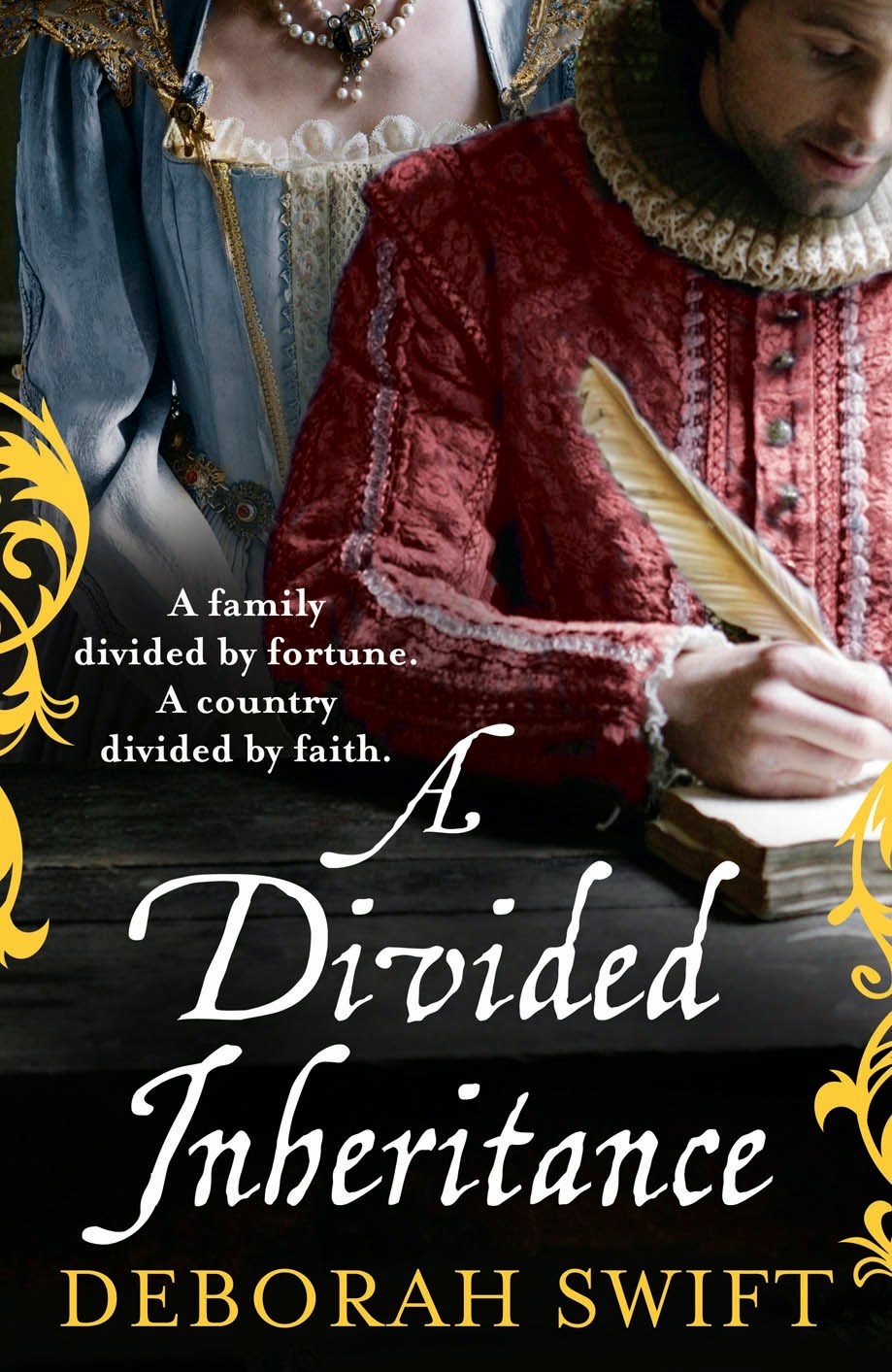
A Divided Inheritance by Deborah Swift


A Divided Inheritance is a fabulous read. Deborah Swift’s other two novels set in the seventeenth century, The Lady’s Slipper and The Gilded Lily, are thoroughly enjoyable books, well-plotted with depth of characterisation. A Divided Inheritance is, without doubt, the most sophisticated work of the three novels and a brilliant achievement. An excellent historical novel owns two elements: the total immersion of a reader into a previous historical era and engaging characterisation. With A Divided Inheritance, Deborah Swift succeeds on both counts.

The story is set during the early years of the reign of James 1st , opening in London to a background of trade and religious tension following the late Elizabethan period and The Gunpowder Plot. Elspet Leviston hopes to inherit her father’s London lace business but is thwarted by the arrival of a lost cousin.  As a consequence her inheritance will be divided. Zachary Deane has a disreputable background, yet despite his shadowy past, her father draws him into their pleasant London home and his business. To Elspet’s chagrin he sends this mysterious cousin on a grand tour to look for new markets and to knock off his rough edges.

Elspet is a devout English Catholic, intrepid, and not deterred by obstacles, she takes on a terrifying sea and land journey into Spain, a country in the grip of Inquisition, in search of Zachary after her father’s sudden demise. The journey to Seville sets in motion intriguing events as the two protagonists become locked in a battle of wills, involved in a school for training swordsmen and in the expulsion of a persecuted people, the Morisco population of Andulusia, one often composed of  baptised Christians . The expulsion is a very moving aspect of this novel’s plot, superb in its depiction and integration into the novel’s overall narrative drive, also providing the story’s sub plot.

At the heart of the novel is character. Even minor characters are extraordinarily well developed and, of course, the protagonists are particularly rich depictions. Elspet is plucky and determined but she is also a prim Jacobean lady who early in the book faces several disappointments. She is a heroine rooted in her time yet propelled by circumstances into situations which permit her ultimate self-discovery. Vividly portrayed she leaps off the page in her farthingales, laced bodices, her desire to visit every Spanish church on the route across this arid, dangerous country, her ability to stay her post under a relentless sun, whilst waiting for the difficult retrograde, Zachary, each day, as he learns skills of the sword. She is indomitable and will confront him. Zachary Deane is a man of the sword, an ultimately likeable ne’er do well. Can he meet the challenge the story’s terrible events present and gain redemption? As for all the personalities in between- they successfully respectively aid or hinder the story’s development. All of them provide a convincing and engaging gallery of characters whose destinies we care about. This novel must be praised for Deborah Swift’s attention to research and her translation of this into brilliant characterisation, scintillating dialogue and a thrilling narrative. Her research, though impeccable and thorough, never shows. The scenes set in a Spanish sword school and amongst the Morisco community are vibrant. I was there participating in Elspet’s and Zachary’s story lives, fighting with sword, trudging Seville’s narrow streets, watching their romances develop and the threats to their survival. A Divided Inheritance is a terrific historical novel; one which on reaching the last page I was reluctant to put down. I hope it provides other readers with an equally delectable sense of enjoyment. It comes highly recommended.
A Divided Inheritance is available from Amazon and from bookshops

review by Carol McGrath

Review: SAINT OF THE BURNING HEART by Julia Robb

Unless you've been waiting with breathless anticipation to read a book by an author with whose work you're familiar, and which you therefore have high hopes of enjoying, the unspoken thought in any reviewer's mind when starting to read a new book must inevitably be: "Oh please, please, please let it be good!"

Well, with Julia Robb's Saint of the Burning Heart, I needn't have worried.

For a start, the reader is in very safe hands.  Julia Robb has a background in journalism - "I spent 20 years in the newspaper business", as it states on her Amazon page - and it shows.  She knows what she's doing.

Not every journalist can write a compelling story, though.  In addition to the craft of turning a neat phrase and getting the information down on the page, there's also the art of spinning a yarn that keeps the reader intrigued, engaged, enthused and entralled.  With Saint of the Burning Heart, Julia Robb proves that she has mastered more than just the craft of writing: she also possesses the art.

Published as an ebook in February 2013, Saint of the Burning Heart swings between steamy melodrama and modern-day tragedy.  Well, almost modern-day: the novel is set mostly in the 1960s, in a part of Texas, within easy reach of the Mexican border.  Like much in the novel, the information that the story is not exactly contemporary isn't spoon fed to the reader: it emerges. 

In the manner of a natural dramatist, the author here plays a sort of hide-and-seek with the audience; there's a slightly teasing quality to the narrative, a sense that - rather than piling on the exposition - the author prefers to let the story unfold in its own way, popping questions into the reader's head and then resolving them when the time is right, which is how a good thriller works.  It's indicative of confidence and a sure hand.  From the opening moments, the reader is caught up in the author's spell.  There are no unnecessary explanations: only crisp, incisive descriptions, plenty of authentic-sounding dialogue, memorable scenes and images, strong, volatile characters and an all-pervading sense of emotional and social conflict, of passions and prejudices, of individuals, families and a whole community on the brink of self-destruction.

Central to the story is the orphaned Nicki.  Raised by a foster-family - which is itself an uneasy mix of "Anglo" and "mescan" blood - she develops an erotic fixation on her rescuer and father-figure.  Obliged by scandal to leave home, she returns to discover that her smalltown community is riven with racial and political tensions.  The whites have had it all their own way, but now the Hispanics are running for office and anxious to overturn years of oppression.  Nicki is caught between the rival camps and rival lovers.

The setting is vividly presented and peopled by believeable characters, all-too human, flesh-and-blood, driven by their own demons and desires.  They speak in their own patois, the emphasis on dialogue over description lending the story an added drama.  The book plays out like a movie in the reader's mind - it has all the sweaty intensity and immediacy, the visual realism and the fatalism of a certain kind of American cinema (I was also reminded of Steinbeck, and especially Of Mice and Men, which uses dialogue to similar effect).

There are many standout moments - including a minor orgy of depravity and self-loathing in which the priest Daniel (the "saint" of the title, I believe) indulges across the border in Mexico - and plenty of characters who stick in the mind, so vividly are they presented; they seem so real, you can almost smell them.  Most of the major characters are introduced in their turn, flaws and all, with the narrative breaking away to discover and follow them, before the author skilfully draws all the strands together.  The tension increases, and the pace seems to quicken, until we're heading for the final showdown.  And even then, right up till the end, Julia Robb plays with our expectations.  We know it will end badly - but quite how, we can't tell.  We must trust to the storyteller, and by that point in the story we have little choice: she has entertained and intrigued us, puzzled and enlightened us, and we are at her mercy.  Fortunately, she delivers.

It should be clear by now that I was somewhat in awe of this story and its author.  I am happy to recommend it, and cannot do so highly enough.  The writing is exciting and excellent, and the story merges the domestic with the historic, the personal and the political, so deftly, and to such an extent, that the whole remains with you long after you have turned the final page.

Julia Robb is also the author of Scalp Mountain, which, if her Saint of the Burning Heart is anything to go by, promises to be as gritty and gripping as anything the avid reader of historical fiction could hope for.

Simon Stirling


Tuesday, 12 November 2013

PAULA'S PEOPLE: AUTHOR JANE GRAY

Many thanks to Paula Lofting for featuring The Bitti Chai on The Review.  Paula said just to tell the readers something about myself and that is exactly when my mind went completely blank. 


Naturally somewhat of a reclusive person, marketing The Bitti Chai and attending book fairs in general is something akin to torture for me.  My family is naturally secretive and for many years did not mix with outsiders, Gauja's they call them, the Romany word for anyone who is not Romany. In fact many people did not know of our Romany background as my grandfather always feared the hostile reaction we would receive and having lived through the Second World War he was understandably cautious.

I was brought up by my Romany grandfather, the youngest of ten children, the bitti chai (the small girl). My family initially inspired the writing of The Bitti Chai but most of all I wanted to share some aspects of Romany culture with the outside world. To inform people about Romanies traditional values, strength of family ties and loyalty utterly contradicting the familiar and incorrect portrayal of this much maligned ethnic minority. 


The Bitti Chai was released in paperback in November 2012 and early in 2013 as an e book.  In October 2013 the ebook of the follow up The Lost Souls was released via Amazon.  The last in the trilogy, The Man with Two Minds hopefully will be released late next year.  I have to say that throughout the process of writing both novels I have been supported by my editor Jo Field and although I had the seed of an idea for the book Jo inspired me to carry on writing.  The New Writers Group to which I belong put me in touch with a graphics company (Avalon Graphics) and Cathy Helms designed my book cover which I am constantly thrilled with each and every time I look at it.  She also made a fabulous book trailer for me which I have to admit have watched over and over again, sad or what.  Shortly after the release I received a B.R.A.G Medallion, an award for Indie writers and gained a great review and received much support from them.

During the Spring and Summer months I tend not to write too much as true to my roots I love horses and breed and show native ponies, Dartmoors in particular.  The show season for us begins in March and carries on until October so this doesn't leave much time for writing although to be fair every day I am going through scenarios in my mind.  At present my hero and heroine, Johnny and Reigneth fill much of my imagination.  In fact I'm not quite sure what will come after the third book in the series about them as their characters tend to dominate much of my thoughts at present.  Reigneth is truly named after my great Aunt who was born on the roadside at Rainworth, Nottinghamshire, which is pronounced Reigneth.  Some of the characters in The Bitti Chai are moulded on real family members. 

I am terribly proud of my family and my birthright and to me having Romany heritage is extremely important, even if one person reads my book and has a positive image of Romanies then I feel my writing has accomplished something very important.


For those of you who haven't read The Bitti Chai the story begins in Lincolnshire an area which my family travelled through extensively and eventually settled in the late 1880's.  The story moves on as does the family when they move to Chagford in Devon.  Chagford is a very special somewhat spiritual place for me.  A place where I feel I can immerse myself in the surroundings and feel at one with nature.  It was therefore natural for me to choose this place to base most of the story.  Dartmoor has long been steeped in tales of ghostly apparitions and happenings and I love nothing more than to walk over the moors and climb the Tors, no matter whether it is rain or shine.  In all its moods the moor is enchanting and this is the setting for my novels, a tale of ghosts, jealousy, prejudice and passion but most of all romance.


Jane is kindly giving away an e-copy of her book The Bitti Chai which was reviewed on Monday (see here) so if you would like a chance to win, just leave a comment.

http://www.bragmedallion.com
http://youtu.be/_Tut_W8Ci7k 

Paula Lofting is the author of 4/5star historical fiction novel  Sons of the Wolf
blogs - www.sonsofthewolf-paulalofting.blogspot.co.uk 
            www.threadstothepast.blogspot.co.uk
website - www.paulalofting.com