Showing posts with label Regency romance. Show all posts

Wednesday, 24 October 2018

A Suggestion of Scandal by Catherine Kullmann


Today Claire Lyons reviews A Suggestion of Scandal by Catherine Kullman. The author has very kindly offered a paperback copy as a giveaway.  To be in with a chance of winning this wonderful prize, simply leave a comment below or on our Facebook page.

Good luck!


If only he could find a lady who was tall enough to meet his eyes, intelligent enough not to bore him and who had that certain something that meant he could imagine spending the rest of his life with her.
As Sir Julian Loring returns to his father’s home, he never dreams that that lady could be Rosa Fancourt, his half-sister Chloe’s governess. Rosa is no longer the gawky girl fresh from a Bath academy whom he first met ten years ago. Today, she intrigues him. But just as they begin to draw closer, she disappears—in very dubious circumstances. Julian cannot bring himself to believe the worst of Rosa, but if she is blameless the truth could be even more shocking, with far-reaching repercussions for his own family, especially Chloe.
Later, driven by her concern for Chloe, Rosa accepts an invitation to spend some weeks at Castle Swanmere, home of Julian’s maternal grandfather. The widowed Meg Overton has also been invited and she is determined not to let the extremely eligible Julian slip through her fingers again.
When a ghost from Rosa’s past returns to haunt her, and Meg discredits Rosa publicly, Julian must decide where his loyalties lie.


A respectable governess finds herself in the centre of an outrageous scandal – what is a woman to do when her involvement could lead to the ruin of herself and those she cares for? This Regency fiction is a beautifully written romance with so much more going on than you expect…

I truly enjoyed this wonderfully crafted and deliciously devious book – so many characters all with a past and with a plan for their futures. The Regency period is explored with great care, through the confines of the story, but still giving lots of food for thought to the reader about the situation of women both in terms of financial security and social position. I loved the large number of strong and interesting female characters, spanning different generations and social standing.

Descriptions of the clothing, buildings, interiors and furniture as well as travel and even hair styles give a very evocative and visual experience for the reader. The book is largely set in two wealthy family estates, but there are many glimpses of other aspects of the period that you really can imagine and therefore feel the atmosphere.

There is a gentle humour and the subtle romance emerging all the way through the trials and tribulations of the scandal itself, with a few unexpected twists and turns to keep your attention. I liked being challenged during the unfolding story – not all the characters are as simple as it first appears and the ease with which I dubbed their behaviour as ‘good’ or ‘bad’ was turned on its head as more of their personal story is revealed. Some characters are very complex and as their personal situations and choices are revealed the reader gains a wider understanding of how the rigidity of society in the Regency period was in fact a surface image, and the way many people actually lived their lives was in stark contrast to these public expectations.

There are a lot of side characters in the book, and they give the story and the period setting a deeper richness, allowing us to see how people entertained themselves, the living conditions, social expectations and politics. The writing has a certain formality which works well with the subject matter and feels very like an authentic work from the period – until the sex scene of course! I can imagine that there more stories to come from this motley crew… I have questions about several of the women and how they will fare in the Regency period and would like to find out what happens to them – will they find financial security or even real love?

A Suggestion of Scandal would suit people who enjoy historical fiction and romance, also those with an interest in the changing role of women. It is a well-researched and intelligent book, inspired by a real event.  When we read it in the Virtual Book Club, two members had never read a Regency Romance before and both are now happy converts!

About the Author:

Catherine Kullmann was born and educated in Dublin. Following a three-year courtship conducted mostly by letter, she moved to Germany where she lived for twenty-six years before returning to Ireland. She and her husband of over forty years have three adult sons and two grandchildren. Catherine has worked in the Irish and New Zealand public services and in the private sector.
After taking early retirement Catherine was finally able to fulfil her life-long ambition to write fiction. Her debut novel, The Murmur of Masks, published in 2016, is a warm and engaging story of a young woman’s struggle to survive and find love in an era of violence and uncertainty. It takes us from the ballrooms of the Regency to the battlefield of Waterloo.
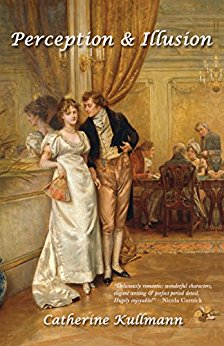
In Perception & Illusion, published in March 2017, Lallie Grey, cast out by her father for refusing the suitor of his choice, accepts Hugo Tamrisk’s proposal, confident that he loves her as she loves him. But Hugo’s past throws long shadows as does his recent liaison with Sabina Albright. All too soon, Lallie must question Hugo’s reasons for marriage and wonder what he really wants of his bride.
In her new book, A Suggestion of Scandal, governess Rosa Fancourt finds her life and future suddenly at risk when she surprises two lovers in flagrante delicto,. Even if she escapes captivity, the mere suggestion of scandal is enough to ruin a lady in her situation. In Sir Julian Loring she finds an unexpected champion but will he stand by her to the end?
You can find out more about Catherine at her website www.catherinekullmann.com/ where, in her Scrap Album, she blogs about historical facts and trivia relating to the Regency or on her Facebook page fb.me/catherinekullmannauthor

Catherine’s books are available worldwide from Amazon as e-books and paperback. Amazon links include:
Amazon.com: https://goo.gl/J3hRIf


About the Reviewer

Claire has run Mrs Average Evaluates for five years now, and still writes a regular book review in a local magazine. Her passion is to share great writing and encourage wide reading for learning, pleasure and escapism. She also runs her own business, has four young children and a dog to keep her busy. You are most welcome to join her friendly FB Group, and she’s always on the lookout for Guest Posts on the website.



Wednesday, 7 February 2018

Nicky Moxey reviews Perception and Illusions by Catherine Kullman

 Today at The Review, Nicky Moxey reviews Catherine Kullman's Perception and Illusions. The author is giving away a paperback copy - to anywhere in the world - as a prize. To win your very own copy, simply leave a comment below or on our Facebook page. The winner will be drawn on 14th February 2018. Good luck!


Perception and Illlusions by Catherine Kullman –.

“England 1814: Brought up by her late grandparents after the death of her mother, Lallie Grey is unaware that she is their heiress. When her father realises that he will soon lose control of his daughter’s income, he conspires to marry her off to his crony, Frederick Malvin in exchange for a share of her capital. But Lallie has fallen in love with Hugo Tamrisk, heir to one of the oldest titles in England. When Hugo not only comes to her aid as she flees the arranged marriage, but later proposes to her, all Lallie’s dreams have come true.”

This book – Catherine’s second – was published in March 2017, and I was delighted to have been given a copy of this book.

“Perception and Illusions” is a lovely, gentle love story, using the classic girl-meets-boy, girl-loses-boy, girl-gets-boy-back theme – but it’s very cleverly done. I pretty much devoured this book, in 3 sittings, I think; and given that neither romantic novels, nor this period, are my usual fare, that gives you an impression of the quality of the writing! The central character, Lallie, is sympathetically drawn, and her character arc is believable and engaging. The secondary characters are well-rounded and appealing too; in particular Hugo’s thoughts and motivations make you like him very much.
I loved the language and the way the book is structured- both very much of the period. There’s a clever device for introducing the chapters, which was a particular favourite of mine; it both sets the tone of the chapter, gives you a hint of the content, and added together describes quite neatly the course and hazards involved in falling in love!

Here’s Chapter Sixteen’s:
“The Island of Perseverance, on the opposite side, is good if the travellers be on a right course; further lies the Island of Obstinacy.” Should be part of every divorce counsellor’s toolkit…
The author has the knack of allowing you inside first one character’s head, then another – so it was possible to follow along with every twist of the all-too-familiar comedy of errors that the lovers managed to achieve – and then to sigh with relief as they finally managed to start unpicking all the things unsaid and assumed, and get their relationship back on course! I was very impressed with the delicacy of the love scenes. Poor old Lallie has had the worst kind of birds-and-bees advice – and this is Hugo’s thoughts on the matter…
“Lallie vielded sweetly to him in bed, it was true, but, in the depths of his heart, he must admit that she did not respond as ardently as he would like and always at the end there was that little sigh, as if she was glad that he had finished. So what have you to complain about, he asked himself savagely. That your wife is not as fond as you would wish? You can hardly tell her you wish she were less inanimate…”

As well as the bedchamber, we are transported to some sumptuous Regency feasts and balls. The author’s descriptions of each, along with the complicated rules of politesse involved, are delightful, and add a great deal to the atmosphere of the book. It’s here that the quality of Ms Kullman’s research is clearest – but never heavy. She concludes the book with one of my favourite things – a Historical Note that clearly explains what is real and what is not, and what accommodations have been made to the story.

Very few, it turns out!

I thoroughly enjoyed this book, for a number of reasons; I loved the period accuracy, the skill with which the author engages the reader, and the delicacy of the love story itself. I’d definitely recommend it - having finished this one, I’ve bought her first – this is an author with an effortlessly beautiful voice, and I want to read more.


About the authorCatherine Kullman was born and educated in Dublin. Following a three-year courtship conducted mostly by letter, she moved to Germany where she lived for over twenty-five years before returning to Ireland. She has worked in the Irish and New Zealand public services and in the private sector. She has a keen sense of history and of connection with the past which so often determines the present. Fascinated by people, she loves a good story, especially when characters come to life in a book.
She has always enjoyed writing, loves the fall of words, the shaping of an expressive phrase, the satisfaction when a sentence conveys my meaning exactly. She enjoys plotting and revels in the challenge of evoking a historic era for characters who behave authentically in their period while making their actions and decisions plausible and sympathetic to a modern reader. In addition, she is fanatical about language, especially using the right language as it would have been used during the period about which she is writing. But rewarding as all this craft is, she says there is nothing to match the moment when a book takes flight, when your characters suddenly determine the route of their journey.
Catherine's novels are set in the newly created United Kingdom of Great Britain and Ireland during the extended Regency period. The Act of Union between Great Britain and Ireland of 1800, the Anglo-American war of 1812 and more than a decade of war that ended in the final defeat of Napoleon at Waterloo in 1815 are all events that continue to shape our modern world. It was a time of revolution and inspiration, still a patriarchal world where women had few or no rights, but they lived and loved and died, making the best lives they could for themselves and their children. And they began to raise their voices, demanding equality and emancipation.
At the same time, the aristocracy-led society was under attack from those who demanded social and political reform, while the industrial revolution saw the beginning of the transfer of wealth and ultimately power to those who knew how to exploit the new technologies.
Links: Amazon US; Amazon UK; Facebook; website.


About the reviewer: Nicky Moxey lives in the middle of rural Suffolk, UK, and is owned by a slinky black cat who's far too clever for her own good. In her spare time, she is an amateur historian/archaeologist, and in non-work daylight hours is usually out on a field somewhere with a metal detector and/or a trowel. She has added quite a few things to the Heritage England Record and the Portable Antiquities Scheme; but what really fascinates her is the stories behind the artefacts. Her first historical novel is about the story of a local boy made good - Wimer the Chaplain was born in Dodnash in Suffolk of a poor Saxon family, but made it to be a confidant of Henry ll, holding down the job of High Sheriff for all Norfolk and Suffolk. Then he gave it all up and came home to found a Priory... finding the original site of that Priory (not where it's shown on the map) is still one of Nicky's proudest discoveries. This should be published in the second half of 2017, touch wood. She also has a self-published series of children’s’ short stories about Henry Baker, a boy who finds a magic pencil on the way to school - she has no idea where these come from, but enjoys writing them immensely! 
Nicky's website can be found at nickymoxey.com

Sunday, 18 September 2016

Diana Talks to Charlotte Betts


I was fortunate enough to catch up with Charlotte Betts in the lift at HNS16 - the Historical Novel Society conference that was held this year at Oxford. Charlotte was one of the people who were making everything run smoothly and enabling us to enjoy the conference, but she was kind enough to answer a few questions.

Charlotte is one of those enviable people who always looks immaculate and I could only admire how she always looked as beautifully presented however harried she must have been feeling.

Please note that if you would prefer to leave a comment on Facebook you can do so here on our
Facebook Page


Charlotte Betts discovered a passion for writing after her five children had grown up and left her in peace. Demanding careers in hotel design and property force her to be inventive in finding time to write but she has achieved seven novels in eight years. One of her short stories was published in Scribble and others short-listed by Writers’ News and Real Writers’. She has won first prize in five short story competitions and wrote a regular column on interior design for The Maidenhead Advertiser for two years. She is a member of WordWatchers http://www.wordwatchers.net/ and the Romantic Novelists’ Association.

Charlotte, I am sure that you are tired of being asked the usual questions that would be interviewers ask authors, so hopefully this interview is an interview with a difference and I have come up with some unusual questions!

If your latest book The House in Quill Court https://goo.gl/Lw4Ure was adapted into a TV show or a film, who would you like to play the lead role?

I had to think hard about this. I’d like Carey Mulligan or Lily James to play Venetia, though both have brown eyes instead of blue-green. The heroine’s spirit and personality is more important here than the colour of her eyes. Perhaps the actress could wear coloured contact lenses? Aidan Turner doesn’t have blue eyes either but would in all other respects be perfect as Jack, the hero. I’m sure you ladies will agree with me on this!
(Note by Diana: Does 'anyone' ever look at Aidan Turner's eyes???? :-) )

If, as a one off, (and you could guarantee publication!) you could write anything you wanted, is there another genre you would love to work with and do you already have a budding plot line in mind?

I’d like to write a really dark psychological thriller. Alternatively, a series of detective novels about a quirky detective who lives somewhere exotic. I don’t have any particular plots in mind because, if I did, I’d become so involved with it I’d have to write the story. I don’t need any distractions at present from producing one historical novel each year!

Do you have any rituals and routines when writing? Your favourite cup for example or ‘that’ piece of music...??

I always have a bone china mug of tea at my side – I hate thick mugs! I prefer to write somewhere quiet, though I’ve learned to tune out of background noise, such as in a coffee shop or on a train. I rarely listen to music as it’s too distracting, though I have been known to put Sounds of the Sea on my i-pod to drown out conversation. My most important ritual is to daydream, usually when walking the dog or at the point of falling asleep. That’s when my plot gets sorted.

What is the worse book you have ever read? What made it unreadable for you?

I couldn’t possibly comment! I would hate another author to quote one of my books as being the worst book they’d ever read so I’m not going there.

What makes a book unreadable for me it to find it full of grammatical errors and spelling mistakes. Even if you tell a terrific story this sloppiness shows a lack of courtesy to the reader. It’s not hard to find professional editors who will correct these mistakes. Then there is waffle. I want a story written in clear, beautiful language that makes me look at life differently and teaches me something new. I dislike apathetic characters and improbable plots. I could go on …

Other than writing full time, what would be your dream job?

I used to have my own interior design business, which was my dream job. I loved (almost) every minute of it. It’s necessary for my wellbeing to be creative in one way or another. I am incredibly fortunate to be able to write full time now and this satisfies that requirement for creativity.

Coffee or tea? Red or white?

I need tea, builders’ tea, on an hourly basis for the creative Muse to sit on my shoulder egging me on. I enjoy a glass of white wine sitting in a sunny garden and a glass of red by a fireside but, if I was forced to make a choice between tea and wine, then tea would win.

If you had free choice over the font your book is printed in, what font/fonts would you choose?

Any font that is clear and unfussy. I want people to read my story not admire the font.

Imagine that you could get hold of any original source document. What would it be?

The diary of someone who lived in whichever period I’m currently writing about. It could be written by a servant or a queen because both would contribute their own view of society at that time. A queen’s maid might give an insight into the lives of both.

Original sources are incredibly valuable to the author. Samuel Pepys’s diary was my bedside companion for years when I wrote three novels set in the seventeenth century.

Historical fiction authors have to contend with real characters invading our stories. Are there any ‘real’ characters you have been tempted to prematurely kill off or ignore because you just don’t like them or they spoil the plot?

It is sometimes annoying when a real historical person won’t conveniently die to suit my plot but it’s up to me as the writer to create a story that fits the facts. The manuscript I’m currently working on has part of the plot revolving around Caroline of Brunswick. Her life events meant I had to make my fictional part of the story cover a much longer period than I’d have liked.  

Are you prepared to go away from the known facts for the sake of the story and if so how do you get around this?

I always adhere to the facts. When I’ve chosen a particular point in time as the setting for my story I research the events carefully and write these out as the ‘skeleton’ of my story. Then I weave the story I want to tell through this, bending the fiction to fit the fact and never the other way around.

It’s important to me that my readers can be confident I’m not ‘messing’ with history. When I read historical fiction I like to learn about history and would be disappointed if I discovered the story wasn’t correct. Of course, facts can be subjective. For example, in the case of a battle, the story is often written from the victor’s point of view. A German soldier might have written a very different account of a WWII battle than that of a British soldier.

Do you find that the lines between fact and fiction sometimes become blurred?

I spend a year or more thinking about and writing a novel and to make it real to me I daydream a great deal. Since I always identify with my heroine, after a while I feel as if I’m living a parallel existence. Sometimes I have to stop and think where I am! It’s as if I have a tiny television screen in my mind and I watch the story in all its detail but if something isn’t working I roll back the film and rewrite it. Daydreaming is a valuable and powerful tool for an author.

Have you ever totally hated or fallen in love with one of your characters?

Always! If I don’t hate my villain and love my heroine it’s unlikely my reader will feel strongly about them.

What do you enjoy reading for pleasure?

Whilst I read historical fiction I also like mysteries and psychological thrillers such as those by Nicci French. I’m a sucker for recipe books as I love to cook. I re-read books I’ve had for years: Mary Stewart, Dick Francis, Robert Goddard and Jean Plaidy. I also get a buzz from whatever research book I’m reading. If I didn’t, I doubt I’d write historical fiction.

What drink would you recommend drinking whilst reading your latest book?

I should probably say a glass of negus or ratafia but the answer has to be, whatever the reader enjoys most. For me, of course, it would be a ginormous cup of strong tea. No sugar, please.

Last but not least... favourite historical author?

There are too many to mention but I shall begin with Tracy Chevalier, Philippa Gregory, Anya Seton, Elizabeth Chadwick, Judith Lennox, Diana Gabaldon …

Diana, thank you for inviting me to be interviewed for The Review. I’ve enjoyed answering your thought-provoking questions.

Website
Twitter

Charlotte's latest book, The House in Twill Court, is available in both Kindle and paperback editions and has had some exceptional reviews

Amazon UK
Amazon.com

© Diana Milne July 2016 © (Charlotte Betts August 2016)

Tuesday, 22 July 2014

Louise E. Rule Interviews D. W. Wilkin for The Review's Author Interview

Louise E. Rule Interviews David W. Wilkin

for

The Review's Author Interview


David W. Wilkin is the author of Beggars Can't Be Choosier

Reviewed by Linda Root on 17th July 2014 


David W. Wilkin - Biography from amazon.com Author's Page

Award winning author, Mr. Wilkin is a graduate in history. He has been writing in various genres for thirty years. Extensive study of premodern civilizations, including years as a 
re-enactor of medieval, renaissance and regency times has given Mr. Wilkin an insight into such antiquated cultures.

Trained in fighting forms as well as his background in history lends his fantasy work to encompass more beyond simple hero quests to add the depth of the world and political forms to his tales.

Mr. Wilkin regularly posts about Regency history at his blog, and as a member of English Historical Fiction Authors. You can read that blog at http://englishhistoryauthors.blogspot.com/ His very first article was published while in college, and though that magazine is defunct, he still waits patiently for the few dollars the publisher owes him for the piece.

Mr. Wilkin is also the author of several regency romances, and including a sequel to the epic Pride and Prejudice by Jane Austen. His recent work, 'Beggars Can't Be Choosier' has won the prestigious Outstanding Historical Romance award from Romance reviews Magazine.


Welcome David, I would like to thank you for taking the time to speak with me today.


(From the front cover of the book)

When a fortune purchases a title,
love shall flourish, for a heart
that is bought, can never be won


For those who haven't yet read your book, Beggars Can't Be Choosier, would you like to give an outline of the story David?

Sure. Beggars is the story of the Earl of Aftlake who is born with a title, but with very little in the way of money. He has about 100 pounds a year which is near poverty for a titled lord. And it is the story of Miss Katherine Chandler who finds that society snubs her for the low birth of her father and his far too rapid rise to wealth and riches. She needs a husband with stature and Lord Brian needs an heiress. An arrangement is made, though not with a typical stipulation, and they are united. He can use the wealth to build a career for himself in politics and reacquire possession to all the properties of his family that have been mortgaged. She can find a place in society that will allow her to have stature and find perhaps some revenge against those who have snubbed her. As a Regency, though, when such a thing is arranged, the road that the two take to fall in love will twist and turn, but it is inevitable that they will fall in love.

Did you already have a title in place for your book, or is it something that evolved as you wrote the story?

Actually no. I considered it another of my Regency Projects, but the title did suggest itself to me as more of the story developed. I started the first draft in April of 2010, so not sure when I actually titled it. I do like that I could play upon the words and take a common cliché, twist it a bit, and see that it worked.

Research is, of course, imperative for an historical fiction novel. How much research did you have to do, and did you travel to the UK to visit the places that feature in your book?

I've been to the UK several times. My grandfather was an Englishman, and had started the old Millet chain of what was first Army Surplus and became better known as camping goods. the depression and marrying my American Grandmother, had them do what I find many couples do, move close to the wife's family, and so we live over the pond. but with many English relatives, I have travelled often to the Isles.

I do less research now on a Regency novel I am working on, than my earlier works. I have it in my veins now, but I still add to my research daily. I have a degree in History from UCLA, and add to my extensive collection of history on the era all the time. I also post every day a biography of a Regency Era person at my blog: http://thethingsthatcatchmyeye.wordpress.com 

It is very interesting how authors create and develop their characters, turning them into believable human beings. How did you develop your characters for Beggars Can't Be Choosier?

The idea came to me slowly about the arranged marriage. We have the thought in our research of the era that a man could live on a hundred pounds a year in London. But a thousand or more is what you need to really have a household. So I worked with that to develop the Earl of Aftlake. I also thought of Georgette Heyer's Grand Sophy, a little because it has been 20+ years since I read that. But a woman, maybe also like Becky Sharp, loud, large, a little brazen, and someone everyone would talk about.

I wanted to get into some issues, with the agreement between my hero and heroine, that would explore events that could bring them closer together, or break them. And so I went into looking at these topics that as a man, I could never truly relate or experience. I asked repeatedly every woman writer I've had a chance to, to give me feedback on the events I do raise in the book. The pregnancy and the other (which I shall keep secret for the readers to discover) and ladies can decide if I have done justice to the issue, or not.

When I start a story I find that the first chapter I either devote to the Hero or the Heroine, and the second is for the opposite character. While writing that chapter I try to reveal the back-story of the character so we can get that out as our base on which the story will be built. I generally will be bringing these chapters to life from a paragraph's worth of details, to a couple pages worth of information I have jotted down.

Covers of books are sometimes seen as an emotive subject; some think that covers aren't important, while others think that they are. I think that they are, as the cover can be a tempting precursor to what lies inside. How did you go about choosing your cover David?

First I have a collection of pictures from the period, or of the period that I can select from. the cover of Beggars is Edward Bretnall's Under the Mistletoe. He passed in 1902 and I, on my limited budget, currently search for inexpensive ways to create a cover. With an idea of what the book is about, as well as the genre, (for my fantasy series, Trolling, you might be able to discern that the close up of one of the Trolls is really me...) I select a picture and place that as my painting. Here, perhaps we have the sense that Brian wants to say something loving and Katherine is pulling away. After all, their marriage is a business arrangement. (Or will it always be such?)

The crucial process of proofreading and editing is very exacting work. Would you like to tell our readers how you go about this please?

Just this week a fellow writer posted on Facebook that they would rather edit 20 pages than write one. I am the opposite. This book went through four drafts, each draft having me edit it and correct it. I first started editing with a double spaced copy and wrote new material in between the lines and along the margins. Then I decided to shrink it to single space and 9 point fonts. I even edited one draft of Beggars during a cruise. Sea days are great days to edit.

After the fourth draft with Beggars, I asked for first readers and two gave me great edited copies back. I should love to be able to pay for professional copy editing, but at near $1,000 we need to sell more than 1,000 copies to make it worth my while to do so. If my sales do break out, then I will put a copy editor on speed dial, and issue more Regencies...

I always like to ask authors if they have a particular routine fore writing. For example, a particular place, time of day, or an aimed-for-word-count. What routine, if any, do you have David?

I aim for four sessions of 1500 words, (about 5) pages, every weekday. So about two or three of those before lunch, and then one in the afternoon. I write a couple bios for the website each day so I can have some backup, and then I can read. Which means reading for fun, or research.

You are a re-enactor, as are many lovers of history. So, would you like to tell our readers a little about your re-enacting life, and how you became involved in it, and does it help you to write your books?

Someone told me to go to this event and they had a girl for me to meet. I loved the event, but the girl and I only were ever destined to be friends. At the event there was medieval dancing, and I turned out to be good at it, and good at teaching it. So I did and have taught over 1,000 in our local Southern California area such dances. While re-enacting and dancing I met my wife at a ball. To woo her, and since it was a Regency Ball, I sent her pages of a Regency Romance, with of course, the main characters having our names. That has yet to be published, but perhaps one day...

Thank you so much for taking part in this interview with me. It has been extremely interesting chatting with you, David.


David W. Wilkin can be found on Facebook
and here


Louise E. Rule is author of Future Confronted
And can be found on Facebook here

Thursday, 26 June 2014

Anna Reviews: Dancing with a Devil by Julie Johnstone


See the instructions below for giveaway details


To write credible, heart-warming romance is an art. It requires the author to breathe life into the protagonists, lifting them above the cardboard cut-outs that so often litter this genre. I therefore approach this genre with certain caution, hoping always for the best, but finding myself quite often disappointed. Dancing with A Devil is as far from a disappointment as it is possible to be. Ms Johnstone brings to life two wonderful characters that I, as a reader, very quickly invest in. From that first sensual scene in which young Audrey decides to gamble it all by openly showing her affection for handsome Lord Davenport, to the last page, I am utterly hooked – so hooked that I decided to skip my planned hot tub soak as I wasn’t sure if my Kindle (or I) would survive an unexpected submersion in water.

For characters to grip you, they need a backstory – not from babyhood on, but sufficient detail must be given for us to understand why they act as they do. Lady Audrey Cringlewood is twenty-two, as yet unmarried, and has an anything-but-loving relationship with her father who just wants her off his hands. He doesn’t particularly care who she marries as long as she does so quickly. Audrey, having witnessed her parents’ loveless marriage, has promised herself she will marry for love – or not at all. Her father is having none of that, but so far Audrey has succeeded in evading his marriage plans. Time, however, is running out.

Audrey’s dead mother – and her sad life – casts a long shadow over pretty, vivacious Audrey, in many ways a girl who scoffs at the more ridiculous rules of the ton, no matter that she is as conscientious as any other young woman when it comes to preserving her reputation. And then one day Audrey meets Lord Davenport, and what begins as a flirtation very quickly develops into something else – at least for Audrey.

Trent Rutherford, the Marquess of Davenport, is a man who has promised himself never to love again. A disastrous previous relationship left him with a broken heart and a deep mistrust of women. Most understandably, but to say more would be to reveal too much of the plot. But Lord Davenport – Trent to his friends, among whom I now include myself – is helplessly attracted to Audrey, entranced by her honesty and forthrightness, by her beauty and her generous, warm personality. Unfortunately, he cannot commit. He is willing to act her protector, but shies away from admitting he loves her, thereby causing Audrey quite some heartbreak.

There is very little not to like about either Audrey or Trent, but Ms Johnstone never falls into the trap of making them one-dimensional. Audrey and Trent struggle with their feelings, with the constraints of the vigilant society that surrounds them, with the expectations of their family and friends. Dancing with a Devil is a novel where the strength of a third person narrative is very obvious: both Trent and Audrey have distinctive and persuasive voices, and the novel gains depth by allowing us insight into both their heads, to their desires and fears.

Any good romance requires obstacles. Ms Johnstone has provided Trent and Audrey with more than their fair share, and the plot twists and turns like an aggravated viper – which is why, of course, I decided to do without my bath. Demons of the past have to be confronted, nasty characters in the here and now must be avoided, and fortunately for Audrey and Trent, they have a supporting cast consisting of cousins and aunts, of former spymasters and loyal friends.

Dancing with a Devil is set in Regency London. The author has chosen to build her story round her characters rather than the historical setting, and as the central plotline is both universal and timeless, this works quite well. Sufficient detail is provided for me to know what period I am in, and while there are some minor faux-pas (such as referring to a brunch) on the whole I perceive the historical context to be correct – in particular as to the somewhat suffocating (and hypocritical) conventions of the time. There is a rather amusing scene with a half-deaf chaperone and her rather listless attempt to ensure Audrey is never out of her sight or hearing. Doesn’t work too well – to this reader’s delight! Ms Johnstone has a driven prose and excellent dialogue. Descriptions are precise and convey a sense of time and place, from the starched cravats that adorn the gentlemen to the grimy underbelly of post-Napoleonic Paris. But mostly, it is Audrey and Trent, two people who have grown into almost tangible beings.

Ultimately, this is a novel about a young girl who listens to her heart and is brave enough to show the recipient of her affections what she feels – despite risking rejection. It is about a man who doesn’t dare to believe in love and so refuses to accept what his own heart is telling him – until it is almost too late.
As I said initially, to write good, credible romance is an art. Clearly, Ms Johnstone knows just how to do that, combining great characters with a plausible plot. Brava, Ms Johnstone!

The author has also so graciously gifted a free copy of Dancing with a Devil to one lucky winner! To enter the draw, simply comment below or at this review's associated Facebook thread.

About the author: Julie Johnstone is a successful writer of Regency romance, a genre she came across more than a decade ago in an airport gift shop. When she isn’t writing Regency, Julie will try her hand at paranormal, and in between all that writing and the needs of her family, Julie attempts to find enough time to keep in touch with friends and stay fit. Read more about Julie on her websiteYou can purchase her book at Amazon US or Amazon UK.
 :

Anna Belfrage is the author of five published books, all part of The Graham Saga. Set in the 17th century, the books tell the story of Matthew Graham and his time-travelling wife, Alex Lind. Anna can be found on Amazon,Twitter, Facebook and on her website. If you would like Anna to review your book, please see our submissions tab at the top of the page.

Sunday, 9 March 2014

Sunday Wrap Up: Week ending March 9, 2014


Hello and welcome to our newest in a new series of weekly wrapping up of the week's worth of activity. This time round we have a gorgeous display of variety, what with Regency romance, historical fiction with focus on the Great War, fantasy and New Kingdom Egypt filling our pages. Very keen to explore a diversity of genres and topics, The Review Group welcomes author submissions for review; details can be found above at our submissions tab. 

Whether you are a returning or new reader, we welcome and encourage your comments, especially as many of our entries are accompanied by giveaways--and the best part is entry involves only commenting on the same blog as the review! Typically there is also a link for Facebook users. Wherever you comment, please ensure we will be able to contact you in the event you're our winner--we want our giveaways to go far and wide and see lots of winners! 

Relax and peruse the posts for the past week, feel free to comment, and enjoy the ride!


Jayne's love of Regency romance shines through in this review of a novel that opens with a tragedy resulting dire circumstances for our protagonist. A further tragedy leads to greater burden for Letty, who plans for the future to regain some of the past. Will it work out? Well, Letty will lead you to that answer, but Jayne states, "I have read many Regency romance books and this one compares favourably with the others. Letty is a character that I could empathise with and I admired her strength which comes over very well in the book." To see more of what Jayne says and information about the book, click right here


Currently there is a giveaway for a FREE copy of The Widow's Redeemer; please follow blog link above for details and to comment. 


First in a series, In Foreign Fields tells of two British officers sent during the Great War's Battle of Mons into enemy territory to complete secret missions. Stuart writes, "David Hough does a terrific job in recreating the image of a nation in ruins as the tide of war sweeps over it leaving destruction and grief in its wake. It is an old fashioned, edge of the seat page turner that holds your attention as Wendel and his friends finally reach the château and prepare to complete their mission. . .  as the book reaches it climatic finale where through the flames and smoke of a night of high drama and horror crimes are avenged and hopes for a fresh start are tantalisingly close." Hold onto your seat and click here for more details on this page turner that Stuart declares he shall follow as the series progresses. 


An exciting fantasy, Deep Echoes brings us further into the week with "a world unto itself. . . complete with annals, geographical features and. . . underlying threat." Well, if the story seems to come alive with that idea reaching out from its pages, your further interest is sure to be piqued by Anna's continuing description: "What follows is a nice combination of a coming-of-age story and a War of the Worlds scenario." And who doesn't want to grow up with their world at war and fighting to defend those whose rejection has placed them at the parameters of society? Fortunately for you, dear readers, and us as well, we can "live" (read: adventure) vicariously through the pages of the book--with hint of a sequel, so reviewer Anna confides--from the safety of our overstuffed chairs. 


Travel to ancient civilizations has also never been so easy! Margaret wraps up our week with a review for Richard Abbott's Scenes From a Life--which by the by entails a giveaway--as Makty-Rasut searches for his roots. Readers are likely to be drawn in by Abbott's progression of the tale, as Margaret elaborates on: "The structure of the book is also interesting – alternate chapters take us to Makty’s present and past – with the chapters in the present moving forwards, those in the past taking us progressively further back. If this sounds complicated, it isn’t. I found it an effective way of structuring the story and had no problem following the timeline." A sort of reverse linear, as it were, seems as if bit by bit the clues to who Makty is and the roots of underlying questions (his and our own) are answered, not unlike how they would be for Makty himself. Engaging indeed!


Currently there is a giveaway for a copy of Scenes From a Life; please follow blog link above for details and to comment. 


Missed last week's wrap up? Reader dear, never fear, click right here!


Tuesday, 4 March 2014

JAYNE'S CORNER: REVIEW OF WIDOW'S REDEEMER

As an avid reader of Regency Romance I was pleased to be asked to read and review Widow’s Redeemer by Philippa Jane  Keyworth


The book opens with the heroine, Letty Burton, at home in the country where her husband John is seriously ill. On becoming a widow, she finds herself in desperate circumstances; John has mismanaged their finances and she has to sell her home. She then moves in with her brother in law David and his wife Theodora, a giddy seventeen year old, whose husband is also dying. Letty finds that she has to take over as Theodora is unable to cope when David dies. 

Later, the ladies' mother-in-law, Clarissa, comes to stay and offers to take them under her wing, but Theodora has to go back to live with her parents. Letty realises that Clarissa is lonely and agrees to stay with her. She forms a friendship with an old friend of her husband's, Edward Deverell, who comes to visit and when Clarissa comes up with the idea of moving to London to find Letty a new husband, one that will win Clarissa back her standing in the community, Deverell accompanies them there. 

An earlier chance encounter with the rude Viscount Beaumont leads Letty to dislike the man immensely and when he turns out to be a friend of Deverell's his appearance at social events causes problems between him and Letty, for the dislike is mutual. As it happens, Beaumont is recovering from a disastrous affair which has put him off women. However, things begin to change between he and Letty and they begin to form a mutual attraction; but will Letty's pride and Beaumont's arrogance spoil their chances of true love? As we know in Regency romances, the course of true love never runs smoothly. 

I have read many Regency romance books and this one compares favourably with the others. Letty is a character that I could empathise with and I admired her strength which comes over very well in the book. At first I did not like Viscount Beaumont because of his arrogance but he redeems himself in the last bit of the book. I found their story very engrossing and I was unable to put the book down. 

For authors of this genre, a great deal of knowledge is needed and the author has presented her understanding of the way the Ton (The Aristocracy) and how it worked in London in the early 1800s, very well. I found the purely platonic relationship between Letty and Deverell very interesting as this rarely happens in many novels and the way the relationship worked in the story was excellently written. The author's clever  use of secondary characters made for an even more engaging read; for example she uses letters from Letty to her friend Sophie to convey the story of Letty's feelings about the Viscount. 

The author's writing style was engaging and it flowed very well with no inconsistencies,  making it easy to immerse myself in. The characters were well rounded and developed and I liked the way they all had a decent part to play in the story. This is the first novel I have read of Philippa Keyworth's and I will certainly look forward to reading more from this author in the future. 


Philippa Keyworth, known to her friends as Pip, has been writing since she was twelve in every notebook she could find. Originally trained as a horse-riding instructor, Philippa went on to become a copywriter before beginning a degree in history. She has always written stories and believes that as one of her loves and passions, she always will.


She has a Facebook page and a website.

Widow’s Redeemer is available in paperback and Kindle. 


For a chance to win an ebook copy of Widow's Redeemer please leave a comment on this blog or if you use Facebook, leave a comment on The Review Blog Page's thread for this blog.


Jayne Smith is an avid reader of historical fiction and Regency romances. She is an admin of The Review Group and is one of its founders. She is Welsh by birth and very proud of that. A nurse by profession, Jayne loves cats and her family. You will always find Jayne in a historical group of some description, participating in debates. Such is her love of history and talking about it, Jayne has created many historical groups on Facebook. You'll never be far from one of Jayne's groups wherever you are.