Showing posts with label Review. Show all posts

Wednesday, 7 February 2018

Nicky Moxey reviews Perception and Illusions by Catherine Kullman

 Today at The Review, Nicky Moxey reviews Catherine Kullman's Perception and Illusions. The author is giving away a paperback copy - to anywhere in the world - as a prize. To win your very own copy, simply leave a comment below or on our Facebook page. The winner will be drawn on 14th February 2018. Good luck!
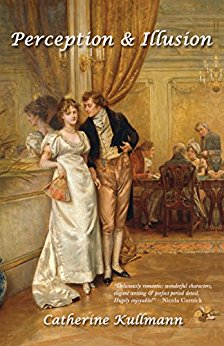


Perception and Illlusions by Catherine Kullman –.

“England 1814: Brought up by her late grandparents after the death of her mother, Lallie Grey is unaware that she is their heiress. When her father realises that he will soon lose control of his daughter’s income, he conspires to marry her off to his crony, Frederick Malvin in exchange for a share of her capital. But Lallie has fallen in love with Hugo Tamrisk, heir to one of the oldest titles in England. When Hugo not only comes to her aid as she flees the arranged marriage, but later proposes to her, all Lallie’s dreams have come true.”

This book – Catherine’s second – was published in March 2017, and I was delighted to have been given a copy of this book.

“Perception and Illusions” is a lovely, gentle love story, using the classic girl-meets-boy, girl-loses-boy, girl-gets-boy-back theme – but it’s very cleverly done. I pretty much devoured this book, in 3 sittings, I think; and given that neither romantic novels, nor this period, are my usual fare, that gives you an impression of the quality of the writing! The central character, Lallie, is sympathetically drawn, and her character arc is believable and engaging. The secondary characters are well-rounded and appealing too; in particular Hugo’s thoughts and motivations make you like him very much.
I loved the language and the way the book is structured- both very much of the period. There’s a clever device for introducing the chapters, which was a particular favourite of mine; it both sets the tone of the chapter, gives you a hint of the content, and added together describes quite neatly the course and hazards involved in falling in love!

Here’s Chapter Sixteen’s:
“The Island of Perseverance, on the opposite side, is good if the travellers be on a right course; further lies the Island of Obstinacy.” Should be part of every divorce counsellor’s toolkit…
The author has the knack of allowing you inside first one character’s head, then another – so it was possible to follow along with every twist of the all-too-familiar comedy of errors that the lovers managed to achieve – and then to sigh with relief as they finally managed to start unpicking all the things unsaid and assumed, and get their relationship back on course! I was very impressed with the delicacy of the love scenes. Poor old Lallie has had the worst kind of birds-and-bees advice – and this is Hugo’s thoughts on the matter…
“Lallie vielded sweetly to him in bed, it was true, but, in the depths of his heart, he must admit that she did not respond as ardently as he would like and always at the end there was that little sigh, as if she was glad that he had finished. So what have you to complain about, he asked himself savagely. That your wife is not as fond as you would wish? You can hardly tell her you wish she were less inanimate…”

As well as the bedchamber, we are transported to some sumptuous Regency feasts and balls. The author’s descriptions of each, along with the complicated rules of politesse involved, are delightful, and add a great deal to the atmosphere of the book. It’s here that the quality of Ms Kullman’s research is clearest – but never heavy. She concludes the book with one of my favourite things – a Historical Note that clearly explains what is real and what is not, and what accommodations have been made to the story.

Very few, it turns out!

I thoroughly enjoyed this book, for a number of reasons; I loved the period accuracy, the skill with which the author engages the reader, and the delicacy of the love story itself. I’d definitely recommend it - having finished this one, I’ve bought her first – this is an author with an effortlessly beautiful voice, and I want to read more.


About the authorCatherine Kullman was born and educated in Dublin. Following a three-year courtship conducted mostly by letter, she moved to Germany where she lived for over twenty-five years before returning to Ireland. She has worked in the Irish and New Zealand public services and in the private sector. She has a keen sense of history and of connection with the past which so often determines the present. Fascinated by people, she loves a good story, especially when characters come to life in a book.
She has always enjoyed writing, loves the fall of words, the shaping of an expressive phrase, the satisfaction when a sentence conveys my meaning exactly. She enjoys plotting and revels in the challenge of evoking a historic era for characters who behave authentically in their period while making their actions and decisions plausible and sympathetic to a modern reader. In addition, she is fanatical about language, especially using the right language as it would have been used during the period about which she is writing. But rewarding as all this craft is, she says there is nothing to match the moment when a book takes flight, when your characters suddenly determine the route of their journey.
Catherine's novels are set in the newly created United Kingdom of Great Britain and Ireland during the extended Regency period. The Act of Union between Great Britain and Ireland of 1800, the Anglo-American war of 1812 and more than a decade of war that ended in the final defeat of Napoleon at Waterloo in 1815 are all events that continue to shape our modern world. It was a time of revolution and inspiration, still a patriarchal world where women had few or no rights, but they lived and loved and died, making the best lives they could for themselves and their children. And they began to raise their voices, demanding equality and emancipation.
At the same time, the aristocracy-led society was under attack from those who demanded social and political reform, while the industrial revolution saw the beginning of the transfer of wealth and ultimately power to those who knew how to exploit the new technologies.
Links: Amazon US; Amazon UK; Facebook; website.


About the reviewer: Nicky Moxey lives in the middle of rural Suffolk, UK, and is owned by a slinky black cat who's far too clever for her own good. In her spare time, she is an amateur historian/archaeologist, and in non-work daylight hours is usually out on a field somewhere with a metal detector and/or a trowel. She has added quite a few things to the Heritage England Record and the Portable Antiquities Scheme; but what really fascinates her is the stories behind the artefacts. Her first historical novel is about the story of a local boy made good - Wimer the Chaplain was born in Dodnash in Suffolk of a poor Saxon family, but made it to be a confidant of Henry ll, holding down the job of High Sheriff for all Norfolk and Suffolk. Then he gave it all up and came home to found a Priory... finding the original site of that Priory (not where it's shown on the map) is still one of Nicky's proudest discoveries. This should be published in the second half of 2017, touch wood. She also has a self-published series of children’s’ short stories about Henry Baker, a boy who finds a magic pencil on the way to school - she has no idea where these come from, but enjoys writing them immensely! 
Nicky's website can be found at nickymoxey.com

Wednesday, 17 January 2018

The Naked Witch, by Wendy Steele; a review by Diana Milne


Lizzie Martin’s new boss has asked her to ‘bare all’ and become more corporate.

For Lizzie, swapping paisley for pin stripe is like asking a parrot to wear pea hen.

She has to choose between her job and her integrity, cope with an unexpected stay in hospital, monitor her fourteen year old daughter’s latest crush, continue seeking the truth about her father’s death and juggle two new men in her life.

There is hope though.

At the bottom of the garden is a little wooden shed that Lizzie calls Sanctuary. Within its warm and welcoming walls, Lizzie surrounds herself with magic.


***

The Naked Witch is so far out of my usual genres of reading and interest that I genuinely wondered if I would be able to enjoy it, gain anything from it, or even be able to review it properly, but my fears were groundless. From the first page Wendy Steele welcomed me into the world of the protagonist Lizzie Martin  and her teenage daughter Rowan and, without even using any witchy magic, just exceptional use of words, enticed me to not just read, but to thoroughly enjoy this wonderful book.

Immediately one starts to read, one feels the fun and laughter and determination of Lizzie, struggling against daunting odds to pick up the pieces after a broken marriage, a new home and a new job. She is a vibrant, colourful woman, who is also a witch. By witch, I am not talking about pointy hats and dark magic, but someone who is really in tune with nature and the old ways and gods and uses her rituals as a way to calm herself and focus her mind - (we could all learn a lot from her!) - and her shed, where she goes to be herself, is a calming sanctuary.

As a heroine, she is human and flawed and any mother, any working woman, can surely relate to her struggles to be everything to everyone and still be a woman in her own right. Ms Steele's depictions of a woman watching her daughter grow from a child to a woman and back, (all on the same day sometimes, as is the wont of teenage girls,) describes the confusion, fear, pride, relief and some other ineffable feeling that I cannot name, so perfectly. So many of us have been there, seen that and survived (just!)

Conversation flows naturally and has the ring of veracity and flashes of humour, one example  being someone calling Lizzie being a vegetarian, a 'vegetablarian.' This conversation between Lizzie and her ex's girlfriend describes Lizzie's 'faith' as a witch, to a total sceptic:

Bryony met Lizzie's invitation with wide, unbelieving eyes. "You're a witch?" she whispered, checking over her shoulder for eavesdroppers.
"I live my life with the Wheel of the Year, connect with the natural world, offer up prayers to the amazing universe we live in and meditate, allowing me to learn and travel on the astral plane, so yes, I'm a witch."
"I'm not ure. I don't know if I want to summon demons."
"Bryony, did I mention demons?"
"No, but ..."
"Earth, rocks, plants, animals, the sea vibrate with energy, with life. The same life, if you like, that courses through our veins.Witchcraft gives me a spiritual connection to the world around me. Best of all, I am never alone."
"I'venever thought about the sea being alive."
"It depends how you look at it, but one thing is certain. Women and the sea are ruled by the moon."
"Wow!"


We see and empathise with Lizzie starting out again on the dating, mating game and watch her growing friendship with her daughter's boyfriend's widowed dad with sympathy and warmth, a friendship that the reader hopes will become more after the book is over.

Throughout the book, Lizzie struggles with the relationship with her own mother and with her lack of knowledge about the death of her adored father and during a visit to her ex mother in law in Spain, sees a photo that begins to unravel the mysteries.

I really could relate to the characters and feel that Ms Steele has a rare talent for bringing interest to the day by day life of your average suburban witch, turning the mundane into a fascinating and readable story that I enjoyed from cover to cover - I totally loved the book and was able to completely escape into it. It was effortless to read because of the clever writing and I will willingly, happily add Wendy Steele to my 'read again' author list.

What other people say:

Rhea's Broomstick: 5 stars. Amazon verified purchase.

Another triumph for Witch Lit! Wendy Steele's The Naked Witch is a fun, easy read with a good storyline. Lizzie, the main character, is easily identifiable with if you are one of those women who are a little bit on the eccentric side, love magic and have the life skills to get down and do what it takes to juggle work, a teenager, an ex-husband and still have time to find love. Finding her unique fashion look from the charity shops and her sanctuary in a shed, she is a woman of resource, yet life throws her more than her share of challenges. In her search for the truth about her father Lizzie finds herself partying in Spain woven into a web of family intrigue. A brilliant book to snuggle down to a bit of 'me time' with.


You may buy The Naked Witch and Wendy Steele's other books by clicking on this link: Wendy Steele's books.

About the author:

In 1972, Wendy Steele came home from the Tutankhamun exhibition and wrote about her experience, beginning a writing journey which she still travels. Since working in the City BC (Before Children), she has trained in alternative therapies, belly dance and writing. Wendy combines these three disciplines to give balance to her life.

Her first novel 'Destiny of Angels' was published in 2012, closely followed by two short story anthologies and a non-fiction book 'Wendy Woo's Year – A Pocketful of Smiles', an inspirational guide, offering ideas, meditations and recipes to make every precious day, a happy one.

Moving to Wales, the fulfilment of a 15 year dream, inspired her to write the Standing Stone book series, set in Wales in the countryside she loves.

Writing workshops in Wales widened her writing perspective and the resulting short stories have been published online and in anthologies.

Wendy writes fantasy, with a dollop of magic, exploring the 'what if...?' the starting point for all her stories. She lives with her partner and cats, restoring her farmhouse and immersing herself in the natural world on her doorstep.

Wendy Steele


© Diana Milne 2018

Wednesday, 20 September 2017

Heroines of the Medieval World by Sharon Bennett Connolly: a brief review by Diana Milne

Since its beginning, I have been an avid reader of Sharon Bennett Connolly's blog, 'History - the Interesting Bits'in which the author finds and explores little known people and situations throughout history and blogs knowledgeably about them. 

When I heard that she was writing a book showcasing the lives of women throughout history, women who have rarely been heard of and never had a voice of their own, I was delighted, not just because I genuinely felt that this author would do an exceptional writing job, but also because the role of a woman as a subject in history is so rarely covered and they, as gender, played major roles in so many situations, not just here in Britain but on the wider world stage, often changing the course of history very much from behind the scenes. 


So many people never look behind the men folk of these ages and consider that the lives and actions of medieval women were totally restricted by the men who ruled the homes, countries and world in which they lived. It is so easy to think that all women from this era were downtrodden, retiring and obedient little housewives, whose sole purpose was to give birth to children (preferably little boys) and serve their husbands. In this groundbreaking book, Heroines of the Medieval World, the author looks at the lives of the women who  defied social mores and made not just their own future, but the future of nations, changing lives, society and even the fate of nations.

Some of the women are famous, like the Maid of Orleans, but others I had never heard of and have now become fascinated by, Maud de Braose, for example and Ms Bennett Connolly's own favourite, Nicholaa de la Haye, who defended Lincoln Castle in the name of King.
As the author says, ''Heroines come in many different forms, and it is no less true for medieval heroines. They can be found in all areas of medieval life; from the dutiful wife and daughter, to religious devotes and to warriors and rulers. What makes them even more unique and heroic, compared to those of today, are the limitations placed on them by those who directed their lives; their fathers, husbands, priests and kings. Women have always been an integral part of history, although when reading through the chronicles of the medieval world, you would be forgiven if you did not know it. We find that the vast majority of written references are focussed on men. The chronicles were written by men and, more often than not, written for men. It was men who ruled countries, fought wars, made laws and treaties, dominated religion and guaranteed the continued survival of their world. It was the men, if anyone, who could read, who were trained to rule and who were expected to fight, to defend their people and their country.''
The book is written in a friendly, easily readable style that belies the impact and interest of the words, each of which has been carefully considered to ensure that the meaning is clear to any reader of any level and maintain its academic importance and integrity. Whilst primarily it is a book aimed at adults, a child interested in history would also benefit greatly and find it an enjoyable read that could be dipped in and out of and also kept as a valuable reference book. The book is carefully referenced and indexed and I can see this being a valuable ‘go to’ book for school projects as well as being an enjoyable read with its well defined concept and clear, convincing language. 

The author has not just attempted to strike out from the pack with something different and new, she has succeeded with this trail blazing book.

Such is the popularity of the author and the subject, that the first run of books sold out on the first day, a major achievement for any author. The presses are working overtime now to fill all orders. Buy this book! You will not be disappointed.

😇
Ms Bennett Connolly has been fascinated by history for over 30 years and studied history academically and just for fun – she even worked as a tour guide at historical sites - and is a keen contributor to many online history groups. Her passion for the subject shines through in every word she writes, together with her extensive knowledge for the history of the Mediaeval and Renaissance eras.  

She is currently working on her second non-fiction book, Silk and the Sword: The Women of the Norman Conquest, which will be published by Amberley in late 2018.

A fluent linguist, Bennett Connolly was born in Yorkshire, and studied at University in Northampton before working in Customer Service roles at Disneyland in Paris and Eurostar in London.She is now having great fun, passing on her love of the past to her son, hunting dragons through Medieval castles or exploring the hidden alcoves of Tudor Manor Houses.


© Diana Milne September 15th 2017

Friday, 16 December 2016

Rob Reviews Clash of Empires by Paul Bennett

* The author has generously offered a copy of Clash of Empires, either ebook or paperback, to a lucky winner of the draw. To enter simply comment, either below or on our facebook page - good luck! *


“It’s as if the whole countryside is a tinderbox, ready to flare up. All that it’s waitin’ on is for someone to strike the flint to the kindling.”

Thanks to the wonders of social media I had the pleasure of making my acquaintance with the author through a mutual love of the written word. The author is an avid reader with his own blog page where he posts reviews (I’m lucky in having my own books reviewed by him). When I heard that he was working on his own project I was intrigued, even more so when I heard what the subject matter was and read some excerpts. For Clash of Empires is set during what is known in North America as the French and Indian War (1754 – 1763) but is better known in the UK as a theatre of the Seven Years’ War.  The French and Indian War could be seen as the spark that set in motion a global conflict between Britain and France (perhaps the real First World War) that dragged in other powers and colonial allies in a conflict fought in Europe, Asia, Africa and the Americas. In truth Europe was already a powder keg after the War of Austrian Succession, where different power blocks (Britain and France in opposing ones naturally!) had failed to satisfy their war aims.

North America at the onset of the French and Indian War - Wikipedia


By 1754 both the British and French empires in the Americas were well established.  However the British American colonies were hemmed in somewhat; they dominated the eastern seaboard but to the south was the Spanish colony of Florida while to the north was New France (Canada) which laid claim to vast swathes of the continent west of the colonies from the Great Lakes to the Gulf of Mexico. Families from the British Isles were encouraged to the New World with the promise of farm land cut from virgin forest. Of course this gave no account to the indigenous peoples who already lived there or to which far away king they gave their allegiance to.  British America wished to expand westwards while French America wished to contain them, each side courting Native American tribes with promises or gifts, while taking advantage of inter-tribal rivalry. Into this Clash of Empires the Author introduces us to the Mallorys.

Seeking freedom and opportunity the Thomas Mallory moves his family from Eastern Pennsylvania to the western frontier which puts them into the disputed territories. As well as Thomas and his wife Abigail we meet their children; Daniel, Elizabeth and Liam. The frontier is fluid and is a melting pot formed by the different nationalities of the colonists and the different tribes. Thomas, a farmer by necessity rather than calling, has a dream to open a trading post. With his family and assorted friends, as the beginnings of a community, they begin trading along the Kiskiminetas River. Rumour is rife along the frontier; there is talk that the French intend to crack down on what they view as British incursions whilst their Indian allies, the Shawnee, are always ready to raid settlements, as well as wage war against their long term enemies, the Mohawk.

Mohawk warriors


The Mohawk befriend the Mallorys, particular young Liam. Liam is a very adept hunter and leaves the family trading post to live with the tribe and learn their ways.  He proves himself in encounters with the Shawnee and is accepted by the tribe, marrying the Chief’s daughter, Orenda. However he makes a mortal enemy of the Shawnee called Chogan.  This animosity comes to a terrible conclusion when, preceding French military action Chogan leads a raid against the Mallory’s trading post. The family now find themselves at the frontline of a war that is all too personal.

Clash of Empires is  an enjoyable work of historical fiction. in its own right, but also very informative with regard to this theatre of the Seven Years War. This is brought about by the author's style whereby we experience the events around the characters in sharp focus and then the reader is drawn back to an overview of strategic events.  It could perhaps be compared to The Last of the Mohicans but it differs in as much as it gives us a detailed overview of the conduct of the war and its developing ramifications, without being a history lesson. Real historical characters are included such as, the capable Colonel (as was then) George Washington and the calamitous General Braddock, whose disastrous expedition is still debated about today. With Liam and Orenda’s storyline we have a tantalising glimpse of what might have been, if only a dialogue of mutual understanding and respect between peoples could have continued; how different would America’s society be today?


In Clash of Empires the reader is swept up into a brutal frontier war of honour and vengeance. But moreover within its pages we see a community, both macro and micro, beginning to assert itself as an entity in its own right; the beginnings of a nation. The seeds are planted and are set to bear fruit in the next book of the Mallory saga – The Sundering of Empire. This is one reader who can't wait!

About the Author:

Paul currently resides in the quaint New England town of Salem, Massachusetts with his wife, Daryl.
The three children have now all grown, turning Paul's beard gray in the process, and have now produced four grandchildren; the author is now going bald. You can read about his exploits in literature on his Blog.


Rob Bayliss is a reviewer at The Review and is currently writing his own fantasy series. Information on his writing projects can be found at Flint & Steel, Fire & Shadow.

Friday, 9 September 2016

Rob reviews Gods of War by C R May

Gods of War King's Bane Book 2

The author has generously offered a signed copy for the draw. To enter please comment here or on our Facebook page


…Before him the sacrificial stone was slick with gore and rough hands gripped his shoulders, forcing him to his knees in the slime. Up close the English guda looked even more terrifying than they had in the distance. One in particular, tall and slim beneath a circlet of stag horns, his hide clad body a mass of runic charms, stood to one side, his face a mask of undisguised joy.

In Gods of War we catch up with Eorle Eofer and his hearth troop who we became acquainted with in Book 1. When last we spent time in their company the Engles had decided to leave old Engeln for the new lands in Anglia (Britannia), but first honour demands that age old scores are settled in a year of Fire and Steel.

With the threat posed by the Jutes to the north eliminated, an invasion of Danish lands is planned to keep the implacable Danes from interrupting the migration of the Engles. Step forward the fame-bright Eofer, Slayer of the king of Sweden and burner of Heorot, charged by his king to raid the eastern shore of the Danes’ territory to draw off Danish warriors who might counter the English invasion in the west.

Loved by Woden, Eofer may be, but it must be remembered that the All-Father is fickle and has unpleasant surprises up his sleeve for all; whether they are foreign kings, or a favoured Eorle and his loyal hearth troop. After all - Wyrd bið ful aræd – Fate remains wholly inexorable. 


Woden

In Gods of war the wordsmith author delivers, bringing the heroic world of Dark Age Northern Europe to life in his own savage and glorious style; combining incredibly  well researched archaeology and sources with the mythic fantastical to forge a masterpiece of historical fiction. You will be led into Eofer’s world, your own sense of disbelief suspended, where the gods are all too real and life can be short and brutal. Be warned,will need to leave your C21st sense of morality behind for this is a different world where gods demand sacrifice and nations vie with one another in a near constant cycle of raiding and war. You must retain your honour, for honour can offer reward from friend or foe alike.

This a tale of the English, but the English before the land we now call England came to be. A tale set in a cultural tap root from which the Anglosphere grew, itself a branch of what we would now call the Viking world, but once it was our world too; our Midgard, set in the limbs of the World Ash between Hel and Valhall.

The author paints some amazing scenes as he dips into his word-hoard, whether it’s the desperate urgency of battle or awe inspiring descriptions of pagan horror, such as the awesome but grim scene of the Ghost Army; destined to guard the abandoned old lands of Engeln for all time.

The Ghost Army stood before him, the massed ranks braced and ready for battle. At the crest, beneath the white dragon battle flag of Engeln the Ghost King sat astride his mount, the thin spring sunlight shining dully from polished mail and spear point.

The scene takes you by surprise, but when you realise what, or rather who, the Ghost Army is, it horrifies and astounds in equal measure.

Dancing warriors from the Sutton Hoo helmet


The author has modernised many old English words, so the reader soon begins to understand this form of old English and the urge to look at the glossary of terms is soon forgotten, although you will find yourself looking back at the map, which is no bad thing, as it’s a wonderful piece of work in itself.

The King’s Bane series has much scope to extend into the future as the English settle on the shores of Anglia. We know Eofer and his like will not simply be gifted lands to call their own, they will need to fight a fierce enemy for them. Indeed one such enemy is revealed as one whom Eofer once trusted, a thorn that will return to worry Eofer and his hearth troop in the future, no doubt.

Mr May’s work is easily on a par with  authors such as Cornwell and Kristian, who write in a similar literally field, and I sincerely hope he enjoys equal success. His wyrd deserves it; this book deserves it. So I would urge you to embark upon reading this series of books before everybody else does!

So take your place on the oarbenchs of the Hwælspere and brave the mountainous seas and  vicious swords of your enemies with Eofer. I can assure you, that you won’t be disappointed; its stunning, its epic, its just bloody glorious!

C.R. May was born in Bow, East London before his family moved to South Ockendon, Essex. After hearing that Ockendon translated as Wocca's Hill in Saxon, a lifelong passion in history was kindled, which has taken him from Berlin to the site of the battle of Little Big Horn (via Erik the Red's Icelandic hall!). The influx of Germanic adventurers was recorded in the place names around him and, inspired one day, he decided to weave his own stories into this history. You can read and discover more information at his blog and the author may be found at Facebook


Rob Bayliss is a reviewer at The Review and is currently writing his own fantasy series. Information on his writing projects can be found at Flint & Steel, Fire & Shadow.