Showing posts with label Regency. Show all posts

Wednesday, 24 October 2018

A Suggestion of Scandal by Catherine Kullmann


Today Claire Lyons reviews A Suggestion of Scandal by Catherine Kullman. The author has very kindly offered a paperback copy as a giveaway.  To be in with a chance of winning this wonderful prize, simply leave a comment below or on our Facebook page.

Good luck!


If only he could find a lady who was tall enough to meet his eyes, intelligent enough not to bore him and who had that certain something that meant he could imagine spending the rest of his life with her.
As Sir Julian Loring returns to his father’s home, he never dreams that that lady could be Rosa Fancourt, his half-sister Chloe’s governess. Rosa is no longer the gawky girl fresh from a Bath academy whom he first met ten years ago. Today, she intrigues him. But just as they begin to draw closer, she disappears—in very dubious circumstances. Julian cannot bring himself to believe the worst of Rosa, but if she is blameless the truth could be even more shocking, with far-reaching repercussions for his own family, especially Chloe.
Later, driven by her concern for Chloe, Rosa accepts an invitation to spend some weeks at Castle Swanmere, home of Julian’s maternal grandfather. The widowed Meg Overton has also been invited and she is determined not to let the extremely eligible Julian slip through her fingers again.
When a ghost from Rosa’s past returns to haunt her, and Meg discredits Rosa publicly, Julian must decide where his loyalties lie.


A respectable governess finds herself in the centre of an outrageous scandal – what is a woman to do when her involvement could lead to the ruin of herself and those she cares for? This Regency fiction is a beautifully written romance with so much more going on than you expect…

I truly enjoyed this wonderfully crafted and deliciously devious book – so many characters all with a past and with a plan for their futures. The Regency period is explored with great care, through the confines of the story, but still giving lots of food for thought to the reader about the situation of women both in terms of financial security and social position. I loved the large number of strong and interesting female characters, spanning different generations and social standing.

Descriptions of the clothing, buildings, interiors and furniture as well as travel and even hair styles give a very evocative and visual experience for the reader. The book is largely set in two wealthy family estates, but there are many glimpses of other aspects of the period that you really can imagine and therefore feel the atmosphere.

There is a gentle humour and the subtle romance emerging all the way through the trials and tribulations of the scandal itself, with a few unexpected twists and turns to keep your attention. I liked being challenged during the unfolding story – not all the characters are as simple as it first appears and the ease with which I dubbed their behaviour as ‘good’ or ‘bad’ was turned on its head as more of their personal story is revealed. Some characters are very complex and as their personal situations and choices are revealed the reader gains a wider understanding of how the rigidity of society in the Regency period was in fact a surface image, and the way many people actually lived their lives was in stark contrast to these public expectations.

There are a lot of side characters in the book, and they give the story and the period setting a deeper richness, allowing us to see how people entertained themselves, the living conditions, social expectations and politics. The writing has a certain formality which works well with the subject matter and feels very like an authentic work from the period – until the sex scene of course! I can imagine that there more stories to come from this motley crew… I have questions about several of the women and how they will fare in the Regency period and would like to find out what happens to them – will they find financial security or even real love?

A Suggestion of Scandal would suit people who enjoy historical fiction and romance, also those with an interest in the changing role of women. It is a well-researched and intelligent book, inspired by a real event.  When we read it in the Virtual Book Club, two members had never read a Regency Romance before and both are now happy converts!

About the Author:

Catherine Kullmann was born and educated in Dublin. Following a three-year courtship conducted mostly by letter, she moved to Germany where she lived for twenty-six years before returning to Ireland. She and her husband of over forty years have three adult sons and two grandchildren. Catherine has worked in the Irish and New Zealand public services and in the private sector.
After taking early retirement Catherine was finally able to fulfil her life-long ambition to write fiction. Her debut novel, The Murmur of Masks, published in 2016, is a warm and engaging story of a young woman’s struggle to survive and find love in an era of violence and uncertainty. It takes us from the ballrooms of the Regency to the battlefield of Waterloo.
In Perception & Illusion, published in March 2017, Lallie Grey, cast out by her father for refusing the suitor of his choice, accepts Hugo Tamrisk’s proposal, confident that he loves her as she loves him. But Hugo’s past throws long shadows as does his recent liaison with Sabina Albright. All too soon, Lallie must question Hugo’s reasons for marriage and wonder what he really wants of his bride.
In her new book, A Suggestion of Scandal, governess Rosa Fancourt finds her life and future suddenly at risk when she surprises two lovers in flagrante delicto,. Even if she escapes captivity, the mere suggestion of scandal is enough to ruin a lady in her situation. In Sir Julian Loring she finds an unexpected champion but will he stand by her to the end?
You can find out more about Catherine at her website www.catherinekullmann.com/ where, in her Scrap Album, she blogs about historical facts and trivia relating to the Regency or on her Facebook page fb.me/catherinekullmannauthor

Catherine’s books are available worldwide from Amazon as e-books and paperback. Amazon links include:
Amazon.com: https://goo.gl/J3hRIf


About the Reviewer

Claire has run Mrs Average Evaluates for five years now, and still writes a regular book review in a local magazine. Her passion is to share great writing and encourage wide reading for learning, pleasure and escapism. She also runs her own business, has four young children and a dog to keep her busy. You are most welcome to join her friendly FB Group, and she’s always on the lookout for Guest Posts on the website.



Wednesday, 7 February 2018

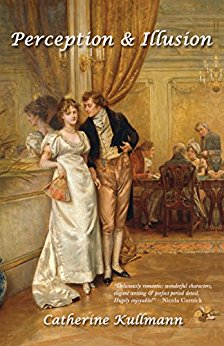
Nicky Moxey reviews Perception and Illusions by Catherine Kullman

 Today at The Review, Nicky Moxey reviews Catherine Kullman's Perception and Illusions. The author is giving away a paperback copy - to anywhere in the world - as a prize. To win your very own copy, simply leave a comment below or on our Facebook page. The winner will be drawn on 14th February 2018. Good luck!


Perception and Illlusions by Catherine Kullman –.

“England 1814: Brought up by her late grandparents after the death of her mother, Lallie Grey is unaware that she is their heiress. When her father realises that he will soon lose control of his daughter’s income, he conspires to marry her off to his crony, Frederick Malvin in exchange for a share of her capital. But Lallie has fallen in love with Hugo Tamrisk, heir to one of the oldest titles in England. When Hugo not only comes to her aid as she flees the arranged marriage, but later proposes to her, all Lallie’s dreams have come true.”

This book – Catherine’s second – was published in March 2017, and I was delighted to have been given a copy of this book.

“Perception and Illusions” is a lovely, gentle love story, using the classic girl-meets-boy, girl-loses-boy, girl-gets-boy-back theme – but it’s very cleverly done. I pretty much devoured this book, in 3 sittings, I think; and given that neither romantic novels, nor this period, are my usual fare, that gives you an impression of the quality of the writing! The central character, Lallie, is sympathetically drawn, and her character arc is believable and engaging. The secondary characters are well-rounded and appealing too; in particular Hugo’s thoughts and motivations make you like him very much.
I loved the language and the way the book is structured- both very much of the period. There’s a clever device for introducing the chapters, which was a particular favourite of mine; it both sets the tone of the chapter, gives you a hint of the content, and added together describes quite neatly the course and hazards involved in falling in love!

Here’s Chapter Sixteen’s:
“The Island of Perseverance, on the opposite side, is good if the travellers be on a right course; further lies the Island of Obstinacy.” Should be part of every divorce counsellor’s toolkit…
The author has the knack of allowing you inside first one character’s head, then another – so it was possible to follow along with every twist of the all-too-familiar comedy of errors that the lovers managed to achieve – and then to sigh with relief as they finally managed to start unpicking all the things unsaid and assumed, and get their relationship back on course! I was very impressed with the delicacy of the love scenes. Poor old Lallie has had the worst kind of birds-and-bees advice – and this is Hugo’s thoughts on the matter…
“Lallie vielded sweetly to him in bed, it was true, but, in the depths of his heart, he must admit that she did not respond as ardently as he would like and always at the end there was that little sigh, as if she was glad that he had finished. So what have you to complain about, he asked himself savagely. That your wife is not as fond as you would wish? You can hardly tell her you wish she were less inanimate…”

As well as the bedchamber, we are transported to some sumptuous Regency feasts and balls. The author’s descriptions of each, along with the complicated rules of politesse involved, are delightful, and add a great deal to the atmosphere of the book. It’s here that the quality of Ms Kullman’s research is clearest – but never heavy. She concludes the book with one of my favourite things – a Historical Note that clearly explains what is real and what is not, and what accommodations have been made to the story.

Very few, it turns out!

I thoroughly enjoyed this book, for a number of reasons; I loved the period accuracy, the skill with which the author engages the reader, and the delicacy of the love story itself. I’d definitely recommend it - having finished this one, I’ve bought her first – this is an author with an effortlessly beautiful voice, and I want to read more.


About the authorCatherine Kullman was born and educated in Dublin. Following a three-year courtship conducted mostly by letter, she moved to Germany where she lived for over twenty-five years before returning to Ireland. She has worked in the Irish and New Zealand public services and in the private sector. She has a keen sense of history and of connection with the past which so often determines the present. Fascinated by people, she loves a good story, especially when characters come to life in a book.
She has always enjoyed writing, loves the fall of words, the shaping of an expressive phrase, the satisfaction when a sentence conveys my meaning exactly. She enjoys plotting and revels in the challenge of evoking a historic era for characters who behave authentically in their period while making their actions and decisions plausible and sympathetic to a modern reader. In addition, she is fanatical about language, especially using the right language as it would have been used during the period about which she is writing. But rewarding as all this craft is, she says there is nothing to match the moment when a book takes flight, when your characters suddenly determine the route of their journey.
Catherine's novels are set in the newly created United Kingdom of Great Britain and Ireland during the extended Regency period. The Act of Union between Great Britain and Ireland of 1800, the Anglo-American war of 1812 and more than a decade of war that ended in the final defeat of Napoleon at Waterloo in 1815 are all events that continue to shape our modern world. It was a time of revolution and inspiration, still a patriarchal world where women had few or no rights, but they lived and loved and died, making the best lives they could for themselves and their children. And they began to raise their voices, demanding equality and emancipation.
At the same time, the aristocracy-led society was under attack from those who demanded social and political reform, while the industrial revolution saw the beginning of the transfer of wealth and ultimately power to those who knew how to exploit the new technologies.
Links: Amazon US; Amazon UK; Facebook; website.


About the reviewer: Nicky Moxey lives in the middle of rural Suffolk, UK, and is owned by a slinky black cat who's far too clever for her own good. In her spare time, she is an amateur historian/archaeologist, and in non-work daylight hours is usually out on a field somewhere with a metal detector and/or a trowel. She has added quite a few things to the Heritage England Record and the Portable Antiquities Scheme; but what really fascinates her is the stories behind the artefacts. Her first historical novel is about the story of a local boy made good - Wimer the Chaplain was born in Dodnash in Suffolk of a poor Saxon family, but made it to be a confidant of Henry ll, holding down the job of High Sheriff for all Norfolk and Suffolk. Then he gave it all up and came home to found a Priory... finding the original site of that Priory (not where it's shown on the map) is still one of Nicky's proudest discoveries. This should be published in the second half of 2017, touch wood. She also has a self-published series of children’s’ short stories about Henry Baker, a boy who finds a magic pencil on the way to school - she has no idea where these come from, but enjoys writing them immensely! 
Nicky's website can be found at nickymoxey.com

Sunday, 18 September 2016

Diana Talks to Charlotte Betts


I was fortunate enough to catch up with Charlotte Betts in the lift at HNS16 - the Historical Novel Society conference that was held this year at Oxford. Charlotte was one of the people who were making everything run smoothly and enabling us to enjoy the conference, but she was kind enough to answer a few questions.

Charlotte is one of those enviable people who always looks immaculate and I could only admire how she always looked as beautifully presented however harried she must have been feeling.

Please note that if you would prefer to leave a comment on Facebook you can do so here on our
Facebook Page


Charlotte Betts discovered a passion for writing after her five children had grown up and left her in peace. Demanding careers in hotel design and property force her to be inventive in finding time to write but she has achieved seven novels in eight years. One of her short stories was published in Scribble and others short-listed by Writers’ News and Real Writers’. She has won first prize in five short story competitions and wrote a regular column on interior design for The Maidenhead Advertiser for two years. She is a member of WordWatchers http://www.wordwatchers.net/ and the Romantic Novelists’ Association.

Charlotte, I am sure that you are tired of being asked the usual questions that would be interviewers ask authors, so hopefully this interview is an interview with a difference and I have come up with some unusual questions!

If your latest book The House in Quill Court https://goo.gl/Lw4Ure was adapted into a TV show or a film, who would you like to play the lead role?

I had to think hard about this. I’d like Carey Mulligan or Lily James to play Venetia, though both have brown eyes instead of blue-green. The heroine’s spirit and personality is more important here than the colour of her eyes. Perhaps the actress could wear coloured contact lenses? Aidan Turner doesn’t have blue eyes either but would in all other respects be perfect as Jack, the hero. I’m sure you ladies will agree with me on this!
(Note by Diana: Does 'anyone' ever look at Aidan Turner's eyes???? :-) )

If, as a one off, (and you could guarantee publication!) you could write anything you wanted, is there another genre you would love to work with and do you already have a budding plot line in mind?

I’d like to write a really dark psychological thriller. Alternatively, a series of detective novels about a quirky detective who lives somewhere exotic. I don’t have any particular plots in mind because, if I did, I’d become so involved with it I’d have to write the story. I don’t need any distractions at present from producing one historical novel each year!

Do you have any rituals and routines when writing? Your favourite cup for example or ‘that’ piece of music...??

I always have a bone china mug of tea at my side – I hate thick mugs! I prefer to write somewhere quiet, though I’ve learned to tune out of background noise, such as in a coffee shop or on a train. I rarely listen to music as it’s too distracting, though I have been known to put Sounds of the Sea on my i-pod to drown out conversation. My most important ritual is to daydream, usually when walking the dog or at the point of falling asleep. That’s when my plot gets sorted.

What is the worse book you have ever read? What made it unreadable for you?

I couldn’t possibly comment! I would hate another author to quote one of my books as being the worst book they’d ever read so I’m not going there.

What makes a book unreadable for me it to find it full of grammatical errors and spelling mistakes. Even if you tell a terrific story this sloppiness shows a lack of courtesy to the reader. It’s not hard to find professional editors who will correct these mistakes. Then there is waffle. I want a story written in clear, beautiful language that makes me look at life differently and teaches me something new. I dislike apathetic characters and improbable plots. I could go on …

Other than writing full time, what would be your dream job?

I used to have my own interior design business, which was my dream job. I loved (almost) every minute of it. It’s necessary for my wellbeing to be creative in one way or another. I am incredibly fortunate to be able to write full time now and this satisfies that requirement for creativity.

Coffee or tea? Red or white?

I need tea, builders’ tea, on an hourly basis for the creative Muse to sit on my shoulder egging me on. I enjoy a glass of white wine sitting in a sunny garden and a glass of red by a fireside but, if I was forced to make a choice between tea and wine, then tea would win.

If you had free choice over the font your book is printed in, what font/fonts would you choose?

Any font that is clear and unfussy. I want people to read my story not admire the font.

Imagine that you could get hold of any original source document. What would it be?

The diary of someone who lived in whichever period I’m currently writing about. It could be written by a servant or a queen because both would contribute their own view of society at that time. A queen’s maid might give an insight into the lives of both.

Original sources are incredibly valuable to the author. Samuel Pepys’s diary was my bedside companion for years when I wrote three novels set in the seventeenth century.

Historical fiction authors have to contend with real characters invading our stories. Are there any ‘real’ characters you have been tempted to prematurely kill off or ignore because you just don’t like them or they spoil the plot?

It is sometimes annoying when a real historical person won’t conveniently die to suit my plot but it’s up to me as the writer to create a story that fits the facts. The manuscript I’m currently working on has part of the plot revolving around Caroline of Brunswick. Her life events meant I had to make my fictional part of the story cover a much longer period than I’d have liked.  

Are you prepared to go away from the known facts for the sake of the story and if so how do you get around this?

I always adhere to the facts. When I’ve chosen a particular point in time as the setting for my story I research the events carefully and write these out as the ‘skeleton’ of my story. Then I weave the story I want to tell through this, bending the fiction to fit the fact and never the other way around.

It’s important to me that my readers can be confident I’m not ‘messing’ with history. When I read historical fiction I like to learn about history and would be disappointed if I discovered the story wasn’t correct. Of course, facts can be subjective. For example, in the case of a battle, the story is often written from the victor’s point of view. A German soldier might have written a very different account of a WWII battle than that of a British soldier.

Do you find that the lines between fact and fiction sometimes become blurred?

I spend a year or more thinking about and writing a novel and to make it real to me I daydream a great deal. Since I always identify with my heroine, after a while I feel as if I’m living a parallel existence. Sometimes I have to stop and think where I am! It’s as if I have a tiny television screen in my mind and I watch the story in all its detail but if something isn’t working I roll back the film and rewrite it. Daydreaming is a valuable and powerful tool for an author.

Have you ever totally hated or fallen in love with one of your characters?

Always! If I don’t hate my villain and love my heroine it’s unlikely my reader will feel strongly about them.

What do you enjoy reading for pleasure?

Whilst I read historical fiction I also like mysteries and psychological thrillers such as those by Nicci French. I’m a sucker for recipe books as I love to cook. I re-read books I’ve had for years: Mary Stewart, Dick Francis, Robert Goddard and Jean Plaidy. I also get a buzz from whatever research book I’m reading. If I didn’t, I doubt I’d write historical fiction.

What drink would you recommend drinking whilst reading your latest book?

I should probably say a glass of negus or ratafia but the answer has to be, whatever the reader enjoys most. For me, of course, it would be a ginormous cup of strong tea. No sugar, please.

Last but not least... favourite historical author?

There are too many to mention but I shall begin with Tracy Chevalier, Philippa Gregory, Anya Seton, Elizabeth Chadwick, Judith Lennox, Diana Gabaldon …

Diana, thank you for inviting me to be interviewed for The Review. I’ve enjoyed answering your thought-provoking questions.

Website
Twitter

Charlotte's latest book, The House in Twill Court, is available in both Kindle and paperback editions and has had some exceptional reviews

Amazon UK
Amazon.com

© Diana Milne July 2016 © (Charlotte Betts August 2016)

Saturday, 8 February 2014

GRIMALDI, King of Clowns

My copy of Richard Findlater's Grimaldi King of Clowns is almost sixty years old, and was a gift from my wife.

I first found the book in my local library.  Having an interest in theatre history, and especially such folk theatre traditions as the Italian Commedia dell' Arte, which helped to inspire the English pantomime, I was intrigued to discover a biography of the most famous and influential English Clown.  What I wasn't expecting was a story that would move and inspire me.  Joseph Grimaldi instantly became one of my heroes.

Richard Findlater had little to go on when he decided to research the life of the great Clown of the Sadler's Wells theatre who became the leading light of the Regency pantomime.  Grimaldi himself had written his Memoirs, later in life, and these were edited by none other than Charles Dickens, but the Memoirs are a curious blend of make-believe and misremembered anecdotes.  They don't really tell us who Joe Grimaldi was.

Joseph Grimaldi, without the distinctive grease paint
 
Findlater had another problem: the theatre is an ephemeral art, and perhaps nowhere more so than in the performance of comedy.  A few scripts might remain; prints and portraits might survive (some prints of Grimaldi in action were hugely popular in the London of the early 19th century), and the occasional recollections of someone who saw the Clown at the height of his uproarious powers might give a hint of his genius.  But how to capture that lightning in a bottle - the particular improvisational skills that, along with his ferocious energy, made Joe Grimaldi such a star?
 
Somehow or other, Richard Findlater achieved the impossible.  Although we can still struggle to imagine precisely what it was that Grimaldi did so well, the atmosphere of the theatre at the time is conjured up so expertly that the reader can almost see Joey the Clown in his element.  He is muscular and elastic, as if he had no bones in his body.  His whitened face, daubed with reddened cheeks and wearing a coxcomb or bobbing antennae, is a lugubrious combination of twinkling, mischievous eyes and a great, wide oven mouth.  He "mugs" - grimacing and winking - and he bounds across the stage in enormous strides.  He transforms himself, and anything else around him, challenging every rule in the book.  He fights, he dances, he tumbles.  He makes you laugh - King George IV once burst his stays laughing at Grimaldi's antics - and he can make you cry.  And in that, Findlater's charming biography matches the stage genius: his life of Grimaldi inspires admiration, sympathy, excitement and heartache.


Born into a theatrical family, just a week before Christmas in 1778, young Joe first appeared on stage when he was barely two and a half years old.  His father - a tyrannical, melancholic character, obsessed with a phobia of premature burial - introduced him to "skin work", which required the child to perform as a monkey, cat or dog.  During one performance, "Old Grim" was swinging his young son around the stage by a chain attached to his waist.  The chain snapped, and the boy was flung out into the stalls, landing on a very fat gentleman in the audience.  Young Grimaldi was, fortunately, unhurt - but it was the first of many theatrical accidents which, combined with the unimaginable exertions that made Grimaldi's act so extraordinary, eventually conspired to ruin him physically.


For all his tremendous success, and the fondness of the theatre-going public in that volatile age, tragedy and misfortune dogged Grimaldi's life and career.  Fastidious in refusing to fall into any "tears of the clown" traps, Richard Findlater covered the emotional blows which struck Grimaldi so often with a neat combination of directness and delicacy.  Moreover, his portrait of Joe the actor, and Joey the Clown, assembled from a thousand minor details, is such a winning picture of a gentle, kind and unassuming man that the reader's sympathies are surely aroused.  We celebrate his triumphs, and we feel his agonies.

Among the high-points is the story of a seaman who, after suffering a bout of sunstroke, had been deaf and dumb for several years.  His friends took him to see Grimaldi on stage.  Partway through the hilarity the seaman turned to his nearest companion and remarked on what a "damned funny fellow" the Clown was.  His companion gawped - "What?  You can talk?"  "Aye," said the seaman; "and I can hear, too!"  A great cheer went up from the sailors.  Grimaldi's fooling had cured a deaf and dumb man.


There are so many gems in Findlater's loving biography that one is spoilt for choice.  The juxtaposition of the farcical and the dramatic, the uplifting and the downright tragic, makes for a very special read.  Whenever I have immersed myself in Grimaldi King of Clowns I have warmed to Joe Grimaldi, often without realising it, and before I know it I am suffering along with him the loss of his loved ones and the physical incapacity which cut short his astonishing career.  So I will sign off with something that is only touched upon at the end of the book.

Every year, in January, clowns gather at a London church to celebrate the life of the King of Clowns, who died 180 years ago.  The rest of the world might have forgotten him, but the professional fools of the circus still honour Joe Grimaldi, the greatest clown that England has ever known.  And thanks to Richard Findlater, who combined detailed research with an easy narrative touch, the life of this wonderful, fascinating man is available to anyone who fancies a trip back to that ludicrous, gluttonous, chaotic period in our country's past and a few evenings spent in the company of a man who gave everything to make people laugh.

The grave of Joseph Grimaldi,
Joseph Grimaldi Park,
St James Churchyard,
Pentonville, London
(photo by Cassiato)
 
 
This is the first of an occasional series in which Simon Andrew Stirling discusses historical nonfiction and those biographies that have most impressed and inspired him.  Simon is the author of The King Arthur Conspiracy and Who Killed William Shakespeare?, both of which are available from Amazon.  He is an experienced public speaker and lecturer, a trained actor and professional dramatist who also works as a script consultant.
 
If you would like Simon to review your book, please click on the Submissions tab at the top of this page.