Showing posts with label Richard Abbott. Show all posts

Wednesday, 28 June 2017

Sharon reviews Half Sick of Shadows by Richard Abbott

 Today Sharon Bennett Connolly reviews Half Sick of Shadows by Richard Abbott, a fascinating historical fantasy. The author has kindly offered a signed paperback as a giveaway to a winner in the UK, or a Kindle copy to anywhere else in the world. To be in with a chance of winning this fabulous story, simply leave a comment below of on our Facebook Page.
The winner will be drawn on 5th July. Good luck! 


In ancient Britain, a Lady is living in a stone-walled house on an island in the middle of a river. So far as the people know, she has always been there. They sense her power, they hear her singing, but they never meet her.

At first her life is idyllic. She wakes, she watches, she wanders in her garden, she weaves a complex web of what she sees, and she sleeps again. But as she grows, this pattern becomes narrow and frustrating. She longs to meet those who cherish her, but she cannot. The scenes beyond the walls of her home are different every time she wakes, and everyone she encounters is lost, swallowed up by the past.

But when she finds the courage to break the cycle, there is no going back. Can she bear the cost of finding freedom? And what will her people do, when they finally come face to face with a lady of legend who is not at all what they have imagined?

A retelling – and metamorphosis – of Tennyson’s Lady of Shalott.


There is one great advantage to being a book reviewer; every now and then you get to read a gem of a book, one that you may never have discovered had you relied on Amazon's reading recommendations. Half Sick of Shadows is one such treasure. This novel, inspired by Alfred Lord Tennyson's epic poem The Lady of Shalott, is unique and engrossing from the very first page.

When trying to think of a single word that could be used to describe this novel, the only one that seemed to fit was 'mesmerising'.

The reader is instantly drawn into the world of the Lady, who can watch the lives and interactions of the people in the world only through the guide of a mirror. She can see the world, but is apart from it, safe in her own keep. And the people are aware of her, can sometimes hear her singing when the veil between their two worlds sometimes allows it. However, there is no communication, at first and the Lady can only watch and learn and yearn to be in their company.

It was late spring outside, so the Mirror told her, and the air was warm. She guided the Mirror's view through the woodland glades and saw the purple flowers pushing through the last year's leaf litter. Small insects busied themselves around them, and she took the view right in to gaze at the intricacy of their bodies. Each probosics plunged deep into the bell petals, and a dust of pollen clothed them as they moved on. She considered her own mouth, her own limbs, and wondered about her origins.

The story is a pleasure to read and has a natural progression all of its own. As the Lady's form changes through the centuries, so do the people she is watching mature and evolve, from early hunter-gatherers through small village communities into the recognisable interdependent feudal system of the Arthurian world. As the Lady changes, so does the world she is watching; an overnight sleep for her can be centuries for humanity; but her attachment to the world she watches grows and her relationship with those she observes is a pleasure to explore, as, once in a while, the veil between her world and there's drops ever so slightly.

She considered the actions of her younger self. She had been foolish, clearly, in placing her trust in the villager before being able to communicate properly. That woman had seen her not as a fellow traveller through the world, but simply is a guarantor of promises. The notion of a shared action to find joint companions, loyal and true, had never occurred to her.
No matter: she had left that woman, her son, her chosen partner, and a whole way of life somewhere in the remote past. It was time to see what llife was now like outside her walls.
She moved out from her sleeping chamber to the console. It looked very much as it had done  last time. The fancy of still working at a loom pleased her. It connected her to a part of the last cycle that she remembered with delight.
"Mirror, what new things should I know?"

Richard Abbott has recreated our world from the earliest times  and the Lady is the observer of our journey through the centuries, documenting our experiences and development. And while she watches us, the author - and through him, the reader - is watching her, reading her thoughts and experiencing her reactions to our changing world and her own experiences as she learns and grows.

Half Sick of Shadows is in a genre all its own, a historical fantasy with some science fiction elements and healthy dose of mystery, it is absolutely unique and a literary sensation. Beautifully written, with an interesting storyline and wonderful imagery, it is in a realm of its own - just like the Lady of Shalott.

I feel truly privileged to have been able to read and review such an engaging, entertaining and fascinating novel.

It truly is mesmerisng.


About the Author: Richard Abbott lives in London, England. He works very happily in IT, including dabbling in new technologies such as Alexa. He writes science fiction about our solar system in the very near future, historical fiction set in the ancient Middle East, and has recently started exploring historical fantasy. He has lots of ideas for new material to explore in writing and just needs a bit more time…
When not writing words or computer code, he enjoys spending time with family, walking and wildlife, ideally combining all three pursuits in the English Lake District. Online, he can be found at his website www.kephrath.com or blog and also on various social media sites including Facebook and Twitter

Speculative Fiction:
 'Half Sick of Shadows'; 'Timing'; 'Far from the Spaceports'

Historical Fiction:
'The Flame Before Us'; 'Scenes from a Life'; 'In a Milk and Honeyed Land'


About the The Reviewer: Sharon Bennett Connolly has been fascinated by history for over 30 years.

She has studied it at university and worked as a tour guide at several historic sites.
Sharon has been writing a blog entitled 'History...the Interesting Bits' for a little over 2 years and has just finished her first non-fiction work, 'Heroines of the Medieval World', which looks into the lives of some of the most fascinating women from medieval history and will be published by Amberley in September 2017. It is now available for pre-order from Amazon.
Sharon can also be found on Facebook and Twitter.


Wednesday, 12 April 2017

Where are they now... Margaret Cavendish - contributed by Richard Abbott

If I asked you to name some early science fiction writers, I'm guessing you'd think of Jules Verne or HG Wells, who established in the 19th and early 20th centuries so many of the conventions and themes of the genre.

Portrait of Margaret Cavendish (Wiki)
You probably wouldn't think of going back to 1666, and Margaret Cavendish, Duchess of Newcastle. But in fact, in the same year that the Plague was raging, and London experienced the Great Fire - only some 50 years after the King James Bible was translated, and Shakespeare was writing plays - Margaret Cavendish published her novel The Description of a New World, Called The Blazing-World. It has been called "the only known work of utopian fiction by a woman in the 17th century, as well as one of the earliest examples of what we now call 'science fiction' — although it is also a romance, an adventure story, and even autobiography".

Margaret Lucas was born in 1623, the youngest of eight children, and had a lively childhood, partly spent with Queen Henrietta Maria in exile in France. In 1645 she married William Cavendish, 1st Duke of Newcastle-upon-Tyne, who was a staunch royalist and reasonably successful military commander (so had had a difficult few years until the Restoration of Charles II). He was an enthusiastic patron of the arts and sciences, which is perhaps why he and Margaret formed a happy couple - her lively and wide-ranging intellect would undoubtedly have attracted his attention. He was devastated by her death in 1673, and died just three years later.

Cover - The Blazing World (Wiki)
She was not only an author of fiction, but also wrote over a dozen original works in diverse fields - poetry and plays, as well as a number of early scientific and philosophical treatises. The Blazing World was routinely distributed with her non-fiction Observations upon Experimental Philosophy, thus combining imaginative and scientific discourse. She was the first woman to attend meetings of the Royal Society, and engaged in debate with leading figures of the time such as Descartes, Hobbes, and Boyle. She was not shy about disagreeing with the thinking of the age when she felt it was in error, a habit which brought her criticism and conflict.

The Blazing World is, by modern standards, a slightly odd book. The protagonist, a lady whose name we never learn, is abducted by an impatient suitor, but her virtue is preserved by divine intervention which diverts the ship towards the north pole where the wickedly motivated men all perish. The lady herself is rescued by creatures which are man-like but with animal qualities - once in the Blazing World proper, she will meet Bear-men, Fox-men, Fly-men, Bird-men, Fish-men and so on. Her rescuers take her through a narrow passageway which connects our world with The Blazing World. Since there is only one such passage, and the celestial view in her new home is entirely different, a modern author might well describe this as a wormhole connection rather like in Stargate.

The Emperor of this world is smitten with her, and after a very short interval the two marry. There is then a long passage in which the new Empress quizzes the various theoretical and experimental factions in her new home - clearly satirising the state of affairs in the Royal Society, though many of the barbs evade recognition by today's reader. Part of this section describes the creation of a array of miniature universes, each intending to explore some particular theme, and most of which are unstable and collapse again because of their own inconsistencies. It sounds very like an early exploration of what we now call the Anthropic Principle - the laws of the universe are constrained by the fact that intelligent life has arisen in it.

Margaret Cavendish (née Lucas),
Duchess of Newcastle upon Tyne,
by Pieter Louis van Schuppen,
after Abraham Diepenbeeck,
line engraving,
late 17th century,
NPG D30185,
© National Portrait Gallery, London
In a way that would now be considered rather shockingly indulgent, she then as author brings herself in as a character - a sort of muse and scribe to the Empress. The two become exceedingly close friends. We are assured that the relationship is entirely platonic, but the degree of closeness far exceeds anything else in the book except that of Margaret to her husband.

The second half of the book describes a kind of interplanetary war - the Empress learns that her original native country is under attack by a large alliance, and decides her duty is to help. So she devises a kind of blitzkrieg strategy including air power (the Bird-men) and submarine warfare (the Fish-men) to overwhelm the assembled enemies. The combination is unstoppable, and it is clear that if she wanted, she could assume control of our world as well. Being of a restrained disposition she does not do this, but withdraws again once victory is assured.

The book closes with William and Margaret gaining inspiration for certain changes to their own estates on the basis of what they have seen in the alternative world, and a commitment to ongoing friendship and communion between the two worlds.

Margaret Cavendish and her writing went off everybody's radar for many years, with the rise of the true novel. However, after a considerable time of obscurity, she has started to resurface. In 1997 the Margaret Cavendish Society was formed to encourage academic study of her work. The blend of feminism, science, philosophy, fantasy and interpersonal relationships has found a resonance in our own age.

Margaret is quite open about her purpose in writing the book, and her pride in being its creator: "...you may perceive, that my ambition is not onely to be Empress, but Authoress of a whole World... in the formation of those worlds, I take more delight and glory, than ever Alexander or Cesar did in conquering this terrestrial world... concerning the Philosophical-world, I am Empress of it my self; and as for the Blazing-World, it having an Empress already, who rules it with great Wisdom and Conduct, which Empress is my dear Platonick Friend; I shall never prove so unjust, treacherous, and unworthy to her, as to disturb her Government, much less to depose her from her Imperial Throne, for the sake of any other, but rather chuse to create another World for another Friend."

Stirring words, indeed, and ones which many an author would identify with!

About the author:
Richard Abbott is one of the reviewers at The Review, and lives in London, England. He writes science fiction about our solar system in the fairly near future, and also historical fiction set in the ancient Middle East - Egypt, Syria, Canaan and Israel. His latest book is an excursion into historical fantasy,

When not writing words or computer code, he enjoys spending time with family, walking, and wildlife, ideally combining all three pursuits in the English Lake District. He is the author of In a Milk and Honeyed LandScenes From a LifeThe Flame Before Us - Far from the Spaceports. and Timing - and most recently Half Sick of Shadows. He can be found at his website or blog, on Google+GoodreadsFacebook and Twitter.

Thursday, 16 February 2017

Richard reviews Mariah's Song, by Barbara Emanuelson

The author of this book has kindly offered one copy of ‘Mariah's Song’. To be in with a chance to win, just leave a comment below or on our Facebook page (https://www.facebook.com/thereviewgroup/posts/1676615552367792).
The draw will be announced about a week after this post.

Cover image, Mariah's Song
Mariah's Song, by Barbara Emanuelson, is primarily intended as a YA book, but can easily be enjoyed by a much wider age range. It is rooted in a place and period of American history about which I knew almost nothing - a fishing village in mid 19th century coastal New England - but this underpinning is done so thoroughly that I soon felt at home. But the history, however authentic, is only the starting point for this lovely tale.

I'm a sucker for Selkie stories, which traditionally come from what we think of as Celtic lands, chiefly Scotland and Ireland. It seemed altogether plausible to me that similar themes might easily arise in the New England fishing communities we read about here. After all, the seal colonies are much the same on both sides of the Atlantic.

It was there that the seals would come. They were there that day, and were a comforting, familiar sight to my eyes... One in particular got my attention. It was a cow. Her head was raised higher than the rest, and she stared at me through the throng. She had beautiful dark eyes that seemed to call me, even though she made no sound.

The story, then, bridges historical fiction and fantasy, and carries the reader along with it. The main character, Mariah, faces difficulties in her community, and has to exercise the ordinary kind of courage needed for navigating through life. There are all kinds of choices to be made, both within her family and also as her romantic life begins to blossom. Such choices are not easy, nor does Mariah always choose rightly.

Monomoy Point Lighthouse, c.1865 (Wiki)
Circumstances have forced maturity on her earlier than we would consider normal today, but which has been the case for many young women throughout history. Surrounded as she is by kindness and cruelty, loyalty and prejudice, she has to choose which to imitate and fashion in her own life, and which to reject. The unfolding events - some of which are acutely painful - challenge her assumptions about life and her future, and draw out from her a growing sensitivity of soul.

But Mariah's life is lived in the liminal zone between two worlds - that of human society and that of the sea. Identifying and choosing the heritage site wants is not an easy task. She is essentially an amphibian, drawn towards two very different futures. On the one hand her life is very ordinary and constrained, but on the other it is full of mystery, enjoying a magical communion with the ocean. She is surrounded by help and support from both sides, but in the end has to make her own decisions.

Seal - Eastern Isles - Scilly
We lifted the nets, one at a time, with me standing in the middle to assist. We heaved as we threw the teeming nets on board. The cod wriggled and jumped, gasping for air, dancing until they moved no more. Soon, the boat was as still as our catch... It took us a few hours to get back to the wharf... Other fishermen were in, some before and some after us... None of them had a catch like ours.

I really enjoyed this book, as much for the immersion in period American life as for the fantasy elements. Mariah becomes a vivid, intensely credible person, and it is easy to prolong the fantasy and imagine her descendants still roaming the Atlantic seaboard. Mariah's Song comes highly recommended by me.


About the author:
Barbara Emanuelson
Barbara Emanuelson  is a retired educator and award winning author of fiction and folklore fantasy. In addition to MARIAH'S SONG, she is the author of the historical fiction  novel, THROUGH TEMPEST FORGED and two short ghost stories, "Blue Like the Water" (TALES FROM THE WASATCH AND BEYOND) and  "The Unveiled Bride" (TALES FROM OGDEN CANYON). As well as writing, she enjoys reading, gardening, walking, and playing the piano. She is the mother of three wonderful daughters. Barbara currently resides in North Carolina with her beloved husband, Reverend Father Jon and two cats, Marzipan and Chimene. The Mariah's Song Facebook page may be found at https://www.facebook.com/Mariahs-Song-1504253213233652

About the reviewer:
Richard Abbott lives in London, England. He writes science fiction about our solar system in the fairly near future, and also historical fiction set in the ancient Middle East - Egypt, Syria, Canaan and Israel.

When not writing words or computer code, he enjoys spending time with family, walking, and wildlife, ideally combining all three pursuits in the English Lake District. He is the author of In a Milk and Honeyed LandScenes From a LifeThe Flame Before Us,Far from the Spaceports- and most recently Timing. He can be found at his website or blog, on Google+GoodreadsFacebook and Twitter.

Saturday, 11 February 2017

Diana talks to ... Richard Abbott


Hi Richard, good to chat with you! Hopefully this interview is an interview with a difference and I have come up with some unusual questions!

First things first I am sure there is a question that you have always longed to be asked. Now is the chance. Ask your own question and answer it!

I thought the question should be something about the roles of men and women in my books. I like writing about both men and women, and the diverse interactions between them. I also write about situations which naturally lend themselves to active participation by both sexes – helped no little by working in an environment where this is completely normal. So it was with great pleasure that I read a recent review of Timing which talked about the “bevy… of intelligent and formidable women” found in its pages. Whether writing about past or future, I like to include as much diversity as I can.

If your latest book ' Timing ' was made into a TV show or a film, who would you like to play the lead role? Hmm, I’m not very good on the names of actors. Aamir Khan (who played the male lead in Lagaan) looks right for Mitnash, while Rene Auberjonois is just right temperamentally, though rather too old now. Alexander Siddig would be good too, I think. Out of women to play Slate, which is necessarily a voice part, I think Jennifer Spence or Alaina Huffman would do a good job. Both have played technically-skilled parts in science fiction before.

What made you choose this genre? Well, I like experimenting with different genres. I started with historical fiction – and one day hope to dive back into the remote past – but recently I have been exploring science fiction. My most nearly complete WIP, Half Sick of Shadows, is something of a historical fantasy. I don’t feel constrained to stick with one genre.

How do you get ideas for plots and characters? I am a great believer that many human traits are the same whether you look back or forward in time. So, I find inspiration in the human interactions and occupations I see around me. The scribe Makty-Rasut and his fellow tomb workers in Scenes from a Life were drawn heavily from situations I saw when I was an IT contractor. My current science fiction series is based around financial fraud and hacking, something I have to be aware of in my day job. But (to reassure those who know me) hardly anyone is copied directly from a real person… there are always changes and blends going on. I hope that readers will recognise the kind of characters they meet in my books, but not specific individuals. Plot-wise I start with broad ideas (say a particular kind of financial crime) and work towards details.

If, as a one off, (and you could guarantee publication!)  you could write anything you wanted, is there another genre you would love to work with and do you already have a budding plot line in mind? (Wry laugh) Well, I can guarantee publication because I do it myself! What I can’t guarantee is popularity… But seriously I like dabbling with multiple genres. I do want to go back to historical fiction sometime, partly to tie up the loose ends in my Late Bronze Age series, and then to go back even further to the Neolithic or such like. But I have rough plans for a couple more science fiction books, and I have really enjoyed the sidestep into fantasy – look out for Half Sick of Shadows, later this year sometime. That’ll keep me busy for a while for sure.

Was becoming a writer a conscious decision or something that you drifted into (or even something so compelling that it could not be denied?) How old were you when you first started to write seriously? I have always liked reading, and way back in university days started a long fantasy novel. That manuscript is long since lost – perhaps for the better – and many years passed before I started writing again. The way in for me was via historical study, and the jump to fiction was small. So, I guess it was progress in fits and starts.

Marmite? Love it or hate it? Kind of indifferent (sorry) – I wouldn’t select it if there was a choice, but I wouldn’t turn it down either.

Do you have any rituals and routines when writing? Your favourite cup for example or ‘that’ piece of music...?? I write a lot on the Northern Line, tucked in a corner as I travel between East Finchley and Embankment. That doesn’t really lend itself to favourite bits and pieces. If at home I almost always write without music on – but if I’m editing or working over some already-written piece, then I will probably put on some cool prog rock like Yes or Caravan. Recently I’ve been indulging in Manfred Mann. I almost always write first on my phone, into GMail, then transfer into a text editor and produce the Kindle version in the evening. That way I can always check how it looks on an actual reader. But often it’s a matter of grabbing whatever time I can in the midst of a busy life, so I can’t be too precious about rituals and such like.

I promise I won’t tell them the answer to this, but when you are writing, who is more important, your family or your characters? Family definitely.

Other than writing full time, what would be your dream job? I really like what I do (quality assurance in IT) and would be reluctant to give it up. I reckon there’s a lot of value in keeping on working with other colleagues and doubt my ability to manage well if I was just on my own – probably this way madness lies! Given the option I’d probably shift the balance a little between day job and writing, but I wouldn’t want to give up the day job altogether.

Coffee or tea? Red or white? Tea, almost every time. For alcohol, probably white though I’d prefer a nice ale to any sort of wine.

How much of your work is planned before you start? Do you have a full draft or let it find its way? For historical fiction, I have a clear plan not just for plot but for structure as well, since formal layout was important back then and I like to try to imitate the process of creation as well as the setting. For the rest, I have a sense of where I want to go, and some specific key scenes along the way, but I am not nearly so orderly about planning here. I don’t make a draft in the conventional sense of that word – just lots and lots of reappraisal as the thing develops.

If you had free choice over the font your book is printed in, what font/fonts would you choose? I’m a rebel here and an enthusiast of epublishing – so I’d want my readers to pick their own font at will rather than feel they had to put up with my choice. Just for fun, I tried seeing what my books look like with the fairly recent dyslexic font available in many Kindles – I couldn’t read it all the time but it was a useful exercise seeing what it was like.

Imagine that you could get hold of any original source document. What would it be? The founding statement of principles of the first colony on the asteroid Ceres, at the point it transitioned from being just a commercial mining settlement into a real human community.

Have any of your characters ever shocked you and gone off on their own adventure leaving you scratching your head??? If so how did you cope with that!? A minor character from Far from the Spaceports has developed something of an interesting life of her own – and will continue to do so in #3 (provisionally called The Authentication Key). I just went with the flow, presuming that my subconscious knew all about this.

How much research do you do and do you ever go on research trips? For historical fiction, yes, lots, and yes I have (some of the Greek islands, Egypt, Jordan, and Israel). For science fiction, I’d certainly be up for a trip to the asteroid belt – or even Mars – if anybody offered it. Sadly, the opportunity has not yet presented itself. For the emerging fantasy books, I guess the research is more into internal space rather than external.

Fiction authors have to contend with real characters invading our stories. Are there any ‘real’ characters you have been tempted to prematurely kill off or ignore because you just don’t like them or they spoil the plot? Well, when I write historical fiction I focus on people who were in normal terms rather unimportant. So, the problem doesn’t really arise. Besides, I am looking at periods of time where the amount of written evidence is small, and we know the names of so few individuals that I don’t feel constrained. Nobody has yet quibbled about my portrayal of Joshua in In a Milk and Honeyed Land, but then I didn’t kill him off or anything nasty. Unless you’ve acquired a time machine it’s not an issue when writing about the future! But even there, I prefer writing about ordinary people rather than Galactic Overlords or the like.

Are you prepared to go away from the known facts for the sake of the story and if so how do you get around this? Same answer really – in the historical periods I like, “known facts” are few and far between. I have a desire to write something set in ancient Doggerland (now under the waves of the North Sea) and I don’t reckon many facts will disturb me there. With futuristic stuff, I try to be careful to make the technology plausible, which I suppose is meeting the same goals as checking historical facts.

Do you find that the lines between fact and fiction sometimes become blurred? In the places and times I write about, they are always blurred! There are ongoing vigorous debates about whether whole decades and centuries need to be moved around, even for something as recent as Late Bronze. I don’t live in a fictional world where everyone is confident of the actual date and hour of this or that event. That’s part of the pleasure…

Have you ever totally hated or fallen in love with one of your characters? Never hated them – I wouldn’t bother to write about them if I hated them. But there are definitely people that I would get seriously fed up with if I had to work with them. But love some of them, oh yes.

What do you enjoy reading for pleasure? Mostly good science fiction or good fantasy. I have got a bit chary of some historical fiction as there is a trend for high body counts and the like. But when I find a book I like then it doesn’t really matter what genre it is. As a rule, I prefer novella or novel length books to short stories.

What drink would you recommend drinking whilst reading your latest book? Russian Caravan tea.** Or maybe a really nice Jasmine green tea. Or just possibly a local ale if something stronger takes your fancy.

Last but not least... favourite author? I think this has to be Ursula LeGuin. There are a few others close to her but on balance I’m sure she is at the top of the pile.
Thank you Richard! Very interesting!!
Richard Abbott writes fiction set in two very different places. First, there is historical fiction set in the Middle East at the end of the Bronze Age, around 1200BC. The second area is science fiction, set in a near-future solar system exploring issues of high-tech crime and human-machine relationships.

His first science fiction book, Far from the Spaceports, introduces Mitnash Thakur and his virtual partner Slate as they investigate financial crime in the asteroid belt. A follow-up novel, Timing, introduces a new investigation starting about a year later.

His first book, In a Milk and Honeyed Land, explores events in the Egyptian province of Canaan. It follows the life, loves, and struggles of a priest in the small hill town of Kephrath.

A follow-up novel entitled Scenes from a Life begins in Egypt. It follows the journey of a scribe as he travels to discover his origins. down the Nile from Luxor and finally out into Canaan.

A third book, The Flame Before Us, is set in the middle of calamity. New settlers are arriving from the north, sacking cities and disrupting the established ways of life as they come. This story follows several different groups each trying to adjust to the new situation.

Author readings from both In a Milk and Honeyed Land and Scenes from a Life are available online as YouTube videos.

The short story The Man in the Cistern is set in the same location as In a Milk and Honeyed Land, but around ten years later.

The short story The Lady of the Lions is set in the same location but around one hundred and fifty years earlier.

Triumphal Accounts in Hebrew and Egyptian is the ebook version of his PhD thesis which, for those who want the technical details, supplies academic underpinning for some of the ideas and plot themes followed up in fiction.

Richard lives in London, England and works professionally in IT quality assurance.

When not writing words or computer code, he enjoys spending time with family, walking, and wildlife, ideally combining all three pursuits in the English Lake District.
 

**Russian Caravan is a blend of oolong, keemun, and lapsang souchong teas, all produced from Camellia sinensis the Chinese tea plant

© Diana Milne January 2017 © Richard Abbott December 2016


Tuesday, 18 October 2016

When the earth moves under your feet, a blog post by Richard Abbott

In Britain, we're used to history - and historical fiction books - where the terrain is basically the same as today. The human presence on the surface might well change, so that towns and cities grow, old buildings turn to ruins, rough tracks turn into railway lines, and so on. Or we might alter the clothing of vegetation - marshes are drained, forests felled, or fertile land turns to peaty bog. But we generally feel here in England that the bones of the landscape itself remain the same on a human timescale. We expect the land to change form only over geological timescales.

Mt St Helens before and after (USGS images)
Other people though, in other parts of the world, have a different expectation. Earthquakes, volcanoes and tsunamis can not only cause loss of life or damage to property, but can reshape the terrain. Mount St Helens was reckoned to be one of the most attractive of the Pacific Rim volcanic cones until May 18th 1980, when the eruption removed over 1/8 of the volume of the former cone. Iceland gained a new island in November 1963, when Surtsey emerged from the waves as a result of subterranean action.

But often we Brits think of that as something which happens in other lands. But actually there are signs of change in counties like Norfolk and Lincolnshire. Near to Cromer, several villages named in the Domesday Book or other more recent records are now up to half a kilometre out to sea. There is evidence that the Lincolnshire coast was, until the 13th century, protected by a chain of offshore barrier islands. The demise of these in a series of storm surges drastically altered the coastline and its vulnerability to the sea. But despite these signs here in our own land that our not-so-distant ancestors walked across a different landscape, it takes a bit of adjustment.

The geology is quite straightforward. During the last ice age, a little over 10000 years ago, a hugely heavy layer of ice pressed the land downwards, to a greater degree in the colder north than the warmer south. When the ice melted, two things happened. The sea level rose because of extra water. But also the land shifted. The land in places where the ice had been heaviest started to lift up. Outside that, further south, it started to sink down. Try placing a heavy book on a soft cushion and you'll see the effect in action.

Now, 8000 BC is not all that long ago, really - the Neolithic Age, and so the beginnings of recognisably complex society started not all that much later, around 5000 BC. And although the vertical movement of land in any one year is tiny - perhaps a few millimetres - over the course of a century it adds up. Our Neolithic and Bronze Age ancestors in some parts of the country experienced quite different terrain.

Aerial view of the Scilly Isles (Wiki)
In the north, where the land has lifted, we find settlements which used to be on the coast now stranded well above the waterline. Stone circles at the southern end of Coniston Water, in Cumbria, used to be close to an arm of the sea reaching in from Morecambe Bay, but are now over five miles from the coast.

But in the far south, in the Scilly Isles, we see an even more dramatic change as the land sinks down. During the Bronze Age, when many of the prehistoric monuments were being built, there was basically a single large island. Around that, especially to the west, there were a few scattered outposts including what we now call St Agnes, Annet, and the Western Isles. The whole central area, now a submerged area in which quite large vessels can anchor if they find the deep patches, was then a fertile plain supporting crops and animals.

Tidally submerged field wall, Samson, Scilly Isles
All that has gone - perhaps spawning tales of Lyonesse or Atlantis - but its passing has been recorded in history. Even now, low tide allows careful explorers to go well beyond the shoreline, disturbing herons and other wading birds browsing what has been left in the seaweed and rock pools. You pass by the remains of stone walls which presumably served as boundary markers, but are now submerged much of the time. At especially low spring and autumn tides, tall people can still cross between most of the islands without swimming - so long as you know where the sand bars and shallow patches are.

As well as simply projecting backwards the change in sea level, at a rate of 30 centimetres per century, we can look back at history. We know that in 1127, Tresco and Bryher were still a single island, with the two names referring simply to internal parish divisions. By 1600 they were separate, and the Grimsby Sound between them had become a sheltered haven for ships. The transition did not take many generations, and you have to wonder what the occupants made of the stories of their ancestors.The central area between St Mary's and the northern cluster of islands probably flooded around 6-700AD. On the other side of the country, ship burials were happening at Sutton Hoo.

But a change of 30 centimetres per century disguises the more dramatic way in which these events unfolded. This figure comes into perspective when you remember that the tidal range in a big spring tide on Scilly is around six metres. During a winter storm, waves coming across the Atlantic sometimes break over the top of the Bishop Rock lighthouse, some fifty metres high. The changes to separate island from island have not always been the result of a steady trickle of rising water; some will have been dramatic, cataclysmic events.

Samson, Scilly Isles - still one island at present...
This continues to happen today. It used to be reckoned that there were 146 islands in the archipelago, where an island is defined as a body of land separated at high tide and able to support vegetation of some kind. A few winters ago, this became 147, when a severe storm broke through a thin land bridge at Rushy Bay, Bryher, and converted a peninsula into an island. You look at some places as you walk around, and wonder how long they will remain attached.

From a fictional point of view, these kinds of gradual changes to the land itself offer a new storytelling dimension. Authors have explored - and I hope will continue to explore - sudden changes like the eruption of Vesuvius, or various earthquakes. Gradual change has not, I think, been used nearly so often. It could perhaps make for an interesting historical plot based on prehistoric Doggerland, in today's North Sea. Or a speculative fiction story where diminishing land serves as a variation on resource failure. It's worth remembering that the terrain we see today is not eternally fixed - even in this green and pleasant land - and has its own changing history.


About the author:
Richard Abbott is one of the reviewers at The Review, and lives in London, England. He writes science fiction about our solar system in the fairly near future, and also historical fiction set in the ancient Middle East - Egypt, Syria, Canaan and Israel.

When not writing words or computer code, he enjoys spending time with family, walking, and wildlife, ideally combining all three pursuits in the English Lake District. He is the author of In a Milk and Honeyed LandScenes From a LifeThe Flame Before Us - and most recently Far from the Spaceports. and Timing. He can be found at his website or blog, on Google+GoodreadsFacebook and Twitter.

Friday, 8 July 2016

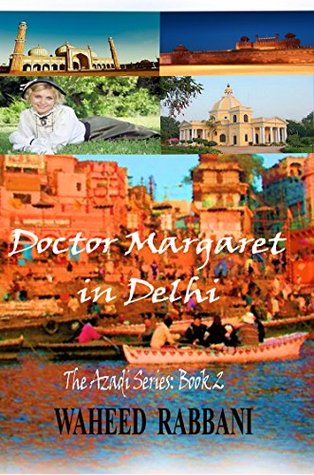
Richard reviews Dr Margaret in Delhi, by Waheed Rabbani

The author of this book has kindly offered one e-copy (Kindle or epub) each of ‘Doctor Margaret's Sea Chest’ and ‘Doctor Margaret in Delhi’ - so there will be two lucky readers this time. To be in with a chance to win, just leave a comment below or on our Facebook page.
The draw will be announced about a week after this post.

Cover image (Goodreads)
Dr Margaret in Delhi is the second book in Waheed Rabbani's series (the first being Dr Margaret's Sea Chest). It continues her journey from Canada via the Crimea to India, and presents a colourful and varied picture of Indian life of that time, mostly in the Delhi area. I had not read the first book, so had some initial anxiety as to whether I would be able to follow this one. It is clear that there will be at least one more book to follow. It is a lengthy book (nearly 400 pages in the print equivalent) and a lengthy series to become absorbed in.

This story is almost entirely set in India of the 1850s. It follows Dr Margaret of the title (Margaret Wallace) as she travels from Calcutta - modern Kolkata - to Delhi, and experiences life in Delhi itself. This part of the book is easily read with no prior knowledge, as the circumstances of Margaret's earlier life are well explained in various stages. However, there is a short frame story set in present-day Canada, and I found this harder to make sense of. I assume that the first story gave some context for the various actions going on there.

But with so much of the story set in mid nineteenth century India, this is where I shall focus. At this time, the British presence in India was changing from its original mercantile base, claimed by the East India company, towards direct rule as a colony, enforced militarily. It was also expanding from a few major entry ports towards assimilating the whole nation. At this time, British leaders were largely acquiring territory by playing off one local ruler against another, and negotiating settlements which appeared fair, but actually favoured British interests and the rapidly growing ambition for empire. India, divided into a dense network of local principalities, alliances, and rivalries, was proving highly vulnerable to this divide-and-conquer strategy, and was beginning, far too late, to realise the inevitable outcome. The political situation leading up to this state of affairs is explained in considerable detail through the book.

Shipping at Calcutta (Kolkata), 1860s
http://www.oldindianphotos.in
So Margaret Wallace arrives into this setting, the child of missionary parents, and medically skilled by training. She is also recently widowed, carrying her husband's unborn child as the story opens. Waheed Rabbani has avoided the stereotype of a strident fundamentalist; Margaret's family are liberal in their faith and keenly interested in the diversity of religious expression in India, which allows her to interact successfully with many different people. She comes over as a caring and compassionate person, eager to practice both her medical skills and her ability to teach in all manner of situations. However, she is also lonely, rather naive, and often seems to have no real moral compass to guide her in difficult situations. Her responses to personal or sexual threats are driven more by social convention and personal likes and dislikes, rather than a clear assertion of right and wrong. She is quite luke-warm in her reaction to both pleasant and unpleasant turns of events, and the difficulties of being a single woman in a male dominated culture are in the foreground.

The fascination of the book comes, I think, from its focus. Rather than write an action story describing the military actions of this era, or a political drama looking at the equally fierce deals and betrayals, we are led to walk alongside Margaret as she pursues her own course. With lavish attention to detail of culture, language, custom, religion, food, and so on, the turbulence of the Indian setting is kept for the most part in the background. We have a personal view, not a national one.

Chandni Chowk from the Palace, Delhi, 1850s
http://www.oldindianphotos.in
However, try as she does to keep away from the conflicts of the rulers, new and old, this proves impossible, and Margaret is caught up in a web of betrayal and false accusation. It is not always clear why some people are so doggedly intent on blocking her progress - perhaps explained more in the first book - but there is something rather insanely determined about the antipathy of her adversaries.

This brings me to what I think is a central theme of the story - the playing out of karmic relationships between people, resulting in constant attraction or antipathy. In terms of Margaret's own Christian perspective, this would be described as reaping what you sow. Certainly her consistent and generous actions towards Indian communities, regardless of wealth or poverty, stand her in good stead in her own hour of need. But whatever the underlying explanation, the dogged way in which those who dislike her seek to ruin her life and reputation is a source of constant distress. Perhaps she will find resolution in book 3, but as reader, you will have to wait a while before you can find out about that.

Definitely a book to read if you like to be immersed in the details of a past society.  The book is set in a time of major transition for India, but the book focuses away from those, in order to explore the transformation of individual lives.


About the author:
Waheed Rabbani
Waheed Rabbani's The Azadi Series:Book I Doctor Margaret's Sea Chest won an Honorable Mention Award in the 2012 Global eBooks Awards Competition.

Waheed Rabbani was born in India, near Delhi, and was introduced to Victorian and other English novels, at a very young age, in his father's library. Most of the large number of volumes, had been purchased by his father at 'garage sales' held, by departing British civil service officers and their families, in the last days of the Raj.

Waheed graduated from Loughborough University, Leicestershire, England, and received a Master's degree from Concordia University, Montreal, Canada. While an engineer by profession, Waheed's other love is reading and writing English literature that prompted him to obtain a Certificate in Creative Writing from McMaster University, Hamilton, Canada and embark on his writing journey.

Waheed's historical fiction The Azadi Series, Book I: Doctor Margaret's Sea Chest, and Book II: Doctor Margaret in Delhi, are available at all Amazon, and other Bookstores.

Waheed and his wife, Alexandra, are now settled on the shores of Lake Ontario in the historic town of Grimsby. More information is available on his website: http://home.cogeco.ca/~wrabbani


About the reviewer:
Richard Abbott lives in London, England. He writes science fiction about our solar system in the fairly near future, and also historical fiction set in the ancient Middle East - Egypt, Syria, Canaan and Israel.

When not writing words or computer code, he enjoys spending time with family, walking, and wildlife, ideally combining all three pursuits in the English Lake District. He is the author of In a Milk and Honeyed LandScenes From a LifeThe Flame Before Us - and most recently Far from the Spaceports. He can be found at his website or blog, on Google+GoodreadsFacebook and Twitter.

Friday, 15 April 2016

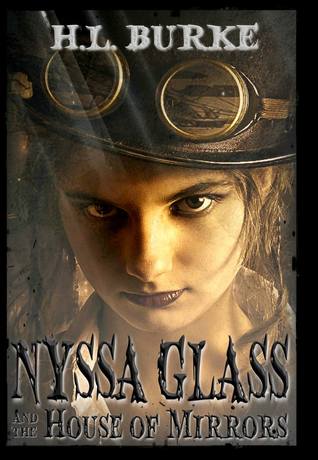
Richard Reviews Nyssa Glass and the House of Mirrors by H.L. Burke

The author of this book has kindly offered an e-copy (Kindle or epub) of Nyssa Glass and the House of Mirrors to one lucky reader. To be in with a chance to win, just leave a comment below or on our Facebook page.
The draw will be announced about a week after this post.

Cover - Nyssa Glass and the House of Mirrors
I read Nyssa Glass and the House of Mirrors, by H.L. Burke, on the recommendation of a friend and am very glad to have done so: I really enjoyed this story.

The plot follows a young lady - Nyssa, of course - through a series of exploits as she tries to extricate herself from being unjustly accused of murder. Her background is dubious enough to make the accusation likely to be believed, but she is determined to deserve the trust of her employer Mr Calloway, and her former teachers at Miss Pratchett's School for Mechanically Minded Maids. This determination keeps her going through puzzles, dangers, and difficulties.

On the surface, her basic task seems clear - find a way into a seemingly abandoned house and retrieve a missing item. But inevitably things are not so simple. The house turns out to be well-defended, although the protective systems are overdue for servicing and overhaul, and it is not so empty as it seems at first sight...

"A little over four years ago, all traffic in and out of Dalhart Manor ceased. Up until that point, Dalhart had been reclusive, but his staff and son were often seen going about their business. Then one day, half the staff was unexpectedly let go, and the remaining half..."

The action takes place almost entirely within a single day - barring some necessary flashbacks and a brief "what followed" section - but it is easy to forget the shortness of the timespan as you are carried along with the action. You reach the end of the book feeling that you have come to learn a great deal about her, owing to the intensity of her experiences.

"Once you start scraping away at the puzzle of that house, you won't be able to stop until you've excavated its last secret."

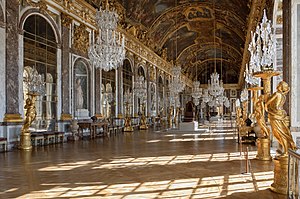
Hall of mirror, Palace of Versailles (Wiki)
A recurring theme of the book is the question of who Nyssa can rely on. Sometimes she makes the wrong decision, and finds herself having to work out how to undo the difficulties resulting from this. Her life experiences have not disposed her to be particularly trusting, and suspicion of motives easily rises to the surface of her thoughts. But the ongoing need to work out who is dependable and who is fickle is a major thread of the book, and one which several of the characters grapple with. The answers to these questions shift multiple times through the book as various facts and snippets of background become clear.

"Did I just turn on the security system? That has to be the biggest blunder in the history of cat burglary."

The author's chosen style is most like Steampunk, though with her own personal spin on the conventions of that genre which worked well for me. The level of scientific and technological accomplishment was a perfect complement to Nyssa's skills and abilities. Both feel entirely credible and I was fully immersed in the tale. I particularly liked the approach towards mechanical intelligence was handled - a very different route to our society's, or indeed what I choose for my own writing - but it is a persuasive and compelling alternative. There is a point where curious enquiry of possibilities gives way to the horrified realisation of reality, and this is handled particularly well.

"Please, someone... no, professor, no. It's not what I want. It's not right..."

House of Mirrors is a YA novel and the personal interactions reflect this. However, this should not deter anyone, and there is ample interest and character depth to satisfy an adult reader.

The cast of characters is comparatively small, and the end of the book strongly suggests that other books set in this world will follow in the future. I certainly hope so, and will be looking out for them.

Meanwhile, Mrs Burke has written a number of other YA fantasy novels, often with a dragonish theme.


About the author:
H.L. Burke
H.L. Burke
Born in a small town in north central Oregon, H. L. Burke spent most of her childhood around trees and farm animals and was always accompanied by a book. Growing up with epic heroes from Middle Earth and Narnia keeping her company, she also became an incurable romantic.

An addictive personality, she jumped from one fandom to another, being at times completely obsessed with various books, movies, or television series (Lord of the Rings, Star Wars, and Star Trek all took their turns), but she has grown to be what she considers a well-rounded connoisseur of geek culture.

Married to her high school crush who is now a US Marine, she has moved multiple times in her adult life but believes that home is wherever her husband, two daughters, and pets are - currently in southern California. She has written twelve books in speculative genres, ranging from Epic Fantasy to YA Steampunk.

Find out more at her web siteblog, on Facebook, Instagram, or Twitter.

About the reviewer:
Richard Abbott lives in London, England. He writes science fiction about our solar system in the fairly near future, and also historical fiction set in the ancient Middle East - Egypt, Syria, Canaan and Israel.

When not writing words or computer code, he enjoys spending time with family, walking, and wildlife, ideally combining all three pursuits in the English Lake District. He is the author of In a Milk and Honeyed LandScenes From a LifeThe Flame Before Us - and most recently Far from the Spaceports. He can be found at his website or blog, on Google+GoodreadsFacebook and Twitter.

Monday, 30 November 2015

Richard reviews: Back to Santa Fe by W.T. Durand

The author of this book has kindly offered an ebook copy (any format) to each of two lucky readers. To be in with a chance to win, just leave a comment below or on our Facebook page.
The draw will be announced on Tuesday December 8th.

Back to Santa Fe cover
Back to Santa Fe, by W.T. Durand, is a contemporary book exploring the personal and official investigation of a cold case. Although this initially appears to be a straightforward road accident, subsequent digging around reveals a much more sinister web of events. The central character, Sullivan, becomes determined to find out the truth of the affair, no matter what the personal cost. He works as a skilled carpenter on short-term building projects, and has to constantly juggle multiple priorities - such as earning money for food while trying to unravel the past.

The book deals with a part of America, and a part of American culture, about which I knew almost nothing. As such, there were plenty of slang words and casual expressions which have to be deduced from context, especially in conversation between the various characters. I actually did not find this a barrier, but rather an extension of the sense of uncovering secrets. There is a sense of listening in on a set of people who have no idea you are there, and are simply going about their daily lives as normal.

Santa Fe, from http://glenn-campbell.com
Santa Fe, from http://glenn-campbell.com
Secrets are, indeed, at the core of the book, and almost nobody is quite who or what they seem at first sight. The occasional person who is, in fact, entirely straightforward, therefore strikes the reader with a sense of confidence and relief amongst all of the pretence and deceit. The suspicion felt by Sullivan, heading towards paranoia, begins to affect you as reader, and you start to doubt the good intentions of perfectly honest people wanting to help.

Unfortunately for Sullivan, the layers of pretence obscure even his own family members. As this becomes clear to him, so also does the fact of his own lack of understanding and empathy. For a man to whom family loyalty is a major driving force, the revelation of his own insensitivity is a terrible blow, which threatens to crush him completely. He survives by rebuilding relationships on foundations of honesty, and the acceptance of difference.

The railyard, from https://www.santafe.org/
The Kindle version I read had a number of punctuation errors, chiefly arising from missing full stops or commas at the end of quoted speech. These could quite readily be caught by another proof reading sweep, and I did not find them a hindrance to my enjoyment of the book.

A lot of the plot circles around the official police investigation, reopened when some previously hidden facts come to light. I have no idea how realistic these are, but again for me that was unimportant. The draw of the narrative was the way in which, from several different angles, buried secrets were brought into the light so that they could be understood and, so far as possible after the gulf of time, justice enacted.

Sullivan's line of work runs as a background metaphor through the book, and surfaces quite explicitly near the end: "...boards are like people - you can't tell what's under the surface unless you take a little time to find out. It might be really good grain you expose, and it might be sign of internal rot. That's why my plane blades are always sharp."

Considering that we first meet Sullivan aggressive and drunk, and very far indeed from being sharp, this highlights the extent of the personal journey he has made.

All in all, an involving and enjoyable book which drew me progressively into Sullivan's life, as well as the part of America he lives in.

About The Author
A former commune-dwelling goat herding hippie and guitar picker turned tree planter and ski mechanic, illustrator, wood carver and carpenter; author Richard Sutton left college and hitch-hiked to New York in 1972 with forty dollars in his pocket and no preconceptions.

"There, I met my wife, worked in advertising and design until I was an empty, hollow shell, then ran a retail gallery, becoming an Indian Trader in 1985." More travel followed and a home in New Mexico. He finally saw the light of day and began to write fiction more or less full-time, in 1996.

An historical fiction/fantasy The Red Gate began it all in 2009, then a sequel, The Gatekeepers in 2010. 2011, saw the release of his first SciFi novella, Home, and Troll, a prehistoric-fantasy, followed in 2012. 2014, Back to Santa Fe was released April 1st, writing as WT Durand and On Parson's Creek, a YA mystery was just released in October. He lives with his wife and their cats, raccoons and other boarders in New York.


Richard Abbott is the author of In a Milk and Honeyed Land, Scenes From a Life, The Flame Before Us, and most recently Far from the Spaceports. He can be found at his website or blog, on Google+, Goodreads, Facebook and Twitter.

Sunday, 6 July 2014

Sunday Wrap Up: Week ending July 6, 2014

This being a pretty fab week for our American friends, who have been preparing for their Fourth of July hols, it's also been a semi-relaxing week here at The Review. Who doesn't want to get in on celebrations of independence? After all, we celebrate the freedom to read books of our own choosing: banned, unapproved, controversial--all kinds of literature that unfortunately in some spots on the globe are permitted only when approved by the government. For all of us here at The Review this is a sad state of affairs and we did a bit of contemplation over the week. 

While nothing in this week's Wrap Up is banned or unapproved in any way (as far as we know), we celebrate them because they, like the other magnificent books and interviews we have reviewed and conducted, add to the lexicon of knowledge, curiosity, creativity and sharing of ideas and fascinations across the world, person to person, in turn inspiring others to seek and achieve their own dreams. 

Happy birthday, America! And may all peoples achieve the freedom to read whatever it is they choose to do. 

********

Babus Reviews: Wynfield's Kingdom by Marina Julia Neary


Wynfield's Kingdom by Marina Julia Neary is a dark historical novel set from 1830, Victorian England. Dr. Thomas Grant, a newly qualified young physician from Cambridge, is relieved of his position in the household of a nobleman; he also is relieved of his license to practice medicine.

Marina Julia Neary creates her characters with much allure; she describes Dr. Thomas Grant:

There was nothing in his demeanor that would inspire suspicion, no distracting gestures or eccentric habits. One would expect neither heroic deeds nor crimes from him. He exuded composure, equanimity, an impartiality.

He vows never to medically treat the rich again and opens a tavern in Bermondsey to support himself. Whilst contentedly living the life of a self-confessed misanthrope, he saves the life of 10-year-old orphan Wynfield, whom he finds breaking into his cellar. After Dr. Grant treats his injuries Wynfield leads the local police and Dr. Grant to two-year-old Diana who is also an orphan. Not expecting the two-year-old to survive from her fragile condition through the night, Dr. Grant surpasses his own rather elevated expectations when she survives, albeit with a weak heart.

The stoic Dr. Grant houses the children as tenants. Wynfield grows up to be an affable young man of many talents. He entertains those around him with knife-throwing and dancing, but primarily works on the docks and contributing most of his wages to his landlord. Wynfield practically raises Diana, who works in the tavern for Dr. Grant and makes her romantic feelings for Wynfield abundantly clear. Their relationship is a complex one as the dividing line between love and hate is quite a fine one.

Wynfield goes from being a well-read misfit in society to the “King of Bermondsey,” and is revered by the local community for his entertaining skills, which include knife-throwing and stealing. A tragic event which results from his illegal activity makes him question what he has become and leads him to write and produce a play about his hero Cromwell. He casts Diana and his friends in this play and he showcases his anti-monarch ideals, which brings him to the attention of those who have a larger political agenda. Among these activists Wynfield discovers more about his origins.


What about these mysterious origins? Click here to see if the rest of the review gives any clues

*********

Louise E. Rule Interviews Richard Abbott for The Review's Author Interview 

Richard Abbott is the author of Scenes From A Life, which was reviewed by Margaret Skea in March here at The Review Group. If you would like to read Margaret's review, please click the above link.

The product description on amazon.co.uk tells the reader that:

[M]akty-Rasut is a scribe in New Kingdom Egypt, fashioning tombs for the elite. He lives a comfortable but restless life, moving every few years further upstream along the river Nile. He is content to exercise his talent without examining his origins.

Then a series of vivid dreams, interpreted with the help of a senior priest, disrupts this pattern. To solve the riddle, he must go on a journey that will take him outside the Beloved Land and away from the life that he knows. His travels take him into the neighbouring province of Canaan, to a hill-country village called Kephrath, and to a way of life he has never considere[d].

About Richard Abbott (from amazon.co.uk)

Richard Abbott lives in London, England. He writes about the ancient Middle East - Egypt, Canaan and Israel - and has also contributed to the lively academic debate about these times. His first book, In a Milk and Honeyed Land, explores events in the Egyptian province of Canaan at the end of the Bronze Age, around 1200 BC. It follows the life, loves, and struggles of a priest in the small hill town of Kephrath. A second novel, Scenes from a Life, follows on from and is set around twenty years later than In a Milk and Honeyed Land. The short story "The Man in the Cistern" is set in the same location in the years between the two novels. The short story "The Lady of the Lions" is set in the same location but around one hundred and fifty years earlier. Triumphal Accounts in Hebrew and Egyptian is the ebook version of his PhD thesis which, for those who want the technical details, supplies academic underpinning for some of the ideas and plot themes followed up in fiction. When not writing words or computer code, he enjoys spending time with family, walking, and wildlife, ideally combining all three pursuits in the English Lake District. He works professionally in IT quality assurance, and also develops mobile and tablet apps with a focus on the ancient world. 

Hello, Richard, welcome to The Review's Author Interview, thank you for taking time out to answer some questions.

Thanks, Louise, for the invitation!

You have an obvious passion for the ancient Middle East. Could you tell our readers what drew you to that time, what was it that captivated you?

Originally I got intrigued by the chronology of the ancient world, and looked into both mainstream views and some of the more alternative ones. But as I started to read actual ancient sources, initially in translation and then more directly, I abandoned chronology in favour of literature, especially poetry and its various forms. It is so much more fascinating! Plus, of course, it gives much more direct insight into the minds of people in the ancient world, rather than just modern ideas of how best to create an exact timeline.

Once hooked by the language and literature, I narrowed in on the particular period in question since it was a time of flux. The Late Bronze Age had been a long period of stability, and in a very short span of time, perhaps fifty years or so, it completely collapsed. Religious freedom, international trade, and cultural interchange gave way to a narrow parochialism. the role of women shrank from a position of importance and respect to one which, in many places, amounted to simple ownership. Many reasons for this have been proposed, and none is entirely convincing, so it is an open field for the writer. My characters live in their world with customs and habits of thought built up in one age, having to adapt to a very different one.

In your first book, In a Milk and Honeyed Land, published in June 2012, you explore events in the Egyptian province of Canaan at the end of the Bronze Age, around 1200 BC. Even though it is a time that you have already researched, and on which you had written a PhD thesis, did you have to do a different type of research for your novel, for example, your characters, and their lives?

Yes indeed. The PhD focused mostly on the language and poetry of the time, so I was pretty comfortable with that. However, for the novels I needed to have a sense of what regular life was like - housing, food, journey times, vegetation, clothing and so on. I put a lot of thought into what village religion would be like - no large temple or priestly hierarchy, for example, and existing mainly to serve the daily struggles and delights of village life. I had a lot of fun thinking how the society might signal things like social or marital status through designs on the headscarves worn (I call these "kefs", which is an adaptation of modern Hebrew and Arabic words) - no gold wedding rings here! We do have a very modest amount of pictorial evidence for headscarves, but nothing to help us interpret the visual differences.

The novels also gave me the chance to speculate on things that are credible but unprovable. For example the society I write about in Kephrath is based around the idea that property passes from mother to daughter rather than father to son. A man moves into his wife's family home rather than the reverse. This did happen occasionally back then, but we don't know if it actually did in that particular place and time.

Jump on over to Louise's fab and extensive interview to see what other delights Abbott gifts us with!

You can also jump back in time to see last week's Wrap Up!