
On Monday 25th September, just five days after their
victory at the Battle of Fulford Gate,
King Harald III of Norway and his English ally Tostig Godwinsson were relaxed,
camped eight miles east of York at Stamford Bridge. A cloud of dust was seen
approaching on the road from the city. Harald and Tostig took it to be a
delegation from the defeated Earls Edwin and Morcar bearing tribute and
hostages. But the keen eyed among the host saw the tell-tale glint of mail and spear
points. King Harold II, brother of
Tostig had arrived with the royal army from his watch over the English Channel.
A forced march of 180 miles in four days by Harold and his
standing army of huscarls, collecting fyrd (militiamen) on the way, had caught
Harald, the famed ex-commander of the Varangian Guard completely by surprise.
Harald’s army would fight bravely, but the English victory over the Norse
invader was utterly decisive. Harold had said that would only yield Harald “six
feet of English earth or seven as he is so tall”. From a fleet of 300 ships
only 24 were needed to ferry the defeated survivors home. Both Tostig and Harald lay slain.
The blood of the slaughter had barely soaked into the ground
when word arrived to Harold’s ears that the much feared invasion from Normandy
had taken place. Duke William had landed at Pevensey on the 28th
while Harold and his forces had been in the north. It is thought that Harold
was informed of this event during his march back south, which would account for
the lack of Edwin and Morcar’s forces at the subsequent battle. Harold hurried
back south to London and made his preparations for the most crucial and
decisive of battles; the Battle of Hastings that took place on Saturday 14th
October 1066.
 |
| The Normans land and establish their bridgehead - Bayeux Tapestry |
The two armies that faced each other that momentous day
would look similar but fought using different tactics.
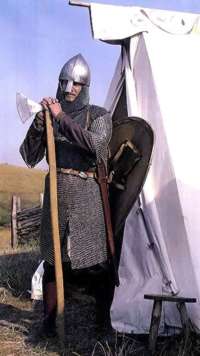 |
| Huscarl - Regia Anglorum |
developed them. Each huscarl would have a long hauberks of mail with a coif and conical helm with a nasal guard. They carried long kite shields and, as well as being armed with swords and throwing spears, they also were adept with the dreaded Danish axe. This was a fearsome weapon, it was able to break shields, lop off limbs and even decapitate a horse in a single blow.
Around this core were the fyrd. The fyrd system dated from
King Alfred’s time. These were territorials who were bound to give two months
service a year. They were raised on the basis on one man for every 5 hides of
land. This raised around twenty shillings which would pay for the warrior’s weapons,
armour and food. These warriors would probably have the more traditional round
shields. In theory a king could call upon up to 20,000 fyrd, but such a number
could never be raised at once due to the practicalities of communication and logistics at
this time. As well as these semi-professionals Harold could also
call on all freemen to his banners in a time of national emergency. Such men
would have grabbed any weapon to hand, whether spear or scythe.
There are further factors effecting numbers available to Harold; the
Southern Fyrd had been on duty all summer in expectation of the Norman invasion
and had been disbanded due to the approach of harvest time. The pitched battle
of Stamford Bridge would have caused great loss both to the huscarls and the fyrd
who answered the call. Normally Harold would have had around 3000 huscarls,
perhaps Stamford Bridge would have reduced this to 2000. Harold’s brothers
Earls Gyrth and Leofwin would have approx. 1000 huscarls each. Perhaps the
recalled fyrd that gathered at Hastings would be around 5000. So Harold would
field around 9000 men, similar to the numbers William commanded.
The Norman army, despite their Scandinavian heritage had a
more continental way of war. Norman society was feudal and at the core of their army
were knights. The knights were granted lands with which to support themselves,
and were required to serve their lord.
Like the Huscarls they would have long hauberks of mail, conical helmets
with nasal guards and kite shields. However these were mounted heavy cavalry;
the shock troops of the time, armed with lances, it is thought that William had
around 2500 of these mounted warriors in total. As well as the knights the
Normans fielded infantry, professional men-at-arms that weren’t landed knights
and would probably be armed in similar fashion to the English Fyrd, these would
be the bulk of the army, numbering perhaps 4500. The Normans also had around 1500 dedicated
archers using short bows to soften up an enemy prior to sword play.
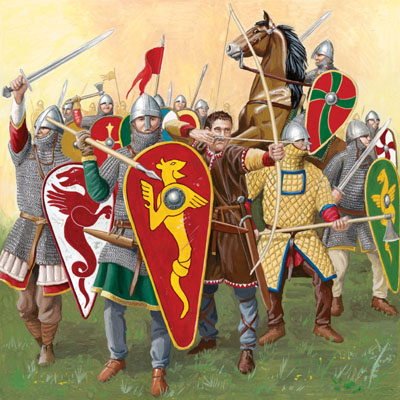 |
| Norman soldiers - Image from model- making.eu |
The army was divided into three; William’s Normans in the
centre supported either side by his subject allies, Eustace of Bologne and his Flemish forces
on the eastern wing and Count Alain and his Bretons on the western.
The invasion itself was a marvel of medieval logistics.
William had to gather around 500-700 ships to carry men, horses, equipment ,
and even a wooden castle in kit form, over the Channel. Encouraging his underlings
and allies to help finance this operation speaks volumes for William’s
reputation and powers of persuasion. He had to remind them of the terms of
their tenure, but also convince then that such an operation was even feasible.
True there was the promise of lands and plunder but due to the efforts of his
advisor Bishop Lanfranc, William had managed to get a Gonfanon – a papal banner – so the enterprise now had the blessing of
Rome. This was no mere invasion, this was a crusade.
The invasion fleet had to wait almost a month until the
tides and winds were favourable, it’s recorded that William only lost 2 ships
during the crossing. Ironically one of these carried the Duke’s soothsayer;
never underestimate the fickle finger of fate, or its sense of humour!
 |
| The papal Banner - Bayeux Tapestry |
Moving hesitantly inland from the landing site at Pevensey, William built a
fortification at Hastings. From here his forces raided the surrounding
countryside both for supplies, with an eye to his extended supply lines, and
also knowing full well the area were part of the Godwinsson lands. William
needed a decisive victory as soon as possible. Likewise, Harold, no doubt
buoyed by his victory in the north, and angered by the Norman pillaging, wished
to grab destiny with both hands.
Arriving in London on the 6th October Harold gave himself a week to gather his forces. True Duke William had been campaigning most of his life, but Harold was also a seasoned warrior and very able commander, and he gathered intelligence of the Norman position. On the 11th October, yet with only half his available forces he advanced across the Weald toward William. On Friday 13th the English gathered at the edge of the forest between the villages Whatlington and Crowhurst . The Anglo-Saxon Chronicle lists the assembly point as the “hoary apple tree” . It has been suggested that Harold initially planned a swift forced march at night to launch a surprise attack against the Norman camp the next day, but his scouts would have reported that William knew of his presence and was advancing towards him. Even with the advantage of surprise lost, Harold had chosen an excellent defensive position, below Caldbec Hill. At 9am on 14th October the battle began at Senlac Ridge, as the Normans organised in the valley Harold’s shield wall took shape across the ridge, their ranks 700 yards long. In the centre Harold unfurled his standards , the wyvern of Wessex and his personal banner of the fighting man.
Arriving in London on the 6th October Harold gave himself a week to gather his forces. True Duke William had been campaigning most of his life, but Harold was also a seasoned warrior and very able commander, and he gathered intelligence of the Norman position. On the 11th October, yet with only half his available forces he advanced across the Weald toward William. On Friday 13th the English gathered at the edge of the forest between the villages Whatlington and Crowhurst . The Anglo-Saxon Chronicle lists the assembly point as the “hoary apple tree” . It has been suggested that Harold initially planned a swift forced march at night to launch a surprise attack against the Norman camp the next day, but his scouts would have reported that William knew of his presence and was advancing towards him. Even with the advantage of surprise lost, Harold had chosen an excellent defensive position, below Caldbec Hill. At 9am on 14th October the battle began at Senlac Ridge, as the Normans organised in the valley Harold’s shield wall took shape across the ridge, their ranks 700 yards long. In the centre Harold unfurled his standards , the wyvern of Wessex and his personal banner of the fighting man.
| Map of the battle from historyofengland.typepad.com/ |
Under William’s papal banner the Normans advanced. The
archers got within range and emptied their quivers at the English line. But
this volley had little effect. They were shooting uphill so most arrows either
were impaled on shields or passed over the English lines. Following this the
Norman infantry struggled up the slope. The rise was some 50 feet from the brook
in the valley bottom and they were met with a hail of missiles from the
English, including spears, throwing axes and even rocks. William threw his
knights forward, alarmed at the lack of progress achieved by the first wave.
 |
| The Norman first wave attacks the English shieldwall - weaponsandwarfare.com |
It was on the shallow western end of the ridge that the
Bretons arrived at the English lines before the Normans and Flemish. It was an uncoordinated
effort that met an intact English line. They were met with missiles and were
unable to get close to the English without risking their mounts. The Breton
wing fell back leaving the Norman left flank exposed to missiles. The Norman
and Flemish wings met the same dreadful site of intact English lines after
struggling up the slope through hurled spears and rocks. The whole Norman line
now waivered, on the verge of a general retreat. William's half brother Bishop Odo desperately tried to rally the fleeing Bretons.
On the western edge of the Ridge the English fyrdmen saw the
Bretons in full retreat, from their perspective the whole Norman line looked on
the verge of defeat; breaking ranks, they set off down the hill in pursuit. In
the centre William saw the unfolding events, he had to act fast to stem the
rout. He took his Norman cavalry and attacked the advancing English. How
quickly in the fog of battle are the tables turned. The English fyrdmen now found
themselves stranded in the open, unable to get back up the hill, and made a
last desperate stand on a small hillock near the valley floor. The event is
shown in the Bayeaux Tapestry. That they aren’t huscarls is shown by the lack
of hauberks. The Bretons rallied and the stranded warriors in the hillock were
slaughtered to a man. In the space of an hour and a half, with a momentary lack of
discipline, Harold’s advantage and seemingly early victory had been snatched
away from him. Harold’s previously impregnable line had to stretch thinner to
compensate for his losses. Both sides paused to regroup.
 |
| The fyrd trapped on the hillock - Bayeux tapestry |
 |
| Duke William shows his men he's alive - Bayeux tapestry |
Again the Normans withdrew and took stock. William must have
been becoming increasingly desperate; the English shield wall held and his men
would be exhausted. The slopes would be churned up by hooves and slick with
blood. He knew his men had one more attack in them. Defeat and retreat would
almost certainly cost William his life. The next attack had to succeed. A
different tack was required. He had to combine his archers and his knights and
foot soldiers more effectively with his whole force attacking the ridge at the
same time.
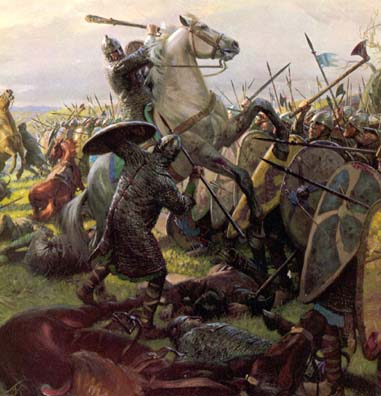 |
| Bishop Odo in action against the shield wall - notice his weapon is a club so as not to sinfully draw blood - from www.robertsewell.ca/ |
At 3 o’clock The Normans advanced slowly with horse and foot
solders together, the archers in the rear.
The Norman advance drew out the usual English volley, but it was impatient and launched at a longer, less effective distance. As the Normans closed with the English the archers fired upwards, high
into the air so the arrows would fall on the English line and draw their shields up. With the shower of arrows causing a distraction the hand to hand
combat began. An hour into the third wave and the turning point was being achieved. Gaps began
to appear in the English line and the Normans forced themselves in, breaking
the shield wall into sections. With both
English flanks now weakened and the whole ridge no longer defensible, William
ordered the Flemish and Bretons to attack from both sides. They broke through,
shattering the English position that had held solid across the ridge all day.
For Harold now the battle was lost, it was all about now
life, death and honour. There was fighting
along the whole ridge. It was at
this point that Harold’s brothers Leofwine and Gyrth fell, defending their king
and brother judging by their proximity to Harold. The fyrd attempted to escape and melt
into the forest but the huscarls, true to their oaths, remained fighting around Harold
and his standards. As the light faded around 5.30pm Harold fell, probably not by an
arrow to the eye, as interrupted in error from the tapestry, but from a sword
blow and then “covered in deadly wounds”, according to William of Jumieges. Fired by
the events of the day and their sense of religious righteousness Flemish
knights hacked at the fallen king, grievously mutilating him. It was said only Harold's handfast wife, Edith Swanneck, could recognise her lover's body, so terrible were the wounds inflicted on the slain Harold.
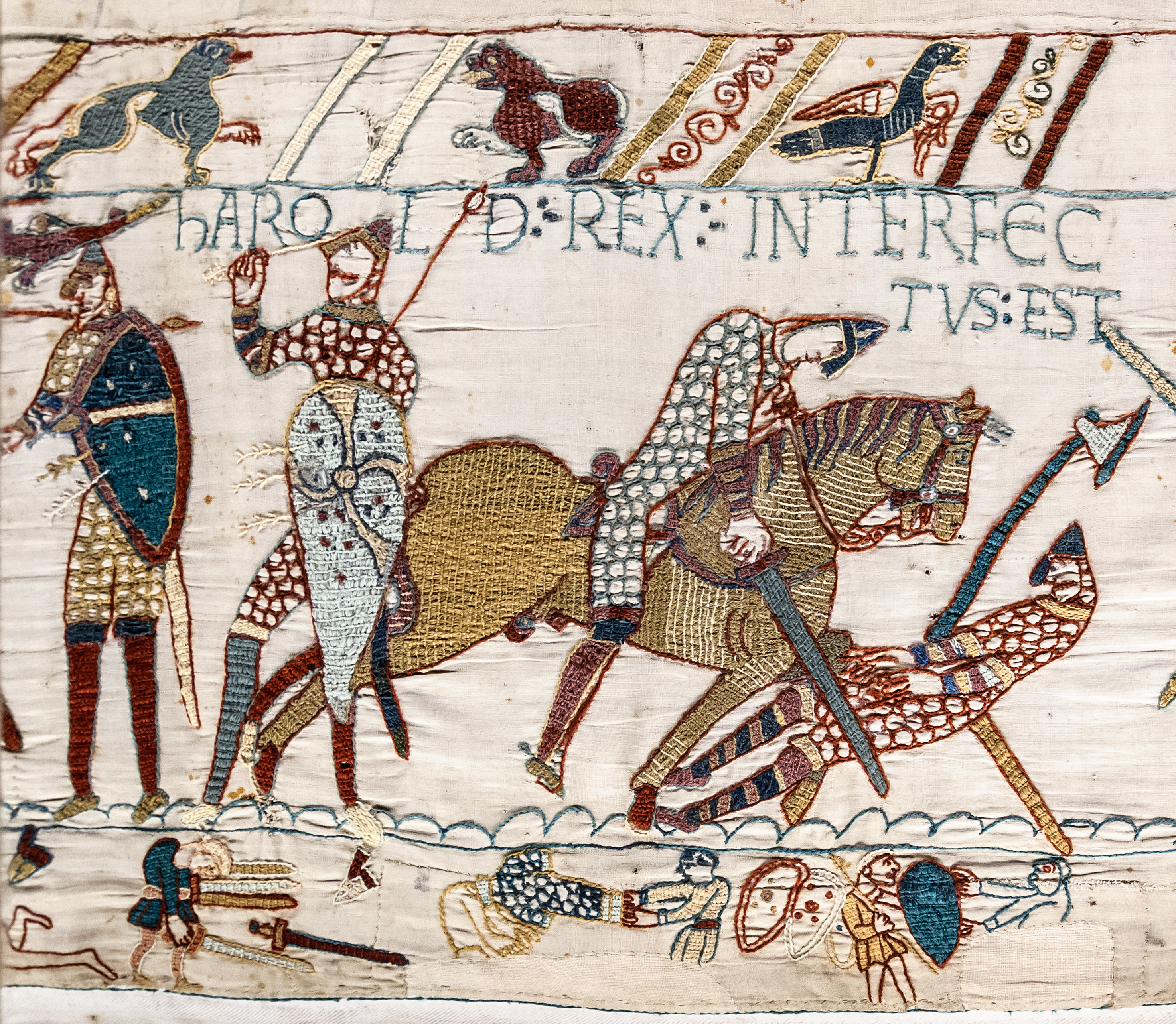 |
| Harold is slain - Bayeux Tapestry |
 |
| The last stand - from bitaboutbritain.blogspot.co.uk/ |
With the King and his brothers slain there was nothing more
to fight for, a few remaining huscarls fought doggedly to the last while others
fled to the forest pursued by the
vengeful Norman cavalry to prevent any regrouping. It might well have been the
case that there were still late arrivals of fyrdmen appearing on the battle’s periphery.
That some English still had the spirit to fight was shown when a band of Norman
knights were ambushed and slaughtered at a place called Malfosse (evil ditch),
named as such after the event. Yet despite the valour of the defenders at
Malfosse the battle was over, and decisively so; England would never be the
same again, of the three contenders for the throne only the Norman Duke William remained.
Harold's bones are lost to history, there would be no shrine to the fallen king. It was said that he was either buried without ceremony on unconsecrated ground (as he was ex communicated), or was perhaps thrown into the sea. Another tale reports him as being buried under a cairn on a headland, as if ironically watching for invaders. William refused the pleading of Harold's mother, Gytha Thorkilsdottir, to yield to her the slain kings remains, even in exchange for Harold's weight in gold. Even in death perhaps, he revealed the precariousness of William's position, that of an invader, a foreign usurper. Yet a new regime would now held sway, and history would be written by them, as victors are wont to do.
Sources;
The Battle of Hastings - Peter Poyntz Wright - (1986)
The Bayeux Tapestry
Anglo-Saxon Chronicle
William of Jumieges - Deeds of the Dukes of the Normans
Frank Barlow - The Feudal Kingdom of England 1042-1216 (1988)
Rob Bayliss is a reviewer at The Review and fantasy author. Information on his writing projects can be found at Flint & Steel, Fire & Shadow.
Harold's bones are lost to history, there would be no shrine to the fallen king. It was said that he was either buried without ceremony on unconsecrated ground (as he was ex communicated), or was perhaps thrown into the sea. Another tale reports him as being buried under a cairn on a headland, as if ironically watching for invaders. William refused the pleading of Harold's mother, Gytha Thorkilsdottir, to yield to her the slain kings remains, even in exchange for Harold's weight in gold. Even in death perhaps, he revealed the precariousness of William's position, that of an invader, a foreign usurper. Yet a new regime would now held sway, and history would be written by them, as victors are wont to do.
Sources;
The Battle of Hastings - Peter Poyntz Wright - (1986)
The Bayeux Tapestry
Anglo-Saxon Chronicle
William of Jumieges - Deeds of the Dukes of the Normans
Frank Barlow - The Feudal Kingdom of England 1042-1216 (1988)
Rob Bayliss is a reviewer at The Review and fantasy author. Information on his writing projects can be found at Flint & Steel, Fire & Shadow.


