Showing posts with label 1066. Show all posts

Saturday, 14 October 2017

Diana talks to the Review's one and only and totally inimitable Paula Lofting !

Hello Paula!!! How lovely to chat with you!

I am sure that you are tired of being asked the usual questions that would be interviewers ask authors, so hopefully this interview is an interview with a difference and I have come up with some unusual questions!
First things first I am sure there is a question that you have always longed to be asked. Now is the chance. Ask your own question and answer it!

Who is your favourite Character in your books? It has to be Tovi, because a: my readers love him, and b: he’s been given a bum deal by his family.

What is the genre you are best known for? Definitely Historical fiction, well that’s all I’ve managed to write about so far, though I did start a psychological thriller some years ago and only got so far with it. I do plan to write one someday, though, and hopefully a ghosty story and a fantasy.


If your latest book Sons of the Wolf: The Wolf Banner   was adapted into a TV show or a film, who would you like to play the lead role? Probably Charlie Hunman, he’s the right age for Wulfhere. Years ago I would have opted for Kevin McKidd but I think he would be too old now.

What made you choose this genre? A love of history, and a visit to the annual Battle of Hastings inspired me.

How do you get ideas for plots and characters? It all started with a book called 1066: Year of the Conquest by David Howarth. He described his home in Sussex, a little village called Little Horsted, as if it were the year 1066. He talked about the thegn who owned the land, what he owned as per the Domesday Book, and what his duties might have been. He described how life in a village in 1066 might have looked and what might one expect to see if one was to visit. He talked about the forest and a picture of children running through it, swimming in the river, and playing on a rope-swing. As I only love a few miles away, I decided to drive out there. It’s still pretty much the same as it was back then. A little hamlet. When I went home, I just wrote what came into my head as I thought about where I had been and the story began to write itself.

Favourite picture or work of art? Gosh, I don’t really think I have one. I’m not clued up on that sort of thing. I guess I could say my children. They’re my works of art. (That is a lovely sentiment and one I can so totally relate to. Diana)

If, as a one off, (and you could guarantee publication!)  you could write anything you wanted, is there another genre you would love to work with and do you already have a budding plot line in mind? Yes, as I’ve said before, I’d love to write a psychological thriller. And yes, I do have a plot in mind. And I may revisit it at some point in the future.

Was becoming a writer a conscious decision or something that you drifted into (or even something so compelling that it could not be denied?) How old were you when you first started to write seriously. I have always wanted to write since I was a young girl, however as I got older, life went on a tangent. Things were difficult for a while, and my confidence was knocked, but when things improved, the idea that perhaps I could actually write a book and it was all I could think about.

Marmite? Love it or hate it? Love it but it stinks on one’s breath!

Do you have any rituals and routines when writing? Your favourite cup for example or ‘that’ piece of music...?? Silence, that’s all. I need silence otherwise my brain can’t handle it. It can’t filter noise.

I promise I won’t tell them the answer to this, but when you are writing, who is more important, your family or your characters? It sort of has to be my family, mainly because I can’t help but worry about them, so if they need me or want me to do something, I always put the lap top down and attend them!

Other than writing full time, what would be your dream job? I have my dream job. I’m a nurse and work 30 hours a week running a mental health clinic in a GP’s surgery. I love it.

Coffee or tea? Red or white? Tea. I don’t drink because it took away my aspirations and I couldn’t allow that to happen again. (I hear you... That. Diana)
How much of your work is planned before you start? Do you have a full draft or let it find its way? I have a plot in my head, but mostly I let the story write itself. It seems to follow a natural progression of what the characters might do, or how they might behave in a certain situation.

If you had free choice over the font your book is printed in, what font/fonts would you choose? I really font know, lol! (Groan!!)

Imagine that you could get hold of any original source document. What would it be? Imagine being able to get your hands on the Domesday book? OMG that would be like heaven

Have any of your characters ever shocked you and gone off on their own adventure leaving you scratching your head??? If so how did you cope with that!? Absolutely, you know him. Burghred. He was only supposed to have had a minor part and he refused to back down, making a nuisance of himself until I had to go with it. He basically created a thread of his own, took the plot and ran off with it.

How much research do you do and do you ever go on research trips? I’ve been around the West Country to visit the places in my book. But just the once. I’ve also read widely, mainly before and just in the beginnings. Every now and then if I am writing a particular theme, I will read something. I’m also a re-enactor so that helps.

Fiction authors have to contend with real characters invading our stories. Are there any ‘real’ characters you have been tempted to prematurely kill off or ignore because you just don’t like them or they spoil the plot? Yes, but I won’t say who. And I don’t go through with it.

Are you prepared to go away from the known facts for the sake of the story and if so how do you get around this? No, not really. But in the case of like what happened in Wolf Banner, there is only the suggestion of what happens, I’ll try and fill in the gaps with a plausible outcome.

Do you find that the lines between fact and fiction sometimes become blurred? Absolutely. Especially in the period I write in, the 11thc.

Have you ever totally hated or fallen in love with one of your characters? I love all my characters, even the villains. They are my children and deserve for someone to understand why they are driven to do the things they do.

What do you enjoy reading for pleasure? Well, wouldn’t you know it, anything historical, fictional, or factional.

What drink would you recommend drinking whilst reading your latest book? Currently I am drinking pepsi lol.

Last but not least... favourite author? I have to say that currently there are a few, but from my early influences, Charles Dickens, Mary Stewart, Sharon Penman, Rosemary Sutcliffe and Leon Garfield.

About Paula:

Paula has always wanted to write. Since she was a little girl, coming home from school to sit at the table with her notebook and write stories that buzzed around in her head. A prolific reader, she loved nothing better than to spend my weekends with a book in her hand. Earliest influences such as Rosemary Sutcliffe, Leon Garfield, Charles Dickens, C.S.Lewis, inspired an interest in history. It became her lifelong wish to one day write and publish a book, but not being able to type, and having no funds for a typewriter to learn on, this ambition was reluctantly put on hold.
With the advent of PC's and a need to retrain and use a computer, this old ambition was stirred and she decided to rekindle her love of books and writing at the grand old age of 42. at this point, she had reached a turning point in her life and studied nursing, and also decided to write the book she had promised herself one day she would write.

Her début novel, 'Sons of the Wolf' was first published with the assistance of SilverWood Books in 2012. More recently she has republished it with her new publishing company Longship Books, in kindle. A new paperback version will be published by June. It is a story set in the years leading up to the Norman Conquest of England and the first in the Sons of the Wolf series, about this amazing time in English history.

She has always admired the works of Sharon Penman and Bernard Cornwell, Edith Pargetter and Mary Stewart, amongst many others. History is a great love of hers and her interest in the subject goes beyond that of the keyboard. She also enjoys Anglo-Saxon re-enactment with Regia Anglorum, also a great source of research for my writing.
Paula says:
"Write for enjoyment, write for yourself, regardless of what is popular and selling; for if you don't write what you love, then how can you expect others to love what you write."


Post Script. In addition to all this she is a wonderful friend.


Ms Lofting after defeating the entire Norman army, single handed.

If you would like to read my blog about the group Paula Loftingis in and the building of a Shield Wall, click this link
Regia Anglorum: Building a Shield Wall


 © Diana Milne January 2017 © Paula Lofting October 2017


Friday, 14 October 2016

Hastings 950 - The Battle by Rob Bayliss

On Monday 25th September, just five days after their victory  at the Battle of Fulford Gate, King Harald III of Norway and his English ally Tostig Godwinsson were relaxed, camped eight miles east of York at Stamford Bridge. A cloud of dust was seen approaching on the road from the city. Harald and Tostig took it to be a delegation from the defeated Earls Edwin and Morcar bearing tribute and hostages. But the keen eyed among the host saw the tell-tale glint of mail and spear points.  King Harold II, brother of Tostig had arrived with the royal army from his watch over the English Channel.

A forced march of 180 miles in four days by Harold and his standing army of huscarls, collecting fyrd (militiamen) on the way, had caught Harald, the famed ex-commander of the Varangian Guard completely by surprise. Harald’s army would fight bravely, but the English victory over the Norse invader was utterly decisive. Harold had said that would only yield Harald “six feet of English earth or seven as he is so tall”. From a fleet of 300 ships only 24 were needed to ferry the defeated survivors home. Both Tostig and Harald lay slain.

The blood of the slaughter had barely soaked into the ground when word arrived to Harold’s ears that the much feared invasion from Normandy had taken place. Duke William had landed at Pevensey on the 28th while Harold and his forces had been in the north. It is thought that Harold was informed of this event during his march back south, which would account for the lack of Edwin and Morcar’s forces at the subsequent battle. Harold hurried back south to London and made his preparations for the most crucial and decisive of battles; the Battle of Hastings that took place on Saturday 14th October 1066.

The Normans land and establish their bridgehead - Bayeux Tapestry

The two armies that faced each other that momentous day would look similar but fought using different tactics.

Huscarl - Regia Anglorum
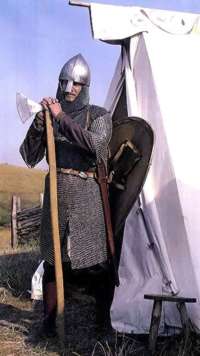
Although still a heroic society the English army had evolved from the days of warlords having retinues of hearth troops, although it retained an aspect of this tradition. The great lords of the day such as King Harold and the earls had their huscarls; the heavy infantry of the day, perhaps on a par with the famed Varangian guard in Byzantium. The huscarls had been introduced some 50 years earlier during Cnut’s reign. These were experienced professional warriors, possibly some of the best soldiers to be found in Europe at the time. They had taken the ancient tactics of the shieldwall and
developed them. Each huscarl would have a long hauberks of mail with a coif and conical helm with a nasal guard. They carried long kite shields and, as well as being armed with swords and throwing spears, they also were adept with the dreaded Danish axe. This was a fearsome weapon, it was able to break shields, lop off limbs and even decapitate a horse in a single blow.


Around this core were the fyrd. The fyrd system dated from King Alfred’s time. These were territorials who were bound to give two months service a year. They were raised on the basis on one man for every 5 hides of land. This raised around twenty shillings which would pay for the warrior’s weapons, armour and food. These warriors would probably have the more traditional round shields. In theory a king could call upon up to 20,000 fyrd, but such a number could never be raised at once due to the practicalities of communication and logistics at this time. As well as these semi-professionals Harold could also call on all freemen to his banners in a time of national emergency. Such men would have grabbed any weapon to hand, whether spear or scythe.


There are further factors effecting numbers available to Harold; the Southern Fyrd had been on duty all summer in expectation of the Norman invasion and had been disbanded due to the approach of harvest time. The pitched battle of Stamford Bridge would have caused great loss both to the huscarls and the fyrd who answered the call. Normally Harold would have had around 3000 huscarls, perhaps Stamford Bridge would have reduced this to 2000. Harold’s brothers Earls Gyrth and Leofwin would have approx. 1000 huscarls each. Perhaps the recalled fyrd that gathered at Hastings would be around 5000. So Harold would field around 9000 men, similar to the numbers William commanded.

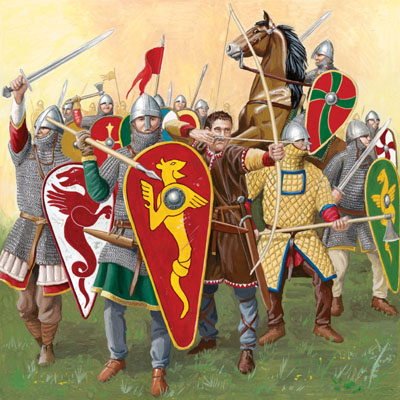
The Norman army, despite their Scandinavian heritage had a more continental way of war. Norman society was feudal and at the core of their army were knights. The knights were granted lands with which to support themselves, and were required to serve their lord.  Like the Huscarls they would have long hauberks of mail, conical helmets with nasal guards and kite shields. However these were mounted heavy cavalry; the shock troops of the time, armed with lances, it is thought that William had around 2500 of these mounted warriors in total. As well as the knights the Normans fielded infantry, professional men-at-arms that weren’t landed knights and would probably be armed in similar fashion to the English Fyrd, these would be the bulk of the army, numbering perhaps 4500.  The Normans also had around 1500 dedicated archers using short bows to soften up an enemy prior to sword play.
Norman soldiers - Image from model- making.eu


The army was divided into three; William’s Normans in the centre supported either side by his subject allies, Eustace of Bologne and his Flemish forces on the eastern wing and Count Alain and his Bretons on the western.

The invasion itself was a marvel of medieval logistics. William had to gather around 500-700 ships to carry men, horses, equipment , and even a wooden castle in kit form, over the Channel. Encouraging his underlings and allies to help finance this operation speaks volumes for William’s reputation and powers of persuasion. He had to remind them of the terms of their tenure, but also convince then that such an operation was even feasible. True there was the promise of lands and plunder but due to the efforts of his advisor Bishop Lanfranc, William had managed to get a Gonfanon – a papal banner –  so the enterprise now had the blessing of Rome. This was no mere invasion, this was a crusade.
The invasion fleet had to wait almost a month until the tides and winds were favourable, it’s recorded that William only lost 2 ships during the crossing. Ironically one of these carried the Duke’s soothsayer; never underestimate the fickle finger of fate, or its sense of humour!

The papal Banner - Bayeux Tapestry


Moving hesitantly inland from the landing site at Pevensey, William built a fortification at Hastings. From here his forces raided the surrounding countryside both for supplies, with an eye to his extended supply lines, and also knowing full well the area were part of the Godwinsson lands. William needed a decisive victory as soon as possible. Likewise, Harold, no doubt buoyed by his victory in the north, and angered by the Norman pillaging, wished to grab destiny with both hands.

 Arriving in London on the 6th October Harold gave himself a week to gather his forces. True Duke William had been campaigning most of his life, but Harold was also a seasoned warrior and very able commander, and he gathered intelligence of the Norman position. On the 11th October, yet with only half his available forces he advanced across the Weald toward William. On Friday 13th the English gathered at the edge of the forest between the villages Whatlington and Crowhurst . The Anglo-Saxon Chronicle  lists the assembly point as the “hoary apple tree” . It has been suggested that Harold initially planned a swift forced march at night to launch a surprise attack against the Norman camp the next day, but his scouts would have reported that William knew of his presence and was advancing towards him. Even with the advantage of surprise lost, Harold had chosen an excellent defensive position, below Caldbec Hill. At  9am on 14th October the battle began at Senlac Ridge, as the Normans organised in the valley Harold’s shield wall took shape across the ridge, their ranks 700 yards long. In the centre Harold unfurled his standards , the wyvern of Wessex and his personal banner of the fighting man.

Map of the battle from historyofengland.typepad.com/


Under William’s papal banner the Normans advanced. The archers got within range and emptied their quivers at the English line. But this volley had little effect. They were shooting uphill so most arrows either were impaled on shields or passed over the English lines. Following this the Norman infantry struggled up the slope. The rise was some 50 feet from the brook in the valley bottom and they were met with a hail of missiles from the English, including spears, throwing axes and even rocks. William threw his knights forward, alarmed at the lack of progress achieved by the first wave.

The Norman first wave attacks the English  shieldwall - weaponsandwarfare.com


It was on the shallow western end of the ridge that the Bretons arrived at the English lines before the Normans and Flemish. It was an uncoordinated effort that met an intact English line. They were met with missiles and were unable to get close to the English without risking their mounts. The Breton wing fell back leaving the Norman left flank exposed to missiles. The Norman and Flemish wings met the same dreadful site of intact English lines after struggling up the slope through hurled spears and rocks. The whole Norman line now waivered, on the verge of a general retreat. William's half brother Bishop Odo desperately tried to rally the fleeing Bretons.

On the western edge of the Ridge the English fyrdmen saw the Bretons in full retreat, from their perspective the whole Norman line looked on the verge of defeat; breaking ranks, they set off down the hill in pursuit. In the centre William saw the unfolding events, he had to act fast to stem the rout. He took his Norman cavalry and attacked the advancing English. How quickly in the fog of battle are the tables turned. The English fyrdmen now found themselves stranded in the open, unable to get back up the hill, and made a last desperate stand on a small hillock near the valley floor. The event is shown in the Bayeaux Tapestry. That they aren’t huscarls is shown by the lack of hauberks. The Bretons rallied and the stranded warriors in the hillock were slaughtered to a man. In the space of an hour and a half, with a momentary lack of discipline, Harold’s advantage and seemingly early victory had been snatched away from him. Harold’s previously impregnable line had to stretch thinner to compensate for his losses. Both sides paused to regroup.
The fyrd trapped on the hillock - Bayeux tapestry


Duke William shows his men he's alive - Bayeux tapestry
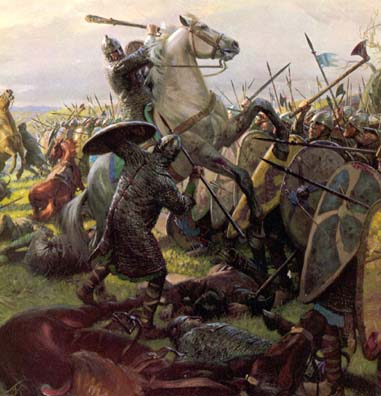
With the archers restocked with arrows the Norman second wave began. Learning from the previous failure William urged a slower advance so the infantry and cavalry could support each other. This second attack went on for 2 blood-soaked hours as the attack against the shield wall became a series of smaller battles along its length.  By 1pm the dead would be piled on both sides yet the shield wall held true. Both the Flemish and Bretons were sent back reeling in disarray. Again English Fyrdmen foolishly gave chase to be caught in the open. Norman chroniclers say these were feigned retreats but with the discipline (or lack of) at the time this is highly unlikely. With the low morale of these troops a feigned retreat could easily become a rout. It is said that William himself fought in this second phase and had 3 horses killed under him. he had to show his face when a rumour began among his men that he had been slain.


Again the Normans withdrew and took stock. William must have been becoming increasingly desperate; the English shield wall held and his men would be exhausted. The slopes would be churned up by hooves and slick with blood. He knew his men had one more attack in them. Defeat and retreat would almost certainly cost William his life. The next attack had to succeed. A different tack was required. He had to combine his archers and his knights and foot soldiers more effectively with his whole force attacking the ridge at the same time.

Bishop Odo in action against the shield wall - notice his weapon is a club so as not to sinfully draw blood - from www.robertsewell.ca/


At 3 o’clock The Normans advanced slowly with horse and foot solders together, the archers in the rear.  The Norman advance drew out the usual English volley, but it was impatient and launched at a longer, less effective distance. As the Normans closed with the English the archers fired upwards, high into the air so the arrows would fall on the English line and draw their  shields up. With the shower of arrows causing a distraction the hand to hand combat began. An hour into the third wave and the turning point was being achieved. Gaps began to appear in the English line and the Normans forced themselves in, breaking the shield wall into sections.  With both English flanks now weakened and the whole ridge no longer defensible, William ordered the Flemish and Bretons to attack from both sides. They broke through, shattering the English position that had held solid across the ridge all day.


For Harold now the battle was lost, it was all about now life, death and honour. There was fighting
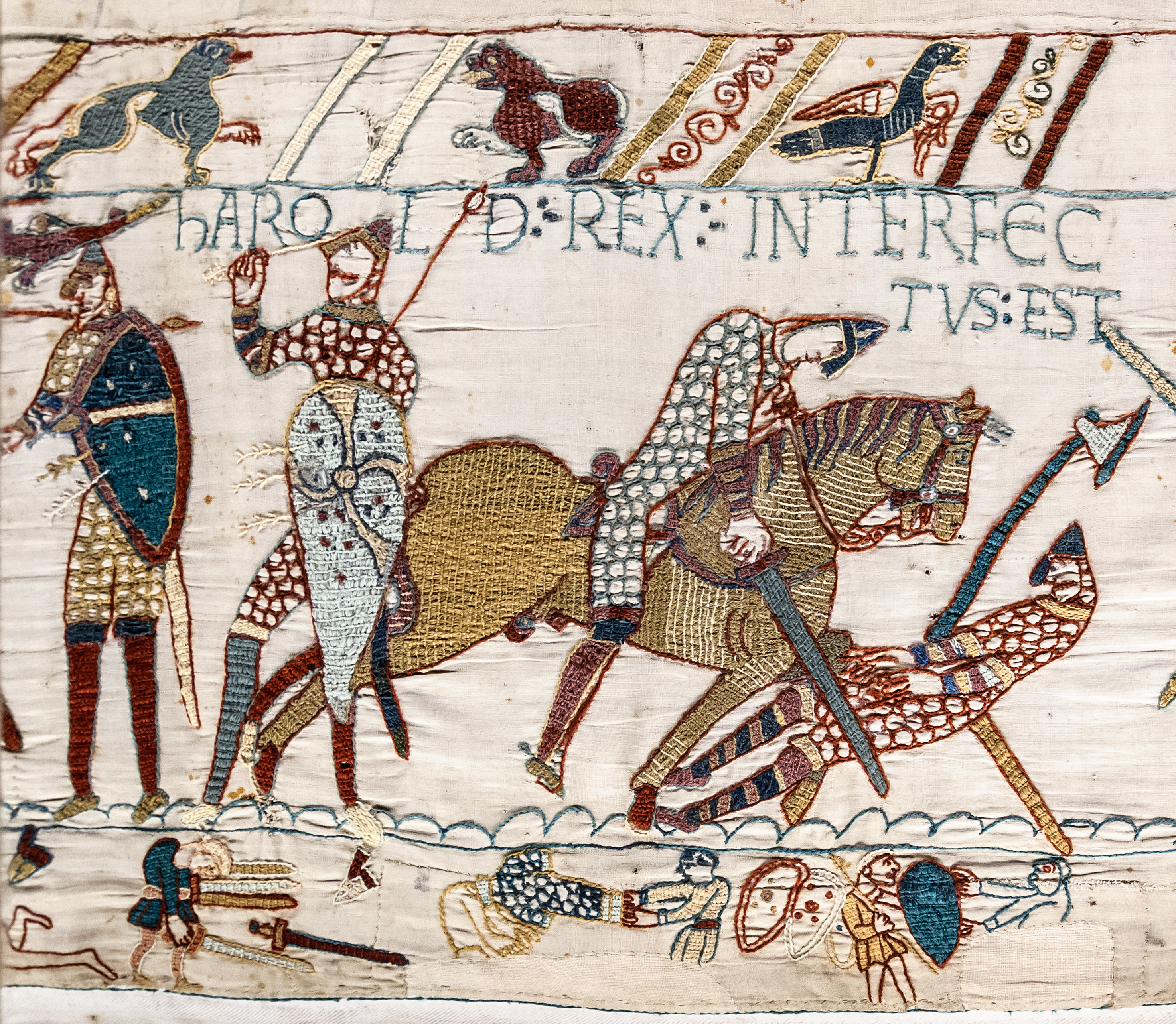
Harold is slain - Bayeux Tapestry
along the whole ridge. It was at this point that Harold’s brothers Leofwine and Gyrth fell, defending their king and brother judging by their proximity to Harold. The fyrd attempted to escape and melt into the forest but the huscarls, true to their oaths, remained fighting around Harold and his standards. As the light faded around 5.30pm Harold fell, probably not by an arrow to the eye, as interrupted in error from the tapestry, but from a sword blow and then “covered in deadly wounds”, according to William of Jumieges. Fired by the events of the day and their sense of religious righteousness Flemish knights hacked at the fallen king, grievously mutilating him. It was said only Harold's handfast wife, Edith Swanneck, could recognise her lover's body, so terrible were the wounds inflicted on the slain Harold.

The last stand -  from bitaboutbritain.blogspot.co.uk/


With the King and his brothers slain there was nothing more to fight for, a few remaining huscarls fought doggedly to the last while others fled to the forest  pursued by the vengeful Norman cavalry to prevent any regrouping. It might well have been the case that there were still late arrivals of fyrdmen appearing on the battle’s periphery. That some English still had the spirit to fight was shown when a band of Norman knights were ambushed and slaughtered at a place called Malfosse (evil ditch), named as such after the event. Yet despite the valour of the defenders at Malfosse the battle was over, and decisively so; England would never be the same again, of the three contenders for the throne only the Norman Duke William remained.

Harold's bones are lost to history, there would be no shrine to the fallen king. It was said that he was either buried without ceremony on unconsecrated ground (as he was ex communicated), or was perhaps thrown into the sea. Another tale reports him as being buried under a cairn on a headland, as if ironically watching for invaders. William refused the pleading of Harold's mother, Gytha Thorkilsdottir, to yield to her the slain kings remains, even in exchange for Harold's weight in gold. Even in death perhaps, he revealed the precariousness of William's position, that of an invader, a foreign usurper. Yet a new regime would now held sway, and history would be written by them, as victors are wont to do.

Sources;

The Battle of Hastings - Peter Poyntz Wright - (1986)
The Bayeux Tapestry
Anglo-Saxon Chronicle
William of Jumieges - Deeds of the Dukes of the Normans
Frank Barlow - The Feudal Kingdom of England 1042-1216 (1988)

Rob Bayliss is a reviewer at The Review and fantasy author. Information on his writing projects can be found at Flint & Steel, Fire & Shadow.

Thursday, 13 October 2016

Just for a change - Diana listens to! Diana listens to Paula Lofting and Regia Anglorum: Building a shield wall


Photos c/o Rich Price


For over a quarter of a century, Regia Anglorum has been re-creating history for audiences around the world. They are skilled, properly equipped and highly motivated men and women of all ages who bring the dull and dead past back to brilliant life, celebrating the very best of life in the round a thousand years ago! They have a fleet of seven full-scale ship replicas. They have a secluded permanent site with a reconstruction of an old mead hall*. The best re-enactment society in the world

– probably...

and here at The Review, we are all fortunate to feel that we have one very special Regia Anglorum member as a friend, the 'Boss Lady' of the group,
Paula Lofting .


Regia Anglorum is a founder member of the
National Association of Re-enactment Societies (NAReS) and were sponsored by DHH Literary to speak about the formation of the shield wall at the Historical Novel Society conference at Oxford this year (HNS16).

The talk was by four colourful characters in full mediaeval garb,
An anonymous Mediaeval warrior showing the leg garb of the time.
Paula Lofting, Roland Williamson, Mike Harris and young thegn, Tom Barrett. I wouldn't have wanted to get on the wrong side  of any of them, (particularly that Paula Lofting!)


Shields seem to have been used universally by all warriors. From the first to the tenth century round shields seem to have been normal, being either flat or 'watchglass' shaped in cross-section. They are always shown with a boss and often have wooden or metal bands on the back to strengthen them. All the examples found have been of planked construction although there is some evidence to suggest a plyed construction would make the 'watchglass' shape easier to make. Some shields were edged with a rim of sewn thick leather or hide to strengthen them whilst others were possibly faced with leather or rawhide. Traditionally, shields were made of linden (Lime) wood although alder and poplar and other woods that do not tend to split may have also been used. 


Round shields seem to have varied in size from around 45 - 120cm (18" - 48") in diameter but the smaller and more manageable 75 - 90cm (30" - 36") is by far the most common.
Typically, a shield should cover your whole torso © Regia Anglorum
The formation of a shield wall (Scildweall or Bordweall in Old English, Skjaldborg in Old Norse) is a military tactic that was common in many cultures in the Pre-Early Modern warfare age. There were many slight variations of this tactic among these cultures, but in general, a shield wall was a "wall of shields" formed by soldiers standing in formation shoulder to shoulder, holding their shields so that they abut or overlap. Each soldier benefits from the protection of their neighbours' shields as well as their own.

In the battles between the
Anglo-Saxons and the Danes in England, most of the Saxon army would have consisted of the Fyrd — a less-experienced militia composed of middle class freemen. The shield-wall tactic suited such soldiers, as it did not require extraordinary skill, being essentially a shoving and fencing match with weapons. The first three ranks of the main wall would have been made up of select warriors, such as Huscarls and Thegns, who carried heavier weapons and consistently wore armour.

Warfare was to a great degree ritualised and a sword is all about symbology. An axe, however, is very good for posing! Imagine the might Huscarl with his axe. A frightening sight, designed to drive terror into the foe.
Fearsome!


Despite swords being shiny in modern minds, they were rusty and strong and were soaked in the morning.

The drawback of the shield-wall tactic was that, once breached, the whole affair tended to fall apart rather quickly. Relatively lightly trained fyrdmen gained morale from being shoulder-to-shoulder with their comrades, but often fled once this was compromised. Once the wall was breached, it could prove difficult or impossible to re-establish a defensive line, and panic might well set in among the defenders.

Although the importance of cavalry in the Battle of Hastings
portended the end of the shield-wall tactic, massed shield-walls would continue to be employed right up to the end of the 12th century, especially in areas that were unsuitable for large scale mounted warfare, such as Scotland.

Some of the tactics employed by the English shield wall consisted of round shields together in the form of a 'foulcon', otherwise known as cauldron. This was described in Roman times as the Testudo as it resembled the shell of a tortoise or turtle.
The shield was used to cover the body in close quarter fighting, and to push or bludgeon one's opponent.The arrows coming towards them would be moving at about 60 mph plus, an unheard of speed when the fastest thing most people saw was a galloping horse, the speed of which, in that era, would be about 20 to 25 miles per hour. A sharp spear would travel about 30 mph and of course can be thrown back! although getting the point caught in the shield wastes time and led to the euphemism, the 'spear net'.
The latest type was the narrow, tapering shield (kite shield),  The other type is like a target, round and heavier, with a central iron boss.  Both kinds of shields were used in the Battle of Hastings by the English.
The kite (long or fish-shaped) shield gives your opponent little to strike at © Regia Anglorum

The differences between the two types of shield were greater than just the shape. The kite shield is large almond shaped shield, rounded at the top and curving down to a point at the bottom and it  was cross gripped. It was developed for mounted cavalry and it's dimensions correlate roughly to the space between a horse's neck and it's rider's thigh.  When standing it  ran down the length of the body from neck to ankle, and, in effect, was an extension of body armour. Round shield were generally large and designed for 'bashing' and shield wall tactics  and were centre gripped and usually had a central iron boss.
One of these fierce warriors is left handed. Guess which one!

The Normans rode exceptionally fierce and aggressive war horses, trained in battle and savage with tooth and hoof. The Norman Horse had to be extremely strong and resilient. During the Battle of Hastings, it would have required the rider to remain mounted and vigilant for up to ten hours. This put a tremendous strain on both horse and rider. William had to march his force 10Km north before he even met Harold. The weight of the armour, sword and saddle increased the burden by 30 or 40 kg. The Norman saddle had a high pommel and cantle, similar to a Hungarian Hussar saddle, and the rider had fierce spurs that to our modern sensibilities are very cruel.

Iron stirrups were very heavy and cumbersome


The following pictures will show a shield wall formation and it will be possible to see how effective these would have been.
Photos c/o Rich Price

Photos c/o Rich Price

Picture on the left shows the men forming the Foulcon - Photos c/o Rich Price

Photos c/o Rich Price

Photos c/o Rich Price


The Battle of Hastings in brief.

(If you don't want to know the scores, looks away now.)

Regrettably, in case you do not already know, despite their shield walls and despite having Paula Lofting on their side, England lost the Battle of Hastings in 1066. Here is some actual footage embroidered hastily whilst the battle was in progress by the war correspondents of the day, the ladies of Bayeux - live from the front line.


Oh dear (sad face).

*

* With regard to the Mead Hall, it was pointed out to the audience at the talk that mead in the Mediaeval period was not a strong liquor as is created from honey today but a beer, a honey beer. To become a distilled product it would have needed anaerobic fermentation, a process not discovered until later.


Written, compiled and plagiarised from the below sources

by Diana Milne  -  letterpress seller extraordinaire - with help and source material from Paula Lofting.

Paula Lofting was born in Middlesex and grew up in South Australia, returning to the country of her birth when she was sixteen. She currently works as a psychiatric nurse as well as writing in her spare time. She now lives in Sussex with two of her three children and is an active member of Regia Anglorum re-enactment society. It was always her ambition to write a novel but found that life lead her on other paths until, in her forties, she began on the journey that has led her to her first book. Sons of the Wolf is Paula's debut novel and the first in a series of books about the Norman conquest of England.
Paula's second book, The Wolf Banner is also now available   and promises to be every bit as good as the first.          

Bibliography


Homework help                                                                                

The Norman Cavalry                                                                                                      
Regia Anglorum 
Wikipedia

Many thanks to Rich Price for supplying the photos of the Regia shieldwall in action                  
                                                   

Wednesday, 12 October 2016

Hastings 950: Matilda and Edith, Women of Different Fates

Hastings 950
Matilda and Edith, Heroines of Different Fates


 Although the Battle of Hastings was fought by men, the women of the two opponents, Harold and William, had as much invested in the outcome as their husbands. Matilda of Flanders and Edith Swan-neck will both appear in my book, Heroines of the Medieval World, but for very different reasons. Whereas Matilda appears as the epitome of the medieval ideal woman, Edith has come down through history as 'the other woman'. However, for both these women, their futures, and the futures of their children, were inextricably linked with the fates of the men fighting on Senlac Hill on that October morning in 1066.

 
Harold had met Edith the Swan-neck at about the same time as he became earl of East Anglia, in 1044. Which makes it possible that Edith the Swan-neck and the East Anglian magnate, Eadgifu the Fair, are one and the same. Eadgifu the Fair held over 270 hides of land and was one of the richest magnates in England. The majority of her estates lay in Cambridgeshire, but she also held land in Buckinghamshire, Hertfordshire, Essex and Suffolk; in the Domesday Book Eadgifu held the manor at Harkstead in Suffolk, which was attached to Harold’s manor of Brightlingsea in Essex and some of her Suffolk lands were tributary to Harold’s manor of East Bergholt. While it is by no means certain that Eadgifu is Edith the Swan-necked several historians – including Ann Williams in the Oxford Database of National Biography – make convincing arguments that they were. Even their names, Eadgifu and Eadgyth, are so similar that the difference could be merely a matter of spelling or mistranslation; indeed, the abbey of St Benet of Hulme, Norfolk, remembers an Eadgifu Swanneshals among its patrons.
  By 1065 Harold had been living with the wonderfully-named Eadgyth Swanneshals (Edith the Swan-neck) for twenty years. History books label her as Harold’s concubine, but Edith was, obviously, no weak and powerless peasant, so it’s highly likely they went through a hand-fasting ceremony – or ‘Danish marriage’ – a marriage, but not one recognized by the church, thus allowing Harold to take a second ‘wife’ should he need to. Harold and Edith had at least 6 children together; including four sons, Godwin, Edmund, Magnus and Ulf and two daughters, Gytha, who married Vladimir Monomakh, Great Prince of Kiev, and Gunnhild, was to become a nun at Wilton Abbey in Wiltshire, but never took her vows.
  However, despite their twenty years and many children together, with the health of the king, Edward the Confessor, deteriorating, it became politically expedient for Harold to marry in order to strengthen his position as England’s premier earl and, possibly, next king. Ealdgyth was the daughter of Alfgar, earl of Mercia, and, according to William of Jumieges, very beautiful. She was the widow of Gruffudd ap Llywelyn, King of Gwynedd from 1039 and ruler of all Wales after 1055, with whom she had had at least one child, a daughter, Nest. Gruffudd had been murdered in 1063, following an expedition into Wales, some sources suggest it was by Harold himself, however Gruffudd’s own men are the chief suspects. Harold’s subsequent marriage to Ealdgyth not only secured the support of the earls of Northumbria and Mercia, but also weakened the political ties of the same earls with the new rulers of north Wales.

  Rather than his loyal and loving 'wife', Edith, it was Ealdgyth, therefore, who was for a short time, queen of England. However, with Harold having to defend his realm, first against Harold Hardrada and his own brother, Tostig, at Stamford Bridge in September of 1066 and, subsequently, against William of Normandy at Hastings, it is unlikely Ealdgyth had time to enjoy her exalted status. At the time of the Battle of Hastings, 14th October 1066, Ealdgyth was in London, but her brothers took her north to Chester soon after. Although sources are confused it seems possible that Ealdgyth was heavily pregnant and gave birth to a son, Harold Haroldson, within months of the battle. Unfortunately, that is the last we hear of Ealdgyth; her fate remains unknown. Young Harold is said to have grown up in exile on the Continent and died in 1098.
  Despite his marriage to Ealdgyth it seems Edith the Swan-neck remained close to Harold and it was she who was waiting close by when the king faced William of Normandy at Senlac Hill near Hastings on 14th October 1066. She awaited the outcome alongside Harold’s mother, Gytha. Having lost a son, Tostig, just two weeks before, fighting against his brother and with the Norwegians at the Battle of Stamford Bridge, Gytha lost three more sons - Harold, Gyrth and Leofwine - and her grandson, Haakon, in the battle at Hastings.
 And it was Edith and the elderly Gytha, who wandered the blood-soaked field in the aftermath of the battle, in search of the fallen king. Sources say that Gytha was unable to identify her sons amidst the mangled and mutilated bodies. It fell to Edith to find Harold, by undoing the chain mail of the victims, in order to recognize certain identifying marks on the king’s body – probably tattoos. 

  The monks of Waltham Abbey had a tradition of Edith bringing Harold’s body to them for burial, soon after the battle. Although other sources suggest Harold was buried close to the battlefield, and without ceremony, it is hard not to hope that Edith was able to perform this last service for the king. However, any trace of Harold’s remains was swept away by Henry VIII’s Dissolution of the Monasteries, so the grave of England’s last Anglo-Saxon king is lost to history.
  Harold’s mother, Gytha, eventually fled into exile on the Continent, taking Harold and Edith’s daughter, another Gytha, with her, possibly arranging her marriage to the prince of Smolensk and – later - Kiev. The sons of Edith and Harold fled to Ireland with all but one, living into the 1080s, though the dates of their eventual deaths remain uncertain. Gunnhild remained in her nunnery at Wilton until sometime before 1093, when she became the wife or concubine of Alan the Red, a Norman magnate. Whether or not she was kidnapped seems to be in question but when Alan died in 1093, instead of returning to the convent, Gunnhild became the mistress of Alan’s brother and heir, Alan Niger. Alan Rufus held vast lands in East Anglia – lands that had once belonged to Eadgifu the Fair and, if Eadgifu was Edith the Swan-neck, it’s possible that Alan married Gunnhild to strengthen his claims to her mother’s lands.  
  Of Edith the Swan-neck, there is no trace after Harold is interred at Waltham Abbey, she simply disappears from the pages of history.


  For Matilda, on the other hand, the Battle of Hastings marked the start of another stage of her life and career as the wife of William, duke of Normandy and, now, King of England. Matilda of Flanders was probably born around 1032, the daughter of Baldwin V, count of Flanders, and his wife, Adela, a daughter of King Robert the Pious of France. The young duke, William of Normandy, was probably pushing his luck when he proposed a marriage between himself and young Matilda. Although he was a duke and Baldwin a mere count, there was the question of his illegitimacy and Normandy was hardly the most stable of regions; William had spent all of his adult life fighting to keep hold of it. 
  A later story tells of how Matilda refused to marry William, stating that, being granddaughter of a king, she was too high born to marry a bastard. William was said to be so incensed with this response that he straightaway rode to Flanders, accosted young Matilda in the street, pulling her from her horse by her braids, before hitting her and cutting her with his spurs; whereupon Matilda changed her mind and agreed to marry William. While amusing, it is highly likely that the story is an invention, and highly unlikely that Matilda was asked her opinion on the marriage. Getting to the altar was not an easy task, however, as the pope refused to allow the marriage, without giving his reasons. It is possible that the refusal was on the grounds of consanguinity, although it seems the only familial link is that William's aunt married Matilda's grandfather as his second wife (Matilda's father, however, was the son of the count's first wife, so there was no blood relationship). It seems more likely that the refusal was politically motivated, due to Count Baldwin's support of the Lotharingian's rebellion against Pope Leo IX's sponsor, the Holy Roman Emperor.
  William was not to be thwarted, however, and before 1053 he married, Matilda despite the papal interdict; they were eventually ordered to establish a monastery each in penance for the marrying without papal dispensation, but the marriage was allowed to stand. In penance Matilda established the Abbaye-aux-Dames, consecrated in 1066, while William founded the Abbay-aux-Hommes, both in Caen.


  The marriage between Matilda and William proved to be a strong and trusting relationship; William is one of very few medieval kings believed to have been completely faithful to his wife, no rumours of extra-marital affairs have ever been uncovered. He trusted Matilda to act as regent in Normandy during his many absences on campaign or in England. Matilda supported her husband's proposed invasion of England, promised a great ship for William's personal used, it was called the Mora; the ship had a figurehead of a small boy, whose right hand pointed to England and left hand held a horn to his lips.
 Matilda and William had a rather large family, with 4 boys and at least 4 daughters. Their eldest son, Robert Curthose, who inherited Normandy, was followed by Richard, who was killed during a hunting accident as a youth, William, known as Rufus who became King William II, and the future Henry I. Of the 4 or 5 daughters Adelida became a nun following a series of failed marriage plans, Cecilia was given to the convent of Ste Trinite as a child, Constance married Alain Fergant, duke of Brittany and Adela married Stephen of Blois; their son, another Stephen would succeed Henry I as King of England. There are suggestions of 2 further daughters, Matilda and Agatha, though evidence for their existence is highly limited.
  Matilda was very close to her family, especially her eldest son, Robert, whose later antics were to cause  problems between his parents. William and Robert, father and son, were often at loggerheads, with Robert in open rebellion against his father as a young adult. Matilda was constantly trying to play the peacemaker and was so upset by one quarrel that she was 'choked by tears and could not speak'. Even during a period of exile imposed on Robert, Matilda still supported her son as best she can; she would send him vast amounts of silver and gold through a Breton messenger, Samson. On discovering Samson's complicity William threatened to blind the messenger and it was only through Matilda's intervention that the Breton escaped.


  Where poor Edith Swan-neck lost almost everything at Hastings, Matilda's star was in the ascendant, but the Conquest was not without problems and it was not until 1068 that William felt secure enough to bring his wife over to England. Matilda was crowned Queen of England in Winchester Cathedral at Pentecost in that year, although further unrest soon saw her returned to the relative safety of Normandy, where she was acting as regent for her absent husband. Matilda was one of the most active of medieval queens, standing in as an able administrator during her husband's absences; hearing land pleas and corresponding with such as the pope, who is known to have asked her to use her influence over her husband, on occasion. She was also the driving force in holding together her family, keeping relations as cordial as possible, even with the rebellious Robert. And it may well be her own strength of character, as the centre of the family, that meant none of her sons would marry until after her death.
  Matilda's piety is renowned. Although founding the Abbaye-aux-Dames in Caen was a penance for her irregular marriage to William, her constant and repeated donations to religious houses demonstrate her dedication to her faith. Among her many donations; she gave the monks of Marmoutier a new refectory and a cope and to the monks of St Evroult she gave £100 for a refectory, a mark of gold, a chasuble decorated with gold and pearls, and a cope for the chanter. The nuns of her abbey at Ste Trinite, Caen, received a substantial bequest from Matilda's will; as well as her regalia, they were given a chalice, a chasuble, a mantle of brocade, 2 golden chains with a cross, a chain decorated with emblems for hanging a lamp in front of the altar, several large candelabras, the draperies for her horse and all the vases 'which she had not yet handed out during her life'.
  Matilda and William's relationship is one of the most successful of the medieval period. Said to be a happy and loving marriage, their trust in each other was demonstrable and it was remarked up on when William fell seriously ill during a stay at Cherbourg between 1063 and 1066, Matilda prayed for his recovery at the altar; the monks remarking on her informal appearance as the sign of her distress her husband illness was causing her. Matilda fell ill in the late summer of 1083 and died on 2nd November of the same year. She was buried at Ste Trinite, Caen, where the original tombstone, with the inscription carved round the edge, still survives. Following her death William cut a sad and lonely figure; becoming increasingly isolated he followed his wife to the grave 4 years later in 1087.


Signatures (crosses) of William and Matilda


*

Select bibliography: oxforddnb.com; The Norman Conquest: William the Conquerors' Subjugation of England by Teresa Cole; William the Conqueror: The Bastard of Normandy by Peter Rex; Kings, Queens, Bones and Bastards by David Hilliam; Britains' Royal Families: The Complete Genealogy by Alison Weir; The Oxford Companion to British History edited by John Cannon; epistolae.ccnmtl.columbia.edu.


*

Sharon Bennett Connolly has been a reviewer for The Review since 2015. Fascinated by history for over 30 years she has studied the subject both academically and  just for the joy of it - and has even worked as a tour guide at historical sites. She is now having great fun passing that love of the past to her 11-year-old son; visiting abbeys, hunting dragons in medieval castles and searching for fossils at the beach. Having received a blog, History . . . the Interesting Bits, as a present for Christmas 2014, she is now enjoying sharing her obsession of history with her readers and currently working on her first book Heroines of the Medieval World due for release in 2017.