Showing posts with label Harold Godwinson. Show all posts

Friday, 14 October 2016

Hastings 950 - The Battle by Rob Bayliss

On Monday 25th September, just five days after their victory  at the Battle of Fulford Gate, King Harald III of Norway and his English ally Tostig Godwinsson were relaxed, camped eight miles east of York at Stamford Bridge. A cloud of dust was seen approaching on the road from the city. Harald and Tostig took it to be a delegation from the defeated Earls Edwin and Morcar bearing tribute and hostages. But the keen eyed among the host saw the tell-tale glint of mail and spear points.  King Harold II, brother of Tostig had arrived with the royal army from his watch over the English Channel.

A forced march of 180 miles in four days by Harold and his standing army of huscarls, collecting fyrd (militiamen) on the way, had caught Harald, the famed ex-commander of the Varangian Guard completely by surprise. Harald’s army would fight bravely, but the English victory over the Norse invader was utterly decisive. Harold had said that would only yield Harald “six feet of English earth or seven as he is so tall”. From a fleet of 300 ships only 24 were needed to ferry the defeated survivors home. Both Tostig and Harald lay slain.

The blood of the slaughter had barely soaked into the ground when word arrived to Harold’s ears that the much feared invasion from Normandy had taken place. Duke William had landed at Pevensey on the 28th while Harold and his forces had been in the north. It is thought that Harold was informed of this event during his march back south, which would account for the lack of Edwin and Morcar’s forces at the subsequent battle. Harold hurried back south to London and made his preparations for the most crucial and decisive of battles; the Battle of Hastings that took place on Saturday 14th October 1066.

The Normans land and establish their bridgehead - Bayeux Tapestry

The two armies that faced each other that momentous day would look similar but fought using different tactics.
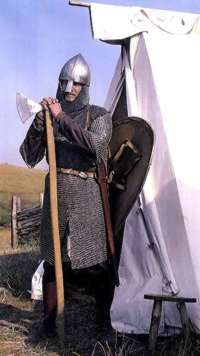
Huscarl - Regia Anglorum
Although still a heroic society the English army had evolved from the days of warlords having retinues of hearth troops, although it retained an aspect of this tradition. The great lords of the day such as King Harold and the earls had their huscarls; the heavy infantry of the day, perhaps on a par with the famed Varangian guard in Byzantium. The huscarls had been introduced some 50 years earlier during Cnut’s reign. These were experienced professional warriors, possibly some of the best soldiers to be found in Europe at the time. They had taken the ancient tactics of the shieldwall and
developed them. Each huscarl would have a long hauberks of mail with a coif and conical helm with a nasal guard. They carried long kite shields and, as well as being armed with swords and throwing spears, they also were adept with the dreaded Danish axe. This was a fearsome weapon, it was able to break shields, lop off limbs and even decapitate a horse in a single blow.


Around this core were the fyrd. The fyrd system dated from King Alfred’s time. These were territorials who were bound to give two months service a year. They were raised on the basis on one man for every 5 hides of land. This raised around twenty shillings which would pay for the warrior’s weapons, armour and food. These warriors would probably have the more traditional round shields. In theory a king could call upon up to 20,000 fyrd, but such a number could never be raised at once due to the practicalities of communication and logistics at this time. As well as these semi-professionals Harold could also call on all freemen to his banners in a time of national emergency. Such men would have grabbed any weapon to hand, whether spear or scythe.


There are further factors effecting numbers available to Harold; the Southern Fyrd had been on duty all summer in expectation of the Norman invasion and had been disbanded due to the approach of harvest time. The pitched battle of Stamford Bridge would have caused great loss both to the huscarls and the fyrd who answered the call. Normally Harold would have had around 3000 huscarls, perhaps Stamford Bridge would have reduced this to 2000. Harold’s brothers Earls Gyrth and Leofwin would have approx. 1000 huscarls each. Perhaps the recalled fyrd that gathered at Hastings would be around 5000. So Harold would field around 9000 men, similar to the numbers William commanded.

The Norman army, despite their Scandinavian heritage had a more continental way of war. Norman society was feudal and at the core of their army were knights. The knights were granted lands with which to support themselves, and were required to serve their lord.  Like the Huscarls they would have long hauberks of mail, conical helmets with nasal guards and kite shields. However these were mounted heavy cavalry; the shock troops of the time, armed with lances, it is thought that William had around 2500 of these mounted warriors in total. As well as the knights the Normans fielded infantry, professional men-at-arms that weren’t landed knights and would probably be armed in similar fashion to the English Fyrd, these would be the bulk of the army, numbering perhaps 4500.  The Normans also had around 1500 dedicated archers using short bows to soften up an enemy prior to sword play.
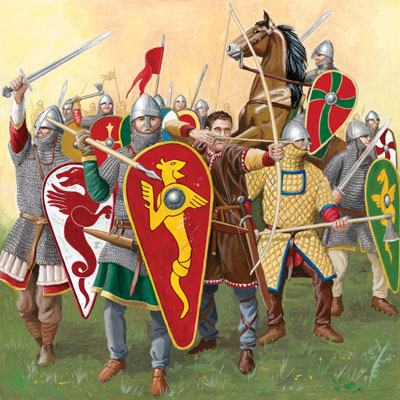
Norman soldiers - Image from model- making.eu


The army was divided into three; William’s Normans in the centre supported either side by his subject allies, Eustace of Bologne and his Flemish forces on the eastern wing and Count Alain and his Bretons on the western.

The invasion itself was a marvel of medieval logistics. William had to gather around 500-700 ships to carry men, horses, equipment , and even a wooden castle in kit form, over the Channel. Encouraging his underlings and allies to help finance this operation speaks volumes for William’s reputation and powers of persuasion. He had to remind them of the terms of their tenure, but also convince then that such an operation was even feasible. True there was the promise of lands and plunder but due to the efforts of his advisor Bishop Lanfranc, William had managed to get a Gonfanon – a papal banner –  so the enterprise now had the blessing of Rome. This was no mere invasion, this was a crusade.
The invasion fleet had to wait almost a month until the tides and winds were favourable, it’s recorded that William only lost 2 ships during the crossing. Ironically one of these carried the Duke’s soothsayer; never underestimate the fickle finger of fate, or its sense of humour!

The papal Banner - Bayeux Tapestry


Moving hesitantly inland from the landing site at Pevensey, William built a fortification at Hastings. From here his forces raided the surrounding countryside both for supplies, with an eye to his extended supply lines, and also knowing full well the area were part of the Godwinsson lands. William needed a decisive victory as soon as possible. Likewise, Harold, no doubt buoyed by his victory in the north, and angered by the Norman pillaging, wished to grab destiny with both hands.

 Arriving in London on the 6th October Harold gave himself a week to gather his forces. True Duke William had been campaigning most of his life, but Harold was also a seasoned warrior and very able commander, and he gathered intelligence of the Norman position. On the 11th October, yet with only half his available forces he advanced across the Weald toward William. On Friday 13th the English gathered at the edge of the forest between the villages Whatlington and Crowhurst . The Anglo-Saxon Chronicle  lists the assembly point as the “hoary apple tree” . It has been suggested that Harold initially planned a swift forced march at night to launch a surprise attack against the Norman camp the next day, but his scouts would have reported that William knew of his presence and was advancing towards him. Even with the advantage of surprise lost, Harold had chosen an excellent defensive position, below Caldbec Hill. At  9am on 14th October the battle began at Senlac Ridge, as the Normans organised in the valley Harold’s shield wall took shape across the ridge, their ranks 700 yards long. In the centre Harold unfurled his standards , the wyvern of Wessex and his personal banner of the fighting man.

Map of the battle from historyofengland.typepad.com/


Under William’s papal banner the Normans advanced. The archers got within range and emptied their quivers at the English line. But this volley had little effect. They were shooting uphill so most arrows either were impaled on shields or passed over the English lines. Following this the Norman infantry struggled up the slope. The rise was some 50 feet from the brook in the valley bottom and they were met with a hail of missiles from the English, including spears, throwing axes and even rocks. William threw his knights forward, alarmed at the lack of progress achieved by the first wave.

The Norman first wave attacks the English  shieldwall - weaponsandwarfare.com


It was on the shallow western end of the ridge that the Bretons arrived at the English lines before the Normans and Flemish. It was an uncoordinated effort that met an intact English line. They were met with missiles and were unable to get close to the English without risking their mounts. The Breton wing fell back leaving the Norman left flank exposed to missiles. The Norman and Flemish wings met the same dreadful site of intact English lines after struggling up the slope through hurled spears and rocks. The whole Norman line now waivered, on the verge of a general retreat. William's half brother Bishop Odo desperately tried to rally the fleeing Bretons.

On the western edge of the Ridge the English fyrdmen saw the Bretons in full retreat, from their perspective the whole Norman line looked on the verge of defeat; breaking ranks, they set off down the hill in pursuit. In the centre William saw the unfolding events, he had to act fast to stem the rout. He took his Norman cavalry and attacked the advancing English. How quickly in the fog of battle are the tables turned. The English fyrdmen now found themselves stranded in the open, unable to get back up the hill, and made a last desperate stand on a small hillock near the valley floor. The event is shown in the Bayeaux Tapestry. That they aren’t huscarls is shown by the lack of hauberks. The Bretons rallied and the stranded warriors in the hillock were slaughtered to a man. In the space of an hour and a half, with a momentary lack of discipline, Harold’s advantage and seemingly early victory had been snatched away from him. Harold’s previously impregnable line had to stretch thinner to compensate for his losses. Both sides paused to regroup.
The fyrd trapped on the hillock - Bayeux tapestry


Duke William shows his men he's alive - Bayeux tapestry
With the archers restocked with arrows the Norman second wave began. Learning from the previous failure William urged a slower advance so the infantry and cavalry could support each other. This second attack went on for 2 blood-soaked hours as the attack against the shield wall became a series of smaller battles along its length.  By 1pm the dead would be piled on both sides yet the shield wall held true. Both the Flemish and Bretons were sent back reeling in disarray. Again English Fyrdmen foolishly gave chase to be caught in the open. Norman chroniclers say these were feigned retreats but with the discipline (or lack of) at the time this is highly unlikely. With the low morale of these troops a feigned retreat could easily become a rout. It is said that William himself fought in this second phase and had 3 horses killed under him. he had to show his face when a rumour began among his men that he had been slain.


Again the Normans withdrew and took stock. William must have been becoming increasingly desperate; the English shield wall held and his men would be exhausted. The slopes would be churned up by hooves and slick with blood. He knew his men had one more attack in them. Defeat and retreat would almost certainly cost William his life. The next attack had to succeed. A different tack was required. He had to combine his archers and his knights and foot soldiers more effectively with his whole force attacking the ridge at the same time.
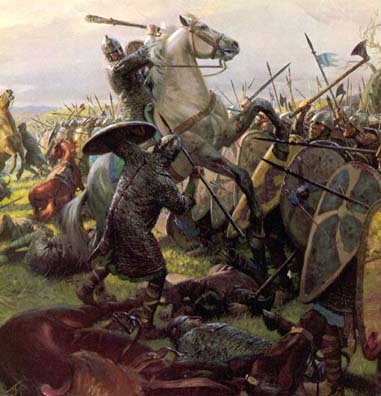
Bishop Odo in action against the shield wall - notice his weapon is a club so as not to sinfully draw blood - from www.robertsewell.ca/


At 3 o’clock The Normans advanced slowly with horse and foot solders together, the archers in the rear.  The Norman advance drew out the usual English volley, but it was impatient and launched at a longer, less effective distance. As the Normans closed with the English the archers fired upwards, high into the air so the arrows would fall on the English line and draw their  shields up. With the shower of arrows causing a distraction the hand to hand combat began. An hour into the third wave and the turning point was being achieved. Gaps began to appear in the English line and the Normans forced themselves in, breaking the shield wall into sections.  With both English flanks now weakened and the whole ridge no longer defensible, William ordered the Flemish and Bretons to attack from both sides. They broke through, shattering the English position that had held solid across the ridge all day.


For Harold now the battle was lost, it was all about now life, death and honour. There was fighting
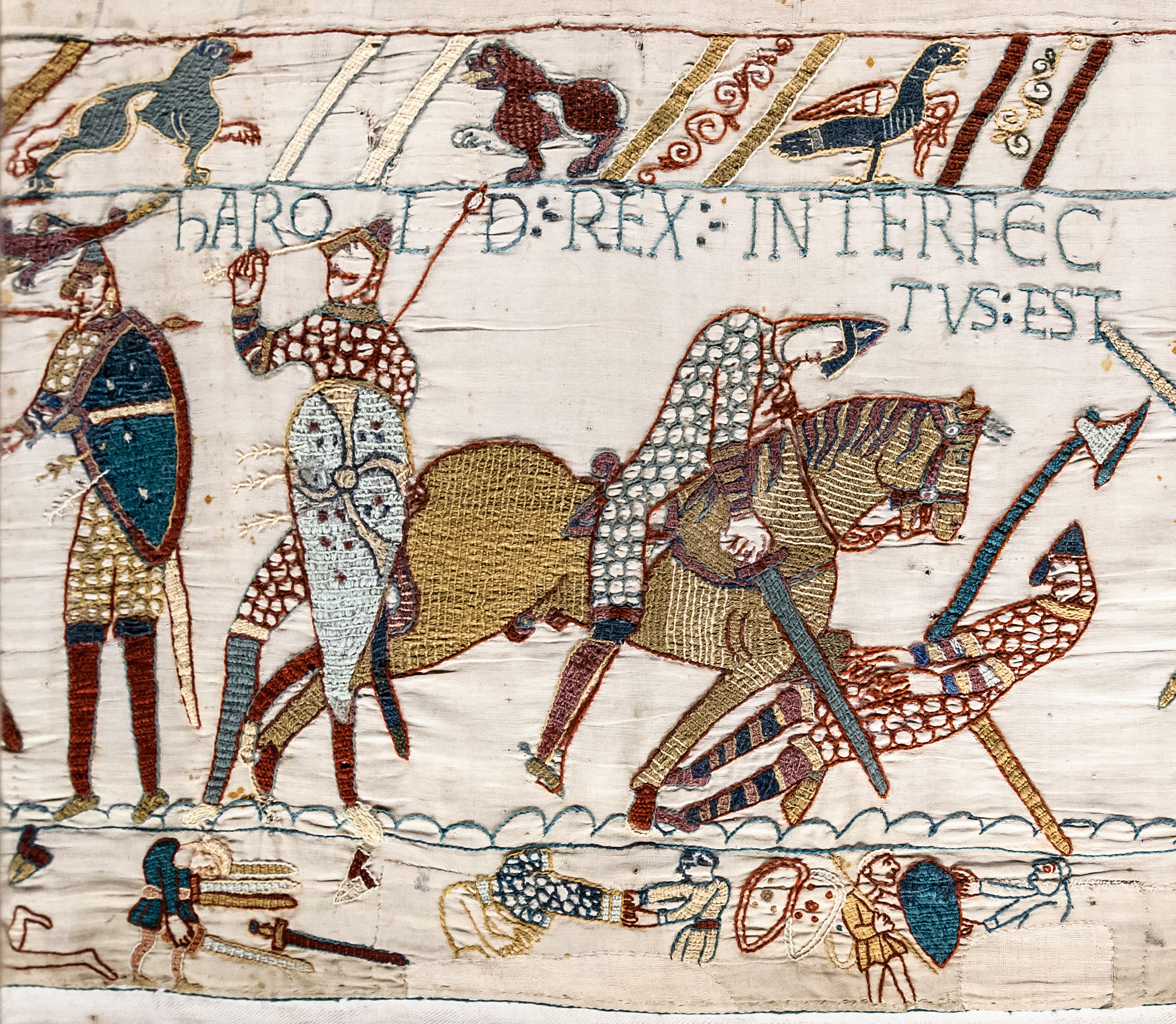
Harold is slain - Bayeux Tapestry
along the whole ridge. It was at this point that Harold’s brothers Leofwine and Gyrth fell, defending their king and brother judging by their proximity to Harold. The fyrd attempted to escape and melt into the forest but the huscarls, true to their oaths, remained fighting around Harold and his standards. As the light faded around 5.30pm Harold fell, probably not by an arrow to the eye, as interrupted in error from the tapestry, but from a sword blow and then “covered in deadly wounds”, according to William of Jumieges. Fired by the events of the day and their sense of religious righteousness Flemish knights hacked at the fallen king, grievously mutilating him. It was said only Harold's handfast wife, Edith Swanneck, could recognise her lover's body, so terrible were the wounds inflicted on the slain Harold.
The last stand -  from bitaboutbritain.blogspot.co.uk/


With the King and his brothers slain there was nothing more to fight for, a few remaining huscarls fought doggedly to the last while others fled to the forest  pursued by the vengeful Norman cavalry to prevent any regrouping. It might well have been the case that there were still late arrivals of fyrdmen appearing on the battle’s periphery. That some English still had the spirit to fight was shown when a band of Norman knights were ambushed and slaughtered at a place called Malfosse (evil ditch), named as such after the event. Yet despite the valour of the defenders at Malfosse the battle was over, and decisively so; England would never be the same again, of the three contenders for the throne only the Norman Duke William remained.

Harold's bones are lost to history, there would be no shrine to the fallen king. It was said that he was either buried without ceremony on unconsecrated ground (as he was ex communicated), or was perhaps thrown into the sea. Another tale reports him as being buried under a cairn on a headland, as if ironically watching for invaders. William refused the pleading of Harold's mother, Gytha Thorkilsdottir, to yield to her the slain kings remains, even in exchange for Harold's weight in gold. Even in death perhaps, he revealed the precariousness of William's position, that of an invader, a foreign usurper. Yet a new regime would now held sway, and history would be written by them, as victors are wont to do.

Sources;

The Battle of Hastings - Peter Poyntz Wright - (1986)
The Bayeux Tapestry
Anglo-Saxon Chronicle
William of Jumieges - Deeds of the Dukes of the Normans
Frank Barlow - The Feudal Kingdom of England 1042-1216 (1988)

Rob Bayliss is a reviewer at The Review and fantasy author. Information on his writing projects can be found at Flint & Steel, Fire & Shadow.

Saturday, 20 August 2016

Sharon reviews The Wolf Banner

Today sees the release of The Wolf Banner by Paula Lofting. The author has kindly donated 2 e-books as prizes in our giveaway and will also offer an ebook of Sons of the Wolf if the winners do not have a copy. To be in with the chance of winning this fabulous book, simply leave a comment below or on our Facebook Page. Good luck!


WAR AND BLOODFEUD
1056...England lurches towards war as the rebellious Lord Alfgar plots against the indolent King Edward. Sussex thegn, Wulfhere, must defy both his lord, Harold Godwinson, and his bitter enemy, Helghi, to protect his beloved daughter.
As the shadow of war stretches across the land, a more personal battle rages at home, and when it follows him into battle, he knows he must keep his wits about him more than ever, and COURAGE AND FEAR MUST BECOME HIS ARMOUR…  


The Wolf Banner is the second book in Paula Lofting's marvellous Sons of the Wolf series which tells the story of Saxon England in the years preceding the Norman Conquest. It follows the trials and tribulations of one family; Wulfhere, his wife and children. A thegn sworn to Harold Godwinson, Wulfhere has responsibilities to his king, his lord and his family, while trying to overcome his own fears, temptations and one big problem; his neighbour and sworn enemy, Helghi.
The Wolf Banner builds on the first book, to draw the reader further into Wulfhere's life, the highs and lows, into battles with swords and words. It is a fabulous adventure, full of family heartache, compromise and love, while never losing sight of the bigger picture; of England and the struggles of Harold Godwinson, Earl of Wessex, both against his enemies and his king.


Paula Lofting is a natural story-teller who has put her heart into her characters. They are all-too-real. Human. Wulfhere's family are as dysfunctional as the rest of us. With bullying twins, sibling rivalries - and friendships - and adults who aren't quite sure what to do for the best. Beset by insecurities, temptations, feelings of despair and a desire for revenge the family dynamic leaves the reader nodding in understanding and sympathy.
The characters are so full of life, it's almost as if they will jump out of the page at you at any moment. I'm sure every reader will have their favourite. Mine has to be Tovi; the middle child - just like me - eager to please and desperate to be a warrior like his father. His sister, Winflaed, comes a close second; another middle child who is eager to please, she has a spark of independence that makes you want to smile. And that rebellious streak of a tom-boy who knows she can do everything her brother can - and is going to prove it. I can only hope that these two wonderful characters will become the stars of later books.
But Wulfhere is more than his family. He is a thegn with duties to his lord - Harold Godwinson - and to his king, Edward the Confessor. He is the leader of a war-band who have to face down England's enemies from within and without. And the book seethes with the tension of brewing war, battles now and in the future - and a father whose two sons must stand in the shield wall for the first time.

The tension is palpable.


The Wolf Banner is the epitome of story-telling. Every now and then there is paragraph, where the descriptive prose is so clear, palpable, that it will send a shiver up your spine. Full of lively characters and plenty of action, the story is told in wonderful, colourful prose which sets the scene and dictates the atmosphere. It paints the picture of an everyday, dysfunctional family life that we can all relate to - even today, a thousand years later.
Ealdgytha kissed her daughter on both cheeks. Freyda hardly responded and not even a smile passed her lips. If she was hurt by her daughter's lack of emotion, Ealdgytha did not show it. She smiled, regardless, and kissed her new son-in-law. She bade them both farewell as they climbed onto the wagon that held their wedding gifts and Freyda's belongings.
"Remember what I told you, my girl; be good to your husband. Love him, and treat him well, even above yoursself," Ealdgytha whispered to her daughter as she stood beside the wagon.
"As well as you have treated my father, Mother?" Freyda replied with a glint of contempt. "I think I can manage better than that; much better."

The Wolf Banner achieves a wonderful balance between the political and domestic life of Wulfhere. It is a fascinating story of duty, family and history. Triumph and tragedy, love and betrayal live side-by-side.
The story moves at an incredible pace, with the worsening political situation of England woven into the story of a family tearing itself apart. And yet, the family must pull together to survive. I hesitate to call any book a 'tour de force' but The Wolf Banner is unique, it is an incredible story of one family's journey in pre-Conquest England. It draws you in, forces you to live through the experiences and dramas of the family; their loves, losses and even their arguments become a part of you as you read, almost one of your own family.
The storyline, descriptions, the dialogue and Wulfhere’s family combine to make this a novel to treasure.
Let's hope there is more to come.....

 About the author:

Paula Lofting was born in Middlesex and brought up in South Australlia. At the age of 16 she returned to the country of her birth where she always dreamed of writing a historical novel. Her dream was not realised until nearly thirty years later when she finally set about writing her first novel, Sons of the Wolf, which she first published in 2012. She has recently re-published it under a new publishing name of Longship and the sequel The Wolf Banner is available from 20th August 2016. Paula is also writing a series of blog posts to commemorate the 950th anniversary of 1066 this year, which can be found on her website, paulalofting.com.

Facebook
Twitter
Amazon


 Sharon Bennett Connolly has been a reviewer for The Review since 2015. Fascinated by history for over 30 years she has studied the subject both academically and  just for the joy of it - and has even worked as a tour guide at historical sites. She is now having great fun passing that love of the past to her 11-year-old son; visiting abbeys, hunting dragons in medieval castles and searching for fossils at the beach. Having received a blog, History . . . the Interesting Bits, as a present for Christmas 2014, she is now enjoying sharing her obsession of history with her readers and currently working on her first book Heroines of the Medieval World due for release in 2017.


Friday, 18 March 2016

Sharon Reviews Paula Lofting's Sons of the Wolf

The author has kindly donated e-book copies of Sons of the Wolf to2 lucky readers. To be in with a chance of winning, simply leave a comment below or on our Facebook page. The draw will be made on 25th March 2016. Good luck!


1054, pious King Edward sits on the throne, spending his days hunting, sleeping and praying, leaving the security of his kingdom to his more capable brother-in-law Harold Godwinson, the powerful Earl of Wessex. Against this backdrop we meet Wulfhere, a Sussex thegn who, as the sun sets over the wild forest of Andredesweald, is returning home victoriously from a great battle in the north. Holding his lands directly from the King, his position demands loyalty to Edward himself, but Wulfhere is duty-bound to also serve Harold, a bond forged within Wulfhere's family heritage and borne of the ancient Teutonic ideology of honour and loyalty. Sons of the Wolf is a panoramic snapshot of medieval life and politics as the events that lead to the downfall of Anglo Saxon England play out, immersing the reader in the tapestry of life as it was before the Doomsday Book. With depictions of everyday life experienced through the minds of the peoples of the time; of feasts in the Great Halls to battles fought in the countryside, it cannot help but enlighten, educate and entertain.


This week has seen the re-release of Paula Lofting's wonderful novel, Sons of the Wolf. Set in the reign of Edward the Confessor, the story revolves around one of the king's trusted thegns, Wulfhere. A real-life thegn who we know little about, beyond his name, Ms Lofting has created a world around him, imagining his home, his family and his life.

Opening with Wulfhere's return from the Battle of Dunsinane, the novel leads us on a lively ride through Wulfhere's frenetic domestic life, full of family dramas and neighbourhood feuds, with one or two unexpected twists along the way. This is expertly contrasted with Wulfhere's public life; as a thegn of Edward the Confessor, and with Harold Godwinson, Earl of Wessex, as his Lord he is close to the centre of English politics, called on to attend the Witan and witness to the political machinations of the great and the good - and bad.
 
The combination of national politics and domesticity balances nicely throughout the book, leading to a dual climax of the Battle of Hereford and its aftermath and a family drama that could have fatal consequences....


This wonderful story gets you hooked from the very beginning, with Wulfhere's homecoming introducing us to a complex hero, affected by war and plagued with nightmares, who tries to balance his family life with his responsibilities as thegn. Although it is a period I know little about, Paula Lofting is an aficionado, a fact which comes across from the beginning. She uses her knowledge of the customs and practices of the era to recreate a stunningly authentic world, evoking the language, sights and smells of the period simply by her words.

...He removed his helmet and gave it to one of the twins. Wulfric immediately set it on his head as his brother, Wulfwin, tried his best to snatch it from him in an amusing display of mock sibling rivalry. The thegn stood before his wife with the reticence of a child and waited for her to speak.
"Welcome home, husband!" Ealdgytha smiled with genuine warmth and stepped forward with her arms open. She pushed herself into him and he enclosed her in an embrace. Bending his head, Wulfhere felt her face against his cheek as she softly breathed the words into his ear. "Welcume."

The strength and power of  Sons of the Wolf is in its characters. They are all complex, interesting individuals - human. Created with the usual mixture of insecurities, fears and hopes that we would recognise today. Paula Lofting has developed strong, intelligent female characters, while still forcing them to remain within the confines of the 11th Century. And yet they manage to express themselves and their feelings. The disillusioned, disappointed wife, the rebellious daughter who wants love on her terms and the ex-lover trying to hold on to someone else's man; all create a tapestry of interwoven lives which threaten to overwhelm the hero as he tries to live up to his responsibilities.

Wulfhere is a sympathetic, flawed hero who is trying to find his way in a turbulent world. His weaknesses are laid bare to his wife, family and close friends; while his abilities on the battlefield earn him respect and admiration from his peers. He has to cope with a willful daughter, wayward sons and an angry wife, whilst dealing with the villain of the piece. Helghi just makes you want to punch him! His actions are despicable, and yet he always seems to come out on top - it's a mark of the power of the book, that you can feel such anguish for Wulfhere, and disgust for Helghi even as you read.


Paula Lofting's wonderful characters benefit from her extensive knowledge of the era. She manages to seamlessly intermingle the fictional characters with the historic. With the author's vivid descriptions it is not hard to visualise Wulfhere's longhall, the crowded Witan of Edward the Confessor, nor the battlefield of Hereford. Ms Lofting skilfully describes the nightmare of battle, it's aftermath and the fear and pain of combatants and non-comabatants alike, drawing the reader in so  they feel they have been a part of the history.

The author cleverly sprinkles her prose with Saxon words, which has the effect of emphasising the protagonists' feelings at critical points in the story - and makes the reader feel even more like an observer of the actual events, rather than a reader of fiction.

Paula Lofting has done a wonderful job of recreating pre-conquest England and the world of Edward the Confessor and Harold Godwinson, in a book which is almost impossible to put down (even to sleep). The best thing is, this is book 1 of 2 - and now I can't wait to get my hands on Book number 2, The Wolf Banner....

(All pictures courtesy of Paula Lofting)


Paula Lofting was born in Middlesex and brought up in South Australlia. At the age of 16 she returned to the country of her birth where she always dreamed of writing a historical novel. Her dream was not realised until nearly thirty years later when she finally set about writing her first novel, Sons of the Wolf, which she first published in 2012. She has recently re-published it under a new publishing name of Longship and the sequel The Wolf Banner is due for release in May 2016. Paula is also writing a series of blog posts to commemorate the 950th anniversary of 1066 this year, which can be found on her website, paulalofting.com.
Website
Facebook
Twitter
Amazon


Sharon Bennett Connolly has been a reviewer for The Review since 2015. Fascinated by history for over 30 years she has studied the subject both academically and  just for the joy of it - and has even worked as a tour guide at historical sites. She is now having great fun passing that love of the past to her 10-year-old son; visiting abbeys, hunting dragons in medieval castles and searching for fossils at the beach. Having received a blog, History . . . the Interesting Bits, as a present for Christmas 2014, she is now enjoying sharing her obsession of history with her readers.

Monday, 25 January 2016

Paula Reads: The Betrothed Sister by Carol McGrath

The author would like to invite you all to her Facebook Event on the 26th January
to help her celebrate the launch of the last installment in her Daughters of Hastings 
series where there will befun, Q&A session
 and the chance to win book prizes.


Harold Godwinson, King of England for only 10 months, died on a battlefield near Hastings, defending his crown and his kingdom from the foreign invaders from across the sea. On the 14th October 1066, the flower of England’s youth lay dead, their bloody carcasses scattered across the marshy slope for their womenfolk to walk amongst, like wraiths, themselves as if dead, too, searching for the bodies of their loved ones. One such woman was the wife of the king, Edith Swanneck, who, as legend tells us, had to seek out her husband’s parts, recognising him by the marks that she knew so well. What followed after this terrible event, was the Diaspora of her family. In one day, the daughters and sons of Harold Godwinson had lost their father, their uncles and their fellow Englishmen. In that same day Gytha, Harold Godwinson’s mother had lost her remaining sons and grandson, with another son and grandson in custody of the Duke of Normandy.

The devastation of that day has been the topic of many novels, compelling authors of fiction to make sense of it all, and one such author, Carol McGrath, has chosen to take us through a journey, not undertaken before: through the eyes of the Godwin women, Ms McGrath takes us on a trail with her trilogy, Daughters of Hastings, to Ireland, to Flanders and Brittany; to Denmark and to Russia. These are the far off places that the Godwinson Diaspora takes us and in her third book, The Betrothed Sister, we end at last in the magnificent palace of the Russian princes’ in Novgorod.
Young Gytha, or Thea as she is called in The Betrothed Sister, is the eldest daughter of Harold and Edith Swanneck. She is fifteen when the book starts and the story opens with a prologue. Gytha is speaking to us as a mature woman, an introduction to the narrative. It then goes on in the third person and in the first chapter, her brothers, Godwin and Edmund, are escorting her to a new life. Many wives and children of dead or dispossessed nobles go with her, their lives tainted by the ‘sin’ of fighting for the wrong side. Led by her namesake, Gytha, Countess of Wessex, Thea’s grandmother, the women and children are bound first for St Omer, where they will join a convent community. But Thea is intended for greater things, and after a long spell in Denmark, she travels to Russia, where she must wait for her prince, the man she is fated to marry, Prince Vladimir of the Rus nation. (As an aside, through Thea’s children with Vladimir, Harold Godwinson’s bloodline was carried back into the English Royal Family.  

Thea’s story is not as simple as it sounds. There is no smooth ride for Thea, as her determination to rise above adversity and prejudices, keeps her spirit alive, motivating her to give her life value. She is inspired to give meaning to her father’s death, that he did not die in vain.  Throughout the story, Thea has to overcome one test after another, but each one makes her stronger, moulding her into the courageous young woman she is fated to become. Thea is the spirit of her father, King Harold II, the driving force that propels her into greatness.

What I admire most about The Betrothed Sister, is the enormous amount of research and determination the author applies to breathe life into this woman’s existence. Women are often assigned to the footnotes of history and superficially we know through the annals of history, that Gytha, (or Thea, as she is called in this story) daughter of a defeated king, marries a Russian Prince and forged a new line of nobles in her own right. That is basically the summary of her life in history. But of course, she was much more than a few lines in a chronicle; we know roughly, the start and the end of her life, but what of those bits in between? This is where Ms McGrath’s skill as a historical novelist comes into play. Through her knowledge of noble Russian medieval life, we see how they are marginalised in politics, fiercely protected by their menfolk, almost emulating the lives of many women in Islam today. They are veiled in the presence of the court, and must not show their faces or parts of their bodies to their husband’s until they are wed. Ms McGrath has used this knowledge to imagine what the changes to Thea’s, as she is called in this story, life must have been like for her, coming from a society where women were regarded, virtually, on equal par with men.

Women in England in the 11thc were able to own property, and do with it as they felt fit. They were land owners in their own right and could hold the status of a land holding thegn. They could represent themselves in court and pursue suits against men. Thea Godwinsdottir, is suddenly thrust into a very different world where men ruled the roost completely, and has to learn to adapt to this new mindset. She finds it difficult, but she has to dampen her spirit in public to survive, even though she fights against it, mostly to her own cost and of those she loves dearly.

Faced with the task of getting Thea from England to Denmark, and from Denmark to Russia, Ms McGrath had little evidence of her trail, but deciphers the facts to give them meaning, and the story she provides us with is both plausible and entertaining. Using both fictional and real historical characters of the time, she creates a world that we can believe. Looking at the facts and examining cultural differences, our author cleverly weaves a story that is not incongruous with the life and times in which they are set. There is excitement, we have at least two battles, one of them a siege, that will have you biting your nails whilst being unable to stop turning the pages.
Ms McGrath enables us to get into the mind of Thea as she experiences the many travails of her life. Her brothers, Godwin and Edmund, lost in the annals of time, are provided with an imaginative version of what men they might have become. We also see an old favourite, Padar, Thea’s father’s scop whose loyalty to her family sees him watching over his master’s daughter, an ever listening ear and shoulder for her to lean on.

The book is an imaginative account of events that little is known about, and for those who are interested to know what might have become of Thea and her family, this series, The Daughters of Hastings, is definitely worth a read. I’ve enjoyed being taken on this journey with Ealditha, the girls’ mother, and Gunnhild and Thea, and am thankful to Ms McGrath for taking me with her.
One of the most poignant themes of this book is that in a world that is forever changing, the only thing that remains the same, is change, and that one cannot fight against it and find victory; but with a strength of spirit, one can overcome the sense of loss that change brings, to rise like the Phoenix from the ashes into a new life.

                “Ah, my mother,” she whispers as she gently drops the silver lid on the letter, “how wise you are and how fortunate I am to have a husband I love and who loves me back, the father of my father’s grandchildren.” She sighs wistfully, and smiles to herself. If there is one constant in our brief lives, it is change.”


About the Author

Based in England, Carol McGrath writes Historical Fiction. She studied History at Queens University Belfast, has an MA in Creative Writing from the Seamus Heaney Centre, Queens University Belfast and an English MPhil from Royal Holloway, University of London. The Handfasted Wife is her debut novel, first in a trilogy titled The Daughters of Hastings. The second and third novels The Swan-Daughter and The Betrothed Sister have followed and are now available on amazon and in bookshops. Carol is an historian specialised in The Medieval Era. Her first love, however, is writing. She is an avid reader and reviewer.
Follow Carol on 


Paula Lofting is the author of soon to be published Sons of the Wolf series. She is the founder of The Review and has been an ardent reader and reviewer for this blog since its creation. She is currently working on the sequel, The Wolf Banner which will follow Sons of the Wolf  in the Spring. you can follow her 1066 blog at her Website:  

Friday, 28 February 2014

Sons of the Wolf reviewed by Linda Root


There is a signed copy of this book to be won, see the bottom of page for details. 

There is a village in pre-Norman Sussex called  Horstede which  has been invaded by a time traveler, or so it seems. I am tempted to speculate that not  even a member of Regia Anglorum like author Paula Lofting could create a story like Sons of the Wolf unless she had lived among them.  I suspect that in spirit, indeed she has.  Her novel  is the product of a writer who not only loves her subject and knows it well, but also knows her craft.  As I read the opening pages, I can smell the woodsmoke and feel the warmth of the greetings of the villagers as protagonist Wulfhere and his right hand man Esegar return from a bloodly battle as the opening curtain rises.  I remain a captive of the story until its final page, and best of all, beyond. Thankfully there is a sequel coming.


Any meticulously researched and authentically presented historical  novel set in a well known milieu faces the risk that devotion to historical truth  may become its own spoiler. Such is not the case with Sons of the Wolf. To avoid the common pitfall,  Lofting has masterfully selected two characters from the pages of Doomsday Book about whom little is known. The only references is to their names –Wulfhere and Helghi—and the amount of land they owned. Their respective societal ranks can be guessed from a notation as to the size of their respective estates. The balance is  Lofting’s creation.

Wulfhere is the thegn of Horstede and Helghi’s superior in rank. Helghi also  is a landowner but a tier below his rival. Their families have been fueding for years, and the conflict brings out the worst of each. Their  abiding hatred forges their destiny and contaminates others. Wulfhere is a  good man who seeks to do the right thing, but he does not always like it. Helghi is the consummate villain,  obsessed with bringing Wulfhere to his knees, and willingly sacrifices the future and the well-being of his family to do so.

When the historical character Harold Godwinson, Earl of Wessex and brother-in-law of King Edward seeks to reconcile Wulfhere and Helghi, he sets events in motion that make matters worse.
After I read the initial four chapters of the book I put it down, not because I did not like it, but because I was utterly unfamiliar with its historical context.  My intense study of British history is framed by the  Plantegenets on one end and the Marlboros on the other. What I knew of the Norman invasion could be  summarized in a  line  from the 1953 movie Young Bess.  Says adolescent  Elizabeth, "England has never been invaded, except by the Normans, who do not count because they were us."  What I knew of Anglo Saxon Britain would have scarcely filled a journal page. I  profited from  spending  a few minutes on Wikipedea,  and once I had a better understanding of what transpired in Britain in the years immediately prior to 1066, I was ready for a breathtaking, violent, fast and furious and often heart-rending ride through the years before the Normans came.

*Horstede (AKA Wychurst)

The protagonist of Lofting’s tale is Wulfhere, a great bear of a man, who is a creature of principal, although he often wishes he were  not. He is a loyal servant of the king and of Harold Godwinson, earl of Wessex,  but he is also the guardian of  Horstede and the protector of his family, and his loyalties and responsibilities often come in conflict. And that is a dilemma for a man who attempts to be all things to everyone.

As early as his homecoming in the first chapers  of the book, we  sense his guilt for having lived when others have not, and his stress  due to the horrors he has witnessed. He and  his wife had quarelled before he left and he worries that his homecoming will not be as joyous as he would like. Because of the carnage he has witnessed, he returns not as a victor but as a survivor.

When his wife  Ealdgytha greets him with open arms, we question whether  her joy in  his safe return  has more to do with matters of her personal security than any great affection she feels for Wulfhere. As the scene develops, we realize that she is sincere in her welcome.  She, too, has personal desires and physical  needs. Wulfhere is suspicious,  but takes what pleasure he is offered. Their shared joy is only on the surface and it is short lived.

Due to Wulfhere’s  past infidelity and the tensions of his fued with Helghi, soon his family is falling apart. His twin sons are undisciplined, his wife runs hot and cold, he is estranged from his lover Alfgyva and the restraint he exercises  in dealing with his traditional enemy Helghi in order to please Harold Godwinson is not working. In addition, his favorite daughter Freyda’s romance with Helghi’s  son only makes matters worse, and provides a weapon that Wulfhere’s enemy Helghi uses against him.  Nevertheless, true to his nature, Wulfhere tries  to hold it all together, and it is there that the intrigues begin.

Lofting takes those facts and builds her storyline from there.  Then she  adds her own considerable knowledge of the sociology and politics of eleventh century Saxon England. Next  she adds to the mix all of the ingredients that  make a novel of any genre readable--love, sex, hate, jealousy, remorse, guilt, infidelity, vengeance,  death and profound tragedy. And to all of that, she  adds her  incredible talent for bringing blood and gore into her action scenes without overpowering the essence of her story, and writes her action scenes as if she were riding in the van.

Readers  will almost  smell the copper of the blood and feel the weight of the dead.  One can actually sense the terror of erstwhile proud and mighty warhorses as they, too, face slaughter. Her knowledge of medieval warfare puts her at the head of the pack of those writing in the medieval military subgenre. It is as if Lofting siezes the reader, puts a weapon in her readers' hands and sends them into the fray. No writer I have  encountered  does battlefield action better, not even Oliver Stone, and like Stone in his masterpiece Platoon, Lofting captures the pathos.

War horses

Without spoiling the story, be assured that a reader will acquire enough insight into the politics of the day to understand a bit of what King Edward was facing, and to explore the character of the king’s brother-in-law Harold Godwinson, his lady and the plotters who threaten  them. The  reader –even one who knows nothing about 1066--will sense  that William of Normandy is coming, and that he is bringing change. But a  more immediate and equally formidable danger  is threatening Wulfhere—a menace that lurks no farther away than his bad neighbor Helghi’s nearby lodge. When Wulfhere’s concern for his family collides  with the fealty he owe to Harold and the king, he  does the best he can to balance one against the other and in doing so, he suffers an egregious loss. Although few of the issues facing him and his family  are resolved in the final pages of this first novel in the series, the reader is not left frustrated or  dissatisifed, but with a sense that while a stage of  Wulfhere’s life has come to an end, the most challenging and eventful chapters in his adventure are yet to come.

While this is primarily Wulfhere’s story, he does not stand alone. Much of the plot is driven by the teenage libido of our hero’s daughter and our villain’s son. The  place of the historical character Harold Godwinson and that of his wife and  his sister Edith are well portrayed, and Helghi is definitely an easy one to hate. The vowel-rich spelling of medieval names and  places makes the first chapters difficult for the unanointed, but worth the effort. Lofting cleverly prefaces her story in a brief recount of an actual  event involving two aristocratic boys whose abduction sets in motion the tensions that culminate in 1066. The Norman invasion had its own version of the  princes in the tower long before either Richard III or Alison Weir came along.  The fate of the boys is mentioned  periodically throughout the book, but not to the extent of making Wulfhere’s tale into Harold’s story. The storyline has just enough historical reference points to place it in the eve of the invasion without reducing Wulfhere and his family to minor characters in an overwhelming historical event. This is not a tale of William of Normandy, who does not appear. Nor is it a story of the very compelling historical person Harold Godwin. From beginning to end, it is Wulfhere’s story.

I love this book. It is Paula Lofting’s first  novel. And yes, there is a sequel, The Wolf Banner, coming soon to my bookshelf.


* Wychurst is owned by the members of the Re-enactment Society Regia Anglorum
Paula Lofting’s book Sons of the Wolf is available at Amazon, and as a paperback.  The sequel to Sons of the Wolf, The Wolf Banner, will be available soon.


Please leave a comment below or on our Facebook thread to be in with a chance of winning a signed copy anywhere you are in the world!


Paula, ready to rumble


Linda Root is the author of the four titles in the Queen of Scots Suite. A fifth book, 1603: The Queen’s Revenge,  is coming  in the spring.