Showing posts with label Merlin. Show all posts

Thursday, 10 April 2014

The Best of The Review: Favorite Posts From the First Half Year (Volume III)

A Riotous Affair~

I love this post by author Stuart S Laing because it reminds me of one of my favourite highwaymen films, Plunkett and McClaine. This is a story of an 18thc gang of merry men, whose criminal activities helped the less well of classes and their outrage at them being brought to the gallows and subsequent fight for justice against the wicked Porteous and the Toll Booth prison. I could imagine this being made into a film. Any film producers out there reading this, take note! ~Paula Lofting, author of Sons of the Wolf

*********

Edinburgh has over the centuries seen many a grim affair darken its famous old streets and had reason to be thankful for the forces of Law and Order being on hand to protect the innocent, and to punish the guilty. Just occasionally however the roles were reversed and it was the defenders of the innocent who were the guilty. One such man, who was to earn the abiding hatred of Edinburgh, was Captain John Porteous of the Town Guard. When it seemed his crimes against the people of the city were to go unpunished, it was the people who delivered justice. The story begins on a dark night, not in Edinburgh, but on the other side of the Firth of Forth in the Kingdom of Fife...
The Porteous Rioters descends the West Bow (now Victoria Street)
THE ORIGINAL CRIME
On the night of 9th January, 1736, Collector of Excise James Stark rested at an inn in the fishing village of Pittenweem, Fife but no sooner had he settled down for the night than he was shaken from his slumber by loud banging on his room door. The noise was caused by a smuggler, Andrew Wilson, and a compatriot attempting to force entry, intent on robbing him. Wilson's other partner in crime, a fellow smuggler named George Robertson waited downstairs acting as lookout.

Realising what was happening, Stark managed to grab one bag of excise money before he jumped from a window and hid in a nearby stable where he spent the cold winter night buried under a heap of straw.

Wilson and his fellow thieves, having finally broken the door down, made off with £200 Stark had left behind along with some personal items such as his Bible. Wilson, Roberston and the third man, Hall, then made their way east but were quickly apprehended in the nearby village of Anstruther only a few miles along the coast, where Stark's £200 and other belongings were recovered. The three men were speedily shipped over to Edinburgh, where they were thrown into the city's notorious Tolbooth Prison to await trial. The Tolbooth Prison stood on the Royal Mile, in front of St Giles Cathedral. Hated, and feared by the people of the city, the Tolbooth was well known for the terrible conditions and cruelty which happened within its grim walls.

When the trial came, the men claimed that the robbery had been a spur-of-the-moment affair. The magistrates, however, were not fooled by this and Hall quickly pointed the finger of blame at his comrades and admitted their crimes. Wilson, Robertson and Hall were all found guilty and sentenced to death by hanging. Hall later had his sentence revoked in return for turning King's Evidence against Wilson and Robertson. Sentence was set for Wednesday, 14th April 1736.

On Friday, 9th April 1736, Wilson and Robertson attempted to escape the Tolbooth. The two smugglers had been provided with saws by visiting friends, which they used to cut through the window bars. Friends of Wilson and Robertson dressed up as women and sang psalms loudly in the Royal Mile to cover the noise of the thieves escape. Wilson insisted on going first but got stuck in the window and was still lodged firmly halfway in, halfway out when the guards arrived.

Click to continue reading


The Adventures of Merlin~

I chose this piece because of its sheer awesomeness. Who on earth else but Lisl could turn a TV show into a magical review such as this. I stopped watching Merlin after the second episode because it just wasn't happening for me anymore. I had initially enjoyed it. This review made me go out and obtain the whole series! Which I haven't got round to watching yet! But it's high on my list. ~Paula Lofting, author of Sons of the Wolf


*********


I actually don't watch a lot of television---not because I am a TV snob, I just don't have a great deal of time--and as a result never bothered to invest in cable. Amusing consequences involved my then-six-year-old son asking me, "What is a commercial?"I was slightly happy he had to ask me this, but later I thought about the vilification of television and settled on the conclusion I'd always done: That television isn't so bad, and in fact can be a worthy tool, but it matters how you use it. Even if for entertainment, I have found it can be used in concert with sneaky little educational insertions, and my now-ten-year-old turtle is the one who actually led us to this particular case. His success in persuading me to sign up for a TV/movie streaming subscription found me one evening, bone tired and flipping through the choices until I saw the word "Merlin," at which point I hastily clicked. For I am fan of Merlin since childhood and still recall dragging my mother to all the libraries in the region to collect books I'd looked up that had anything and everything to do with Merlin and King Arthur. Life having gotten a bit in the way of these pursuits, I nevertheless remembered my mother's voice, "And yet here we are again..."


“He cannot glimpse his part in the great story that is about to unfold. Like everyone else, he must live and learn.”

So we are told as we watch the young Merlin—known to us from Arthurian legend—climb a pathway on the journey’s last leg from his home in Ealdor to Camelot, where he takes up residence with his guardian and the court physician, Gaius.  Merlin’s introduction to Camelot comes in two main parts: one by witnessing an execution and next by tangling with a boisterous and perhaps bored Prince Arthur, who has him thrown into the stocks. By the first episode’s end, Arthur and his father Uther Pendragon’s opinion of the young boy—unbeknownst to them, a powerful sorcerer—settles to deep admiration and he is awarded with a position in the palace.

Watching this and subsequent episodes required me to settle into the idea of Merlin’s story being told rather differently to the way I’d always been taught. For starters, Merlin is unacquainted with Uther until this day, twenty years into the king’s reign, when he meets an Arthur already grown into his role as heir—there is to be no sword in the stone moment, at least not in the accidental discovery sort of way we know best. Moreover, Arthur’s opinion of the newcomer is rivaled only by Merlin’s view of the prince: “There must be another Arthur because this one’s an idiot.” As we later learn, Camelot itself also existed long before the prince and his father: recorded events trace back at least 300 years. 

I enjoyed the show enough to be fairly delighted by it—and amazed at the accidental events that led me to it—though I did wonder how Uther, so zealously fixated on his war against magic, could at times be so gullible. He eagerly laps up stories told by strangers yet refuses to believe his own son, or Gaius, his trusted physician of twenty years. Nevertheless, Uther does argue some powerful points, such as when he consults Geoffrey of Monmouth re: a knight’s nobility papers, or the need to show strength in the brutal world in which they live.

Click to continue reading...

Friday, 21 March 2014

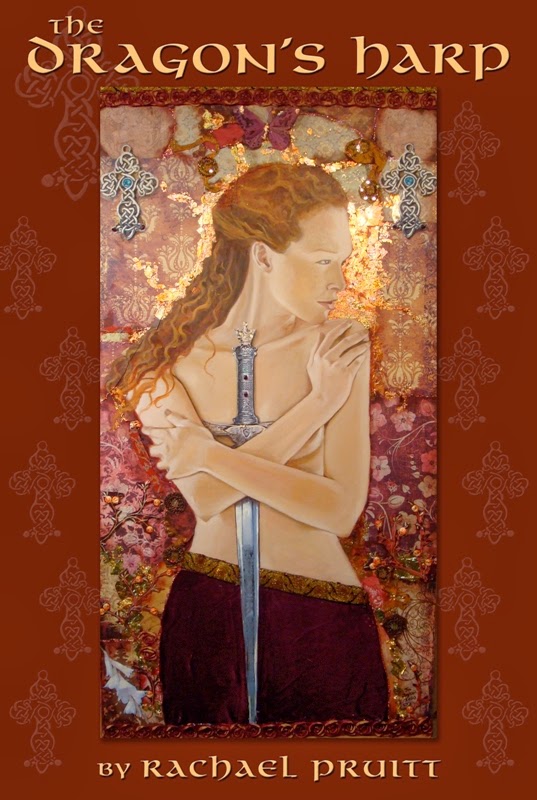
Lisl reviews The Dragon's Harp by Rachael Pruitt

Era of Dragons: The Lost Tales of Gwenhwyfar
Book One: The Dragon’s Harp
By Rachael Pruitt

Please see below for giveaway details!

Growing up, Arthurian legends were practically part of who I was, having been told them at my mother’s knees; later she began to expose me to written accounts, which I greedily consumed. I’ve lost track of how many or even which versions of the various tales I have read, but one thing is certain: there wasn’t much heard from the perspective of one very central character: Guinevere. So it was with great interest I learned of Rachael Pruitt’s novel of Gwenhwyfar—the Welsh spelling of this queen’s given name—where she came from and what made her the person she became.

It is fitting that Pruitt opens the novel not only from Gwenhwyfar’s point of view, but also beginning in the twilight of her life, when she has much to look back upon: this is no naĂ¯ve girl telling her story as it begins and moves forward, but rather a mature woman utilizing hindsight and the wisdom gained over many years to simultaneously examine her own (and others’) behavior. Now, however, her husband murdered and children gone, Gwenhwyfar shares a moment on the sands with a gull, an encounter reminiscent of the many cultures, such as hers, in which the spiritual wisdom of animals is revered and incorporated into tradition and cultural habit.

Born into fifth century Wales, the young Gwenhwyfar, presented to us by her older self, is at this time eight “sunturns”; she reveres her parents but still recognizes the divisions existing between them as her mother has embraced the new religion. Occasionally Ceridwen acts upon outrages from her new perspective, her own mother somewhat of a go-between in the moments when she oversteps her bounds.

Gwenhwyfar has known war her entire life, and though she still retains some of the innocence of youth, her perspective clearly incorporates the reality set around her:

I tiptoed, even though there was no one to hear me, only the oppressive stillness of damp watching stone, its grey gloom penetrated by a faint haze of light from arrow slits rock-cut at each outward turning of the stairs. The worn steps felt like carved bowls beneath my summer-bare feet.

Nevertheless, Gwenhwyfar is, as she reminds herself, a Battle Chief’s daughter, “not to be bested by shadows.” So it is she wills herself to investigate mysteries that present themselves to her, including by listening in on conversations, one scene drawing me back to Stewart’s Merlin crawling through the unused furnace to eavesdrop on conversations in the palace rooms above him. Gwenhwyfar has inherited her father’s tough stance, even if she does on occasion duck behind her mother’s skirts.

Remains of the keep at Dinas Emrys
As the young girl comes of age at Dinas Emyrs, she certainly faces her share of trials, told to us in language filled to the wondrous brim with poetry and magic. Pruitt’s sentences are so fluid readers not only move from one scene to another many pages away without realizing how far they’d travelled, but also do so as part of the story itself, indeed, as part of their surroundings. “I dug into my soul,” Gwenhwyfar confides, “resisting his pull, as if I were digging my toes into sand so as not to get swept out with the tide.”


This, indeed, is how both author and protagonist set it out: the latter by commencing her story at a fireside to a young girl, the former with a “storytelling hearth” aura, the flickers of which can periodically be felt as the pages turn. While the mark of a great “wayback” story tends to be that readers are so immersed in it they forget it is being told from an older or other vantage point—while that is a strength, Pruitt manages to defy the dichotomous nature of that method and still keep us mesmerized within the flow of the tale: Gwen’s metaphorical digging in of her toes is reminiscent of the beach she surveys before she begins her story, and the gull who gifts her a shell, a raven who leaves a feather.

Readers are drawn into the events, warlike and magical—and the two are not always exclusive of one another. Indeed “magic and bloodshed went hand in hand,” as Gwen discovers at a turning point in which her whole world changes in a way that even death had not done. Merlin, her uncle in this telling, reminds her that greatness is typically found in the midst of ordinariness. The merging of elements with dual nature is a theme carried through the story within personalities, relationships, worship, beauty, even to the outcome of how it affects those involved: to their benefit or detriment. The “soft breath of dawn” might awaken to a cruel day; the presence of one with evil in her heart might walk through a night in which “the stars themselves grew tired.” Even the novel’s cover might speak to naked brutality or beauty, most likely both.

There is violence portrayed in The Dragon’s Harp; truth be told, it could not be any other way. Gwenhwyfar’s sixth-century Wales was a violent place where vacuums never existed for very long, a condition which surely also must have influenced the girl to grow into the woman, queen and wife she later became. It was exceedingly breathtaking a tale, a glimpse of sorts, into a world and time of her life many previous storytellers have skipped or ignored in terms of its influence on later history, as if Gwenhwyfar didn’t exist until she became a queen.


Fans of Merlin will also find a treasure within, as the mage appears, as mentioned earlier, as Gwenhwyfar’s uncle and, later, tutor. A seminal moment, one those familiar with the legends will recognize, involves Merlin as pertains to his meeting with Vortigern, who tradition says demanded the blood of a youth without a father to be sprinkled upon the foundations of his constantly collapsing fortress. The boy Merlin is dragged off to be sacrificed, but instead tells the engineers of a pool beneath the foundation, within which two dragons, one red and the other white, nightly battle it out, thus causing the destruction.


Pruitt’s telling is rather different and the duel between red dragon and, in this case white serpent, is not instigated by a superstitious and desperate king, though a young person in peril is present. The author stays true to the legend, however, and her imagery is punctuated by thunderous music from the skies as magic and community work together to ensure the defeat of red over white, leading to Merlin foretelling the freeing of this sacred land from their enemies and the coming of Arthur.


There are trying times ahead in the novel for Gwenhwyfar and Pruitt’s insight into the girl’s character as well as her times indicates a studied approach to an era in which magic reigned, as well as love and respect for those who lived within it. The detail of characters and perspective is impressive, and it is difficult to overstate Pruitt’s mastery with words, the more so given it is of a world that has all but disappeared to those of the modern world. Rachael Pruitt brings it back for us, a gift from our past sweeping us through time to reach the telling. Along the way readers will find this book exceedingly difficult to put down, and late nights are surely in the stars.

Fortunately for us, Pruitt has plans for four more installments in the Era of Dragons: The Lost Tales of Gwenhwyfar series, the title of which perhaps will lead us to clues as to how the tales finally, thankfully, come back us after so long.

 *********

Rachel Pruitt is a creative writing teacher with a lifelong fascination with the Arthurian legends. Visit her fantastic website and look for the sequel to Gwenhwyfar’s story, The Dragon’s Breath, which she is currently hard at work on. She can also be reached at her Facebook author page as well as Twitter.

Rachel is also currently giving away one autographed copy of The Dragon's Harp to one lucky winner. To enter to win, simply comment below. Facebook users may also comment here

If you would like Lisl to review your book or conduct an interview (or both), please see our submissions tab above. 

Monday, 17 February 2014

Lisl's Bits and Bobs: The Never Ending Story


…is something I have always loved to do, and there have always been books in my environment. I remember books collected by my mother on shelves in a family room, books I sought out at an early age, but of which I have only distant memories. To my grown-up mind, these books are quaint and perhaps old-fashioned, but I suppose then they were modern and certainly I was fascinated by them. I was very small, perhaps four, and remember my mother's delight each time I brought them out. 

She herself was a voracious reader, though she tried to limit my spending from getting out of control. As a night-shift nurse she often slept during the day and I, older by then, would creep into her room at lunchtime with my filled-out book club order form from school. I would say my hellos, ask her to sign, then soothe her to sleep once more before I was back off to class. A couple of weeks later she would get the bill and marvel at why she allowed me to spend so much money. In her continuing education for nursing, she often took night classes, and each week would end her night with a visit to the campus book shop where she picked out and brought home a treat for me. One of these was C.S. Lewis's The Lion, the Witch and the Wardrobe. If I already enjoyed reading then, this book expanded my passion not only with a wonderful story--for I loved magic--but also a young girl a lot like me. I also remember loving another class-night treat, Elizabeth George Speare's The Witch of Blackbird Pond.

My father read at almost every spare moment, but even that must not have been enough, for he was up and dressed at about 04:00 each day and could be found sitting at the dining room table with his tea and open book. Every day of my childhood--even at weekends--he was at the table for two hours in the morning reading. He, too, brought books back for me, often from church book sales or shops he happened upon, and since he walked a lot, he seemed to find many of these. I recall great presentation of a hardbound book with plastic covering, ripped and crackling, and held in great esteem by my father. I devoured Francis Marion: Swamp Fox of the Revolution; it and my father's great interest in the American Revolution must surely have influenced my own later interest in history, including weaponry and how wars have been conducted across eras.

I still remember our school's little library (although then it was vast) and chose books about a talking crocodile, Mrs. Frisby and the Rats of NIMH, The Cricket in Times Square, Treasure Island, and how I loved the Beverly Cleary books! Henry Huggins and two neighborhood children, Beezus and her annoying younger sister Ramona, who had their own books but crossed paths with Henry in the various stories, gave me such joy for many hours. I can still remember the main character in Otis Spofford finally getting his "come-uppance" not by any classroom rules or punishments, but in the more natural method of social consequences. Still I liked him, perhaps in the same way I did Edmund Pevensie of Narnia, as mean as he was to his sister, Lucy.

My auntie's house had a bookshelf upstairs, which somehow managed to always have books of interest to me, despite that my cousins were all much older. My first Trixie Belden mystery came from these shelves; another young detective in the Nancy Drew series also greatly appealed and I remember being envious of my friend's full collections.


I also immensely loved words, individually as well as as part of a larger passage or work, and Lewis Carroll's Alice's Adventures in Wonderland gave my brain tremendous exercise, especially when I discovered The Annotated Alice. I was fascinated by Carroll's mathematical genius and the way he applied the subject to language, puzzles, logic and games of many kinds. One year I was gifted The Complete Works of Lewis Carroll and named my two hamsters (also a gift) Sylvie and Bruno, after the characters who lent their names to the story's title. Sylvie and Bruno--the pets--actually were silver with white (Sylvie) and brown and white. Unfortunately, I knew little of how hamsters interacted with each other and despite my fussy care of them, Bruno attacked Sylvie and did her in. The literary characters were much more placid and I made up silly rhymes in the style of their tale, so much did I like the pair.


Then I came upon a lobster quadrille
Who looked to me and said, "Be still.
Would you be free to take some tea
With no one else except for me?"


I don't recall how old I was when I began to read Dickens, but agreed straightaway when a high school teacher told someone, "If you are looking to increase your vocabulary, read Dickens." I loved his characters' names and often engaged for hours in the goings-on within their lives. My favorite became Bleak House, the intricate details of which I frequently discussed with my mother, whose own oral stories and historical information played a large role in my absorption of information. Through her I grew up hearing Arthurian tales and she drove me from one library branch to another for about a one-year period, as I looked up and sought out every book I could possibly find on the topic. One book in particular whose title I no longer recall, told the tale of Tristan and Iseult in a way no other yarn on the pair did: I spoke of it for years afterwards and even got some of my older relatives to read it.


The summer before school one year I was given a list of books to read, one of which was Mary Stewart's The Crystal Cave. It may have been the influence of my Italian friend's monthly romance books, but crazily I didn't want to read it. My mother pleaded with me to do and purchased the entire trilogy, despite my protestations, setting them on my night table shelf. On a weekend afternoon I sank to the floor in the process of dusting and happened to catch sight of the second book's cover, which enraptured me. It held me in its sway and I ended up reading the entire series. (The Wicked Day came later, as I hadn't at first realised a fourth existed.) My previous passion for this era re-ignited and I also began to read more about the Middle Ages. In history class we learned about 1066, naturally, but somehow I never read much about it on my own. Also, required like other pupils to specialize in one historical era, I chose World War II, and later was deeply moved by the German university student protest group The White Rose, which I read about in books such as A Noble Treason and At the Heart of the White Rose: Letters and Diaries of Hans and Sophie Scholl.


It was about this time I was also moved by Willa Cather's short story, "Paul's Case," which I currently own in the volume The Troll Garden, a collection of her selected works. As I set out on my own I continued to read and started to collect more books, including titles not ordinarily within my range of attention, such as Len Deighton's Hook, Line, Sinker and Game, Set, Match spy trilogies. I also started to read le CarrĂ© and Forsyth: The Spy Who Came in from the Cold, The Secret Pilgrim, The Day of the Jackal, The Devil's Alternative and The Odessa File. Though it has been some years since I have read these last titles, I recall them with fondness not only because I enjoyed the stories woven within them, but also because each one and others led me to other topics I was hungry to learn about: history, cultures and languages to name but some. 

In more recent years I have been reading a lot of educational and, lately, historical fiction. By chance several years back I happened to have a conversation with someone, quite superficial really, about Richard III, and we discussed what we'd all been told in school. I decided to re-read a bit about him but, unsatisfied despite having intended to read the one book and be done with it, went on to read more, fiction and non-fiction. One of my favorite fictional accounts is Sharon Kay Penman's The Sunne in Splendour

Perhaps these prepared me for what the future would bring, for as I continued on, by now reading a lot of "boy books" given my interest in boys in education and the way their reading skills tend to taper off and fall below those of girls by about fifth grade--many schools still teach heavily biased towards a female style of learning and ignore the needs of boys--I also found a flame still burned within me for the  histories my father had led me to, and also the Merlin of my childhood, who also piques the interest of my young son. When the opportunity presented itself I read a book I might not have at another time, given my curious hesitation to immerse myself into the time of the Conquest: Paula Lofting's Sons of the Wolf. This book was and remains so important for me because Lofting was able to persuade me into the era as no other author had, and I cared immensely about the characters. Moreover, the novel opened up my world yet again; another turning point was reached in which I learned I could explore a new time and be fascinated (not frightened) all over again, continue to learn as I believe we are meant to in this life, and utilize that growth to shape what else waits ahead. 


My boy also has loved and/or led me to many wonderful books, either because he enjoyed them or he thought I would: Harry Potter, which I'd already read and enjoyed, and he begged me to speed up the learning to read so he could read them on his own; The Alchemist and the rest of the Nicholas Flamel series; Skinny Bones; Dying to Meet You (we both dissolved in laugher trying to read this aloud). Turtle also is rather adept at finding books likely to interest me. Several I've got now in my TBR include: Love and Math: The Heart of Hidden Reality; Incognito: The Secret Lives of the Brain; and Kepler's Witch: An Astronomer's Discovery of Cosmic Order Amid Religious War, Political Intrigue and the Heresy Trial of His Mother.

Perhaps books fascinate me so because in addition to the tales they tell--and humans through history seem innately to like nothing more than a great story--they have such a profound effect on the mind, part of us that scientists have never truly been able to study.The memories our and others' stories stimulate, or events we associate with them, feelings and emotions they elicit, all of this in various ways tell the stories of our lives—even if not completely, though in turn creating yet more stories, linking us to each other. Given the ongoing nature of lifetime learning and constant hunger and reach for new books to read, they become part of our own tales, indeed each a never ending story.

I discovered this title in a US East Coast library, 
initially unaware it was part of a series. I later 
discovered several more series by this author, 
though these tales of a detective in a small, 
landlocked African country remain my favorite.

Do you recognize any of the books mentioned? Do they remind you of other forgotten faves? Do any appeal to your interests? Would you recommend any to Lisl and friends? Write it in below! Facebook users may also comment here.

Lisl can also be found at her blog, before the second sleep, where she writes about anything from her love of math to book reviews and children's literature.