Showing posts with label historical fantasy. Show all posts

Thursday, 16 February 2017

Richard reviews Mariah's Song, by Barbara Emanuelson

The author of this book has kindly offered one copy of ‘Mariah's Song’. To be in with a chance to win, just leave a comment below or on our Facebook page (https://www.facebook.com/thereviewgroup/posts/1676615552367792).
The draw will be announced about a week after this post.

Cover image, Mariah's Song
Mariah's Song, by Barbara Emanuelson, is primarily intended as a YA book, but can easily be enjoyed by a much wider age range. It is rooted in a place and period of American history about which I knew almost nothing - a fishing village in mid 19th century coastal New England - but this underpinning is done so thoroughly that I soon felt at home. But the history, however authentic, is only the starting point for this lovely tale.

I'm a sucker for Selkie stories, which traditionally come from what we think of as Celtic lands, chiefly Scotland and Ireland. It seemed altogether plausible to me that similar themes might easily arise in the New England fishing communities we read about here. After all, the seal colonies are much the same on both sides of the Atlantic.

It was there that the seals would come. They were there that day, and were a comforting, familiar sight to my eyes... One in particular got my attention. It was a cow. Her head was raised higher than the rest, and she stared at me through the throng. She had beautiful dark eyes that seemed to call me, even though she made no sound.

The story, then, bridges historical fiction and fantasy, and carries the reader along with it. The main character, Mariah, faces difficulties in her community, and has to exercise the ordinary kind of courage needed for navigating through life. There are all kinds of choices to be made, both within her family and also as her romantic life begins to blossom. Such choices are not easy, nor does Mariah always choose rightly.

Monomoy Point Lighthouse, c.1865 (Wiki)
Circumstances have forced maturity on her earlier than we would consider normal today, but which has been the case for many young women throughout history. Surrounded as she is by kindness and cruelty, loyalty and prejudice, she has to choose which to imitate and fashion in her own life, and which to reject. The unfolding events - some of which are acutely painful - challenge her assumptions about life and her future, and draw out from her a growing sensitivity of soul.

But Mariah's life is lived in the liminal zone between two worlds - that of human society and that of the sea. Identifying and choosing the heritage site wants is not an easy task. She is essentially an amphibian, drawn towards two very different futures. On the one hand her life is very ordinary and constrained, but on the other it is full of mystery, enjoying a magical communion with the ocean. She is surrounded by help and support from both sides, but in the end has to make her own decisions.

Seal - Eastern Isles - Scilly
We lifted the nets, one at a time, with me standing in the middle to assist. We heaved as we threw the teeming nets on board. The cod wriggled and jumped, gasping for air, dancing until they moved no more. Soon, the boat was as still as our catch... It took us a few hours to get back to the wharf... Other fishermen were in, some before and some after us... None of them had a catch like ours.

I really enjoyed this book, as much for the immersion in period American life as for the fantasy elements. Mariah becomes a vivid, intensely credible person, and it is easy to prolong the fantasy and imagine her descendants still roaming the Atlantic seaboard. Mariah's Song comes highly recommended by me.


About the author:
Barbara Emanuelson
Barbara Emanuelson  is a retired educator and award winning author of fiction and folklore fantasy. In addition to MARIAH'S SONG, she is the author of the historical fiction  novel, THROUGH TEMPEST FORGED and two short ghost stories, "Blue Like the Water" (TALES FROM THE WASATCH AND BEYOND) and  "The Unveiled Bride" (TALES FROM OGDEN CANYON). As well as writing, she enjoys reading, gardening, walking, and playing the piano. She is the mother of three wonderful daughters. Barbara currently resides in North Carolina with her beloved husband, Reverend Father Jon and two cats, Marzipan and Chimene. The Mariah's Song Facebook page may be found at https://www.facebook.com/Mariahs-Song-1504253213233652

About the reviewer:
Richard Abbott lives in London, England. He writes science fiction about our solar system in the fairly near future, and also historical fiction set in the ancient Middle East - Egypt, Syria, Canaan and Israel.

When not writing words or computer code, he enjoys spending time with family, walking, and wildlife, ideally combining all three pursuits in the English Lake District. He is the author of In a Milk and Honeyed Land, Scenes From a Life, The Flame Before Us,Far from the Spaceports- and most recently Timing. He can be found at his website or blog, on Google+, Goodreads, Facebook and Twitter.

Friday, 22 January 2016

Sharon reviews "The Dead Gods" by Robert Bayliss

The author kindly has kindly donated 2 e-books as a giveaway. Just leave a comment at the bottom of the blog or on our Facebook page.
The winner will be drawn on Friday 29th January 2016


After encountering the dark god of Acaross, the Taleeli Commander Kaziviere finds himself transported into the heart of that shadowy realm. Perplexed by the Commander’s disappearance the Sun Shard wielder Tuan, his comrade Bronic, Klesh the Flinter and Kaziviere’s lover Tamzine, embark on a quest to find him.
As war between Acaross and Taleel draws ever nearer Kaziviere discovers the horrific nature of the Messiah of Shadows and his monstrous children, The Dead Gods.


The Dead Gods: Flint & Steel, Fire & Shadow 2 is a beautiful tale of the fantasy genre, with an atmosphere straight out of the medieval world. I am very much a fan of historical fiction, or modern-day archaeological thrillers. Fantasy is a whole new genre for me, so I had no idea what to expect when I opened the cover of The Dead Gods. It was a complete surprise to me - and a very pleasant one. It took me way out of my reading comfort zone and yet had me enthralled from the first page.

The Dead Gods is the second book in the Flint & Steel, Fire & Shadow book series,but you wouldn't know it. From the beginning the book works well as a standalone, with the events of the first book revealed as memories in the thoughts of the main protagonists in a way that is subtle and not overwhelming. Ingeniously, the author makes the past all a part of the present. The back story is introduced as I go along, when it is needed to explain a person or event, rather than in huge lumps that take you away from the actual story.

Fortress of Tiers


Robert Bayliss cleverly draws on aspects of various eras to create a fantasy world of magic, myth and adventure. Every detail is intricately woven in an amalgamation of the medieval, early modern, and the supernatural. Packed full of action, suspense and mystery - and some suitably demonic bad guys; the story moves rapidly, leaving you few moments to take a breath - or even let out the breath you weren't aware you'd been holding for at least the last two pages!


The narrative is wonderfully descriptive, the language evocative:

There was a hammering at the door and a voice demanded from the other side, "Dogel! We heard a noise, is anything ill?"
"Wait," Kaziviere said. "We will need supplies and clothes."
The girl grinned. "you don't like what you see?" she said, facing the gladiator in her nakedness. "there is no time, savage!" she hissed. "If you want to live, jump!" She launched herself from the window and was gone.
Behind him he heard the door being tentatively opened. On the floor the dogel gasped, his eyes looking wildly around from his battered face.
"Tamzine!" Kaziviere said, casting his spell of hope into the world.   

The lead character are wonderful creations, with their own powers to enthrall the reader. Braebec, Kaziviere, Tuan and Tamzine are heroes of the highest caliber. Each has his, or her, own strengths and weaknesses; confronting enemies head-on, while maintaining their humanity at some considerable cost. They fight to the bitter end and prove themselves worthy of the time you've invested in getting to know them. 

The villains are superbly nasty and supernatural, to the point of making you subconsciously cringe as you read about them (although only occasionally). They attract the worst of humanity to their cause.
Princess Karla


The contrast between the human heroes and the other-worldly villains provides a brilliant contrast for the reader, making it easy to root for the heroes. We are also introduced to characters our heroes meet along the way, who act as foils and distraction to the bad guys - and the heroes. People such as the alluring Princess Karla and her father, the Khan, have their own agendas that could divert our heroes from their purpose.

To be honest, my review can't ever do this book justice. It fascinates and enthralls as it entertains. In short, you will have to read it to believe it. But beware, once it has you in its grip, you will be absorbed into this strange world until the very last page. And it will leave you desperate to read the next installment ....


Robert Bayliss lives in Somerset and has long loved reading an eclectic mix of history, fantasy and Sci-Fi. Growing up in the countryside the worlds of Tolkien came alive whilst trying to lose himself in the woods, a hobby he enjoys still. After having a vivid dream (and eager to know what happened next) he felt the need to write it down and so the world of Flint and Steel, Fire and Shadow was born…
Amazon 
Facebook
Blog


Sharon Bennett Connolly has been fascinated by history for over 30 years. She has studied history academically and just for the joy of it – even working as a tour guide at historical sites. She is now having great fun passing on that love of the past to her 10-year-old son. Having received a blog, History...The Interesting Bits as a present for Christmas 2014 she is also enjoying sharing her obsession of history with her readers.
 

Tuesday, 14 July 2015

Rob Reviews: Wulfsuna (Wolf Spear Saga Book One)

Wulfsuna (Book I in The Wolf Spear Saga) by E. S. Moxon
Review by Rob Bayliss

Be sure to see below for how you could win a FREE COPY of Wulfsuna
Signed paperback!
Drawing July 21, 2015
This drawing has been held and a winner announced at Facebook.
Please see new reviews for more chances!

We have a giveaway with every review!


Wulfgar thought of all that had brought him here. Life was not as he would have wished it to be. With each bend in the road, Woden tested his resolve, poking a spearhead in his back to force him along a path he did not want to tread.

By 410 B.C., riven by dynastic power struggles, internal rebellions and gathering threats outside its borders, the Western Roman Empire was in a perilous state. For many years now the empire had clung onto a semblance of unity, its martial glory now a memory, as it got increasingly reliant on using Germanic mercenaries to defend itself. It was only a matter of time until these mercenaries were drawn into the dynastic power plays and began to wield political clout. It was in this year that the famous Rescript of Honorius (Honorious being the Western Roman Emperor) was issued instructing the inhabitants of Britannia to “look to their own defense.” 

In truth the province had already been doing just that. Thirty years previously Roman troops had been withdrawn from the north and west to counter the Visigoth threat to Italy itself. The remaining garrisons were stripped further as the-would-be emperor, Constantine III, endeavoured to build a separate Romano-Celtic Empire of Britannia, Gaul and Hispania. Alas Constantine was no match for the treacherous world of Roman politics and his quest to found his own dynasty came to nothing. And all the time there were raids by Picts, Irish, Scotti, Angles and Saxons. Little wonder then, that the Romano-British did as before and employed Angles, Saxons and Jutes to bolster their defense.


In E. S. Moxon’s Wulfsuna it is now 433 A.D.; we meet a Saxon tribe of the same name which has long traversed the North Sea as mercenaries and settlers. Their leader Wulfric once served Rome as a mercenary, but has a dream of returning and carving out a new home alongside his kinsmen, who stayed and married local women. He is joined in this endeavour with his temperamental allies, the Angles, but upon landing the plan goes awry.

Betrayed by the Angles, Wulfric is killed and his son Wulfgar is thrust into the unenviable task of fulfilling his father’s dream, despite the two branches distrusting each other. Wulfgar is a complex character, mourning his father, not adequately versed in the ways of a Headman and, perplexed by troubling dreams of witchcraft, he must unite the strands of the Wulfsuna, while all the time the Angles are a constant threat.

Meanwhile across the land a young British girl, Morwyneth, has recently lost her mother. She has the gift (or curse) of foresight and is mistrusted among her people. Inadvertently she becomes involved in treacherous Roman politics at the local level and is expelled from her tribe. In the wild, her dreams become dominated by a growing threat to her village, but also a vision of a young wolf…


The author has researched this period to a very high degree to bring this world to life. Dress, custom and beliefs of the time are well described. This is the cusp of when the province of Britannia began to culturally change to modern England and Wales. As well as historical fiction this has the fantasy element of the young seer’s dreams and the manner in which she is found by the tribe. The Wulfsuna fear the supernatural power of the Nix, which Morwyneth seems to exhibit, yet she is the means by which the two branches of the Wulfsuna can be united. There is also an element of the romantic novel here, as a marriage of convenience blossoms into love. This element avoids being clichéd and in some ways is a microcosm of the lands of Romano-Celtic Britain becoming Anglo-Saxon England.


Wulfgar came to understand his wife's affinity with the land and its magick; how she knew every leaf, every fruit and understood each animal and their cry. He felt the ground speak to him, its pulsing life-rhythm flowing through his feet like the roots of the mighty world tree, Yggdrasil.


The characters are well fleshed out; Wulfgar, one of the main point-of-view characters seems initially unpleasant, certainly lacking the charisma of his half-British friend Siegfrith, but he grows on the reader, mirroring his slowly ascending reputation as headman of the Wulfsuna. The other main character, Morwyneth, grows in confidence throughout the novel, both in her adopted tribe and in harnessing her gift. As this is book one of The Wolf Spear Saga it will be interesting to see what the future holds in subsequent sequels.

Author E. S. Moxon has so kindly offered a FREE COPY of Wulfsuna to one lucky winner. To be part of our drawing, simply comment below OR at this review's associated Facebook thread, located here.


About the Author:
Of Anglo-Italian heritage, E. S. Moxon's life has always involved languages and travel. Growing up she spent many family holidays visiting ancient burial sites and stone circles, exploring Britain's multi-cultural past. Her Italian grandfather's tales of the roguish adventures of his youth fuelled Elaine's passion for writing from a young age. She is currently working on  book two of the Wolf Spear Saga, which is set in 460 A.D. and follows the lives of the Wolf Sons 27 years after the end of Wulfsuna. A former holistic therapist and current member of the Historical Novel Society, she lives in the Midlands with her family.

You can learn more about Elaine Moxon and her projects at Twitter, Facebook, Goodreads, her blog and webpage. Wulfsuna may also be purchased at Amazon, Amazon UK or direct. 

*********

Rob Bayliss is a reviewer at The Review and is currently writing his own fantasy series. Information on his writing projects can be found at Flint & Steel, Fire & Shadow.

Note: This post has been updated to reflect the format of the giveaway as a signed paperback. 


Friday, 21 March 2014

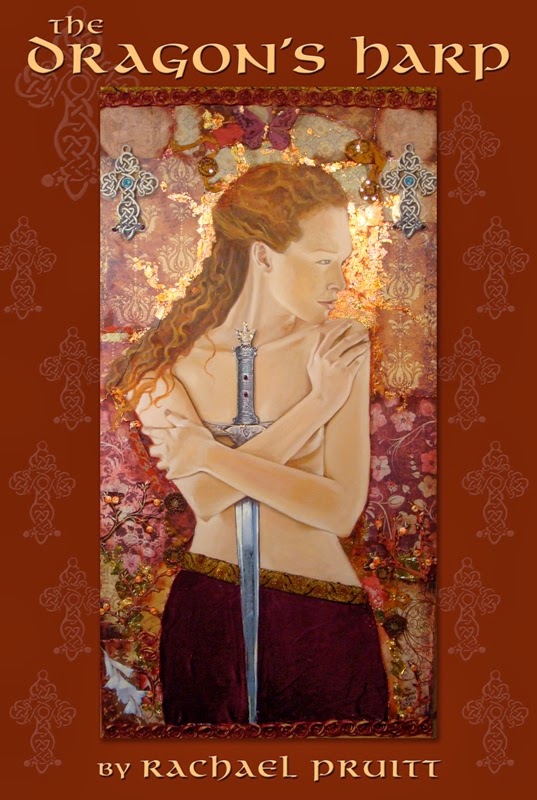
Lisl reviews The Dragon's Harp by Rachael Pruitt

Era of Dragons: The Lost Tales of Gwenhwyfar
Book One: The Dragon’s Harp
By Rachael Pruitt

Please see below for giveaway details!

Growing up, Arthurian legends were practically part of who I was, having been told them at my mother’s knees; later she began to expose me to written accounts, which I greedily consumed. I’ve lost track of how many or even which versions of the various tales I have read, but one thing is certain: there wasn’t much heard from the perspective of one very central character: Guinevere. So it was with great interest I learned of Rachael Pruitt’s novel of Gwenhwyfar—the Welsh spelling of this queen’s given name—where she came from and what made her the person she became.

It is fitting that Pruitt opens the novel not only from Gwenhwyfar’s point of view, but also beginning in the twilight of her life, when she has much to look back upon: this is no naïve girl telling her story as it begins and moves forward, but rather a mature woman utilizing hindsight and the wisdom gained over many years to simultaneously examine her own (and others’) behavior. Now, however, her husband murdered and children gone, Gwenhwyfar shares a moment on the sands with a gull, an encounter reminiscent of the many cultures, such as hers, in which the spiritual wisdom of animals is revered and incorporated into tradition and cultural habit.

Born into fifth century Wales, the young Gwenhwyfar, presented to us by her older self, is at this time eight “sunturns”; she reveres her parents but still recognizes the divisions existing between them as her mother has embraced the new religion. Occasionally Ceridwen acts upon outrages from her new perspective, her own mother somewhat of a go-between in the moments when she oversteps her bounds.

Gwenhwyfar has known war her entire life, and though she still retains some of the innocence of youth, her perspective clearly incorporates the reality set around her:

I tiptoed, even though there was no one to hear me, only the oppressive stillness of damp watching stone, its grey gloom penetrated by a faint haze of light from arrow slits rock-cut at each outward turning of the stairs. The worn steps felt like carved bowls beneath my summer-bare feet.

Nevertheless, Gwenhwyfar is, as she reminds herself, a Battle Chief’s daughter, “not to be bested by shadows.” So it is she wills herself to investigate mysteries that present themselves to her, including by listening in on conversations, one scene drawing me back to Stewart’s Merlin crawling through the unused furnace to eavesdrop on conversations in the palace rooms above him. Gwenhwyfar has inherited her father’s tough stance, even if she does on occasion duck behind her mother’s skirts.

Remains of the keep at Dinas Emrys
As the young girl comes of age at Dinas Emyrs, she certainly faces her share of trials, told to us in language filled to the wondrous brim with poetry and magic. Pruitt’s sentences are so fluid readers not only move from one scene to another many pages away without realizing how far they’d travelled, but also do so as part of the story itself, indeed, as part of their surroundings. “I dug into my soul,” Gwenhwyfar confides, “resisting his pull, as if I were digging my toes into sand so as not to get swept out with the tide.”


This, indeed, is how both author and protagonist set it out: the latter by commencing her story at a fireside to a young girl, the former with a “storytelling hearth” aura, the flickers of which can periodically be felt as the pages turn. While the mark of a great “wayback” story tends to be that readers are so immersed in it they forget it is being told from an older or other vantage point—while that is a strength, Pruitt manages to defy the dichotomous nature of that method and still keep us mesmerized within the flow of the tale: Gwen’s metaphorical digging in of her toes is reminiscent of the beach she surveys before she begins her story, and the gull who gifts her a shell, a raven who leaves a feather.

Readers are drawn into the events, warlike and magical—and the two are not always exclusive of one another. Indeed “magic and bloodshed went hand in hand,” as Gwen discovers at a turning point in which her whole world changes in a way that even death had not done. Merlin, her uncle in this telling, reminds her that greatness is typically found in the midst of ordinariness. The merging of elements with dual nature is a theme carried through the story within personalities, relationships, worship, beauty, even to the outcome of how it affects those involved: to their benefit or detriment. The “soft breath of dawn” might awaken to a cruel day; the presence of one with evil in her heart might walk through a night in which “the stars themselves grew tired.” Even the novel’s cover might speak to naked brutality or beauty, most likely both.

There is violence portrayed in The Dragon’s Harp; truth be told, it could not be any other way. Gwenhwyfar’s sixth-century Wales was a violent place where vacuums never existed for very long, a condition which surely also must have influenced the girl to grow into the woman, queen and wife she later became. It was exceedingly breathtaking a tale, a glimpse of sorts, into a world and time of her life many previous storytellers have skipped or ignored in terms of its influence on later history, as if Gwenhwyfar didn’t exist until she became a queen.


Fans of Merlin will also find a treasure within, as the mage appears, as mentioned earlier, as Gwenhwyfar’s uncle and, later, tutor. A seminal moment, one those familiar with the legends will recognize, involves Merlin as pertains to his meeting with Vortigern, who tradition says demanded the blood of a youth without a father to be sprinkled upon the foundations of his constantly collapsing fortress. The boy Merlin is dragged off to be sacrificed, but instead tells the engineers of a pool beneath the foundation, within which two dragons, one red and the other white, nightly battle it out, thus causing the destruction.


Pruitt’s telling is rather different and the duel between red dragon and, in this case white serpent, is not instigated by a superstitious and desperate king, though a young person in peril is present. The author stays true to the legend, however, and her imagery is punctuated by thunderous music from the skies as magic and community work together to ensure the defeat of red over white, leading to Merlin foretelling the freeing of this sacred land from their enemies and the coming of Arthur.


There are trying times ahead in the novel for Gwenhwyfar and Pruitt’s insight into the girl’s character as well as her times indicates a studied approach to an era in which magic reigned, as well as love and respect for those who lived within it. The detail of characters and perspective is impressive, and it is difficult to overstate Pruitt’s mastery with words, the more so given it is of a world that has all but disappeared to those of the modern world. Rachael Pruitt brings it back for us, a gift from our past sweeping us through time to reach the telling. Along the way readers will find this book exceedingly difficult to put down, and late nights are surely in the stars.

Fortunately for us, Pruitt has plans for four more installments in the Era of Dragons: The Lost Tales of Gwenhwyfar series, the title of which perhaps will lead us to clues as to how the tales finally, thankfully, come back us after so long.

 *********

Rachel Pruitt is a creative writing teacher with a lifelong fascination with the Arthurian legends. Visit her fantastic website and look for the sequel to Gwenhwyfar’s story, The Dragon’s Breath, which she is currently hard at work on. She can also be reached at her Facebook author page as well as Twitter.

Rachel is also currently giving away one autographed copy of The Dragon's Harp to one lucky winner. To enter to win, simply comment below. Facebook users may also comment here. 

If you would like Lisl to review your book or conduct an interview (or both), please see our submissions tab above.