Showing posts with label Anne Neville. Show all posts

Monday, 30 October 2017

Diana talks about Anne Nevill, daughter of a Kingmaker, wife of a King.


During the short reign of Richard III and his queen Anne Nevill*, John Rous compiled a sensational genealogy for the couple, weaving fact and fiction to create an enviable family history, involving King Guthelyn, his son Locryn, the division of land under their rule and even telling how Anne's Warwick family badge of the ragged staff and bear came into being.

Whilst this was an obvious ploy to counter Dowager Queen Elizabeth's alleged ancestry which stated that she was descended from Melusine - a female spirit of fresh water in a sacred spring or river - the truth of Anne's ancestry, as expected, was far more normal. With Richard Nevill, 16th Earl of Warwick (known to history as "Kingmaker") as her father and with Anne de Beauchamp as her mother, she certainly did not need the embellishments of Rous to enhance her pedigree.

Anne was born at Warwick castle on 11 June 1456. She was the youngest of the couple's two children, her sister Isabel, born on 5th September 1451, being almost five years older. Anne was born into the wealthiest and most politically powerful family in the kingdom. Like all girls of wealthy or titled families in that era, Anne, together with her sister, were considered pawns in the political game of matrimonial diplomacy. A marriage for love was never an option. A marriage for political gain would be usually brokered at a very early age for a girl. One reason for this early 'pairing off' was to head off any opposition from the girl, her marriage being a fait accompli almost for as long as she could remember.

Anne's father married Isabel off to George, Duke of Clarence, Edward IV's younger brother, and later, when politically expedient, selected a husband for Anne. He had been at odds with the king he had 'made', Edward IV, for some time, resenting the political rise of the new queen's fairly obscure family, the Wydevilles.

In 1469, the Earl tried to put his son-in-law George on the throne, but met resistance from Parliament. After a second rebellion against King Edward failed in early 1470, he was forced to flee to France, where he allied himself with the banished House of Lancaster in 1470. With King Henry VI imprisoned in the Tower of London, in effect the Lancastrian leader was his consort, Margaret of Anjou, who was suspicious of Warwick's motives. To quell these suspicions, Anne Nevill was formally betrothed to the son of Henry VI and Margaret of Anjou, Edward of Westminster, at the Château d'Amboise in France.

They were married in Angers Cathedral, probably on 13 December 1470, making Anne Nevill the Princess of Wales. It is not known whether the marriage was ever consummated. In 1471 the young couple arrived at the South coast of England to claim Edward of Westminster's inheritance but catastrophic news greeted Anne. Just that day Edward IV's army had killed the Duke of Warwick at Barnett, effectively losing the couple their cause. Anne's mother fled to sanctuary at a nearby abbey, leaving young Anne to depend on her 17 year old husband and her Mother in Law, Margaret of Anjou, whose husband, the deposed king Henry VI was imprisoned in the tower.

Margaret headed North, raising troops in a desperate attempt to gain support and to see her husband back on the throne. Edward dashed to intercept them at Tewkesbury and there followed one of the bloodiest and least chivalric wars of the period. When Margaret's Lancastrian army broke and fled back to the abbey, Edward broke sanctuary and beheaded the refugees.. The Prince of Wales was among the dead that day and was buried beneath the Choir of the Abbey.

Anne and Margaret of Anjou were taken into custody the following day. Transported to London, Margaret was confined to the Tower and Anne given in to the custody of the Duke of Clarence and her sister, the Duchess.

What happened next is rather unclear, but Croyland Chronicle states that, "Clarence caused the damsel (Anne) to be concealed in order that it might not be known by his Brother where she was; as he was afraid of a division of the Earl's property, which he wished to come to himself alone in right of his wife, and not be obliged to share it with any other person." In 
Paul Murray Kendall's, Richard III, 1955, Richard, "discovered the Young lady in the city of London disguised in the habit of a cookmaid; upon which he had her removed to the sanctuary of St. Martin's".  It is probable that she escaped and ran away to sanctuary at St Martin's

As stated before, Anne has traditionally been painted as a pawn in the political game, one of the victims of history, and certainly it seems that her first marriage to Edward of Westminster was a politically motivated move on behalf of her father, but her second marriage to Richard of Gloucester, youngest brother to Edward IV and brother to her sister's husband George of Clarence, may have been a calculated move on her part. The marriage was certainly advantageous to them both, Richard being rewarded with enormous land holdings in the North including her late father's castle and land at Middleham. 

Whilst some of Anne's childhood was spent at, Middleham Castle, despite Richard of Gloucester attending his knighthood training at the castle, there is no record of them having met and fallen in love as some romance writers would like us to believe. Anne's life as a privileged daughter and Richard's as a knight in training would tread very different paths within the same vicinity. Far from being in love, or being a pawn, Anne made a hard headed and pragmatic decision to marry Richard. 

Anne provided Richard with an heir, Edward of Middleham being born sometime between 1473 and 1476. He was described in the The Croyland Chronicle as ‘this only son, on whom, through so many solemn oaths, the hopes of the royal succession rested.’

After the death of Edward IV, having not achieved the status of queen through her marriage to her first husband, it not be a huge leap of imagination to consider her persuading Richard to grasp the throne. Pressure from Anne would help explain the great mystery of Richard of Gloucester's seeming U-turn, from being his brother Edward's most loyal supporter to someone who moved against his brother's allies with almost indecent speed, executing any that got in his way.

Anne's actions at this point are telling. She did not prepare to travel south for the coronation of Edward IV's son and did not commission sumptuous clothes for the occasion, suggesting that she knew the coronation would not take place. History often has Anne being passive or disapproving of Richard's crown heist, but there is no evidence of this and it is far more likely that having already brokered a favourable marriage for herself, she would not only be in favour, but would be the driving force behind the take over and put her in a position to avenge her father.

On July 6th 1483 at Westminster Abbey Richard was crowned as King and Anne as Queen.

It is not known whether their son, Edward of Middleham was present.  We know that he spent his life at Middleham castle and his governess was Anne Idley but little else can be said for sure about him except the tragic news that in April 1484, whilst Anne and Richard were at Nottingham, Edward of Middleham died. The parents went almost mad with grief.

Before too long, with Anne's health declining, Richard's thoughts turned to the future. His Queen would be unlikely to provide another heir and the following winter he was advised not to sleep with her.

On March 6th 1485, coincidentally following an eclipse of the sun, Anne died aged just 28, slipping from history as if she was not visible and being buried in an unmarked grave in Westminster Abbey; a quiet end to a dramatic life.

Anne was married to one prince, widowed and then married to a Duke who became a king; she changed sides in the cousins war not just once, but twice; she escaped from house arrest; forged her own future and claimed her inheritance, fulfilling the dreams of her father the Kingmaker, by becoming Queen of England. Her downfall was something she could not control - having poor health and only one child.


Sources:

Croyland Chronical
P M Kendall
K L Clark
Professor A Pollard
A Licence
L Hilton
D Grummit
M Hicks

Further reading: 

The Nevills Of Middleham, K L Clark

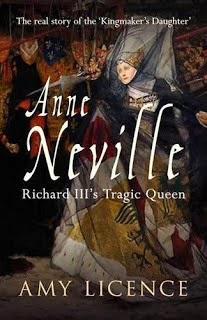
Anne Neville: Richard III's Tragic Queen, A Licence


* Throughout the blog I have adopted the spelling of Nevill used by leading Nevill historian and author, K L Clark

© Diana Milne October 2017

Wednesday, 30 April 2014

Jayne's Corner: Interview with Amy Licence

I have been lucky enough to interview one of my favorite non-fiction writers, Amy Licence. She very kindly agreed to answer some of my questions and I thought I would share them with you.


You have so far chosen to mostly write about women from the 15th century, so what made you choose them ?

There are two answers to this: one about women but also specifically about the 15th century. I can’t help but feel drawn to that period in time, although I started out being interested in the Tudors and gravitated to the Wars of the Roses. Something about that century fascinates me and I can’t really offer a satisfactory explanation of why. I can say that I find the people and events fascinating, but I expect enthusiasts of any era would make the same assertion. The closest I can come to it, is to say that I feel most at home there. Regarding the women aspect, I’ve always been interested in women’s lives, in their experiences within a patriarchal framework and just how far they were able to exercise any influence or control at all, from queenship to motherhood. The women of the 15th century particularly fascinate me because so many of them remain an enigma to us, although they must have been key players in the dynastic power struggles of the day. I don’t accept the theory that they were just there to reproduce. They may not have sat in council chambers or fought on battlefields, but as wives, mothers and daughters, I’ll bet they had a lot to say.

Do you have a favourite out the three women, Anne Neville, Elizabeth of York or Cecily Neville?


They’re all very interesting to me and as I researched each, I learned just how remarkable their lives really were. I think there is a lot we will never know about Elizabeth’s history and marriage and I am endlessly fascinated by the question of what exactly Anne Neville did or didn’t know. But I have to say that Cecily’s role probably interests me the most. As the wife of the Duke of York, and the mother of Edward, George and Richard, she was in a unique position at the heart of that family and occupied a place in their lives. There is also a degree of controversy about some of Cecily’s decisions, such as her support of George’s rebellion against Edward and her role in the allegations about her own fidelity. Perhaps more than the other two, she shaped contemporary events, which is all the more ironic, as she was the only one of the three who did not become queen.


As  a wife and  mother of two young boys how do you manage to make time to write?

It’s literally as you suggest, I have to make time. I’m at home with my toddlers all day and I have to work by stealth. It means that I have to read and think, seize opportunities and use my time effectively. I don’t really watch TV and I don’t procrastinate or waste time. Before I had the boys, it was relatively easy to come up with reasons not to write and put barriers in the way but now, the busier I am, the more I have to just facilitate my writing. I’ve really discovered that the only way to do it, is to actually do it, to stop worrying and finding excuses, just to snatch this half hour and get something typed. Every minute I’m thinking about the next thing I’m writing; I tend to mull over a paragraph for a while and then dash off to write it down before playing Thomas the Tank Engine. I’m also lucky that my husband will take them out for the day, so I can get a good uninterrupted stretch. If I’m not exhausted at the end of the day, I’ll try and do a bit then too.

How long does it take you to research each book?

My publishing record looks a little misleading, as my books have come out in a relatively short space of time, but I would describe this process as an overnight success that took 25 years in the making. I did my MA in medieval history back in 1995 and since then, I’ve never stopped researching and writing on the topic, so I’ve accumulated a body of knowledge over the past two decades- in fact, I began well before that. It’s all there in my head or jotted in notebooks, so with each of my books it was a case of accessing the information and doing some further, specific research for that individual. That process can take around nine to 12 months.


When did you first begin to be interested in history?

I’ve been interested in history as long as I can remember. My parents took me to visit castles and on digs and I’d worked through my local library’s shelves of medieval and Tudor books by the time I was about 14. It was just always there. I decided I would be a writer when I was eight and wrote my first novel at 11 and my first full length biography when I was sixteen, on the romantic poet Thomas Chatterton.

How do you manage to find all your sources for information and do you try to visit some of the places you mention in your books?

I think I’ve been very lucky with the timing of my career. A lot of the key texts, historical and literary, I’d read whilst at university but in recent years, so many primary sources, court records etc., have been uploaded online. It means that I can access and search chronicles and accounts, court payments and letters from my kitchen table. In around 2001, when I was still trying to get published, I was trying to write a biography and there were just no sources out there, so I had to go up to the British Library every weekend. My children hadn’t arrived at that point, so I would teach all week, spend Saturday in the reading room making notes and write them up on Sunday. I couldn’t do that now; the Internet has made it possible. Having said that, there is no substitute for getting out there and visiting these places, and seeing the actual records in the archives. Now my boys are four and 20 months, and I’m starting to take them out to some of the places I write about. Recently, while I was researching my Richard and Cecily books, we managed to get to Raglan Castle in Wales and Tonbridge Castle. They quite enjoyed running about with wooden swords.

What is in the future for you as a writer?

At the moment, I’m working on a book about Henry VIII’s women. Some of the most famous books on this topic are a few years old now and easily turn into a narrative of Henry’s life. I’m writing a really colourful account from the women’s perspectives; what was it like to be his wife or mistress? It’s difficult to squash him down, as he is such a gigantic character, but the focus is definitely on the women. After that, I’m returning to the 15th century to write a joint biography of Edward IV and Elizabeth Wydeville.

Thank you to Amy for sparing the time to talk to me. She has a website which can be accessed here

Jayne Smith is a member of The Review team and a great lover of history. 

Tuesday, 4 February 2014

Lisl's Bits and Bobs: Modern Day Trials of the Last Plantagenet King

Lisl reviews Loyalty Binds Me by Joan Szechtman

***See below for giveaway details!!***

Loyalty Binds Me, second in a projected trilogy concerning Richard III, the medieval monarch of the slanderous “Princes in the Tower” tradition, takes on a huge task. Many readers will be familiar with the last Plantagenet king’s travel to present-day in the first installment, This Time, and speculative fiction fans (and others) will revel in such a journey. However, when Richard finds himself now under arrest for the murders of his nephews–which, mind you, happened some 500 years ago, and there exist contradictions to this charge–he experiences firsthand effects of the success the Tudors, Shakespeare and others have had in blackening his reputation. But how, readers may ask, does the author manage to overcome the label of absurdity; will enough modern lawmen actually believe this is Richard III come to this era, and are willing to risk their careers on such a prosecution? How can this be portrayed?

Worry not, readers, for Joan Szechtman not only manages all this heavy lifting, but also does it with the mark of a brilliant writer: by making it look easy. The flow of the book is so smooth, that when I read certain parts I actually gasped at the ups and downs Szechtman took me through with Richard. So thrilling are those danger moments, I found myself mentally shaking my fist at the need to sleep; I simply had to keep reading and find out what happens next.


One of the ways the author achieves this is via her understanding of today’s society. Unlike most people in Richard’s time, our society has been through so much with technology that even those who scoff at the idea of time travel still often contemplate it with a fair degree of seriousness. Coupled with the viable descriptions and scientific explanations through the book, many doubters will do a double take at the possibilities. Then there’s the government. Oh yes, they want a piece of the pie, and that, paired with the widespread belief that governments already know more than they are telling, clicks it all into place.

Szechtman also brings to bear the unfortunate understanding we all have of post-9/11 policing. When Richard’s tormentors are unable to move in the direction they wish, they play the terrorism card, using that to threaten him with indefinite detention. If that doesn’t strike fear into the hearts of readers today, it at least erases the sometimes smug sureness that we have progressed as much as we think, in terms of governance and liberty, from the days when Richard sought to bestow greater rights on those accused of crimes. It is sadly ironic that this king now falls victim to abuse of power that can cause someone simply to disappear. What grows from this is that where once there was care for a character, now there also is great concern for the peril he is in.

Through all of this, the author allows us to peek into the lives of Richard’s modern-day family: his new wife and the two daughters he has adopted, as well as his beloved son Edward, whose resilience for the new world he is in is fairly strong–witness his grasp of technology, for example. But Edward, who woke from death to find his mother taken from him, speaks to us of how childhood, despite how overhauls, trends and social structures have changed it over the centuries, remains the same. Children are strong but vulnerable, astoundingly bright though need help navigating through even some of the briefest of situations and, perhaps most heartbreaking, love so strongly and want to please, yet withhold as a form of protection. They show us that we adults are given responsibility that is almost frightening in its ability to impact. Yet with brilliant economy Szechtman portrays all this in those peeks we are allowed, and we witness a family coming to terms with the usual trials all families must go through, as well as those of a father who has been arrested, and the merging of medieval and modern times–a blended family like no other.

This is by no means an exhaustive review of everything wonderful in Joan Szechtman’s latest book, but it does point the way to the other two, one as yet unpublished, for this book is not easily put down and forgotten. For those who already care about Richard, it will be a reader’s delight. Others who are new to the king, or willing to re-consider what exactly constitutes “common knowledge,” will find a wealth of historically accurate information as well as recognizable background details in order to do. Moreover, because the second book is written to be enjoyed independently, reading it first will not involve any guessing at the start. Nevertheless, Joan Szechtman’s Loyalty Binds Me will make you want to go back for more.

The author is graciously offering a free e-copy of Loyalty Binds Me for one lucky winner. Simply comment on the blog to get your name in the hat! Facebook users may also comment here

Joan Szechtman is also the author of This Time, book one in her Richard III series. Her web page can be viewed here and readers may find This Time and Loyalty Binds Me at Amazon on Kindle and in paperback.

Lisl can also be found at before the second sleep. If you would like Lisl to review your book or conduct an interview, please see our submissions tab.