Wednesday, 20 April 2016

Sharon Reviews: Plantagenet Princess, Tudor Queen by Samantha Wilcoxson

The author has kindly donated a signed paperback to one lucky reader. To be in with a chance of winning, leave a message in the comments section below, or on our Facebook page. The winner will be drawn on 27th April 2016. Good luck!


She was the mother of Henry VIII and wife of Henry VII, but who was Elizabeth of York? Raised as the precious eldest child of Edward IV, Elizabeth had every reason to expect a bright future until Edward died, and her life fell apart.
When Elizabeth's uncle became Richard III, she was forced to choose sides. Should she trust her father's brother and most loyal supporter or honor the betrothal that her mother has made for her to her family's enemy, Henry Tudor?
The choice was made for her on the field at Bosworth, and Elizabeth the Plantagenet princess became the first Tudor queen.
Did Elizabeth find happiness with Henry? And did she ever discover the truth about her missing brothers, who became better known as the Princes in the Tower?
Lose yourself in Elizabeth's world in Plantagenet Princess Tudor Queen. 


Plantagenet Princess, Tudor Queen is a delightful novel portraying the life of England's first Tudor Queen, Elizabeth of York. Well written and researched, the author's passion for her subject shines through on every page, drawing you into every aspect of Elizabeth's life, from the men in her life, to her siblings and her children. Samantha Wilcoxson's novel immerses you in every aspect of Elizabeth's life; indeed it draws you into the Queen's own thoughts and feelings; into her inner turmoil surrounding the fate of her brothers, the Princes in the Tower, and her desperate desire for her eldest son, Arthur, to succeed his father as king.


I have to admit that I was initially uncertain of the direction this book would take. I was worried that  it would be another of the formulaic 'Richard III good, Henry VII bad' novels that we see all-too-often these days? However, Samantha Wilcoxson goes far beyond the superficial portrayals we see of the rival kings, examining their personalities through the eyes of the queen who knew them both. With great skill, the author has portrayed not only Elizabeth the Queen, but also her thoughts, emotions and inner conflicts, giving us a complex woman who had to make compromises and judiciously pick her battles, in order to help not only her children, but also her Plantagenet family. The book is a wonderfully sympathetic portrayal of the first Tudor queen, showing a deep understanding of the events and emotions that shaped Elizabeth's life ... and the future of the Tudor court.

Plantagenet Princess, Tudor Queen immerses you in the world of the fledgling Tudor dynasty. Surrounded by wonderful palaces and the splendour of the royal court, we are taken on a journey through the life of a remarkable woman, a queen who bridged the gap between the Medieval World and the emerging Renaissance, between the Yorkists and the Lancastrians and became the matriarch of England's most famous ruling dynasty. Samantha Wilcoxson skilfully guides us around the Tudor palaces, the customs and etiquette of the day, in order to bring the world of 500 years ago to vivid life.

The author does not shy away from the controversies of the day and explores, not only the disappearance of the princes in the Tower, but also the effect this has on their sister and the rest of the family.  We are treated to Henry's insecurities and Elizabeth's doubts and anxieties over the Pretenders to the Tudor throne, both Lambert Simnel and Perkin Warbeck:


Almost as an afterthought, Elizabeth asked, "The boy, who was he really?"

Henry released her and returned to his chair with a shrug. "He is nobody. Lambert Simnel turns out to be his name. A simple baker's boy. A pawn."
"What happened to him?" Elizabeth asked, hoping that the young boy had not been sacrificed in battle to grown men's whims.
"I have brought him back to London with me." When Elizabeth turned her face away, he knew she believed the boy imprisoned. "I have put him to work in the kitchens."
Elizabeth's eyes lit up as she turned her face to Henry's. "Truly? He is not in the Tower? Will not be tried for treason?"
"I see no point. He appears to be no older than eleven and understood little of what was going on around him. He does, however, seem to have learned some more desirable skills from this baker."
"Thank you, Henry." Elizabeth went to him and put her arms around him. Maybe he did not understand that she could not bear the death of one more boy, but he had saved this one nonetheless. She loved him for it."


I cannot recommend Plantagenet Princess, Tudor Queen highly enough. My one criticism would be that it races through the 'Princess' years; it would  have been nice to see more of Elizabeth's relationship with her father and of her childhood in general. However, it does a wonderful job of exploring Elizabeth's years as Tudor queen, bringing her to life, not only as queen, but also as a wife, mother, sister, daughter and cousin. Elizabeth is portrayed as the link that holds everyone and everything together; she is dutiful, conciliatory and loving, with an inner determination. A heroine in the greatest sense of the word.

Samantha Wilcoxson has found her own path through the stories of the Richard III and the Wars of the Roses. The book is thoughtful, insightful and inspiring, with thrills and surprises on every page. Her diligent research and love of her subject shine through, shining a spotlight on Elizabeth of York, one of the most remarkable and underrated women to have ever been England's queen.


Samantha Wilcoxson is an American writer and history enthusiast. Her novel, 'Plantagenet Princess, Tudor Queen', looks at the transition from the Plantagenet dynasty into the Tudor era through the eyes of Elizabeth of York. This book has been named an Editors' Choice by the Historical Novel Society. Samantha's next novel, 'Faithful Traitor', will continue to look at the Plantagenet remnant by featuring Margaret Pole.
During rare moments when Samantha is not reading or writing, she enjoys traveling and enjoying time at the lake with her husband and three children.
Links:


Sharon Bennett Connolly has been a reviewer for The Review since 2015. Fascinated by history for over 30 years she has studied the subject both academically and just for the joy of it - and has even worked as a tour guide at historical sites. She is now having great fun passing that love of the past to her 10-year-old son; visiting abbeys, hunting dragons in medieval castles and searching for fossils at the beach. Sharon writes a blog, History . . . the Interesting Bits, and has just signed a contract with publishers, Amberley, to write a book on Medieval women; Heroines of the Medieval World is due for release in 2017.


Friday, 15 April 2016

Richard Reviews Nyssa Glass and the House of Mirrors by H.L. Burke

The author of this book has kindly offered an e-copy (Kindle or epub) of Nyssa Glass and the House of Mirrors to one lucky reader. To be in with a chance to win, just leave a comment below or on our Facebook page.
The draw will be announced about a week after this post.

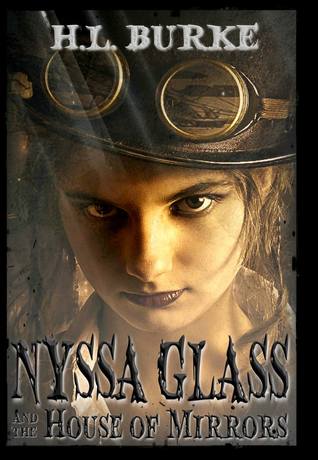
Cover - Nyssa Glass and the House of Mirrors
I read Nyssa Glass and the House of Mirrors, by H.L. Burke, on the recommendation of a friend and am very glad to have done so: I really enjoyed this story.

The plot follows a young lady - Nyssa, of course - through a series of exploits as she tries to extricate herself from being unjustly accused of murder. Her background is dubious enough to make the accusation likely to be believed, but she is determined to deserve the trust of her employer Mr Calloway, and her former teachers at Miss Pratchett's School for Mechanically Minded Maids. This determination keeps her going through puzzles, dangers, and difficulties.

On the surface, her basic task seems clear - find a way into a seemingly abandoned house and retrieve a missing item. But inevitably things are not so simple. The house turns out to be well-defended, although the protective systems are overdue for servicing and overhaul, and it is not so empty as it seems at first sight...

"A little over four years ago, all traffic in and out of Dalhart Manor ceased. Up until that point, Dalhart had been reclusive, but his staff and son were often seen going about their business. Then one day, half the staff was unexpectedly let go, and the remaining half..."

The action takes place almost entirely within a single day - barring some necessary flashbacks and a brief "what followed" section - but it is easy to forget the shortness of the timespan as you are carried along with the action. You reach the end of the book feeling that you have come to learn a great deal about her, owing to the intensity of her experiences.

"Once you start scraping away at the puzzle of that house, you won't be able to stop until you've excavated its last secret."

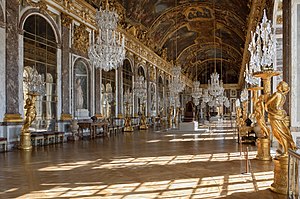
Hall of mirror, Palace of Versailles (Wiki)
A recurring theme of the book is the question of who Nyssa can rely on. Sometimes she makes the wrong decision, and finds herself having to work out how to undo the difficulties resulting from this. Her life experiences have not disposed her to be particularly trusting, and suspicion of motives easily rises to the surface of her thoughts. But the ongoing need to work out who is dependable and who is fickle is a major thread of the book, and one which several of the characters grapple with. The answers to these questions shift multiple times through the book as various facts and snippets of background become clear.

"Did I just turn on the security system? That has to be the biggest blunder in the history of cat burglary."

The author's chosen style is most like Steampunk, though with her own personal spin on the conventions of that genre which worked well for me. The level of scientific and technological accomplishment was a perfect complement to Nyssa's skills and abilities. Both feel entirely credible and I was fully immersed in the tale. I particularly liked the approach towards mechanical intelligence was handled - a very different route to our society's, or indeed what I choose for my own writing - but it is a persuasive and compelling alternative. There is a point where curious enquiry of possibilities gives way to the horrified realisation of reality, and this is handled particularly well.

"Please, someone... no, professor, no. It's not what I want. It's not right..."

House of Mirrors is a YA novel and the personal interactions reflect this. However, this should not deter anyone, and there is ample interest and character depth to satisfy an adult reader.

The cast of characters is comparatively small, and the end of the book strongly suggests that other books set in this world will follow in the future. I certainly hope so, and will be looking out for them.

Meanwhile, Mrs Burke has written a number of other YA fantasy novels, often with a dragonish theme.


About the author:
H.L. Burke
H.L. Burke
Born in a small town in north central Oregon, H. L. Burke spent most of her childhood around trees and farm animals and was always accompanied by a book. Growing up with epic heroes from Middle Earth and Narnia keeping her company, she also became an incurable romantic.

An addictive personality, she jumped from one fandom to another, being at times completely obsessed with various books, movies, or television series (Lord of the Rings, Star Wars, and Star Trek all took their turns), but she has grown to be what she considers a well-rounded connoisseur of geek culture.

Married to her high school crush who is now a US Marine, she has moved multiple times in her adult life but believes that home is wherever her husband, two daughters, and pets are - currently in southern California. She has written twelve books in speculative genres, ranging from Epic Fantasy to YA Steampunk.

Find out more at her web site, blog, on Facebook, Instagram, or Twitter.

About the reviewer:
Richard Abbott lives in London, England. He writes science fiction about our solar system in the fairly near future, and also historical fiction set in the ancient Middle East - Egypt, Syria, Canaan and Israel.

When not writing words or computer code, he enjoys spending time with family, walking, and wildlife, ideally combining all three pursuits in the English Lake District. He is the author of In a Milk and Honeyed Land, Scenes From a Life, The Flame Before Us - and most recently Far from the Spaceports. He can be found at his website or blog, on Google+, Goodreads, Facebook and Twitter.

Friday, 18 March 2016

Sharon Reviews Paula Lofting's Sons of the Wolf

The author has kindly donated e-book copies of Sons of the Wolf to2 lucky readers. To be in with a chance of winning, simply leave a comment below or on our Facebook page. The draw will be made on 25th March 2016. Good luck!


1054, pious King Edward sits on the throne, spending his days hunting, sleeping and praying, leaving the security of his kingdom to his more capable brother-in-law Harold Godwinson, the powerful Earl of Wessex. Against this backdrop we meet Wulfhere, a Sussex thegn who, as the sun sets over the wild forest of Andredesweald, is returning home victoriously from a great battle in the north. Holding his lands directly from the King, his position demands loyalty to Edward himself, but Wulfhere is duty-bound to also serve Harold, a bond forged within Wulfhere's family heritage and borne of the ancient Teutonic ideology of honour and loyalty. Sons of the Wolf is a panoramic snapshot of medieval life and politics as the events that lead to the downfall of Anglo Saxon England play out, immersing the reader in the tapestry of life as it was before the Doomsday Book. With depictions of everyday life experienced through the minds of the peoples of the time; of feasts in the Great Halls to battles fought in the countryside, it cannot help but enlighten, educate and entertain.


This week has seen the re-release of Paula Lofting's wonderful novel, Sons of the Wolf. Set in the reign of Edward the Confessor, the story revolves around one of the king's trusted thegns, Wulfhere. A real-life thegn who we know little about, beyond his name, Ms Lofting has created a world around him, imagining his home, his family and his life.

Opening with Wulfhere's return from the Battle of Dunsinane, the novel leads us on a lively ride through Wulfhere's frenetic domestic life, full of family dramas and neighbourhood feuds, with one or two unexpected twists along the way. This is expertly contrasted with Wulfhere's public life; as a thegn of Edward the Confessor, and with Harold Godwinson, Earl of Wessex, as his Lord he is close to the centre of English politics, called on to attend the Witan and witness to the political machinations of the great and the good - and bad.
 
The combination of national politics and domesticity balances nicely throughout the book, leading to a dual climax of the Battle of Hereford and its aftermath and a family drama that could have fatal consequences....


This wonderful story gets you hooked from the very beginning, with Wulfhere's homecoming introducing us to a complex hero, affected by war and plagued with nightmares, who tries to balance his family life with his responsibilities as thegn. Although it is a period I know little about, Paula Lofting is an aficionado, a fact which comes across from the beginning. She uses her knowledge of the customs and practices of the era to recreate a stunningly authentic world, evoking the language, sights and smells of the period simply by her words.

...He removed his helmet and gave it to one of the twins. Wulfric immediately set it on his head as his brother, Wulfwin, tried his best to snatch it from him in an amusing display of mock sibling rivalry. The thegn stood before his wife with the reticence of a child and waited for her to speak.
"Welcome home, husband!" Ealdgytha smiled with genuine warmth and stepped forward with her arms open. She pushed herself into him and he enclosed her in an embrace. Bending his head, Wulfhere felt her face against his cheek as she softly breathed the words into his ear. "Welcume."

The strength and power of  Sons of the Wolf is in its characters. They are all complex, interesting individuals - human. Created with the usual mixture of insecurities, fears and hopes that we would recognise today. Paula Lofting has developed strong, intelligent female characters, while still forcing them to remain within the confines of the 11th Century. And yet they manage to express themselves and their feelings. The disillusioned, disappointed wife, the rebellious daughter who wants love on her terms and the ex-lover trying to hold on to someone else's man; all create a tapestry of interwoven lives which threaten to overwhelm the hero as he tries to live up to his responsibilities.

Wulfhere is a sympathetic, flawed hero who is trying to find his way in a turbulent world. His weaknesses are laid bare to his wife, family and close friends; while his abilities on the battlefield earn him respect and admiration from his peers. He has to cope with a willful daughter, wayward sons and an angry wife, whilst dealing with the villain of the piece. Helghi just makes you want to punch him! His actions are despicable, and yet he always seems to come out on top - it's a mark of the power of the book, that you can feel such anguish for Wulfhere, and disgust for Helghi even as you read.


Paula Lofting's wonderful characters benefit from her extensive knowledge of the era. She manages to seamlessly intermingle the fictional characters with the historic. With the author's vivid descriptions it is not hard to visualise Wulfhere's longhall, the crowded Witan of Edward the Confessor, nor the battlefield of Hereford. Ms Lofting skilfully describes the nightmare of battle, it's aftermath and the fear and pain of combatants and non-comabatants alike, drawing the reader in so  they feel they have been a part of the history.

The author cleverly sprinkles her prose with Saxon words, which has the effect of emphasising the protagonists' feelings at critical points in the story - and makes the reader feel even more like an observer of the actual events, rather than a reader of fiction.

Paula Lofting has done a wonderful job of recreating pre-conquest England and the world of Edward the Confessor and Harold Godwinson, in a book which is almost impossible to put down (even to sleep). The best thing is, this is book 1 of 2 - and now I can't wait to get my hands on Book number 2, The Wolf Banner....

(All pictures courtesy of Paula Lofting)


Paula Lofting was born in Middlesex and brought up in South Australlia. At the age of 16 she returned to the country of her birth where she always dreamed of writing a historical novel. Her dream was not realised until nearly thirty years later when she finally set about writing her first novel, Sons of the Wolf, which she first published in 2012. She has recently re-published it under a new publishing name of Longship and the sequel The Wolf Banner is due for release in May 2016. Paula is also writing a series of blog posts to commemorate the 950th anniversary of 1066 this year, which can be found on her website, paulalofting.com.
Website
Facebook
Twitter
Amazon


Sharon Bennett Connolly has been a reviewer for The Review since 2015. Fascinated by history for over 30 years she has studied the subject both academically and  just for the joy of it - and has even worked as a tour guide at historical sites. She is now having great fun passing that love of the past to her 10-year-old son; visiting abbeys, hunting dragons in medieval castles and searching for fossils at the beach. Having received a blog, History . . . the Interesting Bits, as a present for Christmas 2014, she is now enjoying sharing her obsession of history with her readers.