Showing posts with label The Sun Shard. Show all posts

Tuesday, 28 October 2014

The Witch of Wookey Hole - A Hallowe'en Post by Rob Bayliss


Marking the north-eastern edge of Somerset, stand the Mendip Hills. These are hills of Carboniferous limestone and Triassic dolomite, and exhibit classic karst landscape features. Climbing up through the hills is the amazing Cheddar Gorge and its network of cave systems. Inside these caves the air has a steady temperature and humidity which was found to be ideal conditions for the six to nine month maturing process of Cheddar cheese.


South of Cheddar lies Wells, the smallest city in England, famous for its Bishop’s Palace and its swans that swim in its moat and ring a bell to be fed. Near to Wells is the tourist attraction of Wookey Hole Caves.


Unfortunately Wookey has nothing to do with Chewbacca from Star Wars! As is usual in Somerset the name derives from an amalgam of Celtic and Anglo-Saxon words to describe a geographical feature. Hence we have a derivative of ochie (Welsh for cave) tagged with hole (Old English for cave) and of course cave, itself a Latin/Norman word. So Wookey Hole Caves translates literally as Cave Cave Caves, and at the same time gives us a linguistic history of England in chronological order!


From out of Wookey Hole the River Axe emerges. It is the dissolving effect of the water on the limestone that has created this cave system: a network of caverns that has been used by humans for at least 45,000 years, evidenced by the discovery of Paleolithic tools and fossilised remains of animals. Ice Age denizens who found shelter in shallow caves in the nearby cliffs included cave hyenas, Eurasian lions and woolly rhinoceros. Other fossils indicate an almost tropical climate was enjoyed here between ice ages.  

The full extent of the main cave system, as it worms deep into the Mendips, is still to be ascertained. It was at Wookey Hole that some of the first successful cave diving expeditions in Britain were attempted by teams led by Malcolm Balcombe in 1935 using standard diving dress. How these early cave divers managed to squeeze through these dark tunnels in cumbersome diving suits doesn't bear thinking about. So far divers have explored approximately 4km including 25 chambers, but at the cost of two lives.


From the Stone Age and beyond the Iron Age these caves and its river have been used by humans. There is evidence of occupation up to the Roman period and the River Axe was used to power mill to grind corn in 1086, and the water used for both power and the manufacturing process for a paper mill since 1610.


The caves and mill are now a popular tourist attraction. In fact the beautiful stalactites and stalagmites have long drawn people to marvel at them. In the 18th century Alexander Pope visited the caves. He had several stalactites shot down from the roof to take home as souvenirs! In 1912 archaeologist Herbert Balch undertook a two-year exploration of the caves prior to them being opened to the public as a recognisable modern tourist attraction.


Obviously with such a long period of occupation the dark mysterious caverns have gathered about them many a tale and legend. I wonder if those early cave divers had a niggling doubt regarding the legend of a huge, 30-feet-long conger eel that once haunted the Severn estuary and set himself up as king of the fish? He would feast and gorge himself, destroying fishermen’s nets and flooding the land with his thrashing about. Eventually, sick of his antics, fishermen managed to corner him near Brean Down and forced him up the River Axe. Unrelenting, they forced the beast further and further upstream. With nowhere to go the deposed king of the fish squeezed into the caves, and was never seen again.


The most well-known legend of course deals with the famous Witch of Wookey. There are a few versions of the story of the goat herding witch who lived in the caves. All gave the caves a wide berth during her reign of terror. If ever there was an example of “hell hath no fury than a woman scorned” then she was it. It was said that the witch had experienced a failed romance and if she was to be denied love, then so would all others. Relationships and marriages around Wookey turned sour as she threw her curses at the villagers. The villagers sent word of their plight to Glastonbury Abbey who dispatched a monk to deal with the fiendish assassin of love.


Some versions say the monk had once been betrothed to a girl from Wookey until the witch had spoiled the relationship; others that he himself was the witch’s one time love before spurning her and commiting  himself to holy orders.


The monk ventured into the dark forbidding caves and there fought a terrible battle with the witch. She cast spells and threw curses at the Benedictine who parried them with prayers and incantations of his own. The caves were lit with the fell light of her magic as she, strong in her lair, sought to finish the priest. But as she advanced upon him he reached inside his robes and, finding a vial of holy water, cast it upon the sorceress. She screamed, stricken by its holy power and turned to stone before his very eyes. And there the petrified witch remains to this day. You can see the crone’s nose, chin and bonnet quite clearly.


A nice story to explain a stalagmite and yet… during Herbert Balch’s investigation in 1912 a thousand-year-old skeleton was unearthed. It was an aged Romano-British woman. Around her were the bones of goats, and beside her a dagger and a polished lump of  stalactite shaped like a crystal ball...


Rob Bayliss is a reviewer at The Review and is currently writing his Flint & Steel, Fire & Shadow fantasy series. Book 1 - The Sun Shard is available at Amazon.

Wednesday, 1 October 2014

Tales of Old Somerset - Mud, Blood, Oil and Dragons - by Rob Bayliss


Unlike its neighbouring West Country counties (with the possible exception of Weston-Super-Mare and Burnham-on-Sea) Somerset isn’t renowned for its beaches. Not until Minehead, and beyond, do we find the beloved golden sands we always picture in our mind's eye. For most of the coast there are
darker and redder beaches leading to treacherous mud flats extending some distance from the shore. This stretch of sea is the Bristol Channel, which has the second largest tidal range in the world. The water is coloured brown with silt from the outflow of the great river Severn from the topper most end of the Bristol Channel, not to mention the River Parrett that drains the levels, Somerset’s marshy heart. Not until you travel west to Porlock, below Exmoor, does the sea finally lose its muddy colouring and the sand become yellow, as it meets the Atlantic.

Looking across the waves you can see the coast of Wales and in the Bristol Channel you can see the two islands: Steep Holm, as the name suggests a tall island of cliffs and, the equally descriptive Flat Holm (in Welsh: Ynys Echni), the most southerly part of Wales. Both islands were once used as religious retreats. St. Cadoc lived as a hermit on Flat Holm for seven years while his friend St. Gildas found refuge from the world on Steep Holm, prior to later founding Glastonbury Abbey.


The river Parrett lazily meanders into the sea, forming the Steart Peninsula, now a major nature reserve for the birds that wade in the rich silts of Bridgwater Bay. Looking westward from here along the coast can be seen Hinkley Point nuclear power station. Whereas looking inland are the tall Quantock Hills. A short distance southward along the Parrett lies the village and port of Combwich. Prior to the construction of the M5 motorway, it was here that building materials were landing for the construction of Hinkley Point.

Combwich itself has a little known place in history: in 878AD the Viking Ubba, brother of Ivar the Boneless and Halfdan Ragnarsson, landed here with 23 ships and some 1,200 warriors. In a stronghold called Cynwit, possibly in the nearby village of Cannington, the king’s representative Odda and local thegns took refuge, forcing the Vikings to attack them. The Wessex forces overcame the Norsemen and even captured Ubba’s raven banner. It was a remarkable victory, all the more so as it was one of the few that was achieved without the presence of Alfred the Great. Ubba’s campaign seems to have been coordinated with that of Guthrum’s. If it had succeeded Alfred’s lines of supply and communication as he gathered his forces at nearby Athelney would have been fatally exposed. On such throws of the dice are kingdoms won and lost.

Following the coast westward from Bridgwater Bay the Quantock Hills fall towards the sea. At Kilve compressed layers of limestone and shale are clearly visible in crumbling cliffs. The village of Kilve consists of three original settlements, centred around the original hamlet of Putsham, that follow Holford stream down to the sea. On the way can be found the ruins of Kilve Chantry, founded in 1329. It fell into disrepair long before the Dissolution of the Monasteries and was later used as a barn and even as a smugglers' store, prior to it being consumed by fire in 1848. Legend has it that this fire was deliberate, consuming barrels of contraband spirits as the revenue men drew near.


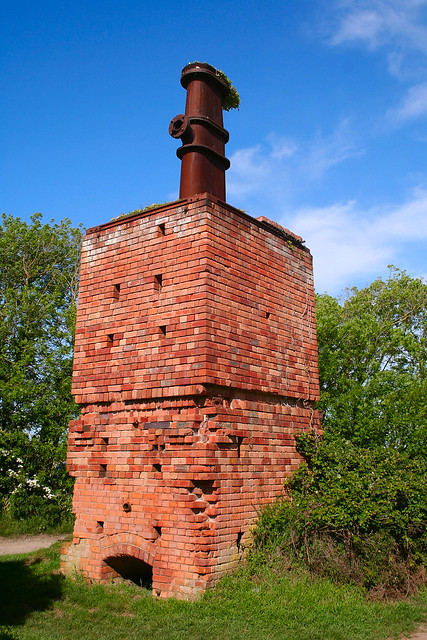
Further downstream is a brick resort, a relic of the expected Somerset oil boom of the 1920s that never was, extracting oil from the local shale rocks. Kilve Pill marks the point where the stream reaches the sea. It was used as a tiny port importing Culm (an inferior coal) to be used in lime kilns.


Below 40-feet-high cliffs the more resilient stratas of rock stretch out into the sea in pavements, revealing fossils of amonites. These causeways carry an interesting local legend. Within Putsham Hill there once lived a particularly fiery dragon called Blue Ben. He used to emerge from a tunnel between Kilve and Putsham so as to swim in the sea and cool himself down. He built the causeway in order to avoid the mudflats. The devil watched Blue Ben and, discovering his lair, harnessed him and rode him along the streets of Hell. Poor Blue Ben suffered terribly with the heat of the hellfires and, after being released after one such sortie, hurried along his causeway in order to cool off. Too eager, he slipped off it, fell into the mud and drowned. 


Obviously Blue Ben was an attempt to explain the geography of the causeways, but perhaps the legend of a fiery dragon who lived under the local hill contained some folk knowledge of the oil in the shale rocks as well? (Especially as the shale has a blue tinge!) The legend of Blue Ben may well have faded from folk memory, but enjoyed a revival in the 1800s when an Ichthyosaur was discovered at nearby Glastonbury. You can imagine the scene when a local heard of the discovery:  "One of they ancient reptiles, that them scientists talk about, you say? Don't be daft; 'tis obvious, 'tis the remains of Blue Ben himself!"


Rob Bayliss is an admin with The Review and author of the Flint and Steel, Fire and Shadow series. Book one, The Sun Shard, can be purchased from Amazon and Amazon UK. He is also a contributor to Felinity, a collection of cat-inspired flash-fiction stories. If you would like Rob to review your book, please see our submissions tab above.

*********

Rob is very generously offering a paperback copy of Felinity for one lucky winner! To get your name in the hat, simply comment below. Facebook users may also comment at this blog's associated thread. 


Thursday, 24 July 2014

Above the Fray by Kris Jackson. A Review by Rob Bayliss

Please see below for giveaway information!

Part One – The Ascent  


Battle lines are being drawn as the Union and Confederacy square up to one another. A young Virginian telegrapher, called Nathaniel Curry, leaves his native Richmond to view a balloon flight in Washington. Without realising the implications, and with a youthful sense of adventure, he joins Professor Thaddeus Lowe aboard a balloon that rises to greet the dawn. As an experiment he transmits instructions and coordinates, inadvertently directing artillery fire on a Confederacy position. in his own country. When word leaks out that he was implicated in this attack he is denounced as a traitor and disowned by his own brother. Forced to leave his home, family and sweetheart he seeks employment with Professor Lowe who is putting together a Balloon Corps to assist the Union cause.


The Balloon Corps are a civilian organisation, a motley collection of scientists and aeronautical enthusiasts, supplying valuable information to the army and revolutionising warfare. Yet despite this they are never being truly accepted by those commanding in the field and their contributions go unappreciated.


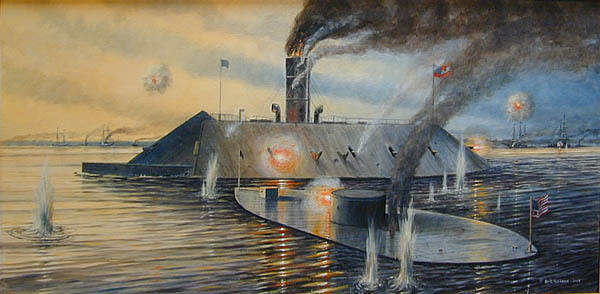
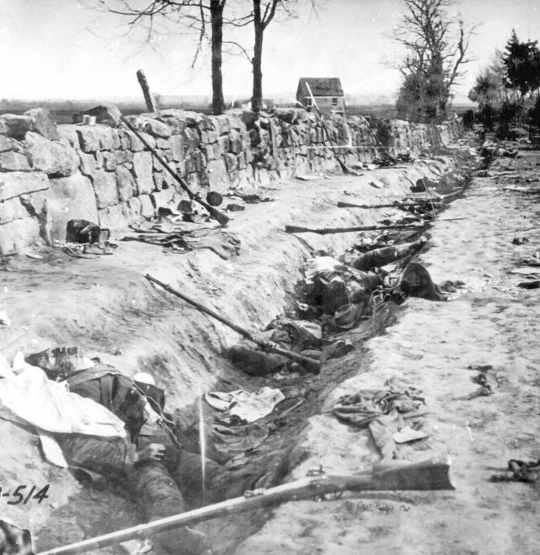
Following the campaigns and soaring above the battlefields we have an overview of the great events of the American Civil War. It is a war that foretells the horrors that Europe will endure some 50 years later, as technology and industrialisation conspire to create a brutal and bloody conflict of attrition. Musketry gives way to repeater rifles and Gatling guns, cavalry charges yield to trench warfare, while at sea Ironclads clash such as between the CSS Virginia and the USS Monitor at Hampton Roads in 1862.


Named as a traitor at home and suspected as a spy by both sides, Nathaniel finds himself caught behind enemy lines and has to don the uniform and persona of a Confederate soldier, as he attempts to escape back to the Union side. This doesn’t go unnoticed by the Union spy network and he finds himself being drawn into their web.


Part Two – The Descent


As the war drags on the Confederacy becomes more and more desperate. It becomes clear that they cannot win; the Union has more men, greater industry and better equipment but perhaps lesser generals.


Losses and shortages caused by the Union's blockade stiffens the resolve of the Confederacy.  Nathaniel Curry finds himself being drawn more into espionage, while the Balloon Corps struggles to retain its funding, looked upon by the military as an unnecessary financial drain. In the end it is forced to cease operations.


Nathaniel is caught between conflicting loyalties: slavery disgusts him yet he hates the damage being wrought on his country and family. He hates the immoral world of espionage and yet enjoys the thrill of it. In the madness of war killing loses its moral sting. Along the line he rubs shoulders with numerous Union generals, the Confederate General Robert E. Lee and even Abraham Lincoln, who encourages him to become a full time spy to hasten the end of the war.

An aptly named sequel, The Descent is altogether darker than the optimistic The Ascent. It maps the disbanding of the Balloon Corps, the fall of the Confederacy and the loss of Nathaniel’s morality and his near collapse into shell shocked madness.


Above the Fray is really an extraordinary book. It is meticulously well researched from the science of ballooning to the topographic description of the Civil War battlefields. I found myself totally absorbed in the life of Nathaniel Curry. There is humour here and there, but it is the humour of the gallows, as the war brutalises everyone and everything it touches.

It is a wonderfully written story; the language so fully evokes the lost world of the Confederate States of America, that even I, an Englishman, could hear the different accents in the dialogue. I learnt much about the American Civil War that I never knew before. It almost reminded me of the film Forrest Gump (albeit a very much darker tale), the way young Curry lives through major battles, crucial events and the individuals he meets (even a young Count Ferdinand von Zeppelin). Being in the Balloon Corps surrounded by scientists he is even exposed to the science of the age, able to discuss Darwin's Origin of Species and its implications for religion. Through Curry's eyes we can see the old order being swept away as the modern USA evolves.


The author doesn’t spare our 21st century sensibilities, the ever present evil, and the dehumanizing language of slavery is always in the background. Within these pages we learn the full implications of what “being sold down the river” means: this was when ruthless owners would sell aged slaves cheaply to be worked until death. A just war then, but a terrible one all the same. If only the great powers in Europe had studied the American Civil War in detail prior to 1914, they would have seen the full implications of modern industrial warfare and known it would never all be over by Christmas.


The story of Above the Fray will stay with me for some time. I can't reccommend it highly enough and I would urge that you should read it, too.

Above the Fray -  Part One The Ascent can be found here and Part Two - The Descent can be found here.


The author has generously agreed to offer a free ecopy of both parts. To enter please comment below or comment on this review's associated Facebook thread.

Kris Jackson is an artist and author based in Massachusetts. His website can be viewed at www.krisjacksondesign.com

This review was written by Rob Bayliss. Rob is currently working on his Flint and Steel, Fire and Shadow fantasy series. Part one, The Sun Shard is available at Amazon.

Saturday, 21 June 2014

Tales of Olde Somerset by Rob Bayliss


Think of Somerset and you probably think of Cheddar cheese, strong cider (scrumpy), straw munching yokels with broad unintelligible dialects, oh, and the Wurzels (for readers beyond these shores they can delightfully be described as a "scrumpy and western" band)… Now I’m not knocking any of these things; I love cheese (I  actually used to be a cheesemaker), I’m more than partial to a glass or three of cider, I even talk like a yokel if I’ve drunk enough of them and, if you ever happen to see them, you will have a good evening's entertainment watching the Wurzels. But there’s so much more to my home county….


Somerset is a rural county framed by rolling hills; the Brendons leading to the wilds of Exmoor to the West, the Blackdowns to the South, the Quantocks and Mendips to the North, while to the east, the land gradually climbs towards the high plateau of Salisbury Plain in Wiltshire. In between are the fertile  lowlands, known as the Levels, where a constant battle has been waged over the centuries to claim the land from its natural state of lazy waterways and swamp. In neolithic times lakeland villages were built on stilts to cope with the rising waters. The remains of  "roads" across the marshes have been found; one such example is called the Sweet Track. It is a 2km causeway made of planks of oak, ash and lime and is some 6,000 years old.


At the time of the Roman invasion of Britain in 43AD, Somerset was split between three Celtic tribes; the Domnonii, Duroriges and Dubunni. After pacifying the southeast corner of Britain, Vespasian and the 2nd Augusta invaded the future county from the south east in 47AD, taking the great hillforts of Ham Hill and Cadbury Castle. Mass graves at Cadbury show the tell-tale injuries caused by ballista bolts and pila.
The Romans moved north ensuring that the Mendips were secured, due to the lead and silver mines that were already being worked there. Indeed the promise of Britannia's metal resources may have been one of the reasons for the invasion of Britain in the first place. Rome had an appetite for lead,  which it was used for aqueducts and plumbing. It wouldn't be until the 18th century that lead extraction matched the levels  of production achieved in the Roman Empire. By 70AD the new province of Britannia was the biggest producer of this metal in the Roman world. Production reached such a high level that the province of Hispania (also a lead supplier) appealed directly to the Emperor Claudius, complaining that they were losing business to the newly aquired province.

The mines at Charterhouse, on the Mendips, were kept under Roman military control in order to stave off corruption. During the Iceni revolt of 61AD, there is evidence that there may have been a slave rebellion at the mines, one of the many wild fires that broke out in the province as word of Boudicca's initial success spread. With Boudicca's eventual defeat rebellions such as those at Charterhouse were brutally crushed by the legions. Such events don't carry the fame and romance of Boudicca, yet they were equally desperate. Who were these slaves who dared to defy Rome? Unlike Boudicca their deeds and names are lost forever in the mists of time; perhaps on purpose, as Rome set about imposing its order on a rebellious province.

Such was the need for lead in the empire that in order to prevent future loss of production, due to slave unrest under the strict military regime, the mines were leased out to private companies. But even after this privatisation mining was still the work of criminals and slaves. It was dangerous work, with a loss of  up to 12% of the workforce each year.

A major Roman road, the Fosse Way was a major Roman military and commercial arterial route across the country. In its course, it linked Bath (Aqua Sulis) continuing to Ilchester and then on southwest to Isca (Exeter) in Devon. Around this road, villas were built as the population became increasingly Romanised. A beautiful mosaic was found in the remains of a villa at Low Ham, near Langport, on the southeastern edge of the Levels.


By 410AD the empire was in decline, under pressure from within and without. Emperor Honorius instructed Britain to "look to its own defence". This the Romano British did with some success. The southwest retained its independence from the advancing Saxons for many years. It appears that some of the old hill forts were reoccupied during this period. (Not to mention the legend of Arthur and Avalon - Glastonbury- which surely deserve a post of its own!) Eventually however the Angles and Saxons broke the land link between the southwest and Wales and they began to encroach onto the lands of the Romano-British successor kingdom of Dumnonia.
Unusually for a county in the southwest of England, Somerset does not derive its name from a Brythonic (Celtic) origin, unlike its neighbours to the west and south, which are named after the old Celtic tribes of the region: Dumnonii (Devon) and Durotiges (Dorset) respectively, and further west still in Cornwall ( a mixture of the tribe Cornovii and the old English for foreigner - Wealas). Instead Somerset’s name derives from the Anglo-Saxon Somersaete, meaning “land of the summer settlers”. The reason for this term became all too evident during last winter’s floods, when huge tracts of the Levels were underwater for weeks on end. As the winter floods receded, rich pasture became accessible to these “summer settlers” and their herds.


The name Somersaete was first recorded in the laws of King Ine, the Saxon king of Wessex 688-726AD, when its boundaries were first set as an administrative region. King Ine’s predecessor, Caedwalla, had gained overlordship over the south and east Saxons but these gains were lost during a sustained period of Mercian hegemony, with a continuous line of Mercian kings being recognised as Bretwalda (high king or Britain ruler). Under pressure from Mercia, Wessex looked westward and advanced towards Dumnonia. Avoiding the swamps of the Levels, Ine pushed through Dorset and along the Blackdown Hills. Around 700AD local legend has it that he fought a battle at Buckland Hill (a hill whose slopes I used to live on!), possibly against King Gerren of Dumnonia. Like all Dark Age battles it was savage; the blood flowed down the hillsides like water, according to legend. Although victorious Ine lost many warriors, including his brother, Noon, whose barrow was said to have once stood on the site.To secure these hard won lands he established my current home town of Taunton as a burh (a fortified settlement) around the same time. In 722AD the town was besieged and destroyed by King Ine's formidable wife, Queen Æthelburg, in a civil war against rebels led by Ealdbert (perhaps Ine's son from a previous marriage). Alas the facts of this internal strife in Wessex have been lost and only hints remain. Ine later brought Earlbert to battle in 725AD and the rebel lost his life. Ine, who was then in his sixties, had clearly suffered greatly through this struggle and abdicated the following year. He and Æthelburg left Wessex to live out their remaining years in Rome.
It appears that Ine had striven to absorb his new British subjects into his kingdom, he drew up laws that allowed for weregelds (financial compensation) to be paid for Wealas as well as Englisc families who had lost a member due to murder (although more was paid if the victim was Englisc!).


Place names in Somerset are usually English in origin, but geographical features usually carry a Celtic element showing a degree of mixture between the cultures. It is interesting to note that the Wessex royal house itself was said to have been founded by Cerdic, Cerdic being a Celtic name. Maybe this mix is reflected in the very Welsh looking county flag of a red dragon on a gold field? 


There was a Saxon royal palace at Cheddar on the Mendips that hosted various Witangemots, but arguably perhaps the most important place in Somerset (and English) history would prove to be an insignificant little hunting lodge set a few miles east of Taunton in the swamps of the Somerset Levels.
A new invader was abroad in England. The Great Heathen Army of Vikings had destroyed the Angle powers of Northumbria, East Anglia and Mercia. During their campaigns they had slain the captured King Edmund of East Anglia with arrows and subjected King Aelle of Northumbria to the particularly gruesome death of the Blood Eagle. Not wishing to suffer a similar grisly fate, King Burgred of Mercia fled to exile in Rome. Only Wessex and the house of Cerdic remained. The future of England looked decidedly Danish.


That insignificant hunting lodge was located at Athelney (Isle of the Princes). It was here that Alfred found refuge from the Danish army of Guthrum, after the Vikings mounted a surprise winter attack in January 878AD on the royal stronghold at Chippenham. Amid the impenetrable marshes Alfred built a fort, licked his wounds and rebuilt his forces. Alfred must have been aware of Athelney to choose it as a base. (It would be here, or nearabouts, where he is famously supposed to have burnt some cakes!) Indeed there is some evidence that there had been an Iron Age fort there which Alfred rebuilt and strengthened. Only a simple memorial on a broad low hill marks this crucial place now.
Recent archaeological digs have shown that metal working was carried out here as Alfred rebuilt and equipped his army. Around Easter 878AD Alfred summoned the Fyrds of Somerset, Wiltshire and Hampshire and went on to defeat Guthrum at the Battle of Edington.
There is a reason why Alfred is the only English monarch to be called "the Great". Alfred had won the war but knew he had to win the peace as well. To that end the defeated Guthrum was forced to accept the Treaty of Wedmore (a village near Glastonbury on the eastern Levels) whereby England was split between the eastern Danelaw and Wessex and Western Mercia. As well as strengthening border defences, Alfred actively promoted an inclusive national identity of Englishness, whereas before there had been seperate kingdoms. His descendents went on to reconquer those lands lost to the Danelaw and thus, from near extinction, the kingdom of England was born. The rest, as they say, is history.
Now our English may sometimes sound unintelligible, but ‘tweren’t vur Zummzet, oi wuzn’t be talkin’ it to ‘ee now, young ‘un!

Rob is currently working on his Flint and Steel, Fire and Shadow fantasy series. Part one, The Sun Shard is available at Amazon.

Thursday, 20 March 2014

Rob reviews Troll by Richard Sutton

Troll by Richard Sutton 

Reviewed by Rob Bayliss

Please see below for giveaway details!


Troll begins in a high valley in present day Norway. An excavation of a cave has yielded an archaeological anomaly. What this anomaly is, and how it has occurred, we won’t discover until the very end; to do so we must travel back thousands of years to a prehistoric time, when there were more than one species of hominid walking the earth.

We are introduced to the clan who once dwelt in the cave. A young clan member called Mokolo is mourning the death of his father, a renowned hunter called Slatolo. Mokolo is clever and dextrous and has the task of crafting traditional hunting spears with fire hardened points. We learn of the ways of the clan: a highly organised matriarchal society, dominated by the elderly Clan Mother, a skilled healer, oral archivist and seer who never leaves the ancestral cave.


The clan are hunters and gatherers living in a dangerous world. They have to contend with predatory cats with huge knife-like teeth and have an uneasy truce with the Great Cave Bears who they fought with long ago in order to claim the cave as their own. Lately however, a new and more dangerous enemy has entered the valley below. They are men, but not like the Clan. We learn that Slatolo himself was slain by these other men, using tiny feathered spears, with flint blades. The Clan is greatly troubled and the Clan Mother wishes for the Clan to discover the secrets of these “arrows”. Mokolo is charged with copying this new technology, which he does, but the new spears seem useless when thrown, even when using spear throwers. It is known that the newcomers can “throw” them accurately and at great speed.


To have any hope of successfully resisting the newcomers the Clan Mother insists that the secret of launching these tiny spears must be learnt. The Clan Chief, Datolo, takes Mokolo and the Clan Mother’s granddaughter and acolyte, Anas’kala, to spy on the newcomers. The spies watch a hunting party of strange fair men launch the arrows using bent sticks strung with sinew. They return to the cave to report their findings and Mokolo is put to work reproducing what he has seen. Successfully learning the craft of bow making and archery, through trial and error, the scouts are sent out again to ascertain the newcomers’ numbers. The Clan Mother fears the newcomers and their intentions, knowing from oral tradition that they have always exterminated clan folk in the past.


However, the spies do not go unnoticed by the tribe of newcomers. The Tribal Seer convinces the Chief that the Clan is a direct threat to all of them and demands, that as the tribe's best hunter, Anson lead an expedition of eradication to the Clan's high valley. But Anson's daughter is gravely ill and the only cure available forces him to question where his tribal and individual loyalties lie. 


Troll is a beautifully written book. Mr Sutton has done a great job in creating and describing the Neanderthal culture and society, at once similar yet different to our own. I found myself completely absorbed by the story, with its undercurrents of racism, ethnic cleansing, fear and ignorance of the “other”. Personally I found the idea that the mythology of trolls, with their coarse features, could be an ancient folk memory of earlier hominids a wonderful notion. It has always been supposed, from previous studies of the fossil record, that the distinct Neanderthal culture was pushed to the periphery of their ancient hunting grounds by technologically superior modern humans and were subject to genetic bottlenecks as advancing ice packs isolated them further, pushed in fact, to extinction. But was this truly the case?
 New research sheds light on these tough evolutionary brothers of ours. They had elaborate funeral ceremonies; this suggests a spiritual belief system. Therefore, like us, they most probably looked at the stars and philosophised about their existence. They lasted 200 millennia and survived numerous ice ages. They invented tanning, to waterproof their leathers. They wore beads and jewelry and shared their caves with body lice which indicates that they wore clothes. It suggests that modern humans actually copied the Neanderthals’ wisdom and technology to a great extent. We intermingled then, and as modern Europeans share 
1-4% DNA with Neanderthals such intermingling may have got very passionate indeed!
These were not simply the brutish fur clad cavemen of popular myth; it may well be they were and are us!


Troll is available for Kindle and as paperback at Amazon. There is also a free copy up for grabs---from Smashwords for an eBook format--and all you do to get your name in the hat is comment below! Facebook users may also comment here. 


This review was written by Rob Bayliss. Rob is currently working on his Flint and Steel, Fire and Shadow fantasy series. Part one, The Sun Shard is available at Amazon.


If you would like Rob or any of The Review Group team to review your book, please check out the submissions tab above.