Showing posts with label Shakespeare. Show all posts

Sunday, 29 October 2017

Shakespeare, Riots, Refugees and Sir Thomas More

Shakespeare's handwriting in the Book of Sir Thomas Moore


Nothing changes. Immigration and refugees were as unwelcome in the time of Shakespeare as they are today. 


The above is part of the only surviving script to contain Shakespeare's writing. Three pages of the manuscript, ff. 8r, 8v and 9r, have been positively identified as Shakespeare’s, based on handwriting, spelling, vocabulary and the ideas and imagery expressed.

The play is about the life of Sir Thomas More, the Tudor polymath and lawyer who was put to death for refusing to acknowledge Henry VIII as Supreme Head of the Church in England. The work was initially written by Anthony Munday between 1596 and 1601, but The Master of the Revels, Edmund Tilney, whose role included stage censorship, refused to allow Sir Thomas More to be performed, most probably because he was worried that the play’s depiction of riots would provoke civil unrest on the streets of London.

After the Queen’s death in 1603, Shakespeare was brought in to revise the script, along with three other playwrights. Shakespeare’s additions include 147 lines in the middle of the action, in which More is called on to address an anti-immigration riot on the streets of London. 


He delivers a gripping speech to the aggressive mob, who are baying for so-called ‘strangers’ to be banished:

"You’ll put down strangers,
Kill them, cut their throats, possess their houses,
And lead the majesty of law in lyam
To slip him like a hound; alas, alas, say now the King,
As he is clement if th’offender mourn,
Should so much come too short of your great trespass
As but to banish you: whither would you go?
What country, by the nature of your error,
Should give you harbour? Go you to France or Flanders,
To any German province, Spain or Portugal,
Nay, anywhere that not adheres to England,
Why, you must needs be strangers, would you be pleas’d
To find a nation of such barbarous temper
That breaking out in hideous violence
Would not afford you an abode on earth.
Whet their detested knives against your throats,
Spurn you like dogs, and like as if that God
Owed not nor made not you, not that the elements
Were not all appropriate to your comforts,
But charter’d unto them? What would you think
To be us’d thus? This is the strangers’ case
And this your mountainish inhumanity."


It is no major stretch of imagination to see these words being addressed at the riots in Charlottesville, in Virginia USA in August 2017; the Dover riots in England in February 2016; the Pretoria riots in South Africa in February 2017; in Stockholm; in Calais ... I could go on... and on...

More relies on human empathy to make his point: if the rioters were suddenly banished to a foreign land, they would become ‘wretched strangers’ too, and equally vulnerable to attack. In an article under the name of the British Library, critic Jonathan Bate is cited as saying: ‘More asks the on-stage crowd, and by extension the theatre audience, to imagine what it would be like to be an asylum-seeker undergoing forced repatriation.’ 


Though proving that ''More’s'' words were indeed written by Shakespeare is no sinecure, in their empathy for the plight of the alienated and dispossessed they seem to show a similarity to the insights of great dramas of race such as The Merchant of Venice and Othello. Whoever wrote them had a fine understanding for the way rhetoric can sway a crowd and also a sharp eye for the troubled relationship between ethnic minorities and majorities.

From various sources including: 

© Diana Milne 22/10/17

Sunday, 13 August 2017

Mary Arden - Shakespeare's Mother


Mary Arden – a Tudor woman.

Mary Arden's son William
 
This is the story of a peasant’s daughter who rose to wealth and status, who buried three of her children and lived through four changes of her country’s religion, who survived the plague and gave birth to one of the world’s best known playwrights and poets. This is the story of Mary Arden, William Shakespeare’s mother.

Mary Arden was born into a time of change and turmoil, a time of radical transformation in both history and society. It was a time of war and violence, of class conflict and the tumult of the reformation overturning a thousand years of religious history and English Christianity in just twenty years.
 
What could it have been like to live through those times for any one, let alone a woman?

Mary Arden was one of eight daughters born to an old farming family in the heart of Warwickshire but Mary married out of life on the land for the challenges of the new world of the Tudor middle class.

Her children would become haberdashers and glovers, two even made names for themselves in the entertainment industry in London! and so Mary Arden’s own story can be likened to a mirror reflecting the changing times of the Tudor era.
Tudor England was a small country with only two and a half million people, ninety percent of whom worked on the land. Life expectancy was just 38! and a third of all children died before their tenth birthday. Mary’s father farmed in Wilmcote, just outside Stratford on Avon in the parish of Aston Cantlow.

The Farm

The Forest of Arden is still a name on the map and it was this place that gave Mary’s family her name. Although Mary’s father Robert was just a husbandman - a well to do peasant - her family could be traced back to before the Norman Conquest. Robert was born around 1480 effectively making him a man from the old world, whose daughters and descendants would welcome the new. Robert built his house in Wilmcote in 1515 and amazingly, under the skin of modernity, it is still surprisingly intact. Originally it was a traditional farming house, open to the ceiling, but the need for space, necessitated it being divided into an up and down stairs.


Mary Arden's House


 Robert and Mary’s mother, whose name is lost to history, were married in 1517 or 18 and the children started to appear very soon. Mary was the youngest of eight children: Agnes, Joan, Katherine, Margaret, Joyce, Elizabeth, Alice and then Mary, in about 1535 (some sources say as late as 1537) and was baptised in Aston Cantlow.  Although religiously it was a country in flux, England was still a Catholic country then and Mary could have been named after the Virgin Mary. The West Midlands is and was a deeply conservative area and religious change came slower there than to many places but after 1540 all this changed. In Aston Cantlow, the local guild was stripped of its silver plate and land. When the monasteries were dissolved all treasures and artefacts were confiscated to raise revenue for the king and realm. The change was also secular as the dissolution flooded the country with land and money, allowing the rise of a new middle class.

By a huge stroke of fortune a list of contents of Mary’s family house in Wilmcote survived, giving us a picture of her life at home. Animals, crops, 8 oxen, 2 bullocks, 7 cows, feather beds and mattresses, cushions, eleven painted cloths for the walls, miscellaneous chattels, total valuation £77 11 10
Mary grew up, as all girls did, multi skilling and was taught to do  essential tasks around the house hold, looking after children, cattle, swine, hens and sheep, then baking, brewing, making cheese, malting and all aspect of housekeeping.  Women and girls were also required to do harder labour, like helping with shearing, ploughing, gathering and threshing corn.
At meals, Mary and her sisters would sit on benches/forms as chairs were a sign of status. Robert, however, had three - one for him, one for his wife and one for an honoured guest. Her aesthetic sense would have been stimulated by the murals in the church, depicting religious scenes and almost three-d representations of ‘what would happen if you were bad’. These were whitewashed over when she was in her twenties, but revealed, still bright, in 1804. A favourite mural was also a pageant often enacted by the guilds at Stratford and that was St George and the Dragon and most people saw this at least once in their lifetime. In 1517 Robert joined the guild.
In 1547 King Henry VIII died and was followed by his pious but cold hearted son, Edward VI, who was surrounded by Protestant fundamentalists who would change the world forever. It was the beginning of the 'commotion time'. When Mary was in her teens, Mass was abolished and all the old rites and festivities were abolished.  The Ardens remained quietly loyal to the old faith. When Mary was about 12, Mary’s mother died and Robert remarried a younger widow, Agnes Hill, who brought he own brood of four children to live at Wilmcote. Joyce and Alice and Mary were still living at home . Living space was cramped and tensions ran high, so Robert drew up 'leases' to ensure his own daughters to ensure if he died they would still inherit.

In 1553, when Mary was about 18, Edward suddenly died and Mary Tudor came to the throne; she was a Catholic who was determined to turn the clock back!

In 1556 Mary’s father fell ill with what may be a fatal flu. He assembles his will. He invokes Virgin Mary and leaves his wordly good, surprisingly provides Mary with land and money - £6 13 4 ( a bit more than a skilled carpenter would earn in a year – roughly equating to £30,000 today.) Even more surprisingly  as she is the youngest, she is named as one of his executors, together with Alice, showing respect and trust and by implication, an acknowledgement that Mary is intelligent and honest. 

Amongst other items showing his generous and thoughtful nature, he leaves 4d to everyone in Aston Cantlow  who didn’t have a team of oxen

As legal executrix  she almost certainly had basic reading skills, but could she write? On later legal documents  she makes her signature with a beautiful calligraphy M. Her wax  seal has her personal emblem , a horse (some say a running horse.) The evidence suggests that she may have known how to write.  She would have been an attractive marriage proposition. There may have been a match already in mind with the son of one of her father’s tenants, John Shakespeare. John had moved from Snitterfield to Stratford  in the early 50s. He had done a 7 year  apprenticeship with a master glover Tom Dixon. He was a young man with prospects and would be an ideal catch. In Oct 1556 he buys 2 freehold properties in town.

Within weeks of his purchase he married Mary Arden in 1557. He was in his late 20s, she was about 22. Stratford then was a small market town with maybe 1200 people and a growing middle class serviced by tailors, and hatters and glovers. 'Home' at that point was just beginning to be a venue for social display and ambition... (i.e. beginning the keep up with the Joneses)  and he needed house to fit status.
They presumably wanted to start a family, but sadly Mary’s first two children died - little Joan aged just 2 months  and Margaret aged 1.

It may have been a comfort, who can tell how she would feel after the death of her babies? but at least her husband was doing well. His freehold in Henley Street entitled him join the corporation. Corporations had replaced the guilds in 1547 and they ran the town. His civic duties ranged from constable to ale taster and charity hand out to the poor. He was a man of credit. Someone they could trust.

In 1558 Mary Tudor died and Elizabeth came to throne, but she was Church of England and so the fourth change of religion in 20 years began. Soon there were risings against her religious policies and the government responded by removing all trappings of Catholicism. In 1563 Stratford council had to do the government bidding and in winter 2/- was paid for defacing images in the chapel so no memory of them remained and the chamberlain, John Shakespeare had to sign off the job.

In April 1564 William was born. On 28th May, Mary was purified at church, but when he was 3 months old the plague came to Stratford. Soon the town was living in fear. At the end of August the corporation held their meeting in the open air, but by then the situation was desperate.  With baby William it was best to get out if she could and Mary rode out to her sister in Wilmcote, 5 miles away where there were no deaths. Luckily William and his parents survived.  

After William, other babies born  and remained healthy; Joan, Anne, Gilbert and Richard and Mary spent time teaching them their ABC and reading prior to them going to school and telling them stories. Years later William would remember  tales of their legendry ancestor, Guy of Warwick. There is also a strong possibility that William would have seen the mystery plays that were still held.

John continued his rise in the council and in 1568 he was elected as mayor, making Mary was the wife of Alderman and High Bailiff, Mr. John Shakespeare.

Now they set out to use John’s position to make real money, investing in wool. It was the mainstay of the economy and was government controlled to prevent illegal dealers undercutting the market – and that is just what John was doing.

John’s web of contacts spread from the Cotswolds to Nottingham and down to Wiltshire. Mary would have dealt with business contacts in an informal capacity. It worked because of trust. But trust was a big issue in Elizabethan England and Elizabeth’s network of spies recorded John’s activities in the Exchequer Memoranda Roll 1572. A government informer, James Langrake, informed on John. This was not the first  time that  Langrake informed on John. The first time he informed about his illegal money lending and then in 1571 he reported him for a wool scam to the value of £210. When you  bear in mind that a waged labourer earned maybe £10 per annum and a house could be bought for £30, it shows just what an enormous sum of money is involved. This time John was able to pay off the informaer and got off with it.

Meanwhile as an alderman John was able to send his son to the Grammar school, the gateway of to university. In late 1570s the government suddenly turned on the illegal wool dealers with the whole force of the law and John’s whole informal network collapsed. Suddenly he had a network of debt everywhere with no network of income!

As the financial difficulties piled up, in 1570 their 7 yr old Anne died. The corporation book has an insight into the tragedy: 'for the bell and pall for Mr Shakespeare’s daughter for her funeral, 8d (pence)'.

Desperate to save money William was taken out of school to help John, losing him the opportunity of University.

Soon they were trying to raise money any way they could. They borrowed from friends and neighbours, inlaws and relatives. Then they start selling off land, including Mary’s 30 or 40 acre and cottage inheritance. John even divided the house up and leased half of it to neighbours who open a pub! Using the house called Asbie’s as security Mary raises £40 from her brother in law, but could not pay it back regrettably she had to forfeit the property.
Four months after Anne’s death she got pregnant again  and although by then in her mid forties, gave birth to Edmund. A couple of years later the teenage William got a 26 year old girl, Anne Hathaway, pregnant first with a daughter and then twins. The family was then squeezed into a third of their old house with William’s new wife and four new children to feed.
 
Worse was to follow 1583 the government discovered a plot to assassinate Elizabeth, the instigator being Edward Arden, a relative of Mary. Edward was head of the most important Catholic family in Warwickshire and after his arrest was put into the chamber called ‘The little Ease’ where you could neither stand up nor lie down and then all the men were tortured on the rack and condemned to death.

Around Stratford the secret police interrogated suspected Catholics and as Mary was an Arden and married to an ex mayor her household was almost certainly one of them. In 1586, having been protected by his fellow councillors for 10 years, John was struck off for non attendance. Mary’s family was now ruined

But there is a twist to the plot. William went to London to try to make it in the theatre. How he did it, we do not know, but in autumn, 1592 a famous metropolitan critic Robert Green poured scorn on the country boy taking the stage by storm. There is no such thing as bad publicity and suddenly William had made it and his box office earnings restored the family fortunes. In 1596 he bought a coat of arms for his father to make him a gentlemen, with (of course) a few rewrites of history, saying of Mary that she had been the daughter and heiress of Robert Arden Esq. and gentleman.
The family could hold their heads high again. William bought the big house near the chapel and John and Mary lived out their days in Henley street with their daughter Joan and her children. Mary had lived from Henry VIIIs reign, through Edward’s, Mary’s, Lady Jane Gray’s, Elizabeth’s and on into James’. She had known grief and disappointment but had held her family together during the commotion time. John died in 1601


John's death recorded in the Parish record

and Mary followed him in 1608, in her early 70s and was buried in the churchyard in Stratford.
*
Shortly after her death William finally published poems he had worked on for most of his life. The poems are imbued with a sense of the destructive power of time and the redeeming power of love. It is tempting to think that it was his mother who taught him how to feel the emotions contained within.
*
This biography of Mary Arden was written from copious notes taken whilst watching a fascinating documentary about Mary Arden, presented by Michael Wood.

Photographs from: 

© Diana Milne August 2017


Sunday, 27 April 2014

Sunday Wrap Up: Week ending April 27, 2014

Please note this is another week in which every review has a giveaway~so be sure to follow each link to their respective reviews and comment for your chance to win! 

Weeeeeeeeeee're back! The Review Group have been having a spot of relaxation before last week and here we are again to greet you with a wrap up of what you've missed or reviews you'd love to re-visit, and posts that are sure to take their rightful places amongst many other favorites. 


*********

To welcome you to kick back and enjoy the tales told, here's our own Louise Rule to give you a glimpse of life with the Grahams.

Anna Belfrage continues her on-going Graham Saga with Serpents in the Garden, after which we are promised at least three more books in this exciting series.


"In Serpents in the Garden, book five in The Graham Saga, we are back following Alex Lind from the 20th century and her husband, Matthew, from the 17th century, thrown together through a rift in time, carrying on their adventures in the New World. Maryland is where they have settled since fleeing their beloved Hillview in Scotland because of Matthew's religious convictions. Now they are settled in their new home which has been named Graham's Garden.

What a book this is! There is more mayhem, more fighting, and Anna certainly doesn't give her readers any respite from the drama of living in 17th century Maryland. There are the old adversaries, and there are also some new and disturbing ones."


Will the Grahams ever find any peace and quiet? Why not find out? It's not too late to add to your summer reading (especially you northerners out there who are still kicking away the last snow berms), and what better way to get started than to win a free copy!? Check out the rest of Louise's fab review for details as to getting in on the action!


*********


"Feud," Emma assures us, "is one of those books that makes reading (and reviewing) so worthwhile and downright enjoyable.  From the striking cover that hints at what lies within, to the last cliffhanger of a sentence, the reader is taken on an enthralling, action-packed and absolutely riveting adventure." That's the hook part; next she goes for reeling in the line: "A violent, emotional and long-standing argument between two land-owning families against the backdrop of the opening era of the Wars of the Roses, Feud gives us an insight to how life must have been. Survival of the fittest - both in mind and body - was the key.  The opening paragraph in this book is where the action starts: no build-up, no hint of what’s coming, just boom!  And the reader is in the thick of it. The author cleverly portrays the transition of the feud from fathers to sons within these opening paragraphs whilst maintaining the constant environment of the war. It is at this point so early on in the novel, that I must say this book is not for the squeamish. The reader is never allowed to forget the era, the trials and tribulations and the constant struggles faced by the characters." Now is that a whammy, or what? This spectacular-sounding book also has a giveaway, and your name just might be the one drawn from the helmet~you know there's only one way to find out!


*********


Lisl keeps the historical fiction pattern going with her review of a book set in Great War South Australia, scene of some unloveliness. "Opening with “Magpies and Mendelssohn,” we see Neddy approaching a music hall from which come voices singing God Save the King, accompanied by piano. Though initially shooed away, he makes his way inside to warn Elsie Fischer, whose family later Anglicise their names, the better to fit in, of danger to her father. Misunderstood by many, Neddy is referred to as the “dull-witted child.” Indeed, he cannot communicate in typical fashion and uses his singing voice to reach Elsie.

[H]is voice utter[ed] a wordless succession of shrill cries. She gaped at him. His voice was so clear, so sure. It uttered just two notes and she could see them as if written. First a crotchet, then an accentuated minim; together making an interval of a rising augmented fifth. A call of alarm!"

"As the individuals’ stories proceed and make connections, readers are given a greater understanding of the war mentality and how it drives otherwise peaceful citizens to harass some of their neighbors to such an extent that lives, careers and futures are destroyed. Using the language of music to convey some of his most lyrical passages, Crabbe guides readers through a story that matures, much like its characters, who themselves act almost as part of an opera, engaging us in the history of a young nation seeking its identity." Join Lisl in exploring this poignant set of novellas, and look for your chance at a freebie by commenting at the review. 


********


Last but not in any way the least, Simon rounds out the week with his ongoing celebration of the birth of William Shakespeare~~poet, playwright, actor, subject of great mystery! Get ready to re-examine everything you have ever been taught about this fascinating figure: "[M]uch of what we think we know (or what we think we don't know) about Shakespeare comes from a period many years after Shakespeare lived. Between 1769, when the actor-manager David Garrick hosted his farcical "Jubilee" for Shakespeare in Stratford-upon-Avon, and 1785, when Rev. James Wilmot, a clergyman who had retired to a village near Stratford, first suggested that Will Shakespeare could not have written his own plays, all our notions about Shakespeare changed.

It was during that very period that the Warwickshire lad became "the god of our Idolatry". At the same time as Will Shakespeare became a kind of national figurehead - the secular patron saint of England - we forgot who he actually was. A scholar named George Steevens whittled the known facts of Shakespeare's biography down to a few notes. We know that he was born, got married, had children, went to London, wrote some plays, and then he went home. And that's all we know."

When you think about it that way, pretty heady stuff!


Tuesday, 15 April 2014

The Best of The Review: Favorite Posts From the First Half Year (Volume VI)

Sworn Sword~~by James Aitcheson

Marsha writes, "I picked Paula's review of Sworn Sword because the review inspired me to purchase the book which I enjoyed immensely. I love the Conquest time frame and was happy to have a new author to explore. I am looking forward to purchasing the rest of the series."


Sworn Sword sweeps us into the 11thc just as the English are on the rise after their devastating defeat at Hastings just over two years before. From the outset we are thrust into a world of where life depends on who wins the battles.  Bloodshed and loss is now a way of life for most people since William of Normandy clawed the English crown from the head of the  usurper’, Harold Godwinson.  

With the opening focusing on an English uprising in the streets of Dunholm, strong hold of Robert de Commines, Lord of the North, we meet our protagonist, Tancred, a Breton, commanding his own conroi. Tancred and his comrades have been trying to fight off the attack when Tancred hears that his beloved Oswynn Is murdered by the marauders; but there is no time to grieve, for he must save his lord, Robert, set upon with his men in the mead hall. Tancred leads his conroi to the rescue but they are too late and Lord Robert is burned alive with his comrades inside the blazing  hall. The Normans are slaughtered almost to a man, but Tancred, who has been badly injured, is carried by his surviving friends Eudo and Wace to the relative safety of York. There the trio find refuge in the house of Robert’s vicomte, Guillaume (William) Malet.

Tancred spends some time under the care of Malet’s priest, Aelfwold who tends his patient’s wounds and saves him from developing a life threatening infection. When he is well, Malet gives the now lordless knight an ultimatum: owe him a debt for the succour and hospitality he had provided him with, or carry out a mission  that would set him free of any obligation owed. Reluctantly, he accepts, for he would rather stay behind in York to exact revenge upon the English who killed his lord and his woman Oswynn. But little did he realise when he gave his oath to Malet, that he would become embroiled in a secret that holds the fate of the kingdom in the balance...

I approached this novel with caution, a) because I am a die-hard Anglo-Saxon supporter and b) because the Normans did terrible things to the English during the invasion, so when I realised this was going to be a story told from the point of view of one of the invaders, I was unsure as to whether or not I was going to enjoy it.  It’s not that I am so narrow minded I can’t enjoy a book from any other viewpoint other than the English one, it is that I didn’t want to read something that promoted the Norman invasion as a good thing and that William was a good guy fighting for his rights, and by the shedding of much English blood, winds up on the English throne. Although Tancred fought on the Conqueror’s side at the Battle of Hastings, he views the English with suspicion and believes that the rightful King now sits on the throne, this is a book that tells the story of one man’s journey to find a new purpose to his life, now that his beloved lord is no longer in the world.

What I liked about James Aitcheson’s portrayal of an England in the aftermath of Hastings, is that it shows the reader how the scene would have looked to just such a man, especially as it is written in the first person, without making it heavily pro-Norman or pro- English. Although the latter are seen as pretty much the bad guys in a way, and the former as the righteous, it’s understandable, because we are seeing it from Tancred’s point of view and as far as he is concerned, he and his comrades are vindicated, for they represent loyal supporters of the rightful King, assisting him in keeping the peace in his new kingdom that was bequeathed to him, quite honourably by his cousin Edward, and stolen from him by the usurper Harold Godwinson. Presented as thus, I found it easy to glide into the story from the start.


Click to continue reading


Paula's People with Simon Stirling

"I picked Paula's piece with Simon about Shakespeare because it was so interesting and I am fascinated by Simon's ideas. I would really like to delve more into Shakespeare's life and plan on purchasing Simon's book."


*********                                                               

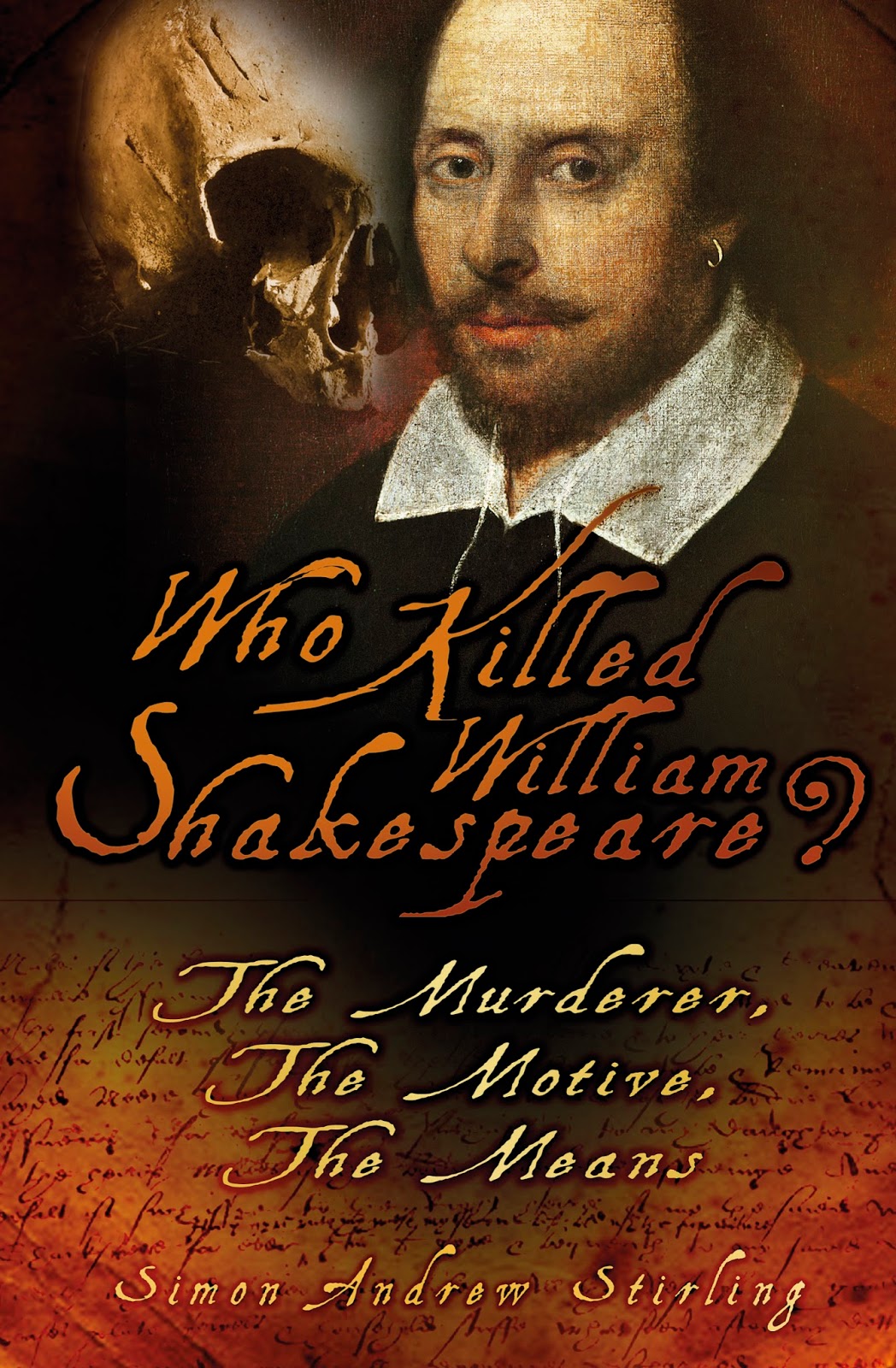
Thanks to Simon for coming along and being a guest on Paula's People. Simon discusses the ideas that spawned his latest novel Who Killed William Shakespeare?  


I was chatting to (chatting up?) a Canadian student at my drama school in London, one day.
“So – got anything planned for this weekend?”              
“Yeah, we’re all going up to Stratford-upon-Avon.  We’re seeing a show at the Royal Shakespeare Theatre, and we get the Shakespeare tour.”
It was part of the one-year course for overseas students: the Stratford Weekend.  And that’s when it struck me.  To lovers of theatre, and literature, all over the world, Stratford is a kind of Mecca.
And there was me thinking it was a place you went to on a Sunday afternoon.
I’ve spent a great deal of my life in and around Shakespeare’s hometown.  It’s given me a different perspective on the ‘Sweet swan of Avon’.  Time after time, reading biographies of William Shakespeare, I was struck by how little interest the biographer had in Shakespeare’s native region, his family connections, the knotty network of friends and co-religionists which made Warwickshire such a tribal county.
London has changed since Shakespeare’s day.  But much of his home county hasn’t altered that much.  You can get closer to Shakespeare in the lanes around Baddesley Clinton or Earls Common than you ever can on the banks of the Thames.
When I started studying Shakespeare in the late-1980s, hoping to understand how a lad from the Midlands became the world’s greatest poet-playwright, I found it all a frustrating experience.  “We know so little about him!” seemed to be the cry on every Shakespeare scholar’s lips.  Twenty-five years on, I’ve come to believe that this mantra is anything but true.  By refusing to concentrate on his London days, I was able to uncover several new facts about Shakespeare’s life.  A whole new picture emerged – more ‘real’, if you will, and certainly more intriguing.  Downright scary, at times.

But the mythology of Shakespeare forms most of what we know, or think we know, or are told to think we know, about this brilliant man.  To engage properly with Shakespeare is to enter the terrifying world of Tudor and Jacobean politics, something unnervingly close to a police state, and the sheer brutality of the repression of those who adhered to the Catholic faith, as their forefathers had done for a thousand years.  It is to enter a period of great upheaval, a massive redistribution of wealth, the remorseless rise of a new political class and a casual recourse to murderous violence.  It was a time of fear and favour, of propaganda and prejudice.

Click to continue reading...

Saturday, 22 February 2014

A Few of Louise's Favourite Books

THESE ARE A FEW OF MY FAVOURITE BOOKS

My passion is history, and I enjoy nothing better than to immerse myself within the pages of history books. My introduction to the world of Roman historical fiction, however, came by way of Conn Iggulden's Emperor Series. I had belonged to a book club and had to buy an extra book to qualify for a free gift. Okay, so there's nothing free in this world! I chose as my extra book the Gates of Romemy accompanying free gift is not even worthy of a mention.

When my free book arrived it sat on the shelf for a little while before I decided to read it. From the first page I was entranced. The book begins with two young boys about eight years of age. The story follows them through adolescence and into adulthood; one child is Brutus, and the other is Caesar. Finding that it was part of a series I was grumpily protesting that I had to wait for a year for the next installment. Eventually I read all five books in the series. Between book four and five, however, Conn Iggulden started another five-book series, Conqueror about Genghis Khan, whom I had been interested in for quite some years, the first in the series being Wolf of the Plains. Again waiting for each book to come out was excruciating. When each book was released I would sit and read as if nothing else mattered. Conn Iggulden has a writing style that is unique. it fills your mind, makes you part of the story, a bystander hiding, unnoticed by the characters that are immersed in their parts.

Paula Lofting's book Sons of the Wolf which is set in 1052 is a very special book for me. Not just because I know the author, but because of its authenticity; there is no modernising of the Anglo-Saxon names, it has a richness of language: its history, its sense of place completely engulfs the reader. I have read it twice now, the second time much slower than the first. It's like getting a second helping of something you love, you take your time over it don't you? So you can savour it, breathe it in, experience it more fully in your mind's eye. It is completely enthralling. Paula's powerful language is woven silently into your psyche, and your experience is complete.


POETRY

What poetry do I like best? Well my taste is eclectic. I like to read out loud The Rhyme of the Ancient Mariner by Samuel Taylor Coleridge. I also have it as a recording read by Richard Burton with Robert Hardy. I sometimes read it 'with' him... trying to get the nuances, the pauses, the rhythm that only Richard Burton could achieve. It opens with words that just draw you in:

'It is an ancient Mariner, And he stoppeth one of three.
"By thy long grey beard and glittering eye, Now wherefore stopp'st thou me?
May'st hear the merry din."
He holds him with his skinny hand,
"There was a ship." Quoth he.
"Hold off! Unhand me, grey-beard loon!"
Eftsoons his hand dropt he.'

The language is wonderfully evocative, and the rhythm and the tension builds and builds until you are almost breathless. It is magnificent and artful poetry.


I have indulged myself in the joys of reading Geoffrey Chaucer's Canterbury Tales with its witty language, its comedy and its forthrightness. The images that are conjured up in the mind are as detailed as they are most entertaining. Such clever use of language is to be admired. If you can, give yourself the pleasure of reading it in its original Old English: the rhythms that this induces are magical.

I am trying to learn Anglo-Saxon, so reading Beowulf: A New Translation by Seamus Heaney is helpful. I also have a recording of him reading it. it is an exhilarating experience to read along in one's head as Seamus Heaney delivers the fearsome lines. His intonations, his lilting voice, rising and falling; the drama, the tension, and the baleful moments are exquisite in their intensity. It is an experience never to be forgotten.


 Then there are the works of John Milton. I told you my taste was eclectic. I studied John Milton at university and became entranced by his works, for example, John Milton The Complete Poems. This book is a mixture of political poems, Psalters, and of course then there is Paradise Lost and Paradise Regained. Such forceful writing, thought provoking, and testing too. I did my dissertation on John Milton's Paradise Lost. I was immersed within his world with my research for many months, and enjoyed every moment of it to the point where I revisit his works at least once or twice a year.


 Most of all I am completely fascinated by William Shakespeare. I first 'met' him at school, but didn't appreciate his work then. it was like dry sawdust, something to be swept aside. I was reintroduced to him when I went back into full time education in my mid-forties. What had I missed! Such use of language, such binding together of words, it was mesmerising. I began reading anything and everything to do with Shakespeare, and still do. My latest acquisition is Who Killed William Shakespeare? the Murderer, The Motive, the Means by Simon Andrew Stirling. I have to admit to never having heard that Shakespeare had been murdered. Although I have read much to do with Shakespeare, I had not come across this information before. It is a truly absorbing book, one which I am still working my way through. Some of it I have had to reread to get it straight in my mind before moving on. This book is so meticulously researched and written and would be one of my Desert Island Books, without a doubt.


My reading goes well beyond this limited list. I would need a complete series of "My Favourite Books". It is difficult to choose which ones I like the best; they all have a special place because they have all given me something that I would not have experienced had I not read them at all.

Louise Rule is the author of Future Confronted.
Louise's Blog can be found here
Louise can be found on Facebook here