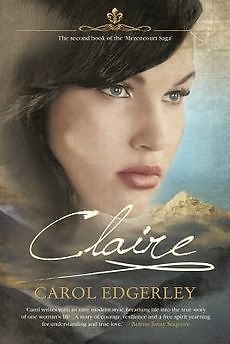
This week we are holding a spectacular 7 day event to launch Marguerite and Claire and to kick it off, we start with this wonderful interview with author Carol Edgerley!
Carol Edgerley was inspired to write after learning the fascinating story of her rebellious great-grandmother from a great aunt, visiting from India. Subsequently, her children encouraged her to write it for a wider audience to enjoy. The result was her debut novel, Marguerite, a fictionalised account of her grandmother's life, published in September 2012. It is the first in a saga about three generations of feisty women. Claire, her second book, was published in September 2013. A third volume, Susanna, is in the pipeline.

.jpg)
Carol, you have an incredibly fascinating background. Please can you tell us a little about it?
Carol Edgerley was inspired to write after learning the fascinating story of her rebellious great-grandmother from a great aunt, visiting from India. Subsequently, her children encouraged her to write it for a wider audience to enjoy. The result was her debut novel, Marguerite, a fictionalised account of her grandmother's life, published in September 2012. It is the first in a saga about three generations of feisty women. Claire, her second book, was published in September 2013. A third volume, Susanna, is in the pipeline.
Welcome, Carol. Thank you for joining me today
to talk about your books, Marguerite and Claire.
 |
| Carol Edgerley |
Carol, you have an incredibly fascinating background. Please can you tell us a little about it?
My parents were British, but aside from their passports, they were a cocktail of different nationalities: Irish, Scottish, French, Swedish and a drop or two of Italian for good measure. I was born in India but moved to France when I was just a toddler, and remained there until I was 10. My education began at a French convent, and I later went to boarding school in England.
A French and English teacher, I happily abandoned my profession to fly instead as a stewardess for some years – a lifestyle decidedly more exciting!
During my years in Hong Kong, I ran a successful tutorial for many years. Brit I technically may be…but France has always been “home” to me, where I choose to live in retirement.
You have
written so far about Marguerite de Merencourt O’Hara and her daughter Claire;
now you are setting down the story of Susanna. Why did you decide to write
about these women?
It fascinated (and dismayed) me to notice a decidedly dysfunctional thread running through each generation of this family, where a matriarch takes an active dislike to one of her children. I like to think I have broken that particular thread! Marguerite began as a sort of testimonial for my own children, I being the only family member in possession of her story, that even at the age of 12 I found riveting. To my surprise and huge pleasure, the book was so well received that I decided to write the story of her elder daughter Claire, an unhappy and complex woman. One of her granddaughters, Susanna, became the target of extreme bullying, which is very much in the news today.
Are there
any other books in the pipeline for Carol Edgerley?
As things stand, I am currently writing the story of Susanna, which may see the light of day by the end of the year. Thereafter, there could be Olivia to write about.
Before
your aunt’s tutoring sessions, did you know anything about the relatives of
which you now write?
Before the maths tutoring, I had gleaned fascinating snippets from my grandmother about her childhood, but who never admitted to having a brother stabbed to death in a bar-room brawl. She was far too elegant and dignified for such a thing! Now and again, I heard occasional gossip from older family members to be stored away in my mind. One way or another, a love of horses has always been part of the Merencourt women’s lives, including my own. And I have a daughter who adores them, too…
How did
you go about capturing all the information? Do you remember being told about your great grandmother and grandmother? Did you record your aunt, write as much
down as you could? Did you have to do any follow-up research?
No. Throughout the years I never wrote anything down at all. Marguerite’s amazing life has always burned bright in my mind, and I was asked on the odd occasion to describe my ancestry. Having decided to write about Claire, I did a spot or two of “research” amongst still-living relatives!
Who did
you find the most challenging to understand, and who do you most relate to?
As to the most challenging to understand, I’m certain I could never have found the strength to cope with the disaster and drama that beset the stalwart Marguerite, even though that strength was later channelled into over-dominance of her children with dismaying results. As for Claire, I roller-coasted between feeling desperately sorry for the terrible disappointments she suffered…and clutching my head over the more ruthless aspects of her character. I was bullied at school…as was Susanna, so perhaps I am able to empathise a little more with her?
Your books
are about your great grandmother and grandmother, so is there any element of
fiction in your books?
It has always been a problem for me to decide on the genre of my books. In the end I reluctantly labelled them as “historical romantic fiction” for want of something rather more accurate to describe them. “Love and roses” they most certainly are not! “Memoirs” …maybe as I have told their stories as accurately as possible…warts and all! The “fiction” aspect is that I fleshed out the characters from my imagination, not having their personal acquaintance…in particular, my great-grandmother, Marguerite!
How do you
think you have evolved creatively?
I most certainly have evolved creatively! I assumed the writing of Marguerite would be a piece of cake since I was an English teacher, possessed a wide vocabulary (having been obliged to learn vast lists of words and their meanings as I had a bad stammer and could substitute in case of difficulty), and I had a “ready-made” storyline…that assumption proved to be a colossal error. It most certainly is a craft! I had to learn the difference between writing for a reader …and writing an essay. For years I staggered along a literary rocky road, regularly barking my shins through erroneous trust in editorial charlatans purporting to show me the way! Finally the penny dropped…and Marguerite became a finished article. My pride was immense! On reflection, it’s a bit like having a baby: the first experience is appalling, but the next pops out relatively easily….
Claire was
re-released with a new cover, which is just beautiful! Who designed it, and
what is your favourite thing about it, Carol?
Claire’s gorgeous new cover was designed by Cathy Helms of Avalon Graphics. I found the girl’s gaze to be particularly riveting…
All
authors like to hear what readers think of their books; do you get much
feedback from your readers?
Feedback…yes, quite a lot. Not everyone has access to a computer or possesses an Amazon account to post a review. Some find doing that very thing to be intimidating…or they merely forget. I have received several lovely messages from people who bought hand-sold books, some of whom are “old India wallahs” declaring the books to be delightful re-visitations of the country they once knew so well. Many eagerly ask when Susanna will be available…
There is
one scene in Claire that is
especially difficult to read – a little shocking that someone could do that. Do
readers ever mention it?
The terrible abandonment of little Timothy was an incident I admit hesitating over. But I wanted to tell Claire’s story as it happened, and it had a long-term effect on Claire herself. I want to point out that she never forgave herself for what she had done, and perhaps regarded her care of the infant Susanna as a small gesture towards atonement. To date, readers have never criticised reading about it, possibly because the book is not in the least way “romanticised” with unpleasantness glossed over.
If your
books were to be made into films, who do you see playing the three lead women?
Fiery Genevieve Bujold would have made a marvellous Marguerite but maybe she’s too old now? As for Claire, Rosie Marcel would be ideal to play her conflicting character. I can see Camilla Arfwedson as Susanna…
I like to
ask authors about their writing routines, where they write, when they write. Do
you have a particular routine when writing?
 |
| Carol's beautiful garden |
I write in my veranda, surrounded by five dogs. Being somewhat occupied by my large animal family (…plus five donkeys, two bunnies, a cockatiel and a cat), I simply don’t have time for writer’s block or any other “diva melodrama.” I write when I can – get interrupted – resume writing hours later, then possibly more interruptions. No routine. Take it up…and put it down! Easy.
Proofreading
and editing, two of the most important things, apart from writing the book, of
course. How do you go about this process?
I always edit a previous chapter before continuing. At the end of the book, I re-edit the whole manuscript, sometimes twice. Then off it goes to Michelle Kelley, my super professional proof-reader/editor, who manages to sort out the necessary without noticeable alterations to my “voice”.
Would you
like to share with our readers what books have had a strong influence on you or
your writing, Carol?
As a girl, I adored Georgette Heyer’s regency novels, especially These Old Shades…(sigh!) then Judith Kranz’s We’ll Meet Again, and Barbara Taylor Bradford’s series, the first being A Woman of Substance.
Besides
your love of writing, Carol, what are your other passions?
My passions? Horses, donkeys and dogs…all animals! Because of them, I am never lonely despite the relative isolation of my home. I also love reading, but sadly have little time for it these days. Historians David Starkey and Simon Scharma are my idols! I also love cooking for friends…and in several different languages. My garden gives me great pleasure…unfortunately deer are finding it a great restaurant to visit!
Is there anything
else that you would like to add, Carol?
The only thing I would add for the benefit of budding writers…DON’T give up the day job!
Thank you so much Carol, it's been a real joy chatting with you. We look forward to your next book, Susanna, being published very soon.
Both Marguerite and Claire have been awarded the prestigious B.R.A.G. Medallion