Showing posts with label Marguerite. Show all posts

Sunday, 12 April 2015

PAULA READS: MARGUERITE

Marguerite (Book I in The Merencourt Saga) by Carol Edgerley
Review by Paula Lofting

This review is written in conjunction with our Facebook event for the official release of Carol Edgerley's books Marguerite and Claire. Please click here to read a review for Claire.

Please note that the giveaway is no longer valid for Marguerite.

How often do women take for granted our relative equality and freedom to live as an independent citizens without a man to sustain us? Today there are still some who demand more liberty from society-- not that I would begrudge them, as I too often believe that as emancipated as we are we still have a long way to go; however, if we dare to look back across the span of more than a hundred years, we would be hard pushed to find many women able to stand on their own two feet, totally dependent on themselves. Times have changed and attitudes to women in the West have also. We no longer are beholden to men for our food, comfort and emotional needs. Women today are unbound from the constraints that women of the fifties had to endure, for whom advice was given such as this website proclaims, on how to be the perfect housewife. And if you think that was rich, imagine what it was like to be a woman of the Edwardian era.

Marguerite is a recipient of the
B.R.A.G. Medallion
But for the memories that live on in these women's  daughters and granddaughters, we may know very little about the emotions of women, how they truly felt, how they viewed life as it was for them then, and how they might have longed to be free, throw away their corsets and ride a great steed with their long hair blowing freely in the wind. And thanks to author Carol Edgerley, we learn of one such woman who did this very thing - Edgerley's very own great grandmother - whose remarkable journey across two continents we follow in Marguerite, the book she wrote for her. It is worth knowing that Marguerite and its sister book Claire were written many years after their tales had been told to Edgerley by  kindly old Aunt Christina. She kept them in her head for generations before she was encouraged to write them down in the form of a fictionalised account of their lives. Nonetheless, Edgerley informs us that she has portrayed the stories of both women as accurately as possible, although there are some details conjectured and fleshed out with the use of her own imagination.

Marguerite's story begins at the very beginning of her existence. We first meet her as a newborn in her noble family's beautiful chateau in the Dordogne, the very day she is birthed into the world. Her mother, the Marquise de Merencourt, takes an immediate dislike to her baby daughter and sadly from then on it is all downhill for the little girl whom her mother, Francine, refers to as 'it'.
"Take it away! I said take it away!" screeched the woman on the bed, shrinking away from the infant lying beside her. "Oh I cannot bear it! How can something so ... so hideous be mine? Oh, someone just take the horrid thing away!"
The reason for this intense dislike of a tiny human being who cannot possibly have done any ill to the woman is a mystery, though there are hints throughout the book as to the reason why Francine favours her boys over her little daughter. Perhaps one of them is that Marguerite, whom her father refers to as Minette, becomes the apple of her father's eye. Unloved by her mother, but favoured by her doting father, whom she resembles in far more ways than she does her mother, Minette grows into a wonderful but headstrong young lady despite the absence of a caring, loving maman. Sadly too, her elder brother Jerome also becomes her mother's accomplice and torments her day and night, playing a huge part in pushing her away from her family.

The beautiful Dordogne
This story is written as a semi-biography of the author, Carol Edgerley's great grandmother, who cleverly puts together for us a wonderfully engaging story about a rich young girl's journey into a world of love, hardship and abuse. From noble beginnings, she chooses a path that sees her become disinherited and banished from French high society, all for the love of a charming Irish doctor, a love that conversely becomes an anathema for Minette. But things don't go smoothly for our headstrong heroine and we see her grow from the naive young 17-year-old into a mother of five children who meets tragedy and loss with great courage and fortitude. As I followed Marguerite's story, I was gripped as I swam through the tides of time with her, experiencing her emotions of love, despair and loathing, and of excitement and adventure as she embarks on a life that she believes will save her from a fate worse than death. All in all, I was enamoured by our tres chic blue-eyed heroine, with her black tresses and olive-skinned beauty. I was aghast when she cast her eyes against taking the path that might have led her to a better life and infuriated by her refusal to marry the man who adored her. Such is Edgerley's gift to us, that we are  imbued with her spirit, and we desire to shout across the pages at her and warn her of danger, such is the emotion it invokes in us.


A French family on a day out in 1880s


Thank Heaven for little girls


Minette, as she is mostly referred to throughout the book, was born in 1875. At this time in France it was the wonderful era known later as La Belle Epoque - the beautiful era. A gay time, full of sanguinity and hopefulness, when the arts flourished and certain creations of literature and music were upheld as magnificent masterpieces. It was also a time when science and technology came into its own and for those women living in the heady decadent quarters of Paris, were most likely to have experienced a world of liberality - a stark contrast to the kind of world that Minette was to be brought up in. For her world, though indeed she was able to enjoy such liberties of riding astride a horse with her hair flowing free in the wind, was one of restriction and containment. But the free spirit that she possessed within her soul was to be horribly and unfairly mistaken for unruliness, harlotry and selfishness.

How Minette should have ridden
Sadly unbeknownst to her awful mother, who could see no good in her daughter whatsoever, no matter how hard the girl tried to please her, Minette's innocence was in her so-called 'wildness'. Her ability to treat people with respect, whatever their station in life, was seen by those rich enough to view life through the splendour of money and titles, as vulgar, improper mixing with those below her station as we see those spiteful snobs belittling her and her children both in India and Ireland. Minette's ability to rise above such treatment and denigration takes force within her from her innocence which  has been tainted by the cruelty of the world as she passes through it, surging from one disastrous encounter to another, none of which her fault. It is just the world as it is. The world that she longs to be no part of. The following passage shows us just the sort of attitude that Marguerite was expected to put up with from the other officers' wives in India:

"Mrs O'Hara, most reluctantly I am taking it upon myself to warn you about  over -familiarity with servants," the lady began with all due pomposity. "You are seen laughing and conversing with your ayah, just as though you considered her your equal. I'm afraid it simply will not do, Mrs O'Hara! Especially in your condition..."

Minette, who was heavily pregnant at the time, is not deterred and she gives the woman a very large piece of her mind. This is just one example of the type of harassment and snide remarks Minette has to put up with, not just in India, but from her husband's Irish relations also.

Marguerite is not just a victim of such disgraceful attitudes; she suffers many tragedies throughout her young life before she reaches thirty. But her spirit never fails her, although time and time, she will doubt herself and long to turn back the clock to a safer time when she was young and without the confines of adult life. Though she learns very harshly that going back to her home in France is not an option, she knows she must do what she can to give her children a chance in life that will enable them to be secure, loved and wanted. After encountering one final life changing tragedy, and having been badly let down by her husband, the man she threw all caution to the wind for, she knows that she must summon that indomitable inner strength of hers to take charge of her destiny and make hard decisions that will have a great impact on her relationship with her children.


How Marguerite and her family may have looked when they visited Scotland

The narrative has many elements to the story and the author has written a beautiful tale that breathtakingly sweeps you to many different destinations: from the hot summers of the sumptous Dordogne chateau in France, where Minette grew up, hated by her mother, but secure in her doting father's protection and her love for horses, to the stark contrasting confines of a Dublin convent school, where she was made to sleep in a cold cell with the door open and no light. Then we are breezed across the sea again to the quintessential English village of Wimbledon where she is forced to hide from her brother and father as they pursue her to bring her home before she can marry her 'kidnapper', the Irish doctor, Patrick O'Hara. The couple race to Gretna Green in Scotland where they may marry under Scottish law without the permission of another and later Marguerite will return to Scotland to study nursing and midwifery. From Scotland the young couple return, married and free, or so they think, to Wimbledon, where they decide to go to India, as far away from the revenge of Marguerite's family as they possibly can. There they settle in Lucknow, among the heat, the flies and the mosquitoes.  It might not be a paradise, but Marguerite eventually comes to see it as home.

Minette loved her horses and even rode in
point to point races in India. This Gymkhana is from
Karachi but could well be like the one in
Darjeeling where Minette rode.

Marguerite is a story of a young girl who was born into a life with values that were way ahead of her time. It is a tale that has will touch your life as irrevocably as it has mine, and will absorb you into the world as it was throughout the late 19th century and early 1900s. It will astonish you, amaze you, and you will be left wondering just how much can the human spirit take and still continue on in hope.

You cannot fail to be moved by this book which is so well written with wonderful prose and a rich narrative that flows effortlessly throughout. 

Marguerite can be found on Amazon in the UK and Amazon.com
and Claire Amazon.com and Amazon.uk

About the Author


Born in India, educated in France and later in England, Carol has returned to live in France with her husband amid a multitude of much-loved animals. A wide circle of friends of varying nationalities provides plenty of spice to her life! 

Something of a connoisseur of the Far East, Carol ran a tutorial in Hong Kong teaching English and French to a great many children, some of whom remain in contact with her. Bilingual, she also retains a smattering of "kitchen" Hindi from years spent in Delhi and Calcutta. 

No longer riding these days due to her two beloved but ancient horses going to heaven, Carol is currently fully occupied writing Susanna, third in The Merencourt Saga series..

An avid reader herself, Carol's favourite authors are David Starkey, Margaret George, Alison Weir and Phillipa Gregory. She also loves cooking for friends in several "languages," and planning out her garden for the following year. (Weeding, however, is quite another story.)


Carol can be found at her website located here

If you would like to win a signed copy of Marguerite, please leave a comment on the blog post here or, if you prefer to use Facebook, comment on this review's thread located here.


Friday, 10 April 2015

Guest Post by Carol Edgerley: A Look at Childhood Then and Now

Today we have a Guest Post, by author Carol Edgerely

A COMPARISON BETWEEN THE CHILDHOOD OF THE
MERENCOURT WOMEN TO THAT OF 
THE CHILDREN OF TODAY...


Whilst writing the story of Marguerite, it crossed my mind to wonder just how fortunate are the children of the 21st century, relative to those of a bygone age. These days, a child's place within the family is celebrated by parents who strive to structure their time and resources around an offspring's needs and desires.

During the 19th century, a girl such as Marguerite spent a sheltered childhood almost entirely isolated from the outside world, and was expected to conform to a restricted lifestyle. Unlike this far-from-usual girl, who appalled her family by dressing like a boy to race about her father's estate on a horse. Nevertheless, she - as other girls of aristocratic status - was viewed as little more than a chattel to be disposed of at will or for the advancement of the family.

Claire, Marguerite's eldest daughter, fared little better. Extroverted and headstrong, she was frequently in trouble for flouting her mother's insistence that she adhere to the rigid social mores of the day. Every move the girl made was supervised, criticised, her attire inspected for suitability by a stern, eagle-eyed mother. Even her eventual husband was the choice of Marguerite de Merencourt, an alliance ultimately proving disastrous for the naïve young girl. It was to colour her view of the world in years to come.

During the early forties, Susanna knew an enviable early childhood. Allowed a freedom unknown to the children of yesteryear, she spent much of her time rock climbing on the beach with friends, falling out of trees, returning home at an appointed hour with grazed knees, filthy, happy and healthy. Lurking sexual predators were simply not part of the equation. She, as most other children of her time, were required to learn the lessons of life, to take responsibility for their own actions, accept occasional failure to succeed, respect their elders and behave in an acceptable manner.

No "canned" entertainment existed in those far-off days. The most sophisticated item for rainy days was a compendium of games containing cards to play Snap, a box of Tiddlywinks, and boards for Draughts or Snakes and Ladders. Story books and annuals were precious items, most children being able to read and write from an early age. Gymnastics, cross-country runs and sport in schools were mandatory if generally unpopular, therefore child obesity was an unfamiliar concept despite jam sandwiches at tea-time.

Are our children any freer, happier or healthier than Marguerite, Claire or Susanna? Now that childish pleasures of yesteryear have been obliterated by a plethora of violent digital games, iPads, mobile phones, and must-have toys relating to television productions? Discipline being regarded as a dirty word, what of school teachers hesitant to curb unacceptable behaviour for fear of legal retribution by outraged parents, or losing their jobs? Generations of children leaving school almost illiterate, some incorrectly labelled as "special needs"?

What of the daily bombardment against the evils of bacteria, skin cancer, cyber bullying, self harming, junk food and anorexia...whilst once-everyday sports and games are suppressed in the name of 'ealth 'n safety?

Despite the constraints of past generations, I sadly shake my head…


Wednesday, 8 April 2015

Lisl Reviews: Claire

Claire (Book II in The Merencourt Saga) by Carol Edgerley
Review by Lisl


Please note that the giveaway is no long valid


The 19th and early 20th centuries contain not a few accounts of resolute women, females who pushed back or laid claim to their slice of the world, many meeting success and motivating others to aspire to greater goals. Marguerite de Merencourt was one such woman, and although the legacy she passed to her children and grandchildren contained mixed blessings—for Marguerite’s obstinate streak, so admirable in her younger years, often worked against her favor as she grew older—she remains a draw for readers precisely because some of her efforts yielded less than absolute success.

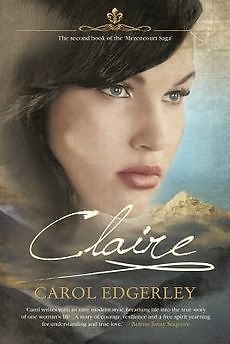
The beautiful new cover for Claire
Marguerite’s eldest daughter Claire, introduced to readers in the final pages of her mother's story, possesses Minette’s striking beauty as well as indomitable spirit, and from an early age mesmerizes those around her, though not always for the better. Her father’s bullying nature softens to smiles, but upon a long-time-coming visit to her maternal grandparents’ home in France, the teen is viciously rejected by the same woman who pushed away her own infant—Marguerite as a baby. As Claire is coming into her own, she often clashes with her mother and the failure of both to choose their battles widens the already substantial chasm between them.

Claire opens to a scene of the girl celebrating—or trying to—her first grown-up birthday at the end of the new century’s debut decade. While the mores of the time have not drastically altered since her mother was 17, Claire recognizes the changes dawning in the world—cars and telephones make their appearances in the novel—as well as within herself, and like most teenaged girls, resents her mother’s strictures as much as she is mortified by her working status as a Calcutta business owner.

Unfortunately for Claire, she doesn’t seem to learn from her mother’s mistakes, nor does Minette—to the detriment of both. Eager to escape the house as well as the hanging cloud of a family secret, Claire enters into a marriage arranged by her mother, only to find that her once-charming fiancé has little feeling for her other than as sexual release in the absence of the married woman he had conducted an affair with during their engagement. Betrayed by her partner in life and humiliated in the public forum, Claire directs her energies and considerable organizational skills on lavish entertaining and a posh lifestyle.

Picknicking at Diamond Harbour near Calcutta
Photo courtesy Carol Edgerley
Before readers get very far into the story, Minette and Claire have already bickered over so many and such petty grievances, one wonders if they spend copious amounts of time nursing exhaustion, for indeed it takes a great deal of energy to be angry. Edgerley’s dialogue, however, always fresh and sharp, combines with the narrative and clearly shows characters’ perspectives as well as the larger picture. Family members frequently engage in heated rows and these strong and well-spoken women are rarely short of intelligently articulated deliveries.  


At the racecourse, near Calcutta
Photo courtesy Carol Edgerley
Having said that, there is indeed more to 
the characters than smartly-chosen words delivered for maximum effect. Readers are permitted to witness the ambitious Claire as she at times struggles to maintain her footing or determine the next step. Troublemaker Sonia is not always able clearly to see her sister’s secrets in order to exploit them, and Christina, with a tendency towards submission and desire just to keep the peace, develops a strength enabling her to speak out against Claire’s less desirable behaviors and actions.


Though Minette has kept most details of her unhappy childhood from her children, some eventually learn the most significant details, such as when Claire’s grandmother verbally assaults her—for being Minette’s daughter, of course, but also because she is so startlingly like her. “That unnatural mother,” as Minette considers the Marquise, nevertheless has exerted some sort of influence as we later see Claire repeat some of her grandmother’s acts and treat her own children with a contempt shocking to modern readers.

Claire’s life does, however, have its happy moments, and Edgerley’s descriptive prowess of them and other scenes is as powerfully true to reality as it is scrumptiously absorbing. Scenes of both ordinary and grand wrap around readers as if they are part of them, and as they move though seamless transitions, investment in those they read about deepens. Appreciation for Claire and others develops despite—or perhaps because of—her flaws and obstinate inability to move past some of them.


“The young woman had never looked more beautiful, her dark hair drawn up into a loose knot encircled by strands of jasmine. In her hands, she held a bouquet of the same delicate white blooms encircled by green foliage. The elegant bodice of her soft taffeta gown was scattered with seed pearls that proceeded in swathes over the flowing skirts. Only her hands were seen to tremble…wedding nerves, it was said.”


Claire, aged about 48 in France
Photo courtesy Carol Edgerley
When still becoming acquainted with Claire and how she endures living in a pressurized society under the seal of a loveless marriage, this reviewer had at first mused she might be a character readers “love to hate.” It soon becomes clear that such stylization shortchanges Claire, her story and readers themselves. Multi-faceted, Claire’s dreams, disappointments, loves, losses, sins and attempts at atonement could be any of ours, and reflect the reality she once lived.


How Claire goes on to make a satisfying life for herself and her family is nothing short of astounding; with her perseverance in the face of unforgiving setbacks as well as unmitigated joy, she carries on amidst global as well as local changes, community and personal. Like India herself as midnight, the new day of an opening era, approaches, Claire must acknowledge the past as she aims to settle into her future, one that will certainly contain agonizing choices alongside the promise beckoned by the birth of a new era. Having grown attached to her, both despite and because of her lapses, readers will long with and for her, and wish for more.


*********
Carol Edgerley has so graciously donated a FREE COPY of Claire for one lucky reader! For your chance to win, simply comment below OR at this review's Facebook thread, located here.

For Paula's review and to comment on Marguerite (and also get your name in the hat for a FREE COPY of that one!), please follow this link

*********

Author Carol Edgerley can be found at her website and Twitter, and you can check out Louise's fabulous interview from earlier this week as well! Claire may also be purchased at Amazon and Amazon UK


*********


Note: This review originally appeared at The Review in January 2014. It has been altered for the reading of the new edition and to reflect the lovely updated cover. 

Update: A link to Paula's review for Marguerite has been added. 

Monday, 6 April 2015

Louise E. Rule interviews Carol Edgerley

This week we are holding a spectacular 7 day event to launch Marguerite and Claire and to kick it off, we start with this wonderful interview with author Carol Edgerley!

Carol Edgerley was inspired to write after learning the fascinating story of her rebellious great-grandmother from a great aunt, visiting from India. Subsequently, her children encouraged her to write it for a wider audience to enjoy. The result was her debut novel, Marguerite, a fictionalised account of her grandmother's life, published in September 2012. It is the first in a saga about three generations of feisty women. Claire, her second book, was published in September 2013. A third volume, Susanna, is in the pipeline.


Welcome, Carol. Thank you for joining me today 
to talk about your books, Marguerite and Claire.


Carol Edgerley


Carol, you have an incredibly fascinating background. Please can you tell us a little about it?

My parents were British, but aside from their passports, they were a cocktail of different nationalities: Irish, Scottish, French, Swedish and a drop or two of Italian for good measure. I was born in India but moved to France when I was just a toddler, and remained there until I was 10. My education began at a French convent, and I later went to boarding school in England. 
A French and English teacher, I happily abandoned my profession to fly instead as a stewardess for some years – a lifestyle decidedly more exciting! 
During my years in Hong Kong, I ran a successful tutorial for many years. Brit I technically may be…but France has always been “home” to me, where I choose to live in retirement.

You have written so far about Marguerite de Merencourt O’Hara and her daughter Claire; now you are setting down the story of Susanna. Why did you decide to write about these women?
It fascinated (and dismayed) me to notice a decidedly dysfunctional thread running through each generation of this family, where a matriarch takes an active dislike to one of her children. I like to think I have broken that particular thread! Marguerite began as a sort of testimonial for my own children, I being the only family member in possession of her story, that even at the age of 12 I found riveting. To my surprise and huge pleasure, the book was so well received that I decided to write the story of her elder daughter Claire, an unhappy and complex woman. One of her granddaughters, Susanna, became the target of extreme bullying, which is very much in the news today.

Are there any other books in the pipeline for Carol Edgerley?

As things stand, I am currently writing the story of Susanna, which may see the light of day by the end of the year. Thereafter, there could be Olivia to write about.

Before your aunt’s tutoring sessions, did you know anything about the relatives of which you now write?

Before the maths tutoring, I had gleaned fascinating snippets from my grandmother about her childhood, but who never admitted to having a brother stabbed to death in a bar-room brawl. She was far too elegant and dignified for such a thing! Now and again, I heard occasional gossip from older family members to be stored away in my mind. One way or another, a love of horses has always been part of the Merencourt women’s lives, including my own. And I have a daughter who adores them, too…

How did you go about capturing all the information? Do you remember being told about your great grandmother and grandmother? Did you record your aunt, write as much down as you could? Did you have to do any follow-up research?

No. Throughout the years I never wrote anything down at all. Marguerite’s amazing life has always burned bright in my mind, and I was asked on the odd occasion to describe my ancestry. Having decided to write about Claire, I did a spot or two of “research” amongst still-living relatives!

Who did you find the most challenging to understand, and who do you most relate to?

As to the most challenging to understand, I’m certain I could never have found the strength to cope with the disaster and drama that beset the stalwart Marguerite, even though that strength was later channelled into over-dominance of her children with dismaying results. As for Claire, I roller-coasted between feeling desperately sorry for the terrible disappointments she suffered…and clutching my head over the more ruthless aspects of her character. I was bullied at school…as was Susanna, so perhaps I am able to empathise a little more with her?

Your books are about your great grandmother and grandmother, so is there any element of fiction in your books?

It has always been a problem for me to decide on the genre of my books. In the end I reluctantly labelled them as “historical romantic fiction” for want of something rather more accurate to describe them. “Love and roses” they most certainly are not! “Memoirs” …maybe as I have told their stories as accurately as possible…warts and all! The “fiction” aspect is that I fleshed out the characters from my imagination, not having their personal acquaintance…in particular, my great-grandmother, Marguerite!

How do you think you have evolved creatively?

I most certainly have evolved creatively! I assumed the writing of Marguerite would be a piece of cake since I was an English teacher, possessed a wide vocabulary (having been obliged to learn vast lists of words and their meanings as I had a bad stammer and could substitute in case of difficulty), and I had a “ready-made” storyline…that assumption proved to be a colossal error. It most certainly is a craft! I had to learn the difference between writing for a reader …and writing an essay. For years I staggered along a literary rocky road, regularly barking my shins through erroneous trust in editorial charlatans purporting to show me the way! Finally the penny dropped…and Marguerite became a finished article. My pride was immense! On reflection, it’s a bit like having a baby: the first experience is appalling, but the next pops out relatively easily….

Claire was re-released with a new cover, which is just beautiful! Who designed it, and what is your favourite thing about it, Carol?

Claire’s gorgeous new cover was designed by Cathy Helms of Avalon Graphics. I found the girl’s gaze to be particularly riveting…

All authors like to hear what readers think of their books; do you get much feedback from your readers?

Feedback…yes, quite a lot. Not everyone has access to a computer or possesses an Amazon account to post a review. Some find doing that very thing to be intimidating…or they merely forget. I have received several lovely messages from people who bought hand-sold books, some of whom are “old India wallahs” declaring the books to be delightful re-visitations of the country they once knew so well. Many eagerly ask when Susanna will be available…

There is one scene in Claire that is especially difficult to read – a little shocking that someone could do that. Do readers ever mention it?

The terrible abandonment of little Timothy was an incident I admit hesitating over. But I wanted to tell Claire’s story as it happened, and it had a long-term effect on Claire herself. I want to point out that she never forgave herself for what she had done, and perhaps regarded her care of the infant Susanna as a small gesture towards atonement. To date, readers have never criticised reading about it, possibly because the book is not in the least way “romanticised” with unpleasantness glossed over.

If your books were to be made into films, who do you see playing the three lead women?

Fiery Genevieve Bujold would have made a marvellous Marguerite but maybe she’s too old now? As for Claire, Rosie Marcel would be ideal to play her conflicting character. I can see Camilla Arfwedson as Susanna…

I like to ask authors about their writing routines, where they write, when they write. Do you have a particular routine when writing?

Carol's beautiful garden
I write in my veranda, surrounded by five dogs. Being somewhat occupied by my large animal family (…plus five donkeys, two bunnies, a cockatiel and a cat), I simply don’t have time for writer’s block or any other “diva melodrama.” I write when I can – get interrupted – resume writing hours later, then possibly more interruptions. No routine. Take it up…and put it down! Easy.

Proofreading and editing, two of the most important things, apart from writing the book, of course. How do you go about this process?

I always edit a previous chapter before continuing. At the end of the book, I re-edit the whole manuscript, sometimes twice. Then off it goes to Michelle Kelley, my super professional proof-reader/editor, who manages to sort out the necessary without noticeable alterations to my “voice”.

Would you like to share with our readers what books have had a strong influence on you or your writing, Carol?

As a girl, I adored Georgette Heyer’s regency novels, especially These Old Shades…(sigh!) then Judith Kranz’s We’ll Meet Again, and Barbara Taylor Bradford’s series, the first being A Woman of Substance.

Besides your love of writing, Carol, what are your other passions?

My passions? Horses, donkeys and dogs…all animals! Because of them, I am never lonely despite the relative isolation of my home. I also love reading, but sadly have little time for it these days. Historians David Starkey and Simon Scharma are my idols! I also love cooking for friends…and in several different languages. My garden gives me great pleasure…unfortunately deer are finding it a great restaurant to visit!

Is there anything else that you would like to add, Carol?

The only thing I would add for the benefit of budding writers…DON’T give up the day job!

Thank you so much Carol, it's been a real joy chatting with you. We look forward to your next book, Susanna, being published very soon.


Both Marguerite and Claire have been awarded the prestigious B.R.A.G. Medallion
Carol can be found on Facebook, Twitter, and on her website.


Friday, 31 January 2014

Lisl's Bits and Bobs: Review of Claire: Book II in The Merencourt Saga

Claire (Book II in The Merencourt Saga) by Carol Edgerley

Remember to see below for a giveaway!

The 19th and early 20th centuries contain not a few accounts of resolute women, females who pushed back or laid claim to their slice of the world, many meeting success and motivating others to aspire to greater goals. Marguerite de Merencourt was one such woman, and although the legacy she passed to her children and grandchildren contained mixed blessings—for Marguerite’s obstinate streak, so admirable in her younger years, often worked against her favor as she grew older—she remains a draw for readers precisely because some of her efforts yielded less than absolute success.

Marguerite’s eldest daughter Claire, introduced to readers in the final pages of her mother's story, possesses Minette’s striking beauty as well as indomitable spirit, and from an early age mesmerizes those around her, though not always for the better. Her father’s bullying nature softens to smiles, but upon a long-time-coming visit to her maternal grandparents’ home in France, the teen is viciously rejected by the same woman who pushed away her own infant—Marguerite as a baby. As Claire is coming into her own, she often clashes with her mother and the failure of both to choose their battles widens the already substantial chasm between them.

Claire opens to a scene of the girl celebrating—or trying to—her first grown-up birthday at the end of the new century’s debut decade. While the mores of the time have not drastically altered since her mother was 17, Claire recognizes the changes dawning in the world—cars and telephones make their appearances in the novel—as well as within herself, and like most teenaged girls, resents her mother’s strictures as much as she is mortified by her working status as a Calcutta business owner.

Unfortunately for Claire, she doesn’t seem to learn from her mother’s mistakes, nor does Minette—to the detriment of both. Eager to escape the house as well as the hanging cloud of a family secret, Claire enters into a marriage arranged by her mother, only to find that her once-charming fiancé has little feeling for her other than as sexual release in the absence of the married woman he had conducted an affair with during their engagement. Betrayed by her partner in life and humiliated in the public forum, Claire directs her energies and considerable organizational skills on lavish entertaining and a posh lifestyle.

Picknicking at Diamond Harbour near Calcutta
Photo courtesy Carol Edgerley
Before readers get very far into the story, Minette and Claire have already bickered over so many and such petty grievances, one wonders if they spend copious amounts of time nursing exhaustion, for indeed it takes a great deal of energy to be angry. Edgerley’s dialogue, however, always fresh and sharp, combines with the narrative and clearly shows characters’ perspectives as well as the larger picture. While the novel has some editing issues, the story within not only withstands, but also is too strong to be detracted and as family members frequently engage in heated rows, the danger of staleness pales when up against these strong and well-spoken women.  

At the racecourse, near Calcutta
Photo courtesy Carol Edgerley

Having said that, there is indeed more to 
the characters than smartly-chosen words delivered for maximum effect. Readers are permitted to witness the ambitious Claire as she at times struggles to maintain her footing or determine the next step. Troublemaker Sonia is not always able clearly to see her sister’s secrets in order to exploit them, and Christina, with a tendency towards submission and desire just to keep the peace, develops a strength enabling her to speak out against Claire’s less desirable behaviors and actions.


Though Minette has kept most details of her unhappy childhood from her children, some eventually learn the most significant details, such as when Claire’s grandmother verbally assaults her—for being Minette’s daughter, of course, but also because she is so startlingly like her. “That unnatural mother,” as Minette considers the Marquise, nevertheless has exerted some sort of influence as we later see Claire repeat some of her grandmother’s acts and treat her own children with a contempt shocking to modern readers.

Claire’s life does, however, have its happy moments, and Edgerley’s descriptive prowess of them and other scenes is as powerfully true to reality as it is scrumptiously absorbing. Scenes of both ordinary and grand wrap around readers as if they are part of them, and as they move though seamless transitions, investment in those they read about deepens. Appreciation for Claire and others develops despite—or perhaps because of—her flaws and obstinate inability to move past some of them.

“The young woman had never looked more beautiful, her dark hair drawn up into a loose knot encircled by strands of jasmine. In her hands, she held a bouquet of the same delicate white blooms encircled by green foliage. The elegant bodice of her soft taffeta gown was scattered with seed pearls that proceeded in swathes over the flowing skirts. Only her hands were seen to tremble…wedding nerves, it was said.”


Claire, aged about 48 in France
Photo courtesy Carol Edgerley
When still becoming acquainted with Claire and how she endures living in a pressurized society under the seal of a loveless marriage, this reviewer had at first mused she might be a character readers “love to hate.” It soon becomes clear that such stylization shortchanges Claire, her story and readers themselves. Multi-faceted, Claire’s dreams, disappointments, loves, losses, sins and attempts at atonement could be any of ours, and reflect the reality she once lived.


How Claire goes on to make a satisfying life for herself and her family is nothing short of astounding; with her perseverance in the face of unforgiving setbacks as well as unmitigated joy, she carries on amidst global as well as local changes, community and personal. Like India herself as midnight, a new day, approaches, Claire must acknowledge the past as she aims to settle into her future, one that will certainly contain agonizing choices alongside the promise beckoned by the birth of a new era. Having grown attached to her, both despite and because of her lapses, readers will long with and for her, and wish for more.


For a chance to win a soft copy of Claire from Carol Edgerley, simply comment below or at our Facebook page!


Carol Edgerley is the author of the first two books of The Merencourt Saga, Marguerite and Claire, with a third, Susanna, in the works. You can find more about the author at her websiteTwitter and Facebook.  

Lisl can also be found at before the second sleep. If you would like Lisl to review your book or conduct an interview, please see our submissions tab above. 


Friday, 17 January 2014

Lisl's Bits and Bobs: Review of Marguerite, Book I of The Merencourt Saga

A 19th century quest for personal autonomy

Marguerite (Book I in The Merencourt Saga) by Carol Edgerley

When I first came upon Carol Edgerley’s Marguerite, I wondered about the historical romance element; this genre generally is not my cup of tea. However, when I learned the novel is based upon events in the life of the author’s great grandmother, my interest was further piqued and I decided to give it a go. Having now finished the book I can say my faith was well-placed as Marguerite is an engaging read whose protagonist is someone a good many of us can relate to.

Born into 19th century French nobility, Marguerite de Merencourt suffers the fallout from her embittered mother’s hatred, the roots of which are secreted in the Marquise’s unwanted arranged marriage to a man she despises. Unable and unwilling to differentiate between her husband and the newborn who is the image of her father, Francine sends the baby away and hurls a bottle of perfume into a mirror, watching in self pity as her image falls in pieces to the floor.

Marguerite’s baby- and childhood does little to soften her mother’s stance and when she captures her attention, it usually is of the negative variety. The Marquise, who refused even to name her child, dotes on her boys, particularly the ingratiating Jérome. It is he who emerges as partner in his mother’s disturbing behavior towards Minette, as she is affectionately known to those who care for her, and the pair engage in childish duplicity designed to ensnare the girl at every turn.

As events occurred my horrified awe at this woman’s conduct gave way to disbelief. While I am aware a great many women were forced into marriages against their will and dislike or even hatred of their husbands kept hidden for years, even lifetimes, the transference of such to an innocent child, and with such unmitigated force, unsettled me. Could a mother of sound mind actually hate her own child simply for being the product of an unwanted marriage? Some women dislike or are uninterested in children, but Francine had others she adored, and only Minette felt the force of her mother's acrimony.

Sadly, no pictures of Marguerite are now known to exist; she was not very keen to be photographed. From childhood Minette drew great comfort from and loved horses dearly. Above: Calcutta Racecourse
Photo courtesy Carol Edgerley


I vacillated between the horror of such loathing and the concept that here perhaps was a shameful secret inhabitants of the 19th century managed to keep buried in obscure or esoteric records and journals, and that it was something more common than I had imagined. If that were the case and Francine simply loathes her daughter for being her husband’s offspring, failing to account for parts of herself in the girl, perhaps she was not of as sound mind as once presumed? Or could it be she fully sees her own image in Minette, hating it as much as she hates herself? But why, interjects a new train of thought, does she love her other children so much? Is it because Minette is a girl? The probing carries on, and in such a magnified way reflects its impact on Minette herself, who remains steadfastly optimistic and forward-looking, perhaps a strength learned as part of her elite upbringing and the behavioral expectations associated with it.

As the years go by and Minette approaches marriageable age, a husband is chosen for her, mostly by her mother’s doing, knowing how her vivacious daughter will react to the thought of being wed to a man many years her senior, and of such distasteful proportion and manner. Minette reacts strongly to her father’s announcement. “Is this a joke, Papa? The man I spoke to at that [b]all was old, sweaty, and bursting out of his clothes. He also made personal remarks… so embarrassing. As a matter of fact, I thought him rather peculiar.” The Marquis will not tolerate such disrespect from his daughter and wonders if her mother’s claims about the girl’s negative behavior have been correct all along. Minette’s impulsive reactions have gotten her into trouble before, though her father’s involvement typically does not include exposure to the injustices that triggered her fits of temper.

Following attempts to buy herself time and Francine’s successful upsets of her daughter’s small victories, the Marquis puts his foot down and announces his intention to “take the advice of your mother to send you away to the Sacred Heart Convent in Ireland…You will spend the next two years there, learning how a young lady of standing should conduct herself in a proper manner.” So commences the immediate series of events that lead to Minette’s introduction to a more suitable, in her eyes, marriage partner and their eventual elopement before her two-year sentence reaches its conclusion.


Monkey-man coming to the house in Alipore to entertain the children
Photo courtesy Carol Edgerley

Edgerley’s layout of timing in Marguerite is noteworthy: Looking back I saw that seventeen years are covered in roughly the first third of the book. From the time Minette is born to when she runs away from Ireland is, comparatively, a small portion of the novel, yet its impact so large. So many events occur in that space of time, with such detail imparted and such strong reader response, one marvels at what may be ahead. From the book’s blurb readers are aware of time spent in British India and hardships ahead for Minette, and because Edgerley’s prose is descriptive and engaging, it becomes difficult to put the book down. While there is a rather sudden fit of references to Minette as “the French girl”—notable here by its too-frequent repetition—it ceases almost as suddenly as it began (partly owing to it no longer being appropriate), and though somewhat distracting, the story is too enchanting to leave off.

Escaping her mother’s influence proves to be a new beginning of Minette’s challenges in life, and readers journey with her as she courageously determines to release her captive spirit, only to find along the way she simply moves from one societal confine to the next. Here, however, is perhaps the part of the book I enjoyed the most, for two elements: my own love for India is indulged as Edgerley releases vivid and evocative imagery as longed-for as the frangipani scent that welcomes Minette to her new home in Lucknow. I also appreciated Minette as a strong woman in a time of severe social bigotry, even more so because her story is so personal. While Minette has flaws like anyone else, her individual biases are not what I might refer to as extraneous: She recognizes the power of men over her and all other women, but declines to adopt an institutionalized hatred or reverse bias against men in general.


Through Edgerley’s telling, readers are presented the opportunity to grow with a historical figure; as she experiences one event after another, we learn more about the ordinary of her time (ordinary is something that tends to fascinate me), historical events and eras and insight into how people of a variety of backgrounds and social classes experienced life in the 19th century and the costs associated with personal autonomy, when such was achievable at all. Marguerite is an honest and at-times gritty account that for me was often very personal, and one that readers are likely to bond with and hold close.


*********

Carol Edgerley is also the author of Claire, (Book II of The Merencourt Saga). Forthcoming is Susanna, third book in the series. You can read more about the author at her website, and find her on Facebook and Twitter.

Lisl can also be found at before the second sleep. If you would like her to review your book or conduct an interview, please see our submissions tab above. 

*********

FACEBOOK USERS MAY ALSO COMMENT HERE

Update: to see Lisl's review for Claire, the sequel to Marguerite, simply click here.