Showing posts with label Graham Saga. Show all posts

Saturday, 7 October 2017

Diana talks to Anna Belfrage

Hi Anna. I have known you for ages on social media and had the pleasure of meeting you in person last year in Oxford. I am a great fan of your books - in common with a great many other people!

First things first I am sure there is a question that you have always longed to be asked. Now is the chance. Ask your own question and answer it!
How do you combine your job as a Financial Director with your writing? Time-wise, it can be a challenge. Inspiration does not take into account such things as Annual Reports and Quarterly Statements, and so I might be busy drafting the text for a financial report when out of the blue Mrs Inspiration (my own muse and veritable pain in the nether parts) pops by and whispers something like “Eleanor of Castile. You could do something with that.” Let me tell you it is difficult to refocus on earnings per share after that..However, overall my financial career and my writing endeavours complement each other. Thanks to my profession, I am very structured in my writing. Thanks to my writing, I am more creative at work.

What is the genre you are best known for? I suppose The Graham Saga which my time-slip series featuring Alexandra Lind and her adventures in the 17th century is the one I am best known for. On the other hand, some readers prefer my “straight” historical fiction.

If your latest book Under the Approaching Dark was adapted into a TV show or a film, who would you like to play the lead role? Well, Charlie Hunnam would make a mouth-watering Adam de Guirande, and I’d love to see Rufus Sewell as Roger Mortimer.


What made you choose this genre? Choose and choose…If we’re talking about The Graham Saga, Alex danced into my brain clad in tight, tight jeans and a bright red jacket and there was Matthew Graham, my 17th century somewhat dour Scotsman. He saw her, he wanted her, and I resigned myself to writing about a woman propelled three centuries backwards in time as Matthew otherwise threatened to disappear. Permanently.
((Speaking as someone more than a little infatuated with Matthew, I am so happy you did not disappear him...)
How do you get ideas for plots and characters? I have a vivid imagination. My brain is like the waiting room at the doctor’s, chockfull with actual characters, potential characters, discarded characters. I generally don’t tell the discarded characters they’re out of the running as it dampens the mood significantly when they sulk. Other than this loud collection of peeps in my head I read a lot of non-fiction history books, and certain events trigger a "What if" or an “Oooo” feeling.

Favourite picture or work of art? How difficult! I’m a big Velázquez fan, and this portrait of little Prince Felipe Próspero 


Note from Diana - I could look at that image forever.
is one I can spend hours looking at. This little child carried a lot of hopes on his frail shoulders, he was even named so as to ensure he’d thrive, but sadly he was sickly and died when he was around two. I am also one of those hopelessly romantic people who sort of sigh happily whenever confronted with a Millais or a Waterhouse –Order of Release by Millais, is a particular favourite. However, if I were to be exceedingly rich, I think I’d expend my money on something far older, namely Rogier van der Weyden’s The Magdalen Reading.

If, as a one off, (and you could guarantee publication!)  you could write anything you wanted, is there another genre you would love to work with and do you already have a budding plot line in mind? Well, I already have a finished trilogy I am going to publish which is probably best labelled as Contemporary Romantic Suspense. Just to spice things up, I have a time-slip angle to it, as well as some sprinklings of paranormal.

Was becoming a writer a conscious decision or something that you drifted into (or even something so compelling that it could not be denied?) How old were you when you first started to write seriously? I have always written. Always. But when I was some years over forty and the youngest child was around ten, then I decided it was time to do something about those little bits and pieces of papers that I had lying around with half-written scenes on them.

Marmite? Love it or hate it? I’m going to pass on that one. I’m not English so I don’t feel I need to an express an opinion on this. 😼

Do you have any rituals and routines when writing? Your favourite cup for example or ‘that’ piece of music...?? I like sitting at my desk and writing while hubby is watching one of his action-packed movies. Other than that, I like having a cup of tea nearby but no nibbles as I hate getting crumbs on my keyboard.

I promise I won’t tell them the answer to this, but when you are writing, who is more important, your family or your characters? Ha! Let’s just say that there were some years when my poor family were left to fend entirely for themselves. I had cooked for twenty years, give or take, and felt entitled to skip the cooking and write instead. Come Christmas, the youngest child was very worried I’d skip the Christmas baking as well. I didn’t. With several years of writing extensively under my belt I have become much better at shutting off the writing for a while, go and do the family thing and then come back, flip the switch to “on” and continue where I left off.

Other than writing full time, what would be your dream job? I rather like the job I have. Numbers speak to me, which is a good thing if you’re in finance.

Coffee or tea? Red or white? Tea. And water. Plus an occasional mojito. If I must, white.

How much of your work is planned before you start? Do you have a full draft or let it find its way? I don’t have all that much planned. Usually, I have a couple of scenes, an idea of how I want things to end, and then off I go.

If you had free choice over the font your book is printed in, what font/fonts would you choose? I have a free choice 😊 I go for Bembo.

Imagine that you could get hold of any original source document. What would it be? “Dear Brother Richard: This is just to confirm those two little lads you sent over have arrived safe and sound. Your loving sister Margaret, Duchess of Burgundy.” Or “My most beloved lord and sovereign: this is to confirm the matter of the two eaglets has been handled according to your instructions. They rest in heavenly peace. Your most loyal servant, XX”

Have any of your characters ever shocked you and gone off on their own adventure leaving you scratching your head??? If so how did you cope with that!? I am no longer surprised. It happens every time. Like when Kit in my medieval books saves her man by swimming the Severn, or when Alex decided to take it upon herself to fight slavery all on her own in the 17th century. So instead of resisting, I embrace their escapades and go with the flow.

How much research do you do and do you ever go on research trips? I do a lot of research, mostly along the lines of reading biographies etc. And yes, I most definitely go on research trips to get a feel for the landscape. In some cases, this has consequences, such as discovering my female lead would not be able to see the sunset from the parapets of a certain castle. Too bad on that rather wonderful sunset scene…

Fiction authors have to contend with real characters invading our stories. Are there any ‘real’ characters you have been tempted to prematurely kill off or ignore because you just don’t like them or they spoil the plot? I think a good author doesn’t allow the real characters to invade. Instead, a skilled writer uses the real-life figures to flesh out the make-believe parts.

Are you prepared to go away from the known facts for the sake of the story and if so how do you get around this? This is a tricky question. When writing stories set in the past, there are quite a lot of blanks which are filled in by conjecture rather than facts – even by historians. After all, neither Edward II, his queen Isabella or Roger Mortimer have left us huge thick diaries in which they share their innermost thoughts. Plus, there are things we don’t know – like the classic conundrum who killed the little princes in the Tower. In fact, do we really know they were killed? Such ambiguity is gold dirt for a writer as we can write our take on things while not going away from facts seeing as there aren’t any…Generally, if I deviate from the standard interpretation of facts I will say so in my Historical Note. I also think this is a mechanism one has to use most sparingly and never when it comes to the historical details which create the background of the story.

Do you find that the lines between fact and fiction sometimes become blurred? Not really—except for those cases when the facts themselves are blurry.

Have you ever totally hated or fallen in love with one of your characters? Well, I adore most of my leads. I have very warm feelings towards Roger Mortimer, I am distinctly less fond of Isabella, I used to detest Luke Graham (Matthew Graham’s younger brother who sold my Matthew as a slave) but he’s earning brownie points like crazy in the later books, so now I’m not so sure what I feel about him. (Luke just winked at me. That man can be devastatingly sexy when he wants to) I guess the short answer to your question is YES.

What do you enjoy reading for pleasure? Everything. Seriously, I read thrillers, fantasy, romance, historical fiction, sagas, mysteries…I have made it my aim in life to totally confuse Amazon by always buying from diverse categories.

What drink would you recommend drinking whilst reading your latest book? Tea is always good. Hubby recommends a good whiskey.

Last but not least... favourite author? At present, I’m devouring everything by Kresley Cole. Other favourites are Philip K Roth, Lucinda Brant, Amanda Quick, Sharon K Penman, Edith Pargeter, Pamela Belle, Barbara Nadel, Michael Dibdin, Ruth Rendell, Gabriel García Marques and Penelope Lively.


© Diana Milne January 2017 © Anna Belfrage September 2017


Friday, 16 January 2015

Lisl Reviews: Whither Thou Goest

Whither Thou Goest by Anna Belfrage

Book seven in The Graham Saga
Review by Lisl


Please see below for giveaway information!

People who populate today’s societies—ehem, us---have a tendency to believe our world is superior to that of the past: more conveniences, broader rights for women and minorities, better medicine. While these advantages have indeed developed, they come with trade offs and in the realization of these gains we’ve lost bits of our selves and relationships. In Whither Thou Goest, the seventh installment of Anna Belfrage’s Graham Saga, this theme comes closer to the fore as time-traveling Alex Lind and her 17th century husband, Matthew, make their way to the West Indies to rescue their unknown nephew from the horrors of indentured servitude—in reality, brutal slavery.

Matthew himself once suffered this fate and it is largely his history that decides for the Grahams they should heed the plea of Matthew’s brother Luke to rescue his son, a youngster persuaded into the Monmouth rebels now facing a terrible future as the consequence of his misguided involvement. There is no love lost between Mr. and Mrs. Graham and Luke, but they also conclude that young Charlie should not be left to such a terrible fate as a result of the animosity between his father and uncle and events not of his doing. Their decision reflects the book’s title as well as their own bond forged, a bond that, like that of Ruth and Naomi, was not “supposed” to be:

“What do we do?” she said, coming over to hug Matthew from behind. She rubbed her face up and down between his shoulder blades, feeling him relax.

“There isn’t much choice, is there?” he said. “I have to go down there and attempt to find him.”


“Wrong pronoun,” Alex told him. “It’s ‘we’, Matthew, not ‘I’.” No way did she intend to let him face the ghosts of his past alone.

“We,” he said, and twisted round in her arms to hold her close.

So they go, and readers follow along, though with the added advantage of seeing events occurring in other family members’ lives. There also are small delights throughout as readers recognize events from the Grahams’ past that led to these moments, links bringing on the awareness of Belfrage’s genius for tying it all together, and from and through such a distance as thirty years. The book’s pace is swift, but not quite as whirlwind as its predecessor, and the author engages in language realistic for the period yet also a comfortable fit for us. So comfortable it is, one never wants to take it off. The only disappointment in this series is that eventually each book comes to an end.

It is a testament to Belfrage’s prowess as a writer of historical fiction that she can manage to get so far into a complicated series of events and a seventh novel, and still maintain reader attention as raptly as in the first book. But more than that, just as history is never static, neither are people and the author brings us along as Matthew and Alex progress through the years: readers never grow out of the series, but rather the characters grow with them. 


Therein lies the ability for Alex to accept—even in many instances relish—the hand she has been dealt. A freak thunderstorm painfully threw her past where a veil customarily divides time and in meeting with Matthew Graham she recognized something so special she fought powerful forces attempting to yank her back. There definitely was a fair share of life in 1658 Scotland unfamiliar and not terribly attractive to Alex—by law and religious tradition loss of voice and stature, for one—so why did she opt to stay? While there were pros to life in 2002, her personal assessment of where she stood may have brought a realization that there, too, the voice she had was also suffocated by circumstance.

Now, in Whither Thou Goest, Matthew and Alex are engaged in welcoming 1686—they have been together for nearly thirty years. The opening passages introduce us to one of the contradictions Alex has grown with all this time: 


“The shrubs were beginning to show buds; here and there startling greens adorned the wintry ground[. . .].Winter was waning, and soon it would be brisk winds, leaves on the trees and weeks of toiling in the fields or the vegetable garden.” 


The beauty of the new life of coming spring is paired with the awareness of the backbreaking labor it brings, with only brief opportunities to savor it around an immediate need to work for survival. In Alex’s 21st century life she wouldn’t have had to do this; instead she would have faced other perils connected to food supply. The lifestyles are so different, but Alex recognizes the similarities as well, here and in many other elements, such as religion. She is content with her choice, a promise towards Matthew that “thy people shall be my people,” and Belfrage’s treatment of Alex’s attitudes towards various aspects of her life strikes a balance, much like the one Alex maintains as she adjusts and carries on.

A complex personality, Alex may differ with us on various perceptions of 2002 as well as 1658 and on, but the author gives Alex’s voice life in a way that even those most opposed could admit that she makes a good argument. 


Like Alex, Matthew is a strong enough man not only to survive, but also thrive because he is willing to grow in a similar way. While Alex certainly caught him off guard that day when they both were on the run and she literally landed at his feet, the intervening years have led him down the road he shares with her. The pair do not always agree, but he has grown secure enough to speak of Alex’s mother—the woman whose hand initiated her daughter’s passage through time—as someone deserving of compassion, even if she was a witch as he always feared she may have been. In discussing her horrific death, Matthew speaks of her dying “well,” that she forgave her tormentors not only because they needed it, but also because she did. 


There is a welcome peace about and within this installment—for reader as well as protagonists, especially given recent events in the Grahams’ lives. Not that Belfrage gives anybody too much of a break--the 1600s in Scotland as well as the Colonies, to where the Grahams have repaired, is a perilous time for all, and getting hold of Charlie is the easy part. Finding their way back to Maryland is the real challenge. Moreover, Alex comes face to face with an old nemesis only to learn painful truths about the world and her place in it. 


Nevertheless a softening shift can be felt, and Belfrage winds the threads of this aura through her narrative like a subtle breeze come to cool a painfully hot day. Acceptance occurs a lot, between Matthew and Alex as well as each of them with others, and the bond they have, one that has been growing over the years to reach this point, is tangible to another. It is significant that Belfrage has this insight coming from a relative of the Burleys, dangerous and destructive men once driven to destroy the Grahams, as she shows us again through this contradiction how life often blooms from the seeds of destruction.


“Tilting his head, he studied Matthew Graham and his wife, fascinated by how they automatically fell in step, a slight leaning towards each other. Her skirts brushed against his leg, her profile turned towards him, and she said something that made him laugh, bending his head close to hers. Her hand touched his, fingers widened and braided tight together as they continued down the dusty road.

He had never seen anything like it, never seen two bodies come together so effortlessly, so obviously halves of a perfect whole. Welded together, it seemed, and Michael stood where he was, his eyes glued thoughtfully to their backs until they dropped out of sight.”


Here as in many passages, Belfrage utilizes ordinary yet such poetic language, painting a moving picture in which readers can easily see what she describes: the tender closeness of a man taking in the words of his wife, the curl of her swinging skirts’ material, the wide, deliberate yet instinctive opening and joining of fingers as they move in time to each other’s steps. What’s more, she does this undetected: the words and rhythm are so natural it is as if they are a part of ourselves; we only understand how much these characters have “over the years” come to mean to us. Like the paintings of Mercedes, Belfrage’s draw us in and bring us to another time. 


There are, of course, no easy conclusions, and the novel ends with a few questions unanswered, a lead-in to the next—sadly the last—installment in the series. There are continued contradictions with which the Grahams find acceptance: an event Alex has painfully yearned for occurs, but at a price; Matthew helps his son build a bridge between his own two worlds; a cherished piece of his past is re-imbursed, though he may never be able to claim it; and, as in the opening passages, fragile life makes an appearance, life that will bloom, but only with perseverance. 

Whither Thou Goest, to be sure, contains scenes of heartbreak and sadness, with painful reminders for some characters of a past and connections they will never completely be able to escape. But it also is a love story of sorts, in which promises and commitments are made, solace is taken from unexpected quarters, and individuals experience awakening, a blooming of new life amidst ruins to be cleared as futures are built. It is a story only Anna Belfrage could tell of a family readers will never forget and often wish to re-visit.

*********

Anna Belfrage has so graciously offered a FREE COPY of Whither Thou Goest for one lucky winner. 
To get your name in the hat, simply comment below OR at the Facebook thread here.

*********

Anna Belfrage and more information about her wonderful Graham Saga series, as well as other works, can be found at her website. Follow her on Twitter and Facebook.


Tuesday, 8 April 2014

The Best of The Review: Favorite Posts From the First Half Year (Volume I)

The Women of the Lost  Colony~Jenny Barden

Chosen for the enduring mystery of the lost Roanoke settlement, this blog indeed calls up the tragedy and ongoing interest in what became of these people. With its photos of reconstructed elements and scattered clues, it is almost as if we are wading through the scene of the women's disappearance ourselves. Haunting, it captivates us.


*********
Amongst the ‘Lost Colonists’ who attempted to found the first permanent English settlement in America were at least seventeen women. What would life have been like for these women, some of them pregnant, at least one of them with a baby at the breast, who left everything familiar in England to begin life afresh in a strange raw land? They would have faced the threat of native hostility, witnessed the aftermath of a horrific murder soon after arrival, and untold hardship at a time of famine. We’ll never know for certain what happened to them. The Colony’s Governor left to summon help barely six weeks after the Colonists were set down on Roanoke Island in the ‘new found land’ of Virginia in the summer of 1587. When he returned, three years later, all the Colonists had disappeared leaving only a few enigmatic clues as to where they might have gone.  


The reconstruction ‘Elizabeth’ at Roanoke. The ship that brought the Lost Colonists from England would have looked much the same

We know the names of the women from a list drawn up by the Governor, John White, which was given to Richard Hakluyt and later included in his account of the enterprise. From the evidence of surnames shared with some of the male Colonists, we can deduce that eleven of the women were married and two travelled with children. Two of the very bravest women embarked on the voyage in an advanced state of pregnancy to be later delivered of their babies in the New World. One of these was the Governor’s daughter, Eleanor (recorded as ‘Elyoner’), who gave birth to a girl, Virginia Dare, the first child of English parents to be born on American soil. At a time when childbirth was likely to be difficult, dangerous and painful for any woman, this must have taken courage indeed. Eleanor Dare chanced everything to accompany her husband and father in their quest to establish the City of Raleigh in the New World and make a home there. She probably marvelled at first at the land’s wild beauty, but she must have been terrified by the brutal death of one of the Governor’s Assistants, George Howe, only a few days after reaching Roanoke. His end came as he was out wading, looking for crabs, no doubt enjoying the feel of mud and sand between his toes, alone, defenceless and unsuspecting. Howe’s body was found shot through with arrows and his head smashed to a pulp. He left a young orphaned son. What must that boy have felt? The women surely would have comforted him with rising fear in their hearts.
                        This is how Roanoke would have appeared to the Lost Colonists on first arrival

Click to continue reading...

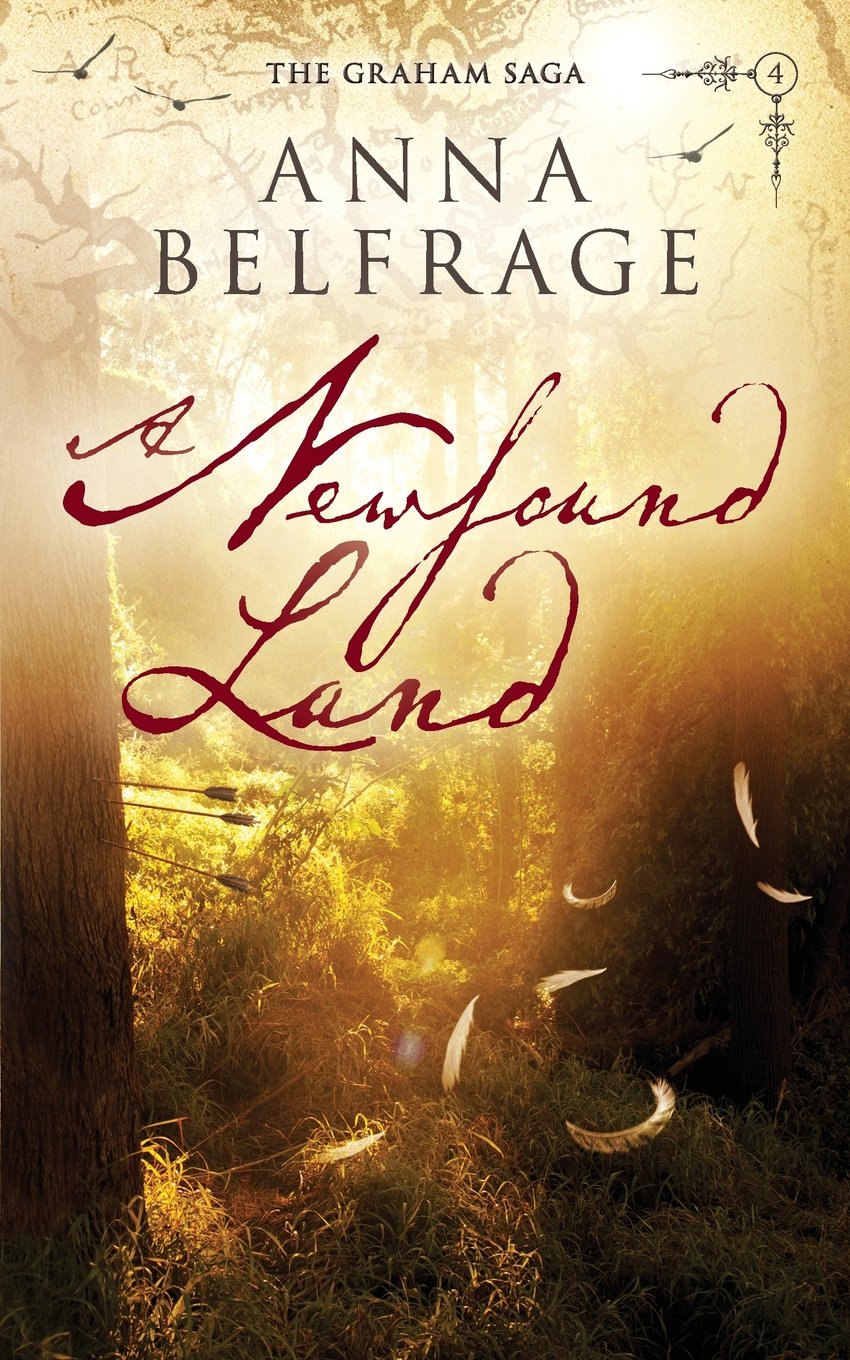
A Newfound Land by Anna Belfrage~

This intriguing review indeed prods readers to discover The Graham Saga for themselves. Like many others who have told us they read the novel as a stand alone but were so drawn to the story they had to read all the others in the series, we are pretty confident you, too, will want to catch up with the Grahams. 

*********
A Newfound Land is Anna’s fourth book in the time-slip series of The Graham Saga. The story continues, and although is complete in itself, Anna weaves the salient points from the other three books seamlessly into this one so that the reader is kept fully up to date of past events. Having said this, I was so involved with the story that when I had finished I just had to buy the other three books just to flesh out those episodes alluded to in the fourth book.


First of all I would like to say that I like the cover to A Newfound Land. The font looks as though it has been written with a quill pen or a dip-pen, and the background picture shows arrows, feathers, and to the top a shadow of a map of what I suspect to be of ‘the new country’ all in sepia tones as if aged. Book covers matter and should be relevant to the book, and this one is perfect, as with all Anna’s covers.

The story starts with the Grahams in the ‘new country,’ having left Scotland because of religious persecution. Matthew is devastated at having to leave Hillview in Ayrshire, the family homestead for generations. Their new home, after nearly four years, is still incomplete, a work in progress. Their nearest neighbour is ‘well over an hour’s ride away.’ The Grahams have been here since 1668 cutting down virgin forest to build a home and make ‘several sizeable fields and pastures, a respectable kitchen garden…’ Anna has a special way of describing the surroundings for the Grahams so that the reader can be placed right beside them. So much so that you feel almost like you are eavesdropping on their private lives in the telling of the story. 

I like the way that Anna has Alex using her 21st century language with Matthew; for example from the very beginning there is the use of the word ‘okay’ which eventually the family uses as common parlance. At one point in the story Alex says, ‘I feel like a teenager…’ and it is only then that you realise that it is an alien expression for that era. When I realised this I had to look it up and found that the word was not really in existence or use until the early 1940s as sited in The Popular Science Monthly in the United States. 

1941 Pop. Sci. Monthly Apr. 223/2, I never knew teen-agers could be so serious. (Taken from the Internet). 


It’s this kind of detail that makes Anna Belfrage’s novels work so well. Time-slip is a fanciful thing, but her book challenges your thinking on this and makes it totally believable. She makes the reader aware of the uncertainties, the traumas, the loneliness that comes with populating a ‘New World’. For all that, you find yourself admiring the tenacity of the Grahams to carve out a home and a life for themselves and their children. I also like the way that Alex’s free modern day thinking is challenged by Matthew, as it is only he who can name each child that they have. It is he who is in charge of their spiritual life. 


Matthew has a clergyman temporarily staying in their home to teach their children the Bible and general education. Alex is put out by this, especially when the clergyman, Richard Campbell, belittles her in front of her husband and children after she tells Campbell that he is wrong. He then tells the children, ‘Your mother has no idea what she’s talking about; she’s a woman.’ And, ‘Man is set to rule over woman on account of his intellect and spiritual strength. Women are more prone to be taken over by the devil, seeing as they’re weaker souls.’ This causes a rift between Alex and Matthew as he doesn’t defend her. We feel her betrayal as Matthew refuses to back her up in front of their children. Will they ever heal their rift?

Click  to continue reading...