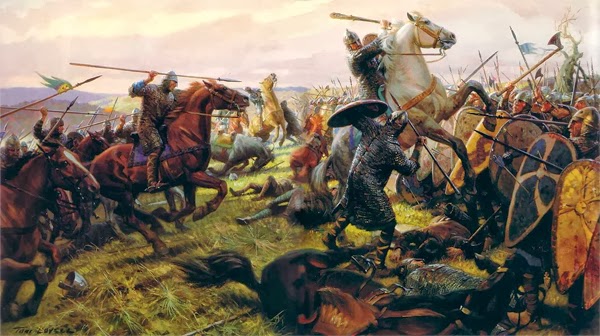
Standing along the ridge where 947 years ago thousands of men, pressed tightly together, stood locked in a shieldwall of death. I close my eyes as I listen to the narrator telling the story of the battle that took place here almost a thousand years ago. I hold the little electronic guide closely to my ear so I don't miss anything and listen in awe as within me a shiver runs through and I imagine myself there among the pandemonium of it all; the heaving, the shoving, the yells and the screams of the dying; the whoops of those whose spear aims have met their targets. I have always had a good imagination and it doesn't take much for me to picture the scene in my minds eye. I have been to the battlefield at Battle Abbey many times and I am never tired of the place. I am drawn to it, like a moth drawn to a candle. Ever since I went there to watch a re-enactment of the Battle that took place there back in 2005, I have wanted to revisit time and time again as if by doing so I could change the course of what happened that day. I don't know why, but I am often so inexplicably affected by the trauma of that day that I cannot explain why in any rational terms. Sometimes I wonder, if re-incarnation were possible, if my spirit had been there when it really happened.Of course I don't believe in such things, well not really...but its uncanny that I am filled with a multitude of different emotions every time I go there.
And so on this day, to pay my respects to all those men who died there for what they believed in, I have revisited the battle site and as I am here, the voices of those who fought here that day, echo down the winds of time, willing their story to be told. But their story does not start or end with William's victory that day, it starts long before that. What happened that caused that great battle to happen; The Battle of Hastings? Why did William of Normandy, commonly known as William the Conqueror or William the Bastard, choose to embark on such a massive venture, taking an enormous gamble to risk so much for the crown of England. What made him think that he had that right anyway? Why did Harold supposedly 'usurp' the throne from its rightful owner. Why did he not support Edgar the Atheling's claim to the throne? Why didn't Edward officially nominate William as his successor and why did the Witan support Harold's claim?
To answer all these questions one needs to examine the back-story. But where is a good place to start? For me, I think 1051 is as good a place as any.
1051
King Edward, approaching his 50's has sat on the throne now for 9 years and is beginning to make in-roads in distancing himself from the influence of Godwin, the canny and powerful Earl of Wessex. Edward has never been able to forgive his leading Earl for the part he played in the death of his younger brother Alfred, even though Godwin has been found innocent of any wrong doing under oath. Edward's long time friend, Robert Champart of Jumieges, the newly appointed Archbishop of Canterbury and Godwin's sworn enemy, finds it easier and easier every day to poison the King's already festering mind, with evil against the Earl.
The Earl of Wessex, he whispers into Edward's ear,
killed your brother and now he is going to kill you. The Archbishop wants Godwin out of the way so he can exert his influence over the king without any impediment.

Now Into the scene comes Edward's dear departed sister's husband, Eustace of Boulogne, that little French province of which he is count, and a plot is devised - or so it appears - to oust Godwin and his family from power. It seems that there is more than one person who might benefit from the Godwinsons' departure from power, for they are on the rise, with 2 of his sons in Earldoms of their own and 3 more waiting in the wings for their own. Eustace and his men cause havoc in the town of Dover on their way home from a visit with the king. Dover is in Godwin's jurisdiction. A fight ensues between the men of Dover and Eustace's men because the townfolk are outraged at the Frenchmen's arrogant demand for food and lodging. They probably have neglected to ask nicely. A comparative amount of men on both sides are killed due to the fight and Eustace and his men scurry back to the king to tell tales on Dover. Godwin is summoned before a disgusted King Edward who demands that he punish the Doverians by burning it to the ground. Godwin naturally comes down on the side of his town after hearing their side of the story and refuses. After a stand off with the king, Godwin and his sons lose the support of his own retainers because the other mighty earls of the realm, Earl Leofric and Earl Siward back the king against them, not wishing to engage the realm in a civil war. The Godwins are given 3 days to leave the country or they will be killed on sight. Godwin, his wife and 3 of his sons and his daughters flee to Flanders and seek asylum from Count Baldwin in St Omer. Godwin's second eldest son, Harold and his younger brother Leofwin take a ship to Ireland to seek assistance from the king there, MacDiarmitt and Edith, Godwin's daughter, married to King Edward, is eventually sent packing, unceremoniously, to a nunnery.
Meanwhile, during their exile, according to the Anglo Saxon chronicle, across the sea from Normandy comes Duke William. There is little other evidence for this visit, but later, the Normans will claim that it was then that Edward offered him the heirdom to his crown. Whether or not this actually happens remains a mystery, but it seems to fit plausibly with what happens later.
Something along those lines must have taken place, otherwise why does William go to all the trouble to invade in 1066. He must have some reason to believe he was offered the crown. He didn't just pluck the idea out of nowhere. However, Edward knows that offering the crown is not his prerogative. Custom and practice dictates that English kings are permitted to name and nominate their heirs, but a number of members of the royal family are considered
'atheling' - meaning throne-worthy. It is up to the Witan to elect the future king, by approving the king's nomination or not.
So, with this in mind, I am inclined to believe that if he makes that journey to visit his cousin, William may be advised by Edward that he will consider supporting him when the time comes for him to nominate his heir. In return, perhaps William will promise to stop allowing Viking raiders to launch their raids upon England from his ports.
It seems that this idea was more likely to have been supported by Edward's Norman courtiers rather than the English. Edward had brought a few Normans with him in his entourage back in 1041 when his half brother King Harthacnut had invited him to come home from exile in Normandy. They would not have been very popular with the English, especially if they had been promoted into positions of power at the expense of the native born English, even the Anglo-Danes. So, would the English courtiers have been happy with this arrangement the king might have made? I think on the whole, probably not, otherwise later, why would the king have approved a search by Bishop Ealdred to find his nephew, Edward the Exile, who was the only apparent living relative alive with the Royal blood of Wessex, apart from perhaps the king's sister's sons, Ralph and Walter, essentially Normans themselves?
The duke did not have any Royal Wessex blood and had no real claim. He had no interests in England, no land, or property. His only connection with Edward was through his Great Aunt Emma, who was Edward's mother, making him a second cousin to Edward. But Robert Champart, Eustace of Boulogne and the other Franco/Norman conspirators were obviously pro-William and most likely could see themselves flourishing in an England under a Norman king's rule, and at this time as the chronicles show, Robert, now Archbishop of Canterbury, was a big influence over Edward who would have relished any plot to oust Godwin from his life. But in a few months, Robert and his cronies' reign of power was soon to be over and regarding plans for William, was soon put on the back burner. Within a year of his exile, Godwin and his family were back, a whirlwind of destruction as they burst their way, hurricane-style, sweeping across the Channel to land back in the kingdom again. Robert and his friends flee back to Normandy, taking with them the young hostages that Godwin had been forced to provide during negotiations with the king before exile; apparently for William, as surety for Edward's promise to him of the heirdom.
1056
Ealdred, Bishop of Worcester since 1046, served Edward for many years as a diplomat and a military leader. He was also a friend to the Godwins for many years. His influence was not just confined to England and he was a well travelled man, including a trip to Rome, perhaps more than once. Edward approved his visit to Germany to try and locate the whereabouts of Edward's nephew, Edward the Exile, who was the son of his older deceased brother, Edmund Ironside and King of England for a short reign. This was so he could be brought back to England, to formalise him as a Royal
Atheling. A title that seems to never have been bestowed upon William. Ealdred was gone for some time, around a year or so, but he eventually returns home to court without the Exile but divulges the whereabouts of the king's nephew at the court in Hungary. Problems abroad have prevented Ealdred in reaching Edward the Exile in Hungary, but at least they have knowledge of his existence and where he can be found.
1057
Harold Godwinson, now Earl of Wessex since his father died in 1053, was definitely abroad in 1057 and may have been part of the expedition that took place to bring Edward the Exile and his Hungarian family home to England. Edward the Exile was referred to as such because when his father, Ironside, died of wounds he sustained in battle fighting Cnut's forces, he was sent, with his mother and his brother Edmund, to King Olof of Sweden's court by Cnut, to be disposed of. Instead of carrying out Cnut's wishes, they were secreted away to Kiev and somehow Edward ended up at the court of King Stephen in Hungary. Edward the Exile returned to England in this year and with him came his wife Agota, a Hungarian noble lady, his two daughters Cristina and Margaret and his infant son, Edgar, who was later to become Edgar the Atheling. Margaret later became the wife of King Malcolm III of Scotland.
Unfortunately, Edward the Exile died within 3 days of arriving in England and never got to meet the king. The Chronicles suggest that this might have been contrived, that perhaps he was prevented from seeing his uncle and, although not directly stated, murdered. There is no evidence to say that he was, but they do not mention the cause of his death. Some historians have suggested also that this might have been the doing of the Godwinsons as they were on the rise and that Harold had already had his eye on the crown. Again there is no evidence to point the finger of murder at Harold or anyone for that matter. One can, however, imagine that rumours would have been rife, especially given the circumstances of Edward's death.
From then on, little Edgar, probably around 5 years old at the time, was known as the
Atheling and proclaimed throneworthy because of his royal blood. He and his sisters and mother were no doubt taken into Queen Edith's care and Edgar would have been nurtured as any Royal Prince would have been.
1064
By this time, Harold Godwinson was practically running the country. He had the title of
subregulus, Latin for deputy king. He was also titled
Dux Anglorum. It was he who had been leading most of the military operations: Harold and Bishop Ealdred led the expedition into Wales, following the Welsh King Gruffudd and exiled Lord Alfgar of Mercia's attack on Hereford, which the king's nephew, Ralph de Mantes, then the Earl of Hereford, had failed to repel.There may have been some following incursions by Gruffudd and Alfgar and a contingent of Norsemen in 1058 which again Harold would have led the forces against. The English chronicles are vague about this occurrence but the Irish Annales describe it as a massive attempt to invade by Magnus of Norway with the Welsh and Alfgar's alliance. In 1063, Harold and Tostig twice led invasions into Wales and devastated the country, possibly after finally losing patience with Gruffudd; the Welsh themselves put an end to their leader after the terrible punishment inflicted by Harold's army. They sent Gruffudd's head to Harold who presented it to King Edward.
Titled
Dux Anglorum, Harold was by all intents, the second most important and wealthiest man beside the king, in England. He was pretty much in charge as, Edward, politically weak, was ineffective compared with the power that Harold had. Wealth and land meant having plenty of retainers and Harold had plenty of all of those things. He was extremely powerful and he had three brothers, all earls too.
In 1064, for some unclear reason, Harold decided to take leave of the king and travel to Normandy. There are two versions of course, as to the reason why Harold did this. Version 1 comes first and as we all know that old adage;
"history is always written by the victors" is quite relevant here
. Norman
Chroniclers
William de Jumieges and William of Poitiers have both asserted that Edward sent Harold to Normandy around this time to confirm that William would succeed to the throne upon his death. Version 2, the English version, was written by Eadmer, a monk of Canterbury, though written some years after the battle, when it was probably more safe to do so. Eadmer asserts that Harold went to Normandy to try to negotiate the release of his brother Wulfnoth and his nephew Hakon, against his king's advice or wishes; Edward told him that
'nought good will come of such a journey'. Unfortunately, Harold's indifference toward his king's advice was to lead to his eventual downfall. Harold wanted the release of his kinsmen, who had been hostages in Normandy since Robert Champart had left London for Normandy with them, back in 1052. The Normans would say that the boys had been sent with Edward's permission to the duke as surety that he would keep his promise of the giving the throne to William. Perhaps this is so; Edward may have been expecting Robert's return to England, but it was clear in a few years, that any negotiations that had taken place with William were going to disappear into the ether as far as everyone, including Edward, were concerned.

Both these versions can be followed in the Bayeux Tapestry. The Tapestry can, whichever theory one chooses to follow, be interpreted to allude to both. It is my opinion that Eadmer's version is the correct. I do believe that Harold, though probably a very foolish idea, went with the purpose of retrieving his brother and nephew. Why at that time and not earlier is a question that is not answerable, for there is no information on the workings of Harold's mind in the years leading up to the Battle of Hastings, unfortunately. Edward would have known William reasonably well, for he had been in Normandy as an exile when the duke was growing up. I do not believe like some people do, that he had promised the young duke the kingdom before he left for England, for there was no way of him knowing that he would ever have been king, especially as his brother, Harthacnut was only 24 and likely to live on and beget heirs of his own. And the boy-duke's father before him had not been that supportive of Edward regaining his kingship so there was no need for him to feel particularly grateful to the young Duke William as some have suggested. If anything was said between them, I believe that it might have been the sort of child-friendly conversation that an older relative might have with a younger relative,
"Oh sure, one day if I am king..."sort of thing. So Edward probably knew that William, when he wanted something, didn't stop until he got it. After all, why should he be content with a small corner of France when he could have a whole kingdom? And who better suited to be king than a man such as he? He had been base born, he wanted to redeem that feature of his life and all those who had mocked him for having been born a bastard and made disparaging remarks about his mother's family would soon be laughing on the other side of their faces when he was King of England!
So Harold falls into William's clutches in Normandy. Having rescued him from Guy de Ponthieu as he is blown off course in his ship with his men, William has the eminent earl where he wants him. William will not let Harold go back to England until he has sworn fealty to him, making him his vassal. William disregards the fact that the Earl of Wessex, equally as powerful in his own country, if not more, cannot be made his vassal, but Harold sees no other way out. If he doesn't agree to kneel before the duke, he and his men and his kinsmen, will never go home. And according to an old church law, an oath given under duress, such as Harold is made to make, can be rescinded at a later date when safe to do so, much like making a promise with one's fingers crossed.
So Harold returns to England, with only one of his kinsmen, Hakon, who would have been about 17 or 18 years old. Wulfnoth, his brother, would be reunited with his family when William was king. Edward, is not amused and according to Eadmer tells the earl,
"I told you so."
1066
Edward lies dying in his palace at Westminster. With him are his closest companions; Robert FitzWimarc, Edward's kinsman and standard-bearer who is also related to William of Normandy; Edith, his wife and queen; Archbishop Stigand and Harold Godwinson. Even the Norman chronicler admits that here, as Edward draws his last breath, Edward declares that he leaves his wife and his kingdom in Harold's care. It doesn't really make any difference anyway, and we might be forgiven in thinking that this is an afterthought from the Godwinson's spindoctors, because it seems that from the haste with which Harold is crowned, the Witan and everyone involved have already decided that Harold is to be the wearer of the crown now.
When William hears about his good friend Harold usurping his crown, he is enraged. In fact enraged doesn't cut it. He is incandescent with such anger that he cannot speak. That crown is his! Harold swore on holy relics that he would support him and would pave the way for him. William doesn't rest on his laurels. He gathers all his vassals and all those who answer his call for aid, promising them great rewards if they will enter into this great venture of his to England.
"You'll never do it," some of them say. William is determined to prove them wrong. He goes off to the Pope and acquires the Popes approval and a Papal Banner. Harold is an oath-breaker and a usurping devil! His good name is dragged through the mud; he is a fornicator, a robber of churches and stealer of lands among many other dastardly deeds. He, William, is a devout and just man. Edward promised him the crown and therefore he will just have to go and take it from the usurper.
William, convinces all that this is a project worth undertaking with promises of lands a plenty in England - lands, I might add, that are not his to give. There are plenty of landless knights in Normandy and the offer of wealth, territory and a possible position in the new regime, is all it takes to change any skeptical minds. He sets about building a flotilla, large enough to carry ships, arms and prefab castles and men, thousands of men, and horses. This is a major undertaking and one has to admire the determination and the courage of the man. He is, no doubt, a remarkable man.
Meanwhile, Harold stands down the fyrd for Harvest time. The men that have been watching the coast for signs of William's coming can not be held upon to do more than their fair share of fyrd duty and he has kept them beyond the 2 months required already. Seeing no sign of the Normans (he knows they are coming having sent spies abroad to investigate) he breathes a sigh of relief, but before he knows it, his brother Tostig, exiled after they fell out in 1065, invades Yorkshire with Harald Hardrada. Hardrada has his sights set on being King of England and Tostig has found him a useful ally who promises him his lost earldom back. Hardrada and Tostig defeat the northern earls, brothers Edwin and Morcar at Fulford Gate. When Harold hears of this invasion, he marches north with his household guard, the Huscarles, and collects armies from the counties along the way. As king, he is entitled to call on the national fyrd in times of crisis and this, is a time of crisis! Harold surprised them, their steel glinting in the sunshine as they come upon the Norse army and surprise them whilst the unsuspecting Norse are sunning themselves in the fields at Stamford Bridge without their armour, waiting for the York townspeople to arrive with the hostages promised to them after their victory at Fulford. Harold's army defeat Tostig and Hardrada, both men dying during the battle. Harold hardly has time to rest when word comes that William and his troops have landed along the Sussex coast and are burning the lands thereabouts, including Harold's manors.
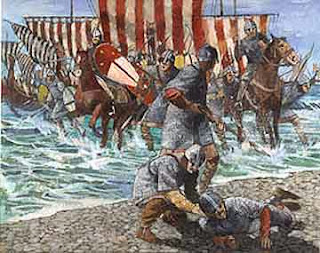
Harold and his tired huscarles are forced to march south, this time to face the invading Frenchmen. This time, on the way down south, he gathers the fyrds of the shires and the counties that did not march north with him to Stamford. It is a different army that comes south for the Battle of Hastings. But it is Harold's own men who are the worn and tired soldiers that fight and die with him.
14th October 1066
So William and Harold's men face each other, 9 hours past midnight. William's are at the bottom of Telham Hill and are looking up at Harold's shieldwall along the ridge on Caldbeck Hill. They have to get their horses up that steep incline to where the solid wall of men, all baying and calling out for their blood, stand rigid on the hill. Several times they are repulsed as they fight their way up toward them. Several of them are killed by the spears and the huge Dane axes that can cut the heads from their horses, cleave the men also that are riding them. The air is filled with voices shouting in French and English and possibly Latin.
"Dex Aie!" shout the Normans and the French. It means
God aid us!
"
Holi Cross!" shout the English,
referring to the piece of the real Cross that was said to have been ensconced in Harold's church at Waltham.
William is fighting for his life. He is trapped there, boxed in with only the land between him and his ships. If he loses today, he is a dead man. Harold, known for his merciful treatment of his enemy, will make an exception for him, he is sure. He
has to win today. He cannot lose! But at first, the battle looks to be going nowhere. His men are repulsed by the ferocity of the English and the horses cannot break the shieldwall.
Harold orders his men to keep the line. They must not break it at all cost. He is in the centre of the crush with his standards, his fighting man and the Dragon of Wessex fluttering high in the breeze. Sworn to protect him are his household guard, around 300 of them. His bothers Gyrth and Leofwin are also there with their own huscarles. These are the highly trained professional warriors, the men with the Dane Axes. Gyrth and his mother Countess Gytha have tried to persuade him to wait until the resting fyrd could make the journey south to join them, after they have recovered from Stamford Bridge and Fulford. Earls Morcar and Edwin should be coming to their aid any day. When Harold refused to wait, his brother Gyrth begs him to allow him to fight in his place until the rest of the army comes. Harold refuses and it is reported that there is a touching scene where Gytha, Harold's devoted mother, clasps his leg, imploring him not to go and he kicks her away in anger. It is a matter of honour that he fights and not anyone else on his behalf; and if God decides that he should be the victor or the loser, so be it. It was in His hands.
Just when William, who also has two of his brothers with him, Bishop Odo and Robert Mortain, is thinking that victory might escape him, he is unhorsed three times, each time commandeering a horse from one of his knights. The Frenchmen, Bretons and Normans hear that he has been killed and they begin to turn around, cavalry and footsoldiers alike, bowmen and crossbowmen too who have been raining arrows up hill all day uselessly, all turn to run for their lives. But Odo, William's brother calls their attention to his brother who has lifted his helm back off his face so they can see it is him.
"Look at me! It is I, your lord and I am alive!"
He rallies them back, shouting that he will kill them if they desert. Seeing he is alive they regroup and the battle is back on.
Then come the feign retreats. The cavalry look as if they are retreating and the English start to run down the hill toward them thinking they are going to rout the invaders. But the Cavalry see that the English have broken out of their lines and encircle them, cutting them down without mercy. This happens again and Harold must look on with despair in his heart, shouting for his men not to break their lines and remember his orders. But they do not listen. It is around this time that both the king's brothers, Gyrth and Leofwin are killed.
The battle continues and dusk approaches. The English shieldwall is depleted but standing strong, still. William is almost despairing of getting the break he hopes for and Harold is praying that the wall will hold until darkness falls, when the fighting will have to stop. William tells his archers to shoot up high in the air so that the arrows will come down at a different gradient and hopefully catch the English at a better angle. This works! A barrage of arrows rain down on the English catching them as they involuntarily look up, hitting them on their shoulders, the exposed parts of their faces, their heads, those without helmets, in their throats. The school of thought has often been that Harold was hit in the eye with an arrow. I do not believe that this happened. This is was what happened as the
Carmen de Hastingae Proelio states: William spies Harold fighting for his life with his body guard and with the lines breaking, he gathers four of his knights and they target him, spearing him in the throat, cutting his leg off at the thigh, emasculating, disemboweling and beheading him. Around him, his huscarles die with him, the men who have fought so hard to save him and keep him alive. It was in the English mindset of the time, that they should die with their lord and this is remarked upon by the foreign invaders, that their loyalty and honour is their downfall.
As Harold dies in the blood and the slough, the battle is lost. A few men, late comers perhaps, valiantly try to make a stand on a hillock but are eventually chased to their deaths like the other survivors who run into the forest in the hope of escape as the dark comes down.
William can now dare to be victorious
as around him, the flower of the English nobility lay in tatters
So we have examined the events leading up to this great battle and now know something of why the battle took place. William believed he had been promised the crown, I am in no doubt about that, but he was an arrogant man and would not have given English laws or customs any consideration when Harold's messages came back to him. That the majority of the English did not wish for a Norman to rule, I also have no doubt by the amount of men who turned out for him that day; there were many more on their way also, I do believe. The English wanted the right to choose their own king and William could not understand that concept.
William did not conquer England on that day, Saturday the 14th October 1066. It took him at least 5 more years putting down rebellions, notably Hereward's rebellion, Edgar Atheling's, and Eadric the Wild's. Even the sons of Harold had a go at invading from Ireland, but they did not have the power their father had.
William was fighting for a crown he believed was his. His followers were fighting for the promise of wealth and land that was not theirs. The English were fighting for their homes and a system they themselves had created. They wanted England to be ruled by an Englishman. The year had started off well for Harold. He was regarded well in contemporary sources. A fair man, a just and good king. He too had faults, he was ambitious and wanted power. He had a distinguishable career and at the time that Edward had died, there was no other choice but him for king. He was the obvious choice. He was powerful, he had noble blood and he had the experience that the young Edgar lacked to face the Norman duke. He could have supported Edgar's claim, acted as regent, but if I had been him, I would have felt like I'd earned the crown.
What happened on that day happened as it was meant to. We cannot change the past, although it often haunts us and the
what ifs and the
if only's will call to us in the signs that our forebears leave us in the landscape and in the ancient ruins. Their voices echo to us like whispers in the wind, blown through the pages of the history books; and the hidden secrets that mingle with the lies and the untruths are what keeps us looking for what really happened.
Bibliography
Barlow
F (1997) Edward the Confessor by (2nd ed) Yale University Press, US.
Harvey
Wood H (2008) The Battle of Hastings: The Fall of Anglo-Saxon England, Atlantic
books, London.
Rex
P (2009) 1066: A New History of the Norman Conquest, Amberley Publishing,
Gloucs.
Stenton
F (1997) Anglo Saxon England (3rd ed) Oxford University Press, US.
Swanton
M (2000) The Anglo Saxon Chronicles (2nd ed) Phoenix Press, US.