Saturday, 18 October 2014

Lisl's Bits and Bobs: Great Land History: The Legend of the Sleeping Lady

Happy Alaska Day!!

Great Land History: The Legend of the Sleeping Lady

October 18 is set aside each year to celebrate in the Great Land the transfer of Alaska from Russian to American governorship. When the date falls on a Sunday the official celebration is the following Monday. If the 18th is a Saturday, as is the case this year, Friday does double duty in celebrating both the end of the work week and raising of the American flag over Alaska for the first time on October 18, 1867, in Sitka. It is marked by parades, dances, costume balls, memorial services and other festivities to commemorate the anniversary.

People will also be talking about and re-visiting in various ways all things Alaskan. In the case of Anchorage one subject frequently on the residents’ radar is the Sleeping Lady, who rests within sight of their shores, a little over 30 miles across Cook Inlet.

Sacred to the local Dena’ina people, Dghelishla, little mountain, also bears an English name, Mount Susitna, from the nearby river with the same name, Tanaina for sandy. To the Dena’ina, she is connected to the mighty peak Dghelay, big mountain, known to Alaskans as Denali, Athabaskan for The Great One.

 No one can say for sure how or when the legend of Sleeping Lady started, and elder and storyteller Shem Pete did not perceive it to be part of his people’s traditional legends. What is known is that about five million years ago, melting glaciers crushed solid rock, eventually forming a mountain over 4,300 feet high and 13 miles long. The resulting sculpture strongly resembles a woman in repose, her long hair streaming behind her as she lay in slumber. 

It has been speculated that prospectors seeing Susitna as a woman brought her story to life, but whatever the case, as Ann Dixon writes, it continues to be told far and wide, including amongst Athabascans in the Tyonek area today. Dixon sets the story down in her children's picture book, The Sleeping Lady.

*********
********* 
 
In a warmer time than it is in Alaska today, when woolly mammoths and saber-toothed tigers peacefully shared the land with fruit trees and the gentle people of what today is known as the Cook Inlet area, a boy and a girl were in love and planned to marry.

The day before Nekatla and Susitna were to wed, a stranger burst into their village, wildly warning about warriors from the north who left a trail of destruction: murdered kinsman, plundered lands, houses set to fire.

The villagers gathered and spoke of many ideas, but it was Nekatla’s plan that was eventually adopted. Wanting to preserve the peaceful ways his people had enjoyed for so long, his proposal entailed meeting up with the frightful warriors, bearing gifts instead of weapons, and persuading them to live in peace. The villagers agreed and all the men prepared for departure on the morrow.

The next morning, rather than being unified in marriage, Nekatla and Susitna bade each other a sad farewell, with promises nonetheless:

“We will be married as soon as I return.”
“I will wait for you at this very spot.”

And so Susitna waited at the same spot she promised Nekatla she would, a hill upon which the pair had previously spent many happy hours. With the baskets she had collected, Susitna gathered fruit until the day became spent. When the daylight marked the second morning since Nekatla’s departure she wove more baskets. On the third day, certain her beloved would return at any moment, she sewed, keeping an eye for his arrival.

Susitna waited, though each day seemed longer than the last, and in this way many days and nights passed, alas, still with no Nekatla in sight. Weary of her tasks, her imagination feeding possibilities regarding the men of her village, Susitna lay down to sleep, but only for a moment. 

*********

"Nekatla was brave."


This was reported from a boy who had escaped what became a slaughter, initiated with a spear thrown by one of the northern warriors. The Inlet men had tried to defend themselves, but the fearsome attackers set upon them, unrelenting until all were perished, even some of their own. 

Wakening Susitna to tell her of the horrible news did not bear thinking about, and so the women of the village wove soft grasses and wildflower blossoms into a blanket and gently laid it over their sleeping sister. 

That night all warmth and joy left the village. As the air grew colder and colder, Susitna settled more deeply into sleep. 

All around her, the fruit trees froze and died, falling like the men in battle. 

The tears of the villagers gathered into clouds, and, in the chill air, returned to earth as Alaska’s first snowfall.

And so the time went.

Days, weeks, months, years, hundreds at first, then thousands, passed. Warmth eventually returned to the land but only for a brief period each year. New animals and even people, though not giants like the Inlet people, came to settle the land.

*********
*********

The Lady slumbers beneath the aurora borealis

And now here, too, are we, and we see what the settlers saw, and now has passed to us. In our snowy country called Alaska there lay a watershed, near which rests a mountain called Susitna, but that we know is really the slumbering form of a woman dreaming of, waiting for, her beloved. The seasons come, they go, and still she waits. We call her the Sleeping Lady or, simply, the Lady. 

In the winter when we look across the Inlet, she can be seen beneath a thick, snowy quilt. In summer she rests beneath the flowered blanket laid upon her form so long ago by her people, unable to bring grief to the girl so in love. 

Now our people say that Nekatla shall one day return. War will cease to ravage the land, peace once more shall reign, and on that day, Susitna shall awake and be re-united with her beloved. 
 

Thursday, 16 October 2014

Searching for Lincoln's Ghost

Searching for Lincoln’s Ghost by Barbara Dzikowski
Review by Anna Belfrage

Remember to see below for details about the giveaway!!!

Some books touch you so profoundly it is with regret you reach the end. Searching for Lincoln’s Ghost is one such book, a reading experience that starts in a cemetery and ends in the same cemetery, but in between I have been treated to a beautiful, heartrending story that will stay with me, I believe, for the rest of my life.

Ms. Dzikowski is an accomplished writer, delivering her story in flawless prose. Her dialogue, her descriptions – they are excellent, transporting me to the late sixties in midwest America, a mere two hour drive from Abraham Lincoln’s home in Springfield, Indiana. Here, in a town called Castalia, lives Andrea Powell, an eleven-year-old girl who is about to start sixth grade at the nearby Lincoln Elementary School.

Andrea – or Andi, as she prefers to be called – is an orphan, and ever since her parents died six years ago, she’s been hoping that somehow God will give her a sign that there is a life after death. So far, there’s been no such sign, so Andi is pinning her hopes on this, her last year at Lincoln Elementary School. After all, there have been two sightings of Abraham Lincoln’s ghost there, and Andi hopes she will see him too, thereby verifying that there is some sort of existence beyond the grave.
Ms. Dzikowski delivers her story as a reminiscence, that is to say it is the adult Andi that remembers this momentous year in her life. This allows the adult to comment on events with far more insight than a child would have, thereby giving the narrative both philosophical depth and a haunting nostalgia.

Andi’s first day at school turns out to be quite catastrophic – at least for an eleven-year-old. The principal has decided to shake things up a bit, and so Andi ends up in a new class, with a new teacher. Even worse, her new classmates are among the slowest – and meanest – students, and where Andi previously enjoyed going to school, now she sees it as some sort of jail sentence, always on her guard.

Into this dreary existence comes John Malone, the new boy with caramel coloured hair that he wears long – like the Beatles – and eyes that have Andi’s heart stuttering to a surprised halt. Just like that, Andi has fallen in love. John, however, seems less than impressed with her, and in general keeps his distance.

Ms. Dzikowski does a fantastic job in presenting her child protagonists. Hovering on the brink of adolescence, Andi and John are complex creatures, torn between the children they are and the adults they will become. In John’s case, there is also something very dark smouldering inside of him, a wariness that has him rebuffing any friendly advances. John no longer trusts people, but Andi is too young to understand this and is repeatedly hurt.

The descriptions of Andi and her classmates will have most of us smiling in recognition – if somewhat crookedly. The class bully is as despicable as all such bullies are; the star pupil shines as much as all such pupils do. And in between we have the normal kids, the girls who twirl their hair around their fingers, the boys who test the teachers’ patience. They are wild, they are curious, they are downright mean at times, and clumsily kind at others.

Not only does Andi have to cope with her new class, but things in Castalia are further complicated by the racial tensions of the time. Once the school day has ended, the white children return to their neighbourhood, the black kids to theirs – that is how things are ordained. Until Ezra comes along, that is.

Wonderful, wonderful Ezra… a black man who has seen his entire family die away from him – through racial violence, through broken hearts, through childbirth – Ezra still has hope. He believes in the curative power of love, and in his shop kids of all races are welcome, gawking at the best candy selection in town. John gravitates towards him, and where John goes, so goes Andi.

With Ezra, Andi can talk about all those questions she can’t talk to anyone else about – mainly about God and the afterlife. Through Ezra, Andi begins to understand just why the class bully is as she is, and how important it is to try to meet hate with love. Not that she always understands what Ezra is saying, but his words bring her comfort all the same, and his quiet certainty that there is a life after death makes her all that more determined to find Lincoln’s ghost.

In her search for Abraham Lincoln’s ghost Andi finds an unexpected ally in John. Where Andi hopes this quest will lead to hand-holding and her first kiss, John makes it clear he is more interested in ambushing the ghost – or rather in discovering just what or who is making those strange sounds Andi has heard. Of course, there is no ghost. Instead, Andi and John stumble upon a secret that will have far-reaching consequences.

Life is rarely blessed with Happily Ever Afters – no matter that we really wish it would be. The racial tensions explode, the budding romance is crushed, and all we are left with is hope. Hope that there is something waiting for us on the other side, hope that someday the world will be a fairer place. The same kind of hope that drove Abraham Lincoln all those years ago to attempt to build a better society. The same hope that has Ezra telling Andi that “after winter comes spring”. And it does, doesn’t it? Every year, spring returns – which is why, of course, we must never give up on hope.
Right at the end, Ezra recommends Andi to read Khalil Gibran’s The Prophet. In many ways, Searching for Lincoln’s Ghost is as full of wisdom as this little classic. Ms. Dzikowski has written a beautiful novel that has touched my heart. I am sure Andi, Ezra and John will touch very many other hearts as well.

The author has so graciously reserved a copy of Searching for Lincoln's Ghost as a giveaway. For your chance to win, simply comment below or at this entry's associated Facebook thread!

About the author: Barbara J. Dzikowski earned an undergraduate degree in philosophy and a graduate degree in counselling from Indiana University. These areas of study fuel her desire to create fiction that closely examines the human heart and its complex search for love and meaning. Fascinated by the passion, idealism, and lost hope of the 1960s, she is putting the finishing touches on her second novel about two families struggling with the changes and uncertainties of that decade, with a particular focus on the cataclysmic year of 1968.

Searching for Lincoln’s Ghost is available on Amazon and Amazon UK.

*********

Anna Belfrage is the author of six published books, all part of The Graham Saga. Set in the 17th century, the books tell the story of Matthew Graham and his time-travelling wife, Alex Lind. Anna can be found on Amazon, Twitter, Facebook and on her website. If you would like Anna to review your book, please see our submissions tab above.

Tuesday, 14 October 2014

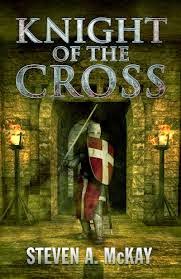
Review of Knight of the Cross by Steven A. McKay

Knight of the Cross by Steven A. McKay
Review by Stuart Laing

Please see below for details about the giveaway!

Scottish author Steven A. McKay has quickly established himself as one of the rising stars in the ranks of British independent authors with his Forest Lord series portraying a fresh new vision on the timeless story of Robin Hood.

The two novels he has published, Wolf's Head and The Wolf and The Raven, swept the reader on fast paced, tautly woven plotlines through the towns and forests of medieval England. Familiar names mix smoothly with new characters in adventures aimed at mature readers where the language can be as robust as the action. Life was cheap at times in 14th century England and the books reflect that fact with an unflinching portrayal of a grim past. However, McKay does not allow the gritty violence to bog the stories down in a relentless recital of death and suffering; there is love, laughter, music and the enduring qualities of true friendship which triumph for our heroes. It is this smooth combination of light and dark which makes the Forest Lord series so enjoyable and it is a combination which he brings to the novella Knight of the Cross.

The story opens in 1309 on the Greek island of Rhodes where the Knights Hospitallers are investigating the disappearance of three of their numbers. Sir Richard-at-Lees, a name familiar to those who have read the Forest Lord series, is ordered by Foulques de Villaret, Grand Master of the Order, to travel to the village of Sgourou with only his trusted sergeant-at-arms Jacob by his side. Together they must get to the bottom of what has happened to their missing brothers in arms and also discover if there is any truth to the rumours of dark deeds which surround the area.

Sir Richard quickly realises that many villagers have also vanished without trace but the surviving locals are clearly too terrified to reveal what is going on. Their silence only spurs him on to find answers and his investigation soon leads him to the tiny village of Krymmeni Thesi where blank stares and an aggressive welcome await them.

Steven A. McKay skilfully builds a rising sense of danger as Sir Richard and Jacob discover that the enemy they face is not of this earth. Deep below the cursed village of Krymmeni Thesi unspeakable acts are being performed and when the fate of the missing Hospitallers is discovered, the two warriors witness human sacrifice being performed before they are forced to flee to seek reinforcements.

Even with a full troop of warriors though Sir Richard discovers that the devil worshippers in the bowels of the earth are not an easy enemy to defeat...

I don't want to give away any more about the plot than that. To discover what happens next then I recommend you grab yourself a copy as soon as possible.

While this is a novella and the paperback version comes in at just short of 100 pages, it packs the cunning, tightly-woven plot we have come to expect from Steven A. McKay who has the knack of packing great characters, memorable scenes (the underground chamber with the chanting crowds will haunt your dreams) alongside a story that races along like a knight's destrier carrying you ever onwards.

One aspect of this book which is wonderfully refreshing is how McKay uses modern folklore, created by the Internet generation, in such a way that it feels like genuine legends from the medieval age. Just as our ancestors once gathered around their fire-pits in roundhouses to tell stories through the long, dark winter nights, the Internet has become its modern equivalent where 21st century folklore is spawned and spread until it becomes familiar to many. 

Here Steven A. McKay takes sources as diverse as death metal bands to Internet-generated myths to create a death-cult on a 14th century island in the Mediterranean which not only feels like it once existed, but actually leaves you believing it once existed.

The Kindle version of Knight of the Cross is cheaper than a four-pack of superstore-own brand lager but leaves a much better taste in the mouth. Even the paperback is cheaper than a pint down your local. It is a book which I read in one sitting and it is a book which I can only heartily recommend to one and all. 

Once again I doff my cap to a writer who never fails to deliver.

Steven A. McKay has so graciously offered a free paperback copy of Knight of the Cross for one lucky winner. To get your name in the hat, simply comment below or at this post's associated Facebook thread. 

Purchase links...

Steven's bio from Amazon - "My second book, The Wolf and the Raven was released on April 7th, at the London Book Fair where I was part of the Amazon KDP/Createspace/ACX stand. My debut novel, Wolf's Head, was also released the same day as an audiobook.
My latest work is a novella, Knight of the Cross, and that too will be available as an audiobook so look out for that.

I was born in 1977, near Glasgow in Scotland. I live in Old Kilpatrick with my wife and two young children. After obtaining my Bachelor of Arts degree I decided to follow my life-long ambition and write a historical novel.

Bernard Cornwell's King Arthur series was my biggest influence in writing Wolf's Head, and The Wolf and the Raven, but I've also really enjoyed recent books by guys like Ben Kane, Glyn Iliffe, Douglas Jackson and Anthony Riches.

I play lead/acoustic guitars and sing in a heavy metal band when we can find the time to meet up."

Reviewed by Stuart S. Laing, author of the Robert Young of Newbiggin Mysteries.

Thursday, 2 October 2014

Lisl Reviews: Revenge and Retribution

Revenge and Retribution (Book six in The Graham Saga)
By Anna Belfrage


Please see below for information about giveaway!!

The first installment of this series, A Rip in the Veil, opens with a frustrated Alexandra Lind hurriedly trying to make her way to an Edinburgh meeting when she encounters a crossroads and a thunderstorm, with inconceivably shocking and perilous consequences. The circumstantial combination creates a rent in the fabric of time, and results in a topological defect, as it were, an unstable vacuum that momentarily lifts the divide between eras and violently pulls her through, landing the frightened woman in 17th century Scotland.

Many of us have expressed the desire—for the sake of curiosity if nothing else—to travel through time, with the caveat that we make it back, of course. Alex, however, meets up with Matthew Graham, an escaped convict wrongfully imprisoned, making his way home, and later concludes she wants to stay. She isn’t idealistic about the shift; she’s not fond of a number of 1658 ways of life and misses parts of her old existence, but decides this time she has been brought to is where she is meant to be, and Matthew is who she is meant to be with. Interestingly, her son Isaac is a part of her old life she doesn’t seem to miss much; Alex carries emotional baggage related to the boy’s birth and she opens up to Matthew regarding this and other portions of her past.

Or would that be her future? This is a question Alex plays with throughout the series, and when we meet up with her again in Revenge and Retribution we find she has known, despite chronological numbers, where her future really is. Since A Rip in the Veil and four subsequent books in the set, Alex’s family have grown and the religious persecution they escape about mid-series has led them to the colony of Maryland. The lifestyle has been difficult but not without rewards and an alliance of sorts has developed between the Grahams and a local tribe of Natives. Alex fears the cost of this alliance, not only from some settlers out to exact revenge, but also the very group from which she has earned a measure of respect.

As in the series’ other installations, Belfrage is tasked with a precarious balancing act: she must weigh the sensibilities of the day with the reality that Alex carries with her: a consciousness often in defiance of those perceptions. So it is not unfitting for Alex to take some of the steps she does, though sometimes foolhardy, given her past experiences in this new/old time. Equally, it makes sense, historically speaking, to observe people  referring to indentured servants and slaves the way we might speak of the weather: it varies but it is. Such competing concepts existing side by side—albeit one very much in the minority and hidden from most others—require careful maintenance to remain in the realm of the feasible, and Belfrage not only pulls it off, but also makes it appear easy.

Following a point in which Alex’s transport is threatened with exposure and she a dreaded accusation of witchcraft, she prepares for a hearing at which she will testify on her own behalf.

“What will they ask me?” Alex asked Matthew as he accompanied her to the meeting house later that same day. “It’s not as if I know the whole bloody Bible by heart, is it?”
         “It will help if you don’t refer to the Holy Writ as the ‘bloody Bible’,” he said drily. “They’ll ask you from the catechism, and you know most of it.”
         “Unfortunately, I don’t always agree with it.”
         “That you must keep to yourself. Concentrate on the questions and on replying to them, not on voicing your opinions as to how Lot treated his daughters, or how unfair some of the laws are to women.”
         “Hmm.” Alex wiped her hand surreptitiously against her skirts.
         All in all, it wasn’t too bad, Alex thought afterwards, curtseying to one after another of the ministers. Despite being barraged by questions from Minister Macpherson, she had acquitted herself well enough to earn herself a wink from Minister Walker.

Although all the previous novels entail some violence and tragedy, within Revenge and Retribution the Grahams reach a turning point, even if they aren’t quite as aware of it as they ought to be. Several previous events, while not occupying large parts of the stories in which they are contained, foreshadow a system that now seems to be breaking apart, or leading to something much larger than anyone might have ever conceived possible. A darker force is ushered in, its influence silently spread, interestingly enough through the keeping of secrets.

We as readers, however, have all the links that individual characters lack, and see the ominous overtones hovering like a dark cloud, embodied at one point in a Voice:

After death—was the Voice dead?
The Voice laughed. Death was a relative in respect of time.  For a person born in the future to fall back and die in this time, how could they be dead if they had as yet not been born? No, the Voice clarified, some people died—the lucky ones.

This is not a contemplation—philosophical or realistic—that has escaped Alex. She has learned to move forward, but is intelligent enough to be afraid of certain conditions, even when—especially when—she doesn’t know exactly what they entail. Belfrage’s treatment of Alex very wisely assigns her vulnerabilities peculiar to her, and her anger becomes more wild as events stack up against her. She finds comfort in her husband, Matthew, even following often bitter arguments that test boundaries: between the pair as a couple as well as over the times each comes from. Belfrage’s masterful, lyrical introspections show us both the strengths and frailties within Alex, and brings us, wherever she may be, to the scene as if we are experiencing the moment ourselves.

         They lapsed into a comfortable silence, watching as the sun transformed the frosted trees into prisms of magical colour. It was very quiet, the migrating birds long gone, and the remaining sparrows and thrushes keeping low to the ground, or at least going about their business without expending energy on making noise. A crow cawed, it cawed again, and then it was all absolute stillness.

Within the pages of Revenge and Retribution is when Alex faces what may be her most difficult challenges yet. There is indeed a lot of violence and for this reviewer it was the most difficult to read of all novels in the Saga. Belfrage skillfully shows Alex in the same boat experiencing it all, as well as the manner in which she opens up to faith, finding some comfort within and reaching out to her past. Readers feel for Alex's entanglements, and perhaps the most enthusiastic nod for Belfrage's talent is how we respond as if Alex were a close friend, someone we care about who is confused and hurting. The author through the series enables each novel to be stand-alones, but rest assured readers will not be satisfied with that, as the next book will always be eagerly sought.

*********

The author has so kindly offered a free e-copy of Revenge and Retribution to gift one lucky winner! To enter the draw, simply comment below or at this entry's associated Facebook thread. 


*********

Anne Belfrage can be found at her blog, which also maps out the series for readers. Find her as well at Twitter, Facebook and at her Amazon author page. 


Wednesday, 1 October 2014

Tales of Old Somerset - Mud, Blood, Oil and Dragons - by Rob Bayliss


Unlike its neighbouring West Country counties (with the possible exception of Weston-Super-Mare and Burnham-on-Sea) Somerset isn’t renowned for its beaches. Not until Minehead, and beyond, do we find the beloved golden sands we always picture in our mind's eye. For most of the coast there are
darker and redder beaches leading to treacherous mud flats extending some distance from the shore. This stretch of sea is the Bristol Channel, which has the second largest tidal range in the world. The water is coloured brown with silt from the outflow of the great river Severn from the topper most end of the Bristol Channel, not to mention the River Parrett that drains the levels, Somerset’s marshy heart. Not until you travel west to Porlock, below Exmoor, does the sea finally lose its muddy colouring and the sand become yellow, as it meets the Atlantic.

Looking across the waves you can see the coast of Wales and in the Bristol Channel you can see the two islands: Steep Holm, as the name suggests a tall island of cliffs and, the equally descriptive Flat Holm (in Welsh: Ynys Echni), the most southerly part of Wales. Both islands were once used as religious retreats. St. Cadoc lived as a hermit on Flat Holm for seven years while his friend St. Gildas found refuge from the world on Steep Holm, prior to later founding Glastonbury Abbey.


The river Parrett lazily meanders into the sea, forming the Steart Peninsula, now a major nature reserve for the birds that wade in the rich silts of Bridgwater Bay. Looking westward from here along the coast can be seen Hinkley Point nuclear power station. Whereas looking inland are the tall Quantock Hills. A short distance southward along the Parrett lies the village and port of Combwich. Prior to the construction of the M5 motorway, it was here that building materials were landing for the construction of Hinkley Point.

Combwich itself has a little known place in history: in 878AD the Viking Ubba, brother of Ivar the Boneless and Halfdan Ragnarsson, landed here with 23 ships and some 1,200 warriors. In a stronghold called Cynwit, possibly in the nearby village of Cannington, the king’s representative Odda and local thegns took refuge, forcing the Vikings to attack them. The Wessex forces overcame the Norsemen and even captured Ubba’s raven banner. It was a remarkable victory, all the more so as it was one of the few that was achieved without the presence of Alfred the Great. Ubba’s campaign seems to have been coordinated with that of Guthrum’s. If it had succeeded Alfred’s lines of supply and communication as he gathered his forces at nearby Athelney would have been fatally exposed. On such throws of the dice are kingdoms won and lost.

Following the coast westward from Bridgwater Bay the Quantock Hills fall towards the sea. At Kilve compressed layers of limestone and shale are clearly visible in crumbling cliffs. The village of Kilve consists of three original settlements, centred around the original hamlet of Putsham, that follow Holford stream down to the sea. On the way can be found the ruins of Kilve Chantry, founded in 1329. It fell into disrepair long before the Dissolution of the Monasteries and was later used as a barn and even as a smugglers' store, prior to it being consumed by fire in 1848. Legend has it that this fire was deliberate, consuming barrels of contraband spirits as the revenue men drew near.


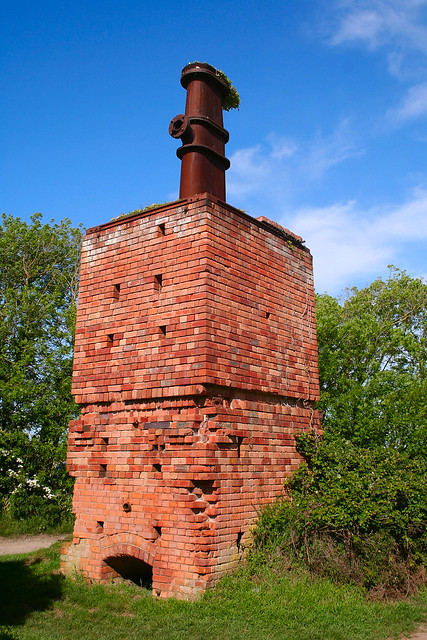
Further downstream is a brick resort, a relic of the expected Somerset oil boom of the 1920s that never was, extracting oil from the local shale rocks. Kilve Pill marks the point where the stream reaches the sea. It was used as a tiny port importing Culm (an inferior coal) to be used in lime kilns.


Below 40-feet-high cliffs the more resilient stratas of rock stretch out into the sea in pavements, revealing fossils of amonites. These causeways carry an interesting local legend. Within Putsham Hill there once lived a particularly fiery dragon called Blue Ben. He used to emerge from a tunnel between Kilve and Putsham so as to swim in the sea and cool himself down. He built the causeway in order to avoid the mudflats. The devil watched Blue Ben and, discovering his lair, harnessed him and rode him along the streets of Hell. Poor Blue Ben suffered terribly with the heat of the hellfires and, after being released after one such sortie, hurried along his causeway in order to cool off. Too eager, he slipped off it, fell into the mud and drowned. 


Obviously Blue Ben was an attempt to explain the geography of the causeways, but perhaps the legend of a fiery dragon who lived under the local hill contained some folk knowledge of the oil in the shale rocks as well? (Especially as the shale has a blue tinge!) The legend of Blue Ben may well have faded from folk memory, but enjoyed a revival in the 1800s when an Ichthyosaur was discovered at nearby Glastonbury. You can imagine the scene when a local heard of the discovery:  "One of they ancient reptiles, that them scientists talk about, you say? Don't be daft; 'tis obvious, 'tis the remains of Blue Ben himself!"


Rob Bayliss is an admin with The Review and author of the Flint and Steel, Fire and Shadow series. Book one, The Sun Shard, can be purchased from Amazon and Amazon UK. He is also a contributor to Felinity, a collection of cat-inspired flash-fiction stories. If you would like Rob to review your book, please see our submissions tab above.

*********

Rob is very generously offering a paperback copy of Felinity for one lucky winner! To get your name in the hat, simply comment below. Facebook users may also comment at this blog's associated thread. 


Monday, 29 September 2014

PAULA PERUSES: Blowing My Own Trumpet - a year in The Review


Well, it's been a really busy first year for our blog and actually the Facebook group has been going for longer than that - since April last year I actually believe. The idea came about when I was contemplating an idea of how one could sort of blow one's own trumpet so to speak, but in such a way that it would engage others and create a forum that was interactive, supportive and fun. I had joined lots of writer groups that allow you to do this. It seemed that most of these groups were all about sharing Amazon buy links, one after the other, several times a day, with several authors posting the same link over and over again. There was hardly any interaction, no one acknowledged one another and it just seemed pointless.

Of course when one tootles their own trumpet, one wants someone to take notice, so I set about thinking what was needed and I think it happened when I was sharing a review that I had received and was very pleased with; suddenly I realised that I had my idea. I was going to start up a group where people could share the heartwarming reviews that they were bursting to let everyone see in a place where the theme was all about exploring books and literature through the medium of the review. Yes! That's what I was going to do!

Our first banner


It would give authors a chance to advertise their book, not just by saying "Buy my book it's fantastic", but by showing people in a positive way what others thought of their books, a testimonial of their work and their talent. I would be more likely to buy a book if someone had told me what they liked about it rather than by someone telling me their book is fantastic. I guessed it was the same for most people, especially when it is by an author who is unknown to them and writing in a genre they don't normally go for.


And so I decided to test my theory out. I opened the group and soon I found that people were joining in, glad of having a place where review sharing was welcome. I also encouraged everyone to share each other's reviews. To be supportive and promote discussion among each other. After all, we learn more about a book by discussion and this creates a millieu where book lovers, reviewers and readers alike can feel safe and free to talk about what excites them most in the literary world. We all understand the foibles of a book lover. I imagined my group would become a feast, where copious amounts of  knowledge would be  shared and consumed over dinner, as well as sharing a love of books of any genre. I did  not want this to be exclusively historical fiction, although we tend to lean toward that essentially, but I made it a mission to invite and engage as many different types of story writing as possible.


I was also keen to broaden the group's awareness of books by encouraging the sharing of anyone's review, and today that still stands though is not often done. I want people to share reviews they have done of other people's books, not just what others have done of theirs and I wanted us to look for fascinating reviews that make us want to buy books. Reviews that intrigue us and urge us to seek books that touch our souls in such a way that we have to share it.

Then of course I had to look for some admins and I asked for volunteers. Jayne Smith and Marsha Lambert joined straight away - two lovely ladies who have also been so supportive of me and other authors. Then Stephanie Moore Hopkins of Layered Pages and BRAG joined and finally my friend from down under, Lorri Lynn, joined. Out of all the original Facebook group, only Jayne is still an admin; the rest have gone onto work on other things.


Well, in the beginning, we kept it to our Facebook group, thinking of ways to engage people and promote healthy discussion about books and different genres. We kept coming up with ideas on how to keep the group lively and our brains were going to eventually explode if we didn't take it further. We toyed with the idea of a blog and that's when we started to grow, recruiting more members.
Once we got the blog designed and it was ready to roll, we launched ourselves as The Review blog, onto the world one year ago this month. We started with a blog launch event on Facebook which was full of games, quizzes discussions and giveaways for a whole two weeks!!!

It was the most fun I think I'd had in ages! The fantastic posts, interviews, reviews, special guest posts, and special features were totally unlike anything I'd ever experienced before. We knew then that we were on to something rather spectacular!


Well, that's how it all began a year ago and now, my main aim is still to help authors promote and sell their books, help readers to find their ultimate reads, to expand knowledge and encourage diversity of genre and to provide reviewers with books they wouldn't normally be able to read and opportunities to improve their own writing processes and analytic skills.

If you would like to become a reviewer for us, please send an email to reviewgroup2014@gmail.com

We are waiting to hear from you! One can never have enough reviewers for so many books!
Watch out for Part Two of this post later this week!


Lisl Reviews: The Life and Demise of Norman Campbell

The Life and Demise of Norman Campbell
By Norman Campbell/Compiled by Diana Jackson

25%  of proceeds from the sales of this book are donated to the local Kingston on Thames branch of Age Concern and Cancer, UK, Mr. Campbell's chosen charity

I have a great love for the ordinary, perhaps largely because so often it translates across history or events as extraordinary, rendering otherwise lesser details worthy of great note. Objects become artifacts, experiences awe, and so often people in later eras feel some link to those of times past; connections bond them despite the enormous differences of their environments that they may nevertheless both relate to so closely.

So it occurs within The Life and Demise of Norman Campbell, in which we the readers are given a firsthand glimpse into life in the earliest years of the 20th century, on through to the end of that era and into the 21st. Narrated by Campbell in a conversational style, the commentary seems to be directed at readers, and parenthetical laughter occasionally pops up, as it would when people are sitting together remembering.

Campbell starts with his parents’ marriage, followed by his birth in 1909, then continues on in linear fashion, through two world wars, his adventures to and in Australia, the advent of radio and television, his passion for music and perhaps surprisingly, his interest in surfing the Internet.

His words, so like the spoken words they actually are as recorded by Diana Jackson, revive for us memories of memories, perhaps stories heard from relatives about an era in which ordinary goals are reached by exhausting and extraordinary means. They then transition us with great succinctness to the present. Campbell does this with the fluidity of a born historian who in just a few sweeping words provides a glimpse of something that was and how it became something else.
Young Norman

Under the stairs was the coal cellar in those days. You could still find coal dust down there today but I’ve put a bit of carpet over it now. The coal man used to come in here with the coal on his back and that’s where he used to shoot the coal. All the dust would fly up in the hall. Schewww! You can imagine.
Most people have taken this cupboard out to give more room and maybe have a telephone or something under the stairs. I have filled in the banisters though, and put in a false ceiling because it was far too high up to paper.
Illustrated throughout, the pictures take on a new dimension of fascinating when we recall a passage from the acknowledgements:

This book, Norman’s memoirs, is also illustrated by photos and pictures from his multitude of albums and scrap books, squirreled away over more than a century.

For most people scrap books initiated 100 years prior, even if they ran for only a few seasons and indeed are exhilarating to take in, typically come from an older relative or, in some exciting instances, are discovered in attics or lofts. That these were held in reserve and collected for so long (100 years!) and by the same person, is nothing short of stunning.

Examination of the pictures reveals our own past, in people, places or items recognizable or not, and one finds their breath at times drawn in to realise the forebears of some of what we know today. This isn’t just about seeing a quaint-looking label on, say, laundry soap, though that is charming as well, but also to reflect about the conditions under which these products came to be or operated. Sunlight soap, for example, was created in 1884 using palm oils as opposed to the heretofore utilised tallow seen in depictions of early sculleries in which the maid’s hand would dip into a jar, emerging with a palm full of goop used for washing up. Sunlight was manufactured into a bar for the sake of convenience and the product came with a £1,000 guarantee.

Interestingly, such advert artifacts appear only at the start of the autobiography in close proximity to family photos. In fact, the Sunlight ad is the first image not of a family member, and subsequent clippings—one for linoleum, the next from an outraged citizen offering to pay £100 to anyone who can prove true the rumor about his consumption of horse meat—given Campbell’s age (toddler) at the time they are dated, points to a collection, perhaps of his mother, that inspired his own continuity of the habit.

Spencer and Annie Campbell
Did Annie Campbell have a sense of history that she perhaps passed on to her son, encouraging him by word or deed to preserve his present for the future? While it may seem an extravagant or extraneous question, its exploration makes other inquiries, of the Campbells as well as ourselves. How many of us today clip and retain product adverts? Do many people now see these even as worthy of retention? While the labels were mass produced in Annie Campbell’s day, now they are produced in mind-boggling numbers, awareness of which perhaps makes them truly unspecial in the eyes of many today. Annie Campbell, perhaps aware of the import of the product’s ingredient transition and maybe with a keen sense of the changes occurring in her world, might have kept them for others. “She was a bit of a clairvoyant. She used to dream of the future,” Campbell says, “and tell fortunes with the cards and tea leaves[.]” Perhaps she looked to the future and wondered what we might make of the people of her time, and wished to provide some answers. If so, she must have known there are clues sprinkled throughout her artifacts.

In addition to this glimpse into perspective, we see notation for images in a font resembling handwriting, much like people did when they pasted photos into the black pages of the old-time albums. When we see, then, the placement of some images at angles, rather than always straight and flush with the same sides of the pages, it brings the realization that the entire autobiography is itself the album. Campbell has not only invited us into his world, but also his time, and over the course of his lifetime has gone to great lengths to ensure we get an extended view. The chapters being headed by the years and a title facilitate the album presentation as it allows readers to peruse from beginning to end or to flip through, much the same way we flip through an album, skipping, going backwards for a second look, comparing the people within at the end to how they appeared—or what they did—at the start.

Compiled by Diana Jackson following Campbell’s death, the inclusion of an occasional address to Jackson herself does not take away from this album being meant for others to share in, and in fact shows a greater depth to Campbell’s invitation for us to participate in his life’s experiences, for indeed he must have realized the connection between readers and himself simply by knowing even portions of what he knew, such as television: Most have seen it, and he reaches out to add to our awareness of the space it occupies in our lives. When television is developed in 1953, and Campbell witnesses on one the wedding of Princess Elizabeth (current Queen Elizabeth II) he sees himself as a pioneer, and later contemplates a purchase.

I thought about it and since I was spending so much in the Kinema and so much in the Elite and so much in the Empire, I thought that all of it could go to pay for the television instead and then we didn’t have to go out.
We’d have all our entertainment indoors; magic. But that was the worst thing that could ever happen. All our social life went. I’ve never been out to the pictures since. The other thing is that everyone is scruffy these days. No one ever dresses up anymore. And then many of the picture houses were turned into Bingo halls when television took over.
As it turns out, Campbell’s wary observations were very keen indeed, for like the labels that are nowadays cast off as ordinary and of little importance for the eyes of the future, activities that once were central functions in people’s lives also transitioned into the ordinary. The processes that got people to those events--saving money, planning for, dressing up—were eliminated as something that once was magical sunk into the insignificant.

In this sense Campbell’s compilation might also serve as a cautionary tale as well as a memorabilia that enables us to cherish our own forebears. In displaying to us the charm of the ordinary, he also discreetly advises us—in his way of saying much with so few words—of the danger of the reverse, of becoming nonchalant in the face of the remarkable. It is here we see that he, too, might have been “a bit of a clairvoyant,” drawing from his mother more than he—at least on the surface—lets on, and presents to us this brilliant autobiography that could be read on a number of levels.

This amazing man continues his story, with clarity and dignity even explaining the pattern of his days with carers, not just for physical assistance but also to help him bear the loneliness around him. At 102 years of age, those from his generation are gone, he is widowed and, living in the home he grew up in, is surrounded by their memories. He finds joy in the Internet and reaches out to his extended family who live, literally, all over the globe. His story is written in a simple manner, but it is by no means simplistic and, as mentioned earlier, he presents it to us with many layers to peel back and discover that beneath it all is great complexity, which is, as Campbell himself might say, “as simple as that!”

To the end, Campbell displays that bright spark, a telling humor that makes us want to dig deeper to understand what else it is he knows, what is he trying to tell us, or even just share with us. Diana Jackson:

I saw Norman in hospital three days before he passed away and he said[,] ‘I’ve got it Diana! The name of my book. The Life and Demise of Norman Campbell!’
‘You can’t call it that,’ I spluttered. ‘You’re still with us.’

Indeed he is.


Norman at 102 years of age
He passed away just two months later
Editor's note: This post has been edited to reflect a correction re: the charity, which has been specified. A link to Diana Jackson's blog has also been added.

(All images from The Life and Demise of Norman Campbell.)

Thank you to Mr. Norman Campbell, for sharing your remarkable life with us!

For more from Diana Jackson, see her blog, where you can also read more about Norman Campbell. 

To purchase this fantastic book, please go to Amazon or Amazon UK.