Showing posts with label Plantagenet. Show all posts

Wednesday, 19 August 2015

Sharon Bennett Connolly Reflects on Visiting Bosworth Battlefield Today

Visiting Bosworth Battlefield Today

“Two Kings – One Battle”


The standards of Richard III and Henry VII


Last year I took my 9-year-old son and 40-something husband to visit their first battlefield. We were holidaying in Derbyshire and decided to drive down to Leicestershire and visit Bosworth. With all the hype around the discovery and re-burial of Richard III, it seemed a great way to show a 9-year-old the story of a battle.

He, of course, knows a little of the Richard III story. He can identify the king’s portrait and knows he was involved in the Wars of the Roses, but we don’t linger on the Princes in the Tower too much. I don’t think he is as familiar with Henry VII, but he can tell you all of Henry VIII’s queens, in order, and tell you their fate. So taking my son to the battlefield was a way of giving him a place and time where he could visualise the events and the people.

It worked.

However, what I found surprising was the effect it had on my husband. Hubby is a bit of a computer geek and into all the mod cons. He never had an interest in history before he met me, and even now I can see his eyes glossing over if I talk too much about the past – 15 minutes a day is usually all he can take!


The Sundial on Ambion Hill


I have visited battlefields before; Waterloo, Stamford Bridge, Hastings and a few others. The calm serenity always amazes me. I expect to hear the echoes of battle, the cries of the wounded, clashes of arms and the shouted orders of the battle’s commanders – and the thunder of the horses hooves during the cavalry charge. At Bosworth, if you close your eyes tight, and listen intently, you can almost hear it…..

The Battle of Bosworth Trail
The Battlefield trail is a wonderful leisurely walk. It’s not the actual battlefield; they found that a short distance away a few years ago, but it is Ambion Hill. And standing at the memorial you have a panoramic view of the area; you can  imagine the 2 sides facing each other, troops in the thick of it and those waiting to engage. My son listened in awe as I described the death of Norfolk and the final, desperate charge of Richard III; and Percy’s men standing, watching and waiting – possibly very close to where we were stood at that moment.


View from Ambion Hill


As you walk round the hill and through the woods, there are markers, pointing the way; and viewpoints and information posts telling the story of the battle and explaining the technology and tactics used. One marker explains the use of the longbow, how it dealt death from afar. The marker explained where the archers were positioned during the fighting; you almost expected to look to your right and see them raising their bows to the air. 

My son was fascinated by the idea that children as young as he was had already started their knightly training, that there were only about 1,000 knights in the whole of England. And I was amazed to discover that many who could be knights chose not to, in order to avoid the duty and responsibility that came with knighthood; these men were simply called esquires or gentlemen.


Information post explaining the use of cannons in the battle


It amazed my husband to discover that cannon and handguns were in use in the battle. 1485 seems to be too long ago for men to have used gunpowder. The handguns were large and cumbersome weapons, too large for one hand to use; guns were still very much in their infancy. However, it was a scattering of cannon balls and other small metal objects (such heraldic badges, spur rowels and coins), found by metal detectors, which finally meant the location of the battlefield could be confidently identified.


Battle standards in Ambion Wood

Although the general battlefield has now been identified, we still don’t know where individual parts of the action took place. We can’t say for certain where the action between Norfolk and Oxford took place, nor where Norfolk fell. We can’t tell where Stanley and his men were standing, watching for that turn in the battle that made him decide to join Henry Tudor’s forces. 

But the specifics don’t matter as much as I expected they would. The battlefield provides its own story. And the fact you can’t say exactly where each part of the action happened serves to highlight the confusion of a battle. When you’re on the ground, in the thick of it, fighting for your life and your king, you wouldn’t be looking round to see where on the field you were. You would be looking to your own survival, fighting the man in front of you while watching your back. 


King Richard’s Well, cairn built close to where it is thought the king fell


So the locations of events are vague, but that they are remembered and commemorated is what matters. Whether the marker is where Richard fell matters less than that there is a marker to the fallen king.


Henry VII


And once you have walked the Battlefield Trail, there is the Heritage Centre to visit. The Centre offers wonderful background to the battle, told through the voices of those involved: a serving girl at a local inn, a mercenary’s wife, an archer. The 2 armoured kings stand watch over you as you view artefacts found on the field of battle and study maps and videos explaining the battle and the troop movements. The Heritage Centre is very hands-on; children can try on the armour and test out the helmets. You can test your ability to draw a longbow; it’s not as easy as you think. By far the most dramatic display is the little corner dedicated to the Barber-Surgeons. The tools of his trade are displayed and a skeleton depicting the wounds of one soldier from the battlefield. Given the recent discovery of Richard III, and the detailed descriptions of his wounds, this seemed a particularly poignant display.


Richard III


Walking the battlefield is a humbling experience. So little is known about the men who fought and died in these fields on 22nd August 1485. And, yet, the date marks so much change in English history: the end of one the Plantagenet dynasty and the start of Tudor rule; the end of the Middle Ages and the beginnings of the Renaissance. Just around the corner were the marital problems of Henry VIII and the English Reformation and the subsequent, glorious reign of Elizabeth I. But the men who fought that day would know nothing of the significance of the battle beyond that moment.


 Sharon Bennett Connolly has a lifelong fascination with history, and has recently discovered a love of writing. She has combined these two in her blog, History…the interesting bits!


Wednesday, 11 February 2015

Guest Post: Kristie Dean presents an excerpt from The World of Richard III

The World of Richard III 
by Kristie Dean

To read Lisl's review of The World of Richard III, click here

I had such high expectations for Middleham Castle that I was afraid it might disappoint. I shouldn’t have worried. From my first visit I was enthralled by the castle, and a subsequent visit just deepened my appreciation for this impressive building situated in Wensleydale. On my first visit, I had seen Middleham glistening in the sun. The day had been mild and I had rambled around the ruin for hours, poking my head into every nook and cranny.

For my research trip – the trip where I would be taking the pictures to be used in the book – I hoped for a similar day. I knew rain was a possibility, but I figured I would be in the area long enough for rain to stop. My eternal optimism was rewarded by a torrential downpour. Rain was hitting me in every direction. I had brought a rain sleeve with me, but it was useless in this deluge. Every picture I took had water beading on the lens. Finally I gave up, hoping that I would find someone to take a picture for me later. I would concentrate on the layout and my research.

The castle looked even more formidable as I peered at it through wet, stringy hair. Richard would have seen Middleham Castle in both states – on sunny days and in the worst weather possible. Somehow, this made me appreciate the view of Middleham in the rain. It added a layer to the experience. I could no longer just write about how beautiful the castle appeared; I would need to explore its intimidating side as well. In the course of researching and writing The World of Richard III I had so many wonderful experiences but this day at Middleham was a special one.

--Kristie Dean

Middleham Castle, North Yorkshire

Rising up out of the dales, Middleham Castle is every bit the fortress it appears. The large, impregnable walls still look formidable, even in a ruinous state. In 1823, English geographer E. W. Brayley said, ‘As it is, majestic in decay, Middleham Castle, as an object, is the noblest work of man in the County of Man.’ You will find the castle is as striking today as it was then.

The first stronghold at Middleham was a motte-and-bailey castle likely built in the eleventh century. Its position can still be seen from the present location of the castle. After the new stone castle was built, the old site was deserted. The new site was not in a highly defensible position; however, evidence remains to show that protective fortifications were built, including a moat around the castle, as well as an outer courtyard.

Through the years, the castle passed from Alan the Red, a Norman who came over with William the Conqueror, to his brother, finally falling into the hands of the Nevilles through the marriage of Robert de Neville to Mary, daughter and heiress of Ralph FitzRanulph. The Neville family would expend money to enlarge and enrich Middleham during their time as its owners. The castle would eventually pass to Richard after the death of the Earl of Warwick.

Perhaps no other place held more meaning for Richard than the imposing stone walls of Middleham Castle. So many significant events in his life took place within the keep of this impressive edifice – events that would change Richard as well as the country. From his days in the earl’s household to his days as King of England, Middleham would hold both happy and depressing memories.

The Gatehouse
Despite centuries of decay, the gatehouse is still imposing. It stands three storeys high, with an arched stone entry. This was not the original entrance to the building, but was a fifteenth-century addition, and would have been the entrance that Richard would have used to reach the inner courtyard. Look up at the gatehouse and find the turrets. While there is little evidence that sculpted stone figures of armed men would have adorned the battlements, these men can be seen on other Neville properties, such as Raby Castle, and it is likely they would have graced Middleham’s battlements as well. Channels in the gatehouse show evidence of a portcullis, which would have offered extra protection.

Arriving at Middleham, Richard would have observed a very different town than the quiet town we see today; there had been a settlement there since Roman times. By the time Richard arrived, it was a bustling market town and important centre for the Earl of Warwick. It is easy to imagine Richard passing through the town and spotting the formidable towers for the first time, easy to picture his pride in his surroundings – pride that he was placed in the household of the greatest lord in the land to begin his training. Maybe he looked up at the turrets of the gatehouse as he entered into the castle through the north entrance. Whatever his thoughts, he had been placed in the care of the Earl of Warwick, and he would come to love this retreat from court.

Richard entered into the household of the Earl of Warwick to complete his education, and it is likely that he spent some of his time at Middleham. Paul Murray Kendall has Richard entering into the earl’s household as early as 1461, but as David Baldwin points out, references to Richard during this time period place him in other locations. Very little is known about Richard’s education, which probably resembled that of most nobles at the time, but it is known he spent time with the Countess of Warwick and her two daughters, Isabel and Anne. Isabel was nearer to Richard’s age, but Richard would have been acquainted with both of the girls, and perhaps a friendship was formed at this time that would later foster a caring marriage between Richard and Anne.

Middleham is also the most likely place for Richard to have established friendships with the nobles who would eventually die fighting with him in battle. Another friendship that Richard presumably fostered at Middleham was with Francis Lovell, who proved time and again to be intensely loyal to Richard. It is conceivable that the two of them became close during their time at Middleham and other Warwick holdings, even though there is dispute as to whether Lovell and Richard were in his household during the same years. It seems likely they did meet while in the earl’s care given their lifelong friendship.

Standing inside the inner courtyard, you will see a wooden staircase leading up to the keep. In the fifteenth century, this would have been a massive stone staircase. Walking towards the keep, you can just make out some remnants of the stone stairway. The twelfth-century keep dominates the area today, just as it would have in Richard’s time.


Middleham Castle, Wensleydale. Richard likely spent some of his childhood here in the 
palatial home of the Earl of Warwick. After Warwick’s death, the castle passed into Richard’s 
hands. His son, Edward of Middleham, was born, and probably died, here.

The Great Hall and Privy Chamber
When Richard came back north after the death of Warwick, he made Middleham his principal residence. From here, he would have administered justice in the area. By entering into a mutually advantageous marriage with Anne Neville, he was able to secure the loyalties of people in the North previously loyal to the Neville family. But he also generated loyalty in his even-handed treatment of the people, and he would keep this northern support for the years of his reign.

All that is left of the Great Hall where Richard would have conducted much of the business of the North, entertained guests and held court is a shell. If you pause long enough, in your mind’s
eye you can recreate the scene. Hear the laughter and the thump of dishes being placed before Richard and his guests, and see the servants scurrying to and fro attending to everyone. It would have been a lavish scene, as Richard spent heavily on feasting. One of the guests he entertained here as king was a German nobleman named Nicholas von Poppelau. The king made a good impression on Poppelau, who described Richard as having a ‘great heart’.

Richard’s council would have met in the Great Hall and administered justice for the area. As Paul Murray Kendall points out in his book The Yorkist Age, ‘Richard of Gloucester’s council at Middleham became such an effective instrument of justice in the 1470s that after Richard became king, he created the Council of the North, which the Tudors continued.’

One of the earliest problems Richard would have to deal with during his tenure in the North was the Bastard of Fauconberg. Thomas Neville, an illegitimate son of Lord Fauconberg, and the Earl of Kent, William Neville, had led an uprising against Edward IV. Neville had been pardoned and sent north with Richard into Yorkshire; however, he returned south without permission and was arrested. Richard dealt swiftly with him, having him executed at Middleham.

From the hall, there would have been access to the great chamber and the privy chamber. These rooms would have also been well used by Richard during his tenure at the castle, and were equipped with a fireplace and access to latrines in the tower. A chapel lies to the east wall of the keep. Little remains, but if you take a closer look, you can make out the tracery windows in the walls. With the destruction of time it is harder to picture, but try to imagine the household meeting in the chapel to observe morning prayers. Take the stairway to the viewing platform for views of the site of the original motte-and-bailey castle, as well as the panoramic view of Wensleydale.

The South Range
The two-storey south range of the castle had towers located at the south-east and south-west corners. This range held several rooms at the first-floor level, with the one at the east end having a fireplace and south-facing windows. Two more chambers were in the west end of the range, with very similar layouts. These rooms were large and were described in the 1538 survey as a lady chamber with a gallery to the presence chamber.

The south-west tower is also known as the ‘Prince’s Tower’ because legend has it that Richard’s only legitimate son, Edward of Middleham, was born here. This is certainly plausible, because the 1538 survey names a room next to the tower in the west range a ‘nursee’. In the nursery, Edward’s wet nurse, Isabel Burgh, and his governess, Anne Idley, would have played an important role in his young life.


At Middleham, Edward would have spent his days playing in the courtyard, watching mummeries in the Great Hall, and spending time with his parents when they were at the keep. It was also here he would die. The Croyland Chronicle said that he was ‘seized with an illness of but short duration …’ His death left Richard bereft of his son and heir at a critical time in his reign. After Edward’s death in 1484, Middleham would cease to be one of Richard’s favourite residences. The memories that he had enjoyed would now be tinged with pain.
*********


Kristie Dean has an MA in History and now enjoys teaching the subject, following a successful career in public relations. She has been published in several online magazines and local newspapers, and presented a paper at the International Congress on Medieval Studies. She lives in Tennessee. 


You can find more about Dean and her work at her website, as well The World of Richard III's Facebook page.


The World of Richard III by Kristie Dean is published by Amberley Publishing, 2015. The book is available to buy at all good bookstores, as well as online at the Amberley website, Amazon, Amazon UK and the Book Depository.


Added notation: This post has been updated to include a link to Lisl's review for The World of Richard III

Wednesday, 30 April 2014

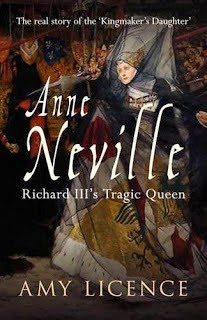
Jayne's Corner: Interview with Amy Licence

I have been lucky enough to interview one of my favorite non-fiction writers, Amy Licence. She very kindly agreed to answer some of my questions and I thought I would share them with you.


You have so far chosen to mostly write about women from the 15th century, so what made you choose them ?

There are two answers to this: one about women but also specifically about the 15th century. I can’t help but feel drawn to that period in time, although I started out being interested in the Tudors and gravitated to the Wars of the Roses. Something about that century fascinates me and I can’t really offer a satisfactory explanation of why. I can say that I find the people and events fascinating, but I expect enthusiasts of any era would make the same assertion. The closest I can come to it, is to say that I feel most at home there. Regarding the women aspect, I’ve always been interested in women’s lives, in their experiences within a patriarchal framework and just how far they were able to exercise any influence or control at all, from queenship to motherhood. The women of the 15th century particularly fascinate me because so many of them remain an enigma to us, although they must have been key players in the dynastic power struggles of the day. I don’t accept the theory that they were just there to reproduce. They may not have sat in council chambers or fought on battlefields, but as wives, mothers and daughters, I’ll bet they had a lot to say.

Do you have a favourite out the three women, Anne Neville, Elizabeth of York or Cecily Neville?


They’re all very interesting to me and as I researched each, I learned just how remarkable their lives really were. I think there is a lot we will never know about Elizabeth’s history and marriage and I am endlessly fascinated by the question of what exactly Anne Neville did or didn’t know. But I have to say that Cecily’s role probably interests me the most. As the wife of the Duke of York, and the mother of Edward, George and Richard, she was in a unique position at the heart of that family and occupied a place in their lives. There is also a degree of controversy about some of Cecily’s decisions, such as her support of George’s rebellion against Edward and her role in the allegations about her own fidelity. Perhaps more than the other two, she shaped contemporary events, which is all the more ironic, as she was the only one of the three who did not become queen.


As  a wife and  mother of two young boys how do you manage to make time to write?

It’s literally as you suggest, I have to make time. I’m at home with my toddlers all day and I have to work by stealth. It means that I have to read and think, seize opportunities and use my time effectively. I don’t really watch TV and I don’t procrastinate or waste time. Before I had the boys, it was relatively easy to come up with reasons not to write and put barriers in the way but now, the busier I am, the more I have to just facilitate my writing. I’ve really discovered that the only way to do it, is to actually do it, to stop worrying and finding excuses, just to snatch this half hour and get something typed. Every minute I’m thinking about the next thing I’m writing; I tend to mull over a paragraph for a while and then dash off to write it down before playing Thomas the Tank Engine. I’m also lucky that my husband will take them out for the day, so I can get a good uninterrupted stretch. If I’m not exhausted at the end of the day, I’ll try and do a bit then too.

How long does it take you to research each book?

My publishing record looks a little misleading, as my books have come out in a relatively short space of time, but I would describe this process as an overnight success that took 25 years in the making. I did my MA in medieval history back in 1995 and since then, I’ve never stopped researching and writing on the topic, so I’ve accumulated a body of knowledge over the past two decades- in fact, I began well before that. It’s all there in my head or jotted in notebooks, so with each of my books it was a case of accessing the information and doing some further, specific research for that individual. That process can take around nine to 12 months.


When did you first begin to be interested in history?

I’ve been interested in history as long as I can remember. My parents took me to visit castles and on digs and I’d worked through my local library’s shelves of medieval and Tudor books by the time I was about 14. It was just always there. I decided I would be a writer when I was eight and wrote my first novel at 11 and my first full length biography when I was sixteen, on the romantic poet Thomas Chatterton.

How do you manage to find all your sources for information and do you try to visit some of the places you mention in your books?

I think I’ve been very lucky with the timing of my career. A lot of the key texts, historical and literary, I’d read whilst at university but in recent years, so many primary sources, court records etc., have been uploaded online. It means that I can access and search chronicles and accounts, court payments and letters from my kitchen table. In around 2001, when I was still trying to get published, I was trying to write a biography and there were just no sources out there, so I had to go up to the British Library every weekend. My children hadn’t arrived at that point, so I would teach all week, spend Saturday in the reading room making notes and write them up on Sunday. I couldn’t do that now; the Internet has made it possible. Having said that, there is no substitute for getting out there and visiting these places, and seeing the actual records in the archives. Now my boys are four and 20 months, and I’m starting to take them out to some of the places I write about. Recently, while I was researching my Richard and Cecily books, we managed to get to Raglan Castle in Wales and Tonbridge Castle. They quite enjoyed running about with wooden swords.

What is in the future for you as a writer?

At the moment, I’m working on a book about Henry VIII’s women. Some of the most famous books on this topic are a few years old now and easily turn into a narrative of Henry’s life. I’m writing a really colourful account from the women’s perspectives; what was it like to be his wife or mistress? It’s difficult to squash him down, as he is such a gigantic character, but the focus is definitely on the women. After that, I’m returning to the 15th century to write a joint biography of Edward IV and Elizabeth Wydeville.

Thank you to Amy for sparing the time to talk to me. She has a website which can be accessed here. 

Jayne Smith is a member of The Review team and a great lover of history.