Showing posts with label 7th Century. Show all posts

Wednesday, 1 November 2017

Richard reviews Queen of a Distant Hive, by Theresa Tomlinson

The author of this book has kindly offered one copy of ‘Queen of a Distant Hive’. To be in with a chance to win, just leave a comment below or on our Facebook page (https://www.facebook.com/thereviewgroup/posts/1958703070825704).

The draw will be announced a little while after this post.


Cover - Queen of a Distant Hive
Queen of a Distant Hive, by Theresa Tomlinson, is a sequel to her earlier book, A Swarming of Bees. Both are set in and around the monastery of Whitby - called here by its old name Streonshalh - in the latter half of the seventh century. Both deal with the life and relationships of both the monastery (a double establishment with both men and women) and the community outside the sacred space, which in various ways depend on each other. As books, however, they are independent, and you don't have to have read the first in order to enjoy the second.

The great and fearful events of the age are background material to the stories, rather than their focus. So, the 664AD Synod of Whitby, with all the changes that meant for Christianity in the British Isles, formed the stage for A Swarming of Bees. Royal marriages, alliances and betrayals, and the ever-present possibilities of war and revenge, haunt Queen of a Distant Hive. But the individuals who we most closely live with and walk alongside in these books are not royalty, but the skilled workers of the community. Most notably, we join Fridgyth in her daily work as herbalist for town and monastery. But also we meet the reeve Ketel, together with tanners and spinners, cooks and craftsmen monks and nuns: in short, the men, women and children of the area. Abbess Hild is an approachable figure, not a remote one.

Looking south at Whitby from Kettle Ness
Fridgyth's mind strayed back to Brigsbeck Woods. She wondered again what could possibly link a dangerous political act like the attempted poisoning of Prince Aethelred, with a quiet young craftsman like Godric? Could the young tanner have accidentally gained knowledge that might be feared to be dangerous? Or had he, as Cynewise had suggested, been killed simply to demonstrate that whoever was behind these threats meant business?

But like any community, Streonshalh is not immune to crimes, either of quick passion or of long-nursed envy. Fridgyth, with her medical knowledge, shrewd assessment of character, and keen eye for detail, takes on the role of investigator in both books. Unravelling the culprit is no easy task - motives abound in this second book, in an age when families keep long memories of ruthless royal judgements and executions. Fridgyth herself, among others, has to acknowledge and set aside her own prejudices and preconceptions, as she threads her way through to the truth of the matter.

Queen of a Distant Hive is full of the details of everyday life, from the gathering and preparation of Fridgyth's medicines, to the occupations of the villagers outside the monastery walls, to the activities of the women attending the ageing widowed queen of Mercia. The seventh century comes alive with all this.
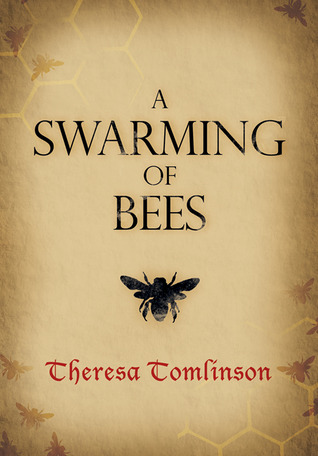
Cover - A Swarming of Bees
Fridgyth shook herself awake and got up hurriedly, yawning and smoothing her hair. "I must prepare a seaweed poultice for our royal visitor," she said and then, with a quiet laugh, she added, "the smell will challenge her senses, I think."
"But you must eat too," Della told her firmly, and the girl placed fresh flatbread and a hunk of goats' cheese down in front of her.
Fridgyth smiled and ate obediently, then got to work. Having pounded dried kelp into a grainy powder, she was just about to ladle it into a wooden bucket, when Della gave a small gasp...
But as well as these external trappings, we are led into something of the thinking and spirituality of the age. Christianity had become a majority religion, at least in this part of the land, and with the direct patronage of the king. However, older religious habits still exert considerable influence. For many people, both faiths coexist without too much contradiction, and appeals from the same person to both Christ and Freya might follow in rapid succession. Christianity was indeed displacing other beliefs, but had not yet reached a stage of development where it was systematically suppressing them. All this makes for a highly credible and immersive story.
Saxon princess pendant, Kirkleatham museum, Redcar
Irminburgh... reached up with shaking hands to unfasten from around her neck a small, but exquisite gold and garnet pendant shaped like a shell... together they laid the precious jewel on Cynewise's breast...
It was then that the Christians stepped back, so that the holly-bearing women could come forward. A slow, steady drumbeat began, and old though most of them were, Cynewise's women danced around the burial as the sun went down.
Fridgyth's eyes filled with tears. As a young girl she'd danced like this, and after a moment or two of hesitation she went to join them. Hild looked on approvingly, and lifted up her gnarled hands to clap in time to the rhythm of the drum; following her example many others joined in.
The drumming built to a crescendo and holly boughs were tossed into the burial pit, as the sun vanished.
Fridgyth returned breathless to Ketel's side. "Cynewise would have liked that," she said.
The book provides a very different view on this period of history, and one which I thoroughly enjoyed. Readers looking for blow-by-blow accounts of the furious battles of the age will not find them here. But if you relish the opportunity to live alongside the occupants of Streonshalh for a while, and to vicariously join in their daily lives, Queen of a Distant Hive could be for you. As and when Theresa writes another book set in seventh century Streonshalh, I will be sure to read it.

Whitby Abbey today
Whitby Abbey today


About the author:
Theresa Tomlinson spent most of her childhood in Cleveland and North Yorkshire, where her father was a vicar. On leaving school she spent two years at Hull College of Art and then went on to train as a teacher. After working as a primary school teacher in Hull, Sheffield and Manchester, she began to write stories to entertain her own children, and at the same time discovered a passion for history. After more years of hard work and research, she eventually began to get her work published and has twice been short listed for the Carnegie Medal. She now lives in Whitby, within sight of the famous abbey, which has inspired her with a fascination for the rich and exciting history of the ancient kingdom of Northumbria.

In a Young Adult novel, entitled WOLF GIRL, Theresa introduced the character of Fridgyth, a half pagan herb-wife, taken on by Abbess Hild to serve the growing community on the cliff-tops. Wishing to try her hand at writing for adults, Theresa looked again at this observant, gossip-loving character. ‘A herb-wife on a mule may go where warriors cannot – she may see what warriors cannot see and hear what warriors cannot hear.’ This resulted in the publication of A SWARMING OF BEES – a murder/mystery set in Hild’s monastery at the time of the Whitby Synod.  Readers kindly begged for another Fridgyth story and QUEEN OF A DISTANT HIVE takes the herb-wife on a further adventure. Ideas for a third book are in the very early stages of development.

About the reviewer:
Richard Abbott lives in London, England. He writes historical fantasy set in the British Isles, science fiction about our solar system in the fairly near future, and also historical fiction set in the ancient Middle East - Egypt, Syria, Canaan and Israel.

When not writing words or computer code, he enjoys spending time with family, walking, and wildlife, ideally combining all three pursuits in the English Lake District. He is the author of In a Milk and Honeyed Land, Scenes From a Life, The Flame Before Us, Far from the Spaceports, Timing - and most recently Half Sick of Shadows. He can be found at his website or blog, on Google+, Goodreads, Facebook and Twitter.

Monday, 8 February 2016

Sharon Reviews: The Serpent Sword by Matthew Harffy

The author has kindly donated a signed copy of the book as a giveaway. To be in with a chance of winning, just leave a comment at the bottom of the blog, or on our Facebook page.The winner will be drawn on Monday 15th January.


Certain that his brother's death is murder, young farmhand Beobrand embarks on a quest for revenge in war-torn Northumbria. When he witnesses barbaric acts at the hands of warriors he considers his friends, Beobrand questions his chosen path and vows to bring the men to justice.
Relentless in pursuit of his enemies, Beobrand faces challenges that change him irrevocably. Just as a great sword is forged by beating together rods of iron, so his adversities transform him from a farm boy to a man who stands strong in the clamour and gore of the shieldwall.
As he closes in on his kin's slayer and the bodies begin to pile up, can Beobrand mete out the vengeance he craves without sacrificing his own honour...or even his soul?
The Serpent Sword is the first novel of the Bernicia Chronicles.

The Serpent Sword is Matthew Harffy's debut novel (not that you would know it), and the first installment of his Bernicia Chronicles. Set in the turbulence of 7th century Northumbria, The Serpent Sword is a wonderful story full of action, adventure, betrayal ... and just a little romance. The novel leads you across the countryside of the ancient kingdom of Bernicia, taking you from battlefield, to ancient strongholds or small villages and religious settlements; meeting heroes and villains, friends and foes along the way. The fast-paced action leaves you eager to see how the story ends while experiencing a wealth of emotions along the way.


The two-fold story-line keeps you on your toes, seeing the young hero tackling the enemies of Bernicia - in the forces of Penda and Cadwallon - whilst searching for his brother's killer.
There are some moments of 'head-hopping' in the book, where the author changes the focus of thoughts between the characters. Where this can be confusing in some books, it tends to work well in The Serpent Sword and, to be honest, while it was noticeable at the beginning as I got further into the book, I became less and less aware of it.

The novel is a treasure trove of human experiences; wild, untamed landscapes and people fighting to overcome nature and their enemies in order to make decent lives for themselves.  Life is short and often brutal, and the author does not spare you from the tragedy, but tempers it with stories of deep friendships and a little bit of love.

The story is original and entertaining, with even a little humour thrown in:

 "It cuts the land from east to west," Bassus said. Beobrand thought there could be no way such a huge thing could exist, but it disappeared into the distance in each direction and Bassus seemed serious.
"Who could have built such a wall?" Leofwine had asked as they made their way through a gap in the Wall, amazed at the scale of the stone edifice.
"The same people who made that angel floor back in Engelmynster, I'd imagine," Bassus had answered. "Some say they were giants, but they were just men far to the south. They built the road we're walking on too, I'd wager."
"I wonder what happened to them," Leofwine had pondered.  


The descriptions of fighting are authentic and the author's description of the shield-wall is at the same time accurate and terrifying, thorough and frightening. You can almost hear the clash of arms and the screams of the wounded. The action is frenetic, while the story itself has a depth to it that leaves you speechless.

Matthew Harffy's characters are wonderful creations, exciting, human and - in the case of the bad guys - suitably despicable. From the moment you start reading you are aware you are going on an incredible journey of discovery, though where it will take you and what you will experience along the way are still a mystery.

"Well, Beobrand, Eanflaed here tells me you were in the stables, in the dark. What were you doing there?"Beobrand did not even contemplate lying.
"Grieving for the loss of my brother, sisters and parents, sire," he said, his voice breaking. "I did not want to cry in front of everyone." 
The hall was now completely silent, save for the crackling of the fire and the sound of the dogs crunching bones under the tables. Everyone was straining to hear what was said.

Throughout the novel we follow the adventures of young Beobrand, a young man who has lost more or less everything, and is looking for his place in the world. He is aware of his own demons, but still somewhat naive and easily trusts the wrong people - at first. The Serpent Sword traces the hero's story from his arrival in Northumbria in search of his brother, Octa, through his first disastrous battle, from which he barely survives. But this battle is also the springboard from which his adventure really starts. What follows are a series of events and experiences that turn him from a naive boy learning to fight, into a confident, experienced warrior.

The author has managed to include a wonderful, eclectic mix of characters, who help or hinder our hero on his way; from a friendly young monk, to great war leaders and Sunniva, Beobrand's lover, a  young woman who gives Beobrand a purpose and reason to fight.

Beobrand's nemesis is Hengist; a truly nasty individual. A warrior who appears to have lost all humanity and almost makes Beobrand do the same - almost. 

The enmity between  the two is the driving force behind the novel.

The story is set in 7th century Bernicia - what is now Northumbria - with the action moving from the imposing fortress of Bebbanburgh (Bamburgh Castle) through the wilds of modern-day Northumbria and Yorkshire. Matthew Harffy has done his research well and this shows in his attention to detail; from the weaponry and fighting tactics to the villages and their residents, and the bleak reality that the people need each other - and their warriors - in order to survive. 

The story-line grabs your attention and leads you on many twists and turns, building up to a wonderful, all-consuming climax. The Serpent Sword is a marvelous, action-packed story from start  to finish. It takes you on a roller-coaster ride of action and emotion that leaves you breathless and eager for more, which is why book 2 of the Bernicia Chronicles, The Cross and The Curse is next on my reading list....


Matthew Harffy lived in Northumberland as a child and the area had a great impact on him. The rugged terrain, ruined castles and rocky coastline made it easy to imagine the past. Decades later, a documentary about Northumbria's Golden Age sowed the kernel of an idea for a series of historical fiction novels. The first of them is the action-packed tale of vengeance and coming of age, The Serpent Sword. The sequel is The Cross and The Curse.
Matthew has worked in the IT industry, where he spent all day writing and editing, just not the words that most interested him. Prior to that he worked in Spain as an English teacher and translator. He has co-authored seven published academic articles, ranging in topic from the ecological impact of mining to the construction of a marble pipe organ.
Matthew lives in Wiltshire, England, with his wife and their two daughters.
When not writing, or spending time with his family, Matthew sings in a band called Rock Dog.
Website
The Serpent Sword
The Cross and the Curse
Facebook
Twitter

Sharon Bennett Connolly has been fascinated by history for over 30 years. She has studied history academically and just for the joy of it – even working as a tour guide at historical sites. She is now having great fun passing on that love of the past to her 10-year-old son. Having received a blog, History...The Interesting Bits as a present for Christmas 2014 she is also enjoying sharing her obsession of history with her readers.