Saturday, 6 January 2018

Diana talks to Matthew Lewis, author of 'The Survival of the Princes in the Tower.'


Hi Matt. It's lovely to talk with you. Thank you for agreeing to answer these questions for me. Let us start straight away...

What is the genre you are best known for?
I started off writing a couple of historical fiction novels but appear to somehow have ended up writing non-fiction medieval history books. I guess if I’m anywhere near well-known, it’s probably for the non-fiction now.

If your latest book TheSurvival of the Princes in the Tower was adapted into a TV show or a film, who would you like to play the lead role?
It would have to be one of those part-dramatised documentaries I guess, but this would be an excuse to talk about casting Richard III, who is the subject of my first novel, Loyalty, too. Eddie Redmayne might be my top pick. He’s an incredibly versatile actor and I think he could bring a real emotional depth to a figure often viewed as one dimensional.

What made you choose this genre?
Historical fiction was a combination of interests I’ve always had. The non-fiction was a result of my inability to refuse real offers from real publishers. I could claim a noble compulsion to spread knowledge and appreciation of the histories that have fascinated me for years, but it’s probably more like vanity!

How do you get ideas for plots and characters?
One of the benefits of writing historical fiction about well-known figures is that I don’t need to invent too much. That could hardly be less true. Even where records are good, particularly during the medieval period, they weren’t great, so we have no idea what people were really thinking. Empathy is the key for me. Fact can provide a framework to operate within, but there is still plenty of wiggle room with character’s emotions, thoughts and words. I get to look at what happened and try to get beneath the skin to look for a plot, motives and other people at work. The freedom is simultaneously exciting and terrifying.

Favourite picture or work of art?
Hans Holbein fascinates me. Jack Leslau’s theory about Holbein’s portrait of Sir Thomas More’s family has made that painting a long-standing favourite of mine (if you don’t know why, please look it up!).
Sir Thomas More and Family is a lost painting by Hans Holbein the Younger, painted circa 1527 and known from a number of surviving copies. The original was destroyed in 1752 in a fire at Schloss Kremsier (Kroměříž Castle), the Moravian residence of Carl von Liechtenstein, archbishop of Olmutz.

Holbein’s Henry VIII is one of the most instantly recognisable images in all of history and a testament to his ability to weave meaning into his paintings. From the aggressive, confrontational stance to the prominent codpiece and the glare, it tells as much of a story about Henry’s desire to project an image of himself as it does about what he may have really looked like. Holbein opened a real window into the Tudor court and made characters from history into real people you can almost touch for the first time. The guy was a genius.

If, as a one off, (and you could guarantee publication!)  you could write anything you wanted, is there another genre you would love to work with and do you already have a budding plot line in mind?
I’d love to have a go at some children or young adult fiction. I’ve got a couple of ideas rattling around in my brain but they’re currently caged by commitments to non-fiction books.

Was becoming a writer a conscious decision or something that you drifted into (or even something so compelling that it could not be denied?) How old were you when you first started to write seriously.
I had been writing for years just for fun and although I might have hoped to become a writer one day, it was never something I really considered as a serious option. I self-published my first novel in 2012, expecting nothing to really come of it. A few months later, Richard III’s remains were discovered and as interest peaked, my novel started to sell. I was 36 then and wrote a sequel to try and make the most of what I assumed would be a passing fascination with the subject of the novel rather than anything else. Some of the nonsense doing the rounds after Richard III’s remains were found caused me to start a blog to try and get more accurate information out there. All of a sudden, a publisher got in touch through the blog to ask me to write a non-fiction account of the Wars of the Roses for them. I couldn’t believe it. I still can’t. I write for three publishers now and have books due for the next few years, which is mind-blowing to me. If anyone asks me, I still can’t bring myself to claim that I’m a writer or an historian. It makes me smile when I see others describe me as either. It feels like I’m getting away 
with something naughty.

Marmite? Love it or hate it?
I fall into some kind of freakish middle ground here. I don’t mind it, but I can’t remember the last time I chose to ate any. It’s okay spread thinly on toast. If this is too weird, put me down as a hater. That’s probably the safest bet.

Do you have any rituals and routines when writing? Your favourite cup for example or ‘that’ piece of music...??
I try to create routines to convince myself that I should be writing, but I have’t really found one that sticks. I’m a procrastinator of the highest order, but I get it done in the end, on time too. It’s a family trait that has made trying to convince the children to do their homework when they get it instead of leaving it to the last second more difficult. Apparently, they’re genetically predisposed to leaving it late and it’s my fault.

I promise I won’t tell them the answer to this, but when you are writing, who is more important, your family or your characters?
I can honestly say my family. They’re always the most important thing because without them, I would never be able to write a word. They’ve put up with this flight of fancy for years now, spending time with them is my favourite form of procrastination and they’re always my main source of inspiration.
So that’s the paragraph to put in the version I’ll show them. Now…. (I actually laughed out loud!! Diana)
Other than writing full time, what would be your dream job?

I’ve never had the same job twice in a row or anything much like a career. I’ve had jobs I’ve loved though, as well as a few I’ve not enjoyed. If I could pick any job, it would either be manager of Wolverhampton Wanderers or Prime Minister. I’ve done both for years from the comfort of my armchair. I’d love to get into politics if I’m honest. I avoid it on social media because I try to keep it to the history, but it’s an interest that runs parallel and isn’t unrelated.

Coffee or tea? Red or white?
Tea. Preferably intravenous by drip. Strong, milky and no sugar. I can’t drink coffee, which is often an awkward social problem. I get proper dirty looks when I try to explain that I don’t like coffee. I really like camomile tea and decaf green tea too. That may not be very cool, but I’m not known for being cool.
I like red and white wine. When I want to be pretentious I’ll talk about drinking Chilean red wine before it became popular. When I’m not, a bit of Black Tower in front of the TV suits me just fine. 😸

How much of your work is planned before you start? Do you have a full draft or let it find its way?
I’ve never planned a book so far. They’re organic things, both the fiction and the non-fiction. I have some themes in my head and threads I might like to follow sometimes, but generally I sit down with no clue what’s going to happen and hope I don’t want to delete it by the end of the day. I admire writers with a huge plan. It shows a foresight I don’t possess.

If you had free choice over the font your book is printed in, what font/fonts would you choose?
Calibri is my go-to font. I’m aware how desperately sad it is to have a go-to font, but I’m going to hold my head up high for this sans-serif champ. Microsoft has adopted it as the default font for Office now, so I’ll probably have to change it now to something obscure. Angelic War is cool, but maybe not suitable for everyday use.

Imagine that you could get hold of any original source document. What would it be?
Whatever evidence was produced to convince the powers that be in London to declare the sons of Edward IV illegitimate in June 1483 would be my choice. It hasn’t survived, but something was obviously shown around. Did they accept something that was obviously a sham and a hatchet job, or has it failed to survive precisely because it was compelling? To be able to sift through it and try to work that out would be incredible. More than anything else, it could answer a lot of questions about 1483 and Richard III.

Have any of your characters ever shocked you and gone off on their own adventure leaving you scratching your head? If so how did you cope with that!?
As I don’t really plan, my only plan is to let characters roam around with free will and see where they chose to go. I have to check them a little to keep within the framework of the facts, but within my flimsy, cardboard box of rules, they’re free to do as they please. It saves me having to think about it too much.

How much research do you do and do you ever go on research trips?
I try and do loads of research. I read out of interest as much as anything else, which helps. I’m amazed by how different a story can be if you go right back to the original, contemporary source material. So much mythology springs up around many of these issues and becomes accepted as real history that it can be hard to break down the barriers, even with original material on your side. I referred to a clause Edward IV placed on his brother Richard’s title to his wife’s Neville inheritance in my novel. It’s in the Parliament Rolls, yet one reviewer took issue with that particular aspect because they had read a lot on the subject and never come across it before. Therefore, they believed, it was untrue and I’d made it up. (Sigh. There's always one... Diana.)

Fiction authors have to contend with real characters invading our stories. Are there any ‘real’ characters you have been tempted to prematurely kill off or ignore because you just don’t like them or they spoil the plot?
Facts are often inconvenient, especially when a character is at full pelt in a direction they can’t take, or want to do something they simply can’t. As a Ricardian, there are a few select characters I might have wished had kept their noses out of things. Rather than killing off an unwanted character, I’d rather have been able to keep Richard III alive after Bosworth to carry on his story and to see where it might have gone. Maybe alternative history will call one day.

Are you prepared to go away from the known facts for the sake of the story and if so how do you get around this?
Nope. For a number of reasons. Readers of fiction can be disproportionately influenced by the fiction they read, especially if non-fiction isn’t their bag. Some might be inspired to pick up factual books to find out more, but for many, the fiction they read shapes their view of people and events from the past. The main reason, for me, is simply that the facts are so incredibly fascinating that I can’t imagine plots more worthy of reading. When writers change a real story into something less interesting, I’m left wondering what the point is. We already have the honour of putting words into these peoples’ mouths and thoughts into their minds. Changing what happened to them is a step too far for me.

Do you find that the lines between fact and fiction sometimes become blurred?
The line has to be blurred when you start providing thoughts and words to real people that are never more than educated guesses. I think a writer has a duty to respect the facts of the history they write about as a kind of recompense and balance for the honour of filling their minds, hearts and mouths with what the author wants to put there.

Have you ever totally hated or fallen in love with one of your characters?
I like John, one of the few fictional characters in my novels. He represents all of that stuff we don’t know about, that even the most ordinary people are never really ordinary. Everyone has a story. I hated my Bishop Morton because I knew what he was up to. No matter how loud I screamed, no one else would listen though. They seemed to think he was a harmless old man. Fools. 

What do you enjoy reading for pleasure?
I don’t get as much time to read anything but medieval chronicles and parliament rolls as I’d like. Non-fiction histories have always been a favourite to feed my interest. I’ve always enjoyed stories that take something from the past that no one has ever really explained and build a story around that.

What drink would you recommend drinking whilst reading your latest book?
The Survival of the Princes in the Tower returns to the contemporary source material to investigate one of the most enduring mysteries in history. As the title suggests, there is a heavy focus on the notion that they did not die at all in 1483. The reader needs to go into it with an open mind and I hope there is lots there to think about. Maybe it suggests a wing-backed armchair, an open fire and a smoking jacket (a dressing gown might suffice). A nice 40-year-old  port might make a nice companion, or a brandy rolling around a large glass as you mull it over.

Last but not least... favourite author?
Dan Brown. Is that unfashionable now? I haven’t enjoyed his most recent books so much, but Angels and Demons, The DaVinci Code, Deception Point and Digital Fortress set a new standard in fast paced fiction that leant heavily on unexplained histories. There was always just enough to make you wonder, to leave it tantilisingly possible. He has a knack for writing such technical and intelligent-sounding detail that I always felt more clever for being able to follow it. And when I couldn’t, I could always pretend that I did.    (😸 Yep. Me too!! Diana)

About the author:


Matthew Lewis was born and grew up in the West Midlands. Having obtained a law degree, he currently lives in the beautiful Shropshire countryside with his wife and children. History and writing have always been a passion of Matthew's, with particular interest in the Wars of the Roses period. His first novel, Loyalty, was born of the joining of those passions.


About the book:

The murder of the Princes in the Tower is the most famous cold case in British history. Traditionally considered victims of a ruthless uncle, there are other suspects too often and too easily discounted. There may be no definitive answer, but by delving into the context of their disappearance and the characters of the suspects Matthew Lewis examines the motives and opportunities afresh as well as asking a crucial but often overlooked question: what if there was no murder? What if Edward V and his brother Richard, Duke of York survived their uncle’s reign and even that of their brother-in-law Henry VII? There are glimpses of their possible survival and compelling evidence to give weight to those glimpses, which is considered alongside the possibility of their deaths to provide a rounded and complete assessment of the most fascinating mystery in history.

© Diana Milne January 2017 © Matt Lewis December 2017


Monday, 1 January 2018

The Cat, the Rat and Lovell, our Dog: Part two**. 'The Ratte' - Sir Richard Ratcliffe.

The Ratcliffe Arms

Sir Richard Ratcliffe, otherwise spelled Radcliffe, was a younger son of Sir Thomas Radcliffe, who in his turn was younger son of the Clitheroe branch of the Radcliffes of Radcliffe Tower, Lancashire, and himself became Lord of Derwentwater and Keswick, through marriage.
Richard's mother was Margaret, daughter of Sir William Parr of Kendal, grandfather of Catherine Parr, the sixth and final wife of Henry VIII. 

The family pedigree makes him the second son of his parents, and his brother Edward, who ultimately succeeded to the Derwentwater estates, the third. There must, however, be some mistake here, for Radcliffe's son stated in parliament in 1495 that his father had two elder brothers, both of whom were living in that year. It is not impossible that Edward and Richard were twins and the exact order of their birth unknown.

Ratcliffe is said by Davies to have married Agnes Scrope, daughter of John, Lord Scrope (d. 1498) of Bolton in Wensleydale. The only child given to him in Nicolson and Burn's pedigree of him is a son, another Richard, but a correspondent of 'Notes and Queries' (1st ser. x. 164) asserts, without quoting his source, that 'Radcliffe's daughter Joan married Henry Grubb of North Mimms, Hertfordshire, and was heiress to her brother, Sir John  Radcliffe.' 

Richard Ratcliffe's maternal grandfather was well known at court as Comptroller of the Household to Edward IV and this explains the friendship and intimacy of Richard Ratcliffe and Richard of Gloucester. Both he and his uncle, John Parr, were knighted by the king on the field of Tewkesbury, and Gloucester made him a knight-banneret during the siege of Berwick in August 1482.

The following year, 1483, Gloucester, sent Radcliffe to summon his Yorkshire friends to his assistance, just before seizing the throne. Leaving London shortly after 11 June 1483, he presented the Protector's letters to the magistrates of York on the 15th, and by the 24th he had reached Pontefract on his way south with a force estimated at five thousand men. On that day Earl Rivers, Sir Richard Grey, son of the queen-dowager, Sir Thomas Vaughan, and Sir Richard Haute were brought to Pontefract from their different northern prisons and executed there on the 25th by Radcliffe. 

According to the well-informed Croyland chronicler they were allowed no form of trial, though the statement of Rous that the Earl of Northumberland was their principal judge may imply a formal sentence by a commission. As High Constable of England, however, if these executions were done under Richard of Gloucester's orders, no trial was actually necessary.

Richard rewarded Ratcliffe handsomely, He was made a Knight of the Garter, Knight of the Body to the King (10 Aug. 1484), and High Sheriff of Westmoreland for life. Besides the advantageous stewardship of Wakefield, estates to the yearly value of over £650 were given to him.These grants were only exceeded in amount by those made to the Duke of Norfolk, the Earl of Northumberland, and Lord Stanley. 

Ratcliffe and William Catesby, who did not benefit anywhere near so richly, were reputed to be Richard's most confidential counsellors, 'quorum sententiis vix unquam rex ipse ausus fuit resistere;' and this, as was mentioned in last month's blog on The Catte, found popular expression in the satirical couplet which cost its author, William Collingbourne, his life:

The catte, the ratte, and Lovell our dogge
Rulyth all Englande under a hogge.
The 'catte' and the 'ratte' wasted no time telling their master  in the spring of 1485 that he must publicly disavow a rumour that was going round idea about him marrying his niece, Elizabeth of York, or even the loyal Yorkshiremen  would think that he had had his wife, Anne - nee Nevill-  removed to make way for an incestuous marriage. 

They found twelve doctors of theology to testify that the pope had no power of dispensation where the relationship was so close. Their opposition, to which Richard yielded, was perhaps a little too forceful to be wholly disinterested, and they are often thought to have entertained a fear that if Elizabeth became queen she would some day take revenge upon them for the death of her uncle Rivers and her half-brother, Richard Grey. If this is true, it raises the question of whether they were behind the executions, rather than the king.

Shortly after this (22 April), as head of a commission to treat with Scotland, Radcliffe received a safe-conduct from King James, but is thought to have been prevented from going by the news of Richmond's contemplated invasion. At any rate, he fought at Bosworth Field on 21 Aug., and was there slain. He was attainted in Henry VII's first parliament, but the attainder was removed on the petition of his son Richard in 1495.

**Next month Lovell oure dogge is in the spotlight.

Sources:
Whitaker: History of Richmondshire
Davies: Ramsay, Lancaster and York
John Rous
Paston Letters
Croyland Chronicle

© Diana Milne 3/12/17

Saturday, 30 December 2017

Diana talks to Annelisa Christensen, author of award winning, ''The Popish Midwife.''


Recently I was fortunate enough to win a copy of Annelisa Christensen's amazing book, The Popish Midwife. From page one, I was hooked. The book is a true story told in novel form, and tells of the little known life of Elizabeth Cellier, an unusual woman for her time in that she is an upper class Catholic midwife, married to a French Huguenot. It is a tale of treason, prejudice and betrayal that sees Elizabeth's inner strength tested to the core...


Hi Annelisa. Thank you for joining me. If you don't mind, I'll jump straight in...


What is the genre you are best known for?
That has to be historical fiction, since that’s the only genre I’ve yet published.

If your book, The Popish Midwife , was adapted into a TV show or a film, who would you like to play the lead role?
Apart from me, you mean? Ha ha. At one point while writing her story, I so strongly empathised with Elizabeth Cellier, the protagonist, I think I could easily have played her.
But, seriously, which actress… Difficult one. One choice might be Caitriona Balfe of Outlander. She’s adaptable and has a lot of passion. Whoever played Elizabeth Cellier would need passion, strength, boldness and a dash of sass. I think Caitriona could carry her off well.
(Whilst reading the book, and still now some time later, the skill of the author is so great, I so strongly related to Elizabeth that I think I too could play her. Diana.)

What made you choose this genre?
I didn’t choose historical fiction, it chose me. I would never have had the confidence to write such a novel, but Elizabeth Cellier’s story demanded to be told. I won a 300 year old copy of her trial, loved the woman’s pluck and temerity and simply had to research her more. The puzzle of her story was scattered in many places, a piece of it here in the Popish Plot, a piece of it there in the study of authors of the past and another piece in her craft of midwifery. Putting them together gave a picture of an extraordinary woman whose tale is barely known today. Like I said, it was a story that needed to be told.

How do you get ideas for plots and characters?
It sometimes makes me feel a bit of a fraud, because I pieced together The Popish Midwife from the different sources rather than plotting and planning (although it does have its fair share of real-life plots and sham-plots). The story was already there (in ‘Malice Defeated’ - Cellier’s own book, and in trial and court records, religious and session records, contemporary satires and personal letters). My novel uses many of the original situations and dialogue Cellier herself wrote. All the characters are there in the past too. I know some readers have become quite frustrated with Cellier, because she doesn’t always do what they think she should, but I haven’t changed her character to suit the novel. She is the novel.

Favourite picture or work of art?
This is going to sound corny, but I’m in love with the sky. It does sometimes seem that it’s a new canvas every day, and I love how our star, the Sun, shines through the clouds and creates such amazing sky-scenes. (Not corny. Beautiful! D.)

If, as a one off (and you could guarantee publication!) you could write anything you wanted, is there another genre you would love to work with and do you already have a budding plot line in mind?
Actually, I’ve already written a couple of novels that just need editing, and have another five in various states of completion, in a magical realism series called ‘The University of Lights’. I love the ideas in Sole Possession, the first novel of the series, which is based on a recurring dream. The others are all linked, but not necessarily chronologically. I plan to publish once I have all the story details down pat across the series. 


Was becoming a writer a conscious decision or something that you drifted into (or even something so compelling that it could not be denied?) How old were you when you first started to write seriously.
I’ve been writing since I was about eight, but then… life. I never put the pen down completely, but could never finish anything either. Finishing Sole Possession as an off-the-record NaNoWriMo in 2007 was amazing and gave me the confidence to go on.

The Popish Midwife was indeed one of those compelling ones that couldn’t be denied, and I’m glad I didn’t ignore the call. It opened the door to the other novels in the Seventeenth Century Midwives series (I’m currently writing The French Midwife) – stories of fascinating real people of the past.


Marmite? Love it or hate it?
Love.

Do you have any rituals and routines when writing? Your favourite cup for example or ‘that’ piece of music...??
‘A bit every day’ is the way I write. Even more so, it’s the way I edit. I wrote the outline of The Popish Midwife in a month or so, but it took 4 years to edit and research all the little details. Two of my children had OCD and I had a heck of a lot of life stuff going on, including the death of my best friend and my mother, but I was determined to finish this one, and woke early every day to work on it.

Oh, and music? Don’t tell anyone… there’s one artist that gets me writing, but I rarely admit it to anyone as the music is not at all my normal taste. My dad used to play Demis Roussos when I was a kid, and I associated it with writing, so now I only have to hear it and I have the itch to get out my laptop and start pumping out the words!

I promise I won’t tell them the answer to this, but when you are writing, who is more important, your family or your characters?
Family always come first, but since my family are so supportive of my writing, the characters are a close second. If you read my acknowledgements at the end of TPM, you will see my kids put up with a lot!

Other than writing full time, what would be your dream job?
Nope, that’s it. Writing full time is the one-and-only…

Coffee or tea? Red or white?
I like coffee but drink lots of tea. And wine isn’t wine unless it’s red, especially delicious if it’s home-made bramble and elderberry!

How much of your work is planned before you start? Do you have a full draft or let it find its way?
That depends. For the historical fiction, I research meticulously and stick to the story, so it’s more a case of making sure I’ve got it all in. For my magical realism stories, however, I only have a rough idea of where I want it to go then wing it!

If you had free choice over the font your book is printed in, what font/fonts would you choose?
I’m old-fashioned, and like good old-fashioned Times Roman, but I’m rather chuffed that I slipped ye olde English style for the headings. It might not be so readable, but it transports you right back in time the moment you see it. (I loved that too. D)

Imagine that you could get hold of any original source document. What would it be?
Right now? I’m looking for documents showing when The French Midwife came to England, where she first married, where her children were born. Is that too boring? Okay, how about a print of her? Oh yeah, my son found that for me last Christmas (Did I tell you what great kids I have? All four of them!).

Have any of your characters ever shocked you and gone off on their own adventure leaving you scratching your head??? If so how did you cope with that!?
Elizabeth Cellier certain did her own thing, even to the frustration of myself and others, placing not only herself in danger, but her husband and family. Thing is, she really did, and I was so tempted to write her up as a more thoughtful person, but then it wouldn’t have been her, would it? And I do prefer a character who doesn’t neatly fit into a ‘good’ or ‘bad’ box.

How much research do you do and do you ever go on research trips?
OMG! I knew nothing about seventeenth century London when setting out to write The Popish Midwife. Nothing except that The Great Plague and The Great Fire of London were some time around then. I had to look up every. single. detail. I had no idea what people ate, what they wore, what the used for lighting or writing or smoking or travelling… I couldn’t take anything for granted, so if it went into the story, I double-checked whether it was right. I probably missed a couple of words or phrases that weren’t around 300 years ago, and maybe some other details I didn’t even know to check, but most everything else was verified where I could. 90% of that research was online, though I did take a trip to Great Missenden to see where Elizabeth Cellier came from, and also took a ‘The Popish Midwife’ tour of London to get a feel for where she lived and places she visited.

Fiction authors have to contend with real characters invading our stories. Are there any ‘real’ characters you have been tempted to prematurely kill off or ignore because you just don’t like them or they spoil the plot?
Not at all. That hasn’t happened to me yet, but if it did, I’d invite them in, sit them down and have ‘the talk’ with them why they can’t just barge in and take over someone else’s story! Then I’d send them out to the waiting room… seems to me that they’re there for a reason and might have their own story to tell! ( 😁 )

Are you prepared to go away from the known facts for the sake of the story and if so how do you get around this?
No. I like to tell the story as it was, or as close as possible to how it was. For me, that’s the fun of it, bringing history to life. Of course, you have to fill in between the facts, and that’s where you get to tie all that research together.
Do you find that the lines between fact and fiction sometimes become blurred?
When I’m immersed, it’s another world. I can be thinking ‘in-story’, trying to get to the heart of the characters’ actions, for big chunks of the day – driving, running, eating, working – so it does sometimes feel as if my life is being taken over by the story.

Have you ever totally hated or fallen in love with one of your characters?
I fell for Elizabeth Cellier as a forward-thinking, humanitarian. I loved her sass and her tenaciousness, and her willingness to do what was right, even though it put her life in danger. I hope I would be so brave, but fear I’m not.

What do you enjoy reading for pleasure?
Anything but horror as long as it has a good story. Well, even horror, if you count Stephen King’s The Stand.

What drink would you recommend drinking whilst reading your latest book?
How about a glass of mulled sac (mulled white wine drunk in C17th England), a cup of cider or a yard of ale? Otherwise, a dish of coffee would be appropriate.

Last but not least... favourite author?
I don’t think I can say other than Terry Pratchett. His books make me chuckle, and that doesn’t happen enough. A mention also for David (and Vivien) Eddings with the Mallorean and Belgariad series – the characterisations were brilliant. They are the only books I’ve ever read more than once.


About the book:

In seventeenth-century London, thirteen years after the plague and twelve years after the Great Fire, the restoration of King Charles II has dulled the memory of Cromwell's puritan rule, yet fear and suspicion are rife. Religious turmoil is rarely far from tipping the scales into hysteria.

Elizabeth Cellier, a bold and outspoken midwife, regularly visits Newgate Prison to distribute alms to victims of religious persecution. There she falls in with the charming Captain Willoughby, a debtor, whom she enlists to gather information about crimes against prisoners, so she might involve herself in petitioning the king in their name.

"Tis a plot, Madam, of the direst sort.'

With these whispered words Willoughby draws Elizabeth unwittingly into the infamous Popish Plot and soon not even the fearful warnings of her husband, Pierre, can loosen her bond with it.

This novel is the incredible true story of one woman ahead of her time and her fight against prejudice and injustice.

**AWARD WINNER for Christian Historical Fiction in the Readers' Favorite 2017 International Book Awards**


About Annelisa Christensen:

Award-winning author, contributor to Read My Mind magazine: Bringing history to life.

One day, several years ago, Annelisa bought some pages of a trial, merely to hold a piece of a 300-year-old book. That purchase changed her life. The defendant in the trial captivated her and her story demanded to be told. Annelisa's debut novel, The Popish Midwife, is based closely on the true story of Elizabeth Cellier, an extraordinary 17th century midwife.

Annelisa's research revealed Elizabeth to be known in three areas of interest - for being a woman writer when it was much frowned upon, for being caught in The Popish Plot and as a forward-thinking midwife - but her story was all in pieces and scattered. It was such an fantastic tale, Annelisa wanted to link it all together and share it with people of today. If Cellier could be all she was in a time of such prejudice and suppression, echos of our own time, how much more amazing would she be now when we have so much more freedom?

*The Popish Midwife won the bronze award in the Christian Historical Fiction category of the Readers' Favorite international book awards 2017*

Annelisa also writes poetry and story rhymes, and is currently writing The French Midwife, the second in The Seventeenth Century Midwives series, as well as a magical realism series (University of Lights).


© Diana Milne January 2017 © Annelisa Christensen December 2017


Wednesday, 20 December 2017

Sharon reviews There is Always a Tomorrow by Anna Belfrage

Today Sharon Bennett Connolly reviews There is Always a Tomorrow, the fabulous latest instalment of The Graham Saga from Anna Belfrage. The author has kindly offered an ebook as a giveaway. To be in with a chance of winning this fabulous story, simply leave a comment below of on our Facebook Page.
The winner will be drawn on 3rd January 2018.
Good luck!


It is 1692 and the Colony of Maryland is still adapting to the consequences of Coode’s Rebellion some years previously. Religious tolerance in the colony is now a thing of the past, but safe in their home, Alex and Matthew Graham have no reason to suspect they will become embroiled in the ongoing religious conflicts—until one of their sons betrays their friend Carlos Muñoz to the authorities.

Matthew Graham does not leave his friends to rot—not even if they’re papist priests—so soon enough most of the Graham family is involved in a rescue attempt, desperate to save Carlos from a sentence that may well kill him.
Meanwhile, in London little Rachel is going through hell. In a matter of months she loses everything, even her surname, as apparently her father is not Master Cooke but one Jacob Graham. Not that her paternity matters when her entire life implodes.

Will Alex and Matthew be able to help their unknown grandchild? More importantly, will Rachel want their help?

Anna Belfrage has to be one of the best authors around today. She has an incredible talent for storytelling and has a knack of drawing the reader in, and not letting them go! 

I was introduced to Anna Belfrage through her King's Greatest Enemy series, set in the time of Edward II and fell in love with her writing instantly. I am, therefore, a late-comer to the Graham Saga. I have only read the first couple of books in the series when Anna Belfrage asked me if I would like to review  There is Always a Tomorrow, the ninth book in the series. I was a bit dubious, wondering if I would be able to follow the story, but I needn't have worried. Even if this was your introduction to the Graham's you would have no problem following the story, and the author has a very subtle way of introducing the backstory as you go along. It's like meeting an old friend in town - catching up on the bits you've missed as you talk about what's happening now.

The author really invests her passion for writing in her  characters.  You find yourself hoping beyond hope that all will turn out well for them. But, of course, even if things do turn out well, it is not necessarily in a way you would expect.

The  large dark-panelled room was crammed, every seat available on the low benches taken. The majority were men - and, to hear them, convinced every papist deserved to die. But there, to the right, were their friends. Martin paled and half rose at the sight of his brother, but Robert waved him down to sit. Alex Graham was not to be thus stopped. Before Mathew had grabbed hold of her, she was  forging a path towards them.
"Have these men eaten?" she demanded of the magistrate. "Look at them! What have you done? Locked them up in a cellar somewhere and left them to rot?"
The magistrate scowled at her, but the transferred his glare to one of the guards.
"Well?" he barked. "Answer the question, man!"
"They've had some bread," the guard said defensively. Carlos had to smile at how the man retreated before Alex's wrath.
"Some bread?" Alex advanced upon him, "They've been in your cell for over two months and all you've given them is some bread?"
The magistrate held up his hand. "They've been fed," he said coldly.
"Fed?" Alex drew in a breath, but before she could say anything, Matthew had her by the arm.
"Come awa," he said. "You've made your point, lass. These two men have been despicably treated, and I am sure our revered magistrate will ensure those guilty will be adequately punished."
Matthew Graham was an imposing man, and under his fierce gaze, the magistrate wilted somewhat.

There is action, adventure, suspense and tension by the bucket-load. This is the story of a family trying to survive, supporting each other and their friends. Anna Belfrage draws in the politics and religious intolerances of the time, to give the reader a story which is all-consuming; an experience for all the senses and emotions. Whether the setting is a London parlour, a squalid prison or the GRaham family's homestead in the American colonies, Annd Belfrage transports the reader there with her consummate skill, recreating the sights, sounds, smells of the locale and the fears, hopes and anticipation of the characters.

The story comes to life around its characters. Alex and Matthew are now the head of a rather large family of children, grandchildren, and probably should be thinking of retiring. However, they are still the couple that everyone looks to in order to solve problems and keep everything together. You find yourself falling in love with them from the  opening pages, cheering them on and hoping they can overcome their tribulations. Their son, Samuel,  is split in two by his loyalty to his birth parents, and to his adpoted native American family. He is just lovely - such a sweet boy. And granddaughter Rachel is an abused child you want to love, but her anger and pain make her hit out and hurt those who want to care for her. Her story is touchingly and skillfully told, leaving the reader emotionally drained.

There is Always a Tomorrow is a treasure of a story. It is not all sunshine and flowers and the story will take you through the full range of emotions. It had me smiling in some places and in tears in others - always the sign of a good story. Beautifully written, it transports you back to the early days of Colonial America, so much so that you get the dust in your nostrils!


About the Author


I was always going to be a writer - well in between being an Arctic explorer, a crusader or Richard Lionheart's favourite page (no double entendre intended - I was far too innocent at the time) Anyway, not for me the world of nine to five, of mortgages and salary checks. Oh no; I was going to be a free spirit, an impoverished but happy writer, slaving away in a garret room.

Life happened. (It does, doesn't it?) I found myself the bemused holder of a degree in Business Admin, and a couple of years later I was juggling a challenging career, four kids, a husband (or was he juggling me?) a jungle of a garden, a dog, a house ... Not much time for writing there, let me tell you. At most, I stole a moment here or there.

Fortunately, kids grow up. My stolen moments became hours, became days, weeks, months... (I still work. I no longer garden - one must prioritise) It is an obsession, this writing thing. It is a joy and a miracle, a constant itch and an inroad to new people, new places, new times.

You can find Anna at her Website and blog. And you can buy her books here

About Sharon Bennett Connolly

Sharon has been fascinated by history for over 30 years.She has studied history at university and worked as a tour guide at several historic sites. She has lived in Paris and London before settling down back in a little village in her native Yorkshire, with husband James and their soon-to-be-teenage son.
Sharon has been writing a blog entitled 'History...the Interesting Bits' for a little over 2 years and has just finished her first non-fiction work, 'Heroines of the Medieval World'. The book looks at the lives of the women – some well known and some almost forgotten to history – who broke the mould; those who defied social norms and made their own future, consequently changing lives, society and even the course of history.

Sharon can also be found on Facebook and Twitter.

Heroines of the Medieval World,  is now available in hardback in the UK from both Amberley Publishing and Amazon UK and worldwide from Book Depository. It is also available on Kindle in both the UK and USA and will be available in Hardback from Amazon US from 1 May 2018.

Saturday, 16 December 2017

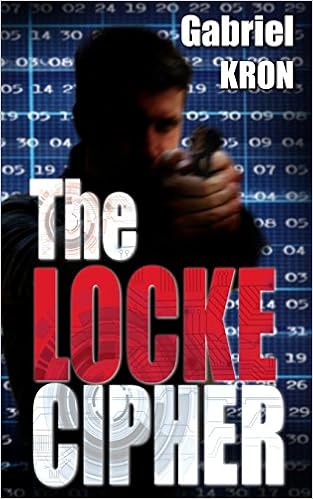
Diana talks to Gabriel Kron, author in a very unusual genre, International Crime Techno Thriller!


Hello Gabriel. It is lovely to meet you. I have come up with some unusual questions for you today!
Thank you Diana, you are my very first author interview, so I hope I can answer your questions and hopefully provide some entertainment.

What is the genre you are best known for?
I want The Locke Cipher to become best known for being a Thriller.  Specifically an International Crime Techno Thriller, if there is such a sub-genre. (Wow!)


If your latest book - The Locke Cipher -   was adapted into a TV show or a film, who would you like to play the lead role?
Oh this is a fun one. After doing a virtual casting I’m thinking of Jude Law for Daniel Bateman. But I think he is busy with Captain Marvel right now.

What made you choose this genre?
I didn’t choose the genre or really even think too much about it until after the story had been told. This meant that when it came to categorising The Locke Cipher for publication, I had to think hard, compare it to others and listen to my beta readers.
It was definitely a thriller, but what kind of thriller. The research spanned many subject matters from the history of electrical engineering, fringe science, espionage, hacking, politics, whiskey (do you know how expensive some whiskies are?), methods of suicide, effects of gun shot injuries, police jurisdiction and even German language. If you’re a writer then you know what I mean.
In the end, and only recently, it became apparent that The Locke Cipher was an International Crime Techno Thriller.

How do you get ideas for plots and characters?
From the same place I dream.
When my four kids were young I used to tell them stories about a dream fairy called Twonkle, who delivered dreams to children in the form of dream crystals. There were tree-houses, dream academies, dream crystal factories and dream caves. One of the special dream crystals was called an astral projection crystal.  There were creatures, dramas, giants, flying, other fairies, evil fairies, and no adults.
I told these stories nearly every night for years, making each story up on the spot until my kids were either asleep or ready for sleep, or I fell asleep.
The point is, I learnt to let go and not fear not knowing what was next and let the story tell itself.

Characters in The Locke Cipher I decided to name after my group of friends on an on-line forum called the OTG.  I initially did this for ease, with the intention of changing them later when the first draft was done and anyone else read it.
However, I email my manuscript to myself after each session as a backup and on one particular night I accidentally sent it to the whole of the OTG forum and everyone got it as an attachment. After an embarrassed apology and some explanations, those named had read the unfinished draft copy and encouraged me to continue with a few members wanting new updates as I wrote them. So the names stuck.  As for their personalities, they grew as I told the story.

Favourite picture or work of art?
Hubble deep field.
Part of Hubble Deep Field HD sourced from Google.

If, as a one off, (and you could guarantee publication!)  you could write anything you wanted, is there another genre you would love to work with and do you already have a budding plot line in mind?
Beyond the Daniel Bateman series, I have a Heist story that is burning to be told and a coming of age college drama about cheating in a final exam.

Was becoming a writer a conscious decision or something that you drifted into (or even something so compelling that it could not be denied?) How old were you when you first started to write seriously.
I was so never meant to be a writer. I wanted to tell stories but through the medium of film. I had a plan, join the BBC and become a cameraman. Trouble was, I was too young and although technically well qualified I had failed O level English twice. First with a grade U and then with an F. My English was beyond rubbish.
Luckily, I was in a musical band and the drummer’s mum offered to teach me English. So after school I’d go round their house and sit at the kitchen table reading broadsheet newspaper articles out loud. Ann taught me as though I were a foreigner and when I re-sat my exam I passed with a grade B.  I also began to enjoy reading and was beginning to devour Stephen King and James Herbert. And I  began to write. Short stories at first, and then novels, screen plays, stage shows and even had ideas for radio plays. I wish I had kept all those attempts. (I wish you had, too.)

Marmite? Love it or hate it?
LOVE IT

Do you have any rituals and routines when writing? Your favourite cup for example or ‘that’ piece of music...??
I would like to, but as a debut indie author, I have learnt to write when I can. But once I sit down to actually write, I like to have a strong coffee at hand as I upload the story into my brain and begin reading the previous days writing.
As for music, has to be something by Hans Zimmer or similar and be instrumental. Interstellar is a phenomenal soundtrack, as is Inception. But once engrossed in the writing and story, I won’t even notice when the music ends and it goes silent.

I promise I won’t tell them the answer to this, but when you are writing, who is more important, your family or your characters?
Shhhhhh, I can’t answer that because my characters are family.

Other than writing full time, what would be your dream job?
Working in film production behind the camera, or just being allowed to be creative. Those that know me, know I make my own furniture etc, in a particular style.

Coffee or tea? Red or white?
Proper strong filtered coffee, or real tea.  Whiskey isn’t red or white, it’s golden. 😂

How much of your work is planned before you start? Do you have a full draft or let it find its way?
In my head I live with the overall story for a long time before I begin to write it down. I then plan four or five chapters ahead usually, blocking out the major points in CAPITALS and inserting flashes of dialog and action I see them.
I then go back and expand the capital lettered outlines into a sentence for each paragraph. I carry on going over and over until it reads in the way I want.

If you had free choice over the font your book is printed in, what font/fonts would you choose?
I do have free choice and I choose either Times New Roman or Arial………. Never ever ever ever ever ever ever ever ever ever ever ever ever ever ever ever ever ever ever ever ever ever ever ever ever ever ever ever ever ever ever ever ever ever ever ever ever Comic Sans. (Phew! You have made me very happy!)

Imagine that you could get hold of any original source document. What would it be? 
The original global temperature data-set that was “accidentally” deleted.

Have any of your characters ever shocked you and gone off on their own adventure leaving you scratching your head??? If so how did you cope with that!?
Oh yes all the time and I think that’s a huge privilege to the story teller when it happens. It happened in Locke a few times especially with one of the major plot twists that actually made me sit back with my hands on my head and say “Oh my god! It’s you!”.  As the story teller, I can only hope the reader feels the same.

How much research do you do and do you ever go on research trips?
Soooooooo much research over such a long time for Locke that will extend into several of the planned series.  But it is important with research to let it sink in and become part of the story naturally. With Locke, there was a lot of historical research on key scientists and inventors as well as locations used where if I hadn’t already been then would spend a good while on Google Maps 3D, and Google Earth.
I hope to do actual location research in person for future books.

Are you prepared to go away from the known facts for the sake of the story and if so how do you get around this?
In The Locke Cipher I touch on some very volatile subjects where real facts are ignored in real life anyway. Readers have said they’ve felt compelled to go and fact check what I’ve written, but none have yet to find where I’ve bent the truth for the device in the story to work.

Do you find that the lines between fact and fiction sometimes become blurred?
I avidly get angry at politics where there are no lines between fact and fiction any more.

Have you ever totally hated or fallen in love with one of your characters?
All of them.

What do you enjoy reading for pleasure?
I’d love to dazzle everyone with someone historically great, but I like fast paced thrillers like Da Vinci Code, Alex Cross, Jason Bourne, Jack Reacher……. I think it shows in my own writing.

What drink would you recommend drinking whilst reading your latest book?
Glenlivet 25 year old single malt.

Last but not least... favourite author?
That changes, but right now it’s Lee Child. I should read more.

About the author:


Gabriel Kron grew up and worked in London through the London race riots and IRA bombings of the 80's and 90's. Having trained as an Engineer with the Ministry of Defence, he joined the computer industry working for large US merchant banks before changing direction completely and becoming a full time Martial Arts Instructor, teaching internationally including presidential bodyguards and police.

About the book:

" If you like a Jason Bourne style of reading, then I strongly recommend this for you. Matthew Reilly readers will also find this a very appealing read...." 5* Amazon review. 

International Crime Thriller that takes the reader into the conspiracy behind technology suppression and how our technology loving main character has to fight for his life against powerful, highly influential forces. When Daniel Bateman learns of a working Lockridge device left over from WWII Nazi Germany, he's soon on its trail. But there are powerful forces that will stop at nothing to suppress technology that would solve the world's energy crisis. Soon the hunter becomes the hunted as Daniel is accused of multiple murders, wounded and on the run. Can his friends and survival instincts buy him enough time to publicly disclose the Lockridge and expose those hell-bent on suppressing it. In the fight of his life, the only secret, which will save him, is hidden in the Locke Cipher. 

"...It's original, it's exciting and it's chillingly plausible. Its greatest strength is that Kron can really tell a story. He grabs you from the start and pulls you into an intriguing web of international crime and conspiracy." 5* Amazon review.


© Diana Milne January 2017 © Gabriel Kron 2017


Saturday, 9 December 2017

Diana talks to Christine Hartweg


Hi Christine. Thank you for coming on *Diana Talks To...*

Let us get started. I am sure there is a question that you have always longed to be asked. Now is the chance. Ask your own question and answer it!

 Do you really like Queen Elizabeth I? 
– Not sure, really. The circles I grew up in considered her an overdressed, bewigged old hag who presided over an unprecedented cultural flowering. It took me years to understand that she was a real human being (seeing her as a 12-year-old in a red silk dress was a healthy shock in this respect); my respect for her grows daily.

What is the genre you are best known for?
– That would be historical non-fiction; I hope if people know me at all, they know me for my research into John & Robert Dudley of Tudor England (the Duke of Northumberland and the Earl of Leicester, respectively). (Christine's excellent books are available from Amazon: John Dudley, Amy Rosbart )

What made you choose this genre?
– Clearly my fascination with said people. It started in the late 1990s and was rekindled in about 2007 after reading a book on the Earl of Essex, Robert Dudley's stepson (I also like Essex).    

Favourite picture or work of art?
– That's so hard, as I love so many, literally thousands. But if I have to choose one, the Wedding at Cana by Paolo Veronese in the Louvre.


Was becoming a writer a conscious decision or something that you drifted into (or even something so compelling that it could not be denied?) How old were you when you first started to write seriously.
– I sort of drifted into writing about the Dudleys due to my interest in them, and at some point I started a blog and some friends said I should write a book. I don't think that I ever wanted to be a writer, although I've always loved writing and there were moments when I thought it would be great to be able to write a biography on this or that person. As a teenager, I wanted to make films.

Marmite? Love it or hate it?
– Never tried it. ((What??? Shocked face!! Diana))

Do you have any rituals and routines when writing? Your favourite cup for example or ‘that’ piece of music...??
– I don't hear music while writing, nor do I have any rituals except to open the file and actually get started. But I need the writing space I am used to. For most of the year this is me sitting on my bed with my laptop; in summer, the weather allowing, this is a small table on the terrace (also with my laptop).  

Other than writing full time, what would be your dream job?
– I've always wanted to be a pharmacist.

Coffee or tea? Red or white?
– I don't drink any of those, actually, my favourite beverage is Coke.

How much of your work is planned before you start? Do you have a full draft or let it find its way?
– Writing non-fiction, I think working hard on a chapter plan is essential. Still, there always come up important new aspects or facts while writing, so you never know at the start what exactly the book will be like in the end. You never know what you'll find, that's exiting.  

If you had free choice over the font your book is printed in, what font/fonts would you choose?
– I'm happy with Times Roman (and Georgia for some elements).

Are you prepared to go away from the known facts for the sake of the story and if so how do you get around this?
– No, I am certainly not prepared to do this, ahem; but I know that moment when something you believe did happen would fit very nicely into the story and then, upon checking the sources again, you notice it didn't happen at all. I guess cutting the whole passage is best, although it may be hard and entail some rewriting.

Have you ever totally hated or fallen in love with one of your characters?
– I think writing about people automatically makes them more likeable. On the other hand, of course I needed to “fall in love” with my main characters in order to keep up the research on them.

What do you enjoy reading for pleasure?
– I try to read all I read for pleasure, I have serious trouble reading things I can't get into. My favourite stuff is historical non-fiction, not necessarily about the Tudors, and also art books.  ((Same here!))

What drink would you recommend drinking whilst reading your latest book?
– Coke, of course.

Last but not least... favourite author?
– Let's say Robert Louis Stevenson and William Shakespeare.

Christine Hartweg

© Diana Milne January 2017 
© Christine Hartweg November 2017


Christine Hartweg lives in Berlin and was born in South America in 1972. She has researched the Dudley family of Tudor England since 2008 and has advised the BBC and other TV channels. She wrote "John Dudley: The Life of Lady Jane Grey's Father-in-Law", and her new book is "Amy Robsart: A Life and Its End". Christine runs the specialist blog www.allthingsrobertdudley.wordpress.com