Friday, 15 November 2013

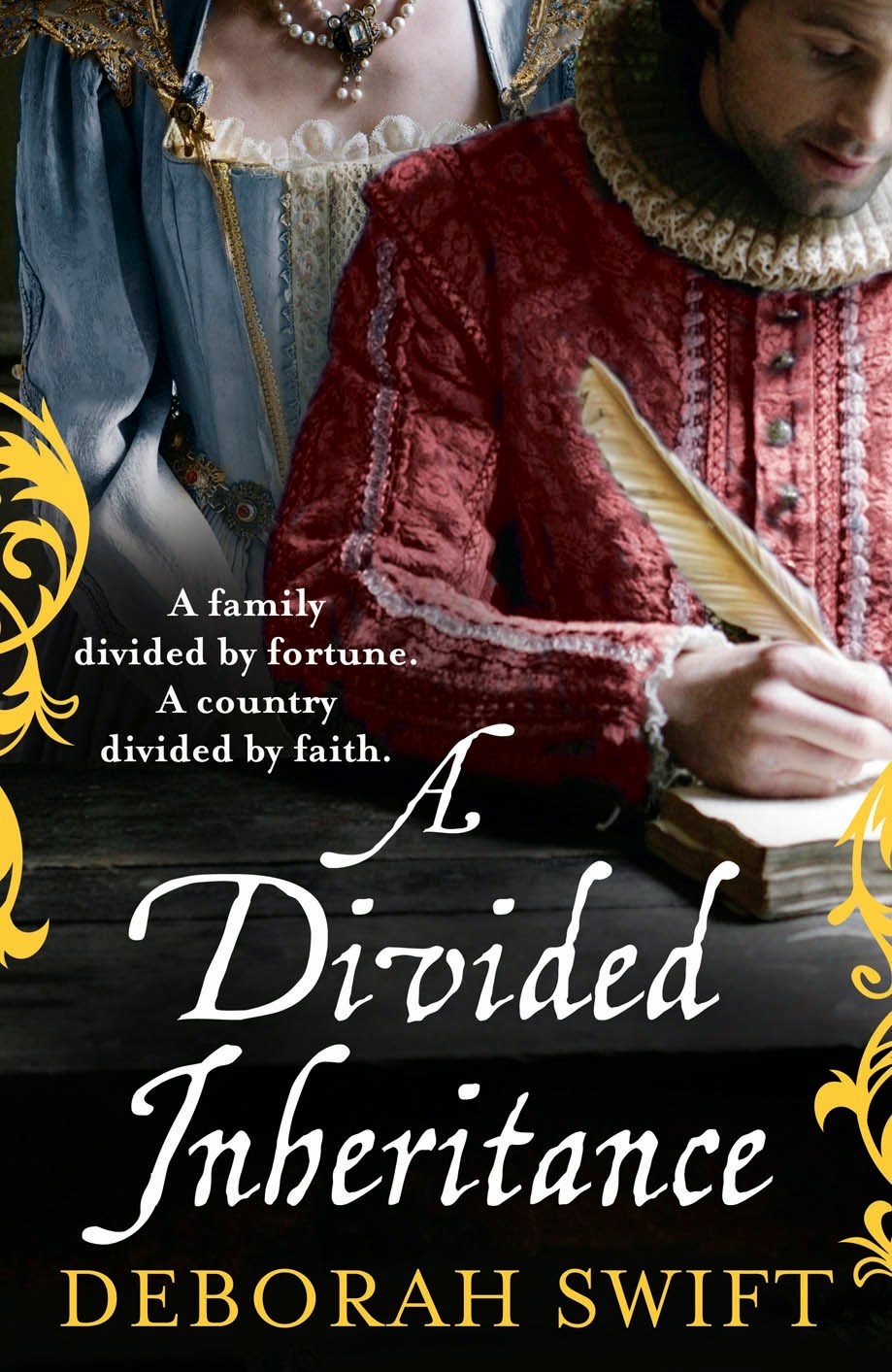
An Interview with Deborah Swift, author of A Divided Inheritance

Thank you, Deborah, for being our special guest author on The Review Blog today. I loved A Divided Inheritance and am curious to hear about how you set about researching and writing this very rich novel. Below are the questions I asked the author and Deborah's interesting answers.


Carol: I loved reading a novel set in Jacobean London and in Spain during the Inquisition. I learned much about the persecution of the Morisco minority and about the finer details of sword play. Could you tell us a little about the historical background to A Divided Inheritance?
Deborah: I started by researching Seville because that is where the real sword school was located. When I went there on my research trip I discovered some archive material in the Inquisition museum that mentioned the Morisco expulsion, and a statue dedicated to those whose lives had been lost. When I came home I researched it and found the chilling text of the expulsion order which told people they had three days to leave or they would be killed. Of course then, when I discovered more about the Moriscos and their way of life, I just couldn't resist it and it became the major focus of the latter part of the novel.
17thC Seville ( from the museum of Seville)


Carol: I am curious about how you went about writing your novel which is very character driven.  How did you discover your characters?
Deborah: I had always wanted to write about a woman in business in the 17th century. My research told me that women in business at that time were usually widows, who took over the husband's business on his death. Often these were very successful - after all, well-off women of the day were used to handling household accounts and a large number of domestic staff already. However, when I started the novel I had no idea that Elspet Leviston would go to Spain or become interested in the art of the sword, or friends with the Morisco family, the Ortegas. That all came through my other main protagonist, Zachary Deane. The inspiration for him came directly from a 1630's book on the art of the Spanish sword - the esoteric art of 'La Destreza'. In the manual the characters in the drawings were called Alexander and Zachary (presumably to indicate the A-Z of fighting), but I decided to fictionalise them and both Zachary and Alexander now appear in the book.

Carol:  How did you set about planning A Divided Inheritance?
Did you plan it section by section or chapter by chapter and were there any surprises as you set it down?
Deborah: I knew it was going to be a big book because of the epic journey I wanted Elspet to make - from a staid, somewhat prim London lady into a much more open-minded and physically capable woman. And because to do that I would need to cross three cultures. So I divided it at first into four rough parts and structured each part like a mini-novel. At the end of each part though I tried to have a question hanging to propel the reader into the next part. I also used the image of the swallow both in the text and pictorially (thanks to the designer) to tie the parts together. The swallow flies free and crosses all the boundaries without limitations, giving a literal 'bird's eye view' of the struggles of the characters.
Carol:  How many rewrites did you need or should I say drafts? Do you have any 'director's cuts?
Deborah: Yes, I do lots of drafts, plus edit the previous days work as I go. I think there were probably about five drafts, though in these days of computers it's hard to tell as I don't print them all out. There are a few director's cuts. I cut quite a lot of Elspet's journey by ship to Spain, and through the countryside. Travelling time is always awkward - you need enough to have a sense of real distance and journey, and the arduousness of travel in those days, but not so much that it bores the reader, who is thinking, 'are we ever going to get there!' I needed enough time for her to develop a relationship with Mr Wilmot, but not too much.
I cut a few scenes in Senor Alvarez's fencing school too. I loved him as a character and he was in serious danger of taking over the novel! I needed all four parts of the book to balance, so I cut back to what I thought was essential.
Girard Thibault's fencing training ( taken from the cover of his book)


Carol: Can you say a few words concerning your writing day and other interests. What do you prefer for relaxation.
Deborah: I write in the mornings, and that leaves the afternoons free to fit in my other job and my research. If I'm having a particularly good day or nearing the end of a draft I hate to be interrupted and might carry on until I run out of steam. For relaxation I do a lot of physical things like tai chi, yoga and drumming. This is because it helps get rid of the adrenaline involved in writing - I really do live all those tense scenes! Also it gets me off my chair and somewhere where I can be sociable. I also love nature and the outdoors and do a lot of walking.


Carol: Did you read any other novels pertinent to the period you have researched for A Divided Inheritance
Deborah : I didn't - I try to avoid it if I can, and concentrate on reading research and novels set in other times. I pick up accents easily when I meet people, and 'voices' easily when I'm writing, and I want to keep focussed on my own. Also, there are not many novels set in this period, but now I've finished I'm open to any recommendations!
Some research books that I read and enjoyed, which are very accessible are:
'By the Sword' by Richard Cohen
'The Gunpowder Plot' Antonia Fraser
'Inquisition' Toby Green


Carol: Finally, what/who are your favourite historical novels/writers?

Deborah: I enjoy Rose Tremain, Tracy Chevalier, CJ Sansom. I've just started reading Elizabeth Chadwick (why did I wait so long?! fantastic) and just discovered Kate Forsyth, an Australian historical fiction writer.
Twitter @swiftstory
Carol McGrath is the author of The Handfasted Wife, a biographical fiction of Edith Swan-Neck and her possible survival after the Norman Conquest.

Thursday, 14 November 2013

A Divided Inheritance by Deborah Swift


A Divided Inheritance is a fabulous read. Deborah Swift’s other two novels set in the seventeenth century, The Lady’s Slipper and The Gilded Lily, are thoroughly enjoyable books, well-plotted with depth of characterisation. A Divided Inheritance is, without doubt, the most sophisticated work of the three novels and a brilliant achievement. An excellent historical novel owns two elements: the total immersion of a reader into a previous historical era and engaging characterisation. With A Divided Inheritance, Deborah Swift succeeds on both counts.

The story is set during the early years of the reign of James 1st , opening in London to a background of trade and religious tension following the late Elizabethan period and The Gunpowder Plot. Elspet Leviston hopes to inherit her father’s London lace business but is thwarted by the arrival of a lost cousin.  As a consequence her inheritance will be divided. Zachary Deane has a disreputable background, yet despite his shadowy past, her father draws him into their pleasant London home and his business. To Elspet’s chagrin he sends this mysterious cousin on a grand tour to look for new markets and to knock off his rough edges.

Elspet is a devout English Catholic, intrepid, and not deterred by obstacles, she takes on a terrifying sea and land journey into Spain, a country in the grip of Inquisition, in search of Zachary after her father’s sudden demise. The journey to Seville sets in motion intriguing events as the two protagonists become locked in a battle of wills, involved in a school for training swordsmen and in the expulsion of a persecuted people, the Morisco population of Andulusia, one often composed of  baptised Christians . The expulsion is a very moving aspect of this novel’s plot, superb in its depiction and integration into the novel’s overall narrative drive, also providing the story’s sub plot.

At the heart of the novel is character. Even minor characters are extraordinarily well developed and, of course, the protagonists are particularly rich depictions. Elspet is plucky and determined but she is also a prim Jacobean lady who early in the book faces several disappointments. She is a heroine rooted in her time yet propelled by circumstances into situations which permit her ultimate self-discovery. Vividly portrayed she leaps off the page in her farthingales, laced bodices, her desire to visit every Spanish church on the route across this arid, dangerous country, her ability to stay her post under a relentless sun, whilst waiting for the difficult retrograde, Zachary, each day, as he learns skills of the sword. She is indomitable and will confront him. Zachary Deane is a man of the sword, an ultimately likeable ne’er do well. Can he meet the challenge the story’s terrible events present and gain redemption? As for all the personalities in between- they successfully respectively aid or hinder the story’s development. All of them provide a convincing and engaging gallery of characters whose destinies we care about. This novel must be praised for Deborah Swift’s attention to research and her translation of this into brilliant characterisation, scintillating dialogue and a thrilling narrative. Her research, though impeccable and thorough, never shows. The scenes set in a Spanish sword school and amongst the Morisco community are vibrant. I was there participating in Elspet’s and Zachary’s story lives, fighting with sword, trudging Seville’s narrow streets, watching their romances develop and the threats to their survival. A Divided Inheritance is a terrific historical novel; one which on reaching the last page I was reluctant to put down. I hope it provides other readers with an equally delectable sense of enjoyment. It comes highly recommended.
A Divided Inheritance is available from Amazon and from bookshops

review by Carol McGrath

Review: SAINT OF THE BURNING HEART by Julia Robb

Unless you've been waiting with breathless anticipation to read a book by an author with whose work you're familiar, and which you therefore have high hopes of enjoying, the unspoken thought in any reviewer's mind when starting to read a new book must inevitably be: "Oh please, please, please let it be good!"

Well, with Julia Robb's Saint of the Burning Heart, I needn't have worried.

For a start, the reader is in very safe hands.  Julia Robb has a background in journalism - "I spent 20 years in the newspaper business", as it states on her Amazon page - and it shows.  She knows what she's doing.

Not every journalist can write a compelling story, though.  In addition to the craft of turning a neat phrase and getting the information down on the page, there's also the art of spinning a yarn that keeps the reader intrigued, engaged, enthused and entralled.  With Saint of the Burning Heart, Julia Robb proves that she has mastered more than just the craft of writing: she also possesses the art.

Published as an ebook in February 2013, Saint of the Burning Heart swings between steamy melodrama and modern-day tragedy.  Well, almost modern-day: the novel is set mostly in the 1960s, in a part of Texas, within easy reach of the Mexican border.  Like much in the novel, the information that the story is not exactly contemporary isn't spoon fed to the reader: it emerges. 

In the manner of a natural dramatist, the author here plays a sort of hide-and-seek with the audience; there's a slightly teasing quality to the narrative, a sense that - rather than piling on the exposition - the author prefers to let the story unfold in its own way, popping questions into the reader's head and then resolving them when the time is right, which is how a good thriller works.  It's indicative of confidence and a sure hand.  From the opening moments, the reader is caught up in the author's spell.  There are no unnecessary explanations: only crisp, incisive descriptions, plenty of authentic-sounding dialogue, memorable scenes and images, strong, volatile characters and an all-pervading sense of emotional and social conflict, of passions and prejudices, of individuals, families and a whole community on the brink of self-destruction.

Central to the story is the orphaned Nicki.  Raised by a foster-family - which is itself an uneasy mix of "Anglo" and "mescan" blood - she develops an erotic fixation on her rescuer and father-figure.  Obliged by scandal to leave home, she returns to discover that her smalltown community is riven with racial and political tensions.  The whites have had it all their own way, but now the Hispanics are running for office and anxious to overturn years of oppression.  Nicki is caught between the rival camps and rival lovers.

The setting is vividly presented and peopled by believeable characters, all-too human, flesh-and-blood, driven by their own demons and desires.  They speak in their own patois, the emphasis on dialogue over description lending the story an added drama.  The book plays out like a movie in the reader's mind - it has all the sweaty intensity and immediacy, the visual realism and the fatalism of a certain kind of American cinema (I was also reminded of Steinbeck, and especially Of Mice and Men, which uses dialogue to similar effect).

There are many standout moments - including a minor orgy of depravity and self-loathing in which the priest Daniel (the "saint" of the title, I believe) indulges across the border in Mexico - and plenty of characters who stick in the mind, so vividly are they presented; they seem so real, you can almost smell them.  Most of the major characters are introduced in their turn, flaws and all, with the narrative breaking away to discover and follow them, before the author skilfully draws all the strands together.  The tension increases, and the pace seems to quicken, until we're heading for the final showdown.  And even then, right up till the end, Julia Robb plays with our expectations.  We know it will end badly - but quite how, we can't tell.  We must trust to the storyteller, and by that point in the story we have little choice: she has entertained and intrigued us, puzzled and enlightened us, and we are at her mercy.  Fortunately, she delivers.

It should be clear by now that I was somewhat in awe of this story and its author.  I am happy to recommend it, and cannot do so highly enough.  The writing is exciting and excellent, and the story merges the domestic with the historic, the personal and the political, so deftly, and to such an extent, that the whole remains with you long after you have turned the final page.

Julia Robb is also the author of Scalp Mountain, which, if her Saint of the Burning Heart is anything to go by, promises to be as gritty and gripping as anything the avid reader of historical fiction could hope for.

Simon Stirling


Tuesday, 12 November 2013

PAULA'S PEOPLE: AUTHOR JANE GRAY

Many thanks to Paula Lofting for featuring The Bitti Chai on The Review.  Paula said just to tell the readers something about myself and that is exactly when my mind went completely blank. 


Naturally somewhat of a reclusive person, marketing The Bitti Chai and attending book fairs in general is something akin to torture for me.  My family is naturally secretive and for many years did not mix with outsiders, Gauja's they call them, the Romany word for anyone who is not Romany. In fact many people did not know of our Romany background as my grandfather always feared the hostile reaction we would receive and having lived through the Second World War he was understandably cautious.

I was brought up by my Romany grandfather, the youngest of ten children, the bitti chai (the small girl). My family initially inspired the writing of The Bitti Chai but most of all I wanted to share some aspects of Romany culture with the outside world. To inform people about Romanies traditional values, strength of family ties and loyalty utterly contradicting the familiar and incorrect portrayal of this much maligned ethnic minority. 


The Bitti Chai was released in paperback in November 2012 and early in 2013 as an e book.  In October 2013 the ebook of the follow up The Lost Souls was released via Amazon.  The last in the trilogy, The Man with Two Minds hopefully will be released late next year.  I have to say that throughout the process of writing both novels I have been supported by my editor Jo Field and although I had the seed of an idea for the book Jo inspired me to carry on writing.  The New Writers Group to which I belong put me in touch with a graphics company (Avalon Graphics) and Cathy Helms designed my book cover which I am constantly thrilled with each and every time I look at it.  She also made a fabulous book trailer for me which I have to admit have watched over and over again, sad or what.  Shortly after the release I received a B.R.A.G Medallion, an award for Indie writers and gained a great review and received much support from them.

During the Spring and Summer months I tend not to write too much as true to my roots I love horses and breed and show native ponies, Dartmoors in particular.  The show season for us begins in March and carries on until October so this doesn't leave much time for writing although to be fair every day I am going through scenarios in my mind.  At present my hero and heroine, Johnny and Reigneth fill much of my imagination.  In fact I'm not quite sure what will come after the third book in the series about them as their characters tend to dominate much of my thoughts at present.  Reigneth is truly named after my great Aunt who was born on the roadside at Rainworth, Nottinghamshire, which is pronounced Reigneth.  Some of the characters in The Bitti Chai are moulded on real family members. 

I am terribly proud of my family and my birthright and to me having Romany heritage is extremely important, even if one person reads my book and has a positive image of Romanies then I feel my writing has accomplished something very important.


For those of you who haven't read The Bitti Chai the story begins in Lincolnshire an area which my family travelled through extensively and eventually settled in the late 1880's.  The story moves on as does the family when they move to Chagford in Devon.  Chagford is a very special somewhat spiritual place for me.  A place where I feel I can immerse myself in the surroundings and feel at one with nature.  It was therefore natural for me to choose this place to base most of the story.  Dartmoor has long been steeped in tales of ghostly apparitions and happenings and I love nothing more than to walk over the moors and climb the Tors, no matter whether it is rain or shine.  In all its moods the moor is enchanting and this is the setting for my novels, a tale of ghosts, jealousy, prejudice and passion but most of all romance.


Jane is kindly giving away an e-copy of her book The Bitti Chai which was reviewed on Monday (see here) so if you would like a chance to win, just leave a comment.

http://www.bragmedallion.com
http://youtu.be/_Tut_W8Ci7k 

Paula Lofting is the author of 4/5star historical fiction novel  Sons of the Wolf
blogs - www.sonsofthewolf-paulalofting.blogspot.co.uk 
            www.threadstothepast.blogspot.co.uk
website - www.paulalofting.com

Monday, 11 November 2013

Jayne's Corner: Interview with Regency author Jane Lark

For Jayne’s corner this month I am trying my hand at interviewing and the author Jane Lark has agreed to talk to me.

Jane lives near Stonehenge in England, and near the Regency city of Bath. To research her books she spends  her  spare time visiting historic houses and properties about the UK. She is chartered member of the United Kingdom of  Institute of Personnel and Development and holds the equivalent of a Masters degree in People Management . Her first book Illicit Love was released earlier in the year and it had great reviews and she has just released a follow up The Passionate Love of a Rake . Both books are about the Marlow Brothers and their quest to find love ,

Jane writes a blog on   interesting people who lived in Regency times and at the moment is writing about Courtesan Harriette Wilson . You can find this at  http://janelark.wordpress.com/
. She also has a website which can be found at  http://www.janelark.co.uk/index.html

Jayne  Your story is about the love between a courtesan and a Lord / What made you decide on that?

Jane  The idea came from the memoirs of a real Regency courtesan, Harriette Wilson. I have been sharing her story on my history blog. But there was one particular man she fell in love with, and it was that story which made me want to write the, “and then… and then… and then…” which Harriette Wilson spoke of.

Jayne  How long did it take for you to write this book?

Jane  It took me about four months to complete the first draft, but I wrote it about six years before I found a publisher for it, so it’s had many drafts since the first. The advantage to this is I’ve had six years to keep writing, so the rest of the Marlow Intrigues books will follow very quickly on its heels.

Jayne  Have you always wanted to be a writer?

 Jane  Yes. My imagination has always been rampant. When I was eight I was told by a teacher that when I was older I would write a book, because my story about giant crabs taking over the world stood out so much from anything anyone else was writing, and I basically day dreamed my way through school.

Jayne   What made you decide to write a Regency romance? 

Jane  The writer who made me fall in love with writing history and love stories was Anya Seton. I have dabbled with medieval stories, and considered the popular Tudor era, but then I started reading some of the Regency books and researching this era, and it was such an exceptional period for romance. Men really did believe in going the extra mile in flirtation, of course it was all for show, nothing was really any different in behaviours than today, but what a show.  I was sucked in. I love the era.

Jayne Where did you grow up and did it influence your writing?

 Jane I think everything in your life influences your writing. I grew up on the boarder of Wiltshire and Oxfordshire, in a village, and then in the small market town of Faringdon between Swindon and Oxford, in the UK. Out of the two cities, I would always via towards the one with historical character, Oxford, as now I via towards Bath. My Parents always loved history, so I have grown up doing amateur archaeology and exploring historical places, castles, houses, the white horses and hill-forts around us… While my imagination ran rampant - with knights in shining armour wondering about in my head, a reader told me Edward in The Illicit Love of a Courtesan had a knight in shining armour feel, and even though I am writing Regency in my head, the men will always be knightly to me :D . Anyway there is one very obvious influence you’ll come across in book three. I grew up in the shadow of a folly which will appear in book three in February 2014, so keep an eye out for pictures on my Facebook page ;)

 Jayne How do your family cope with you being a writer ?

 Jane  I won’t lie; they do get fed up with my attachment to my laptop. I’m still working a day job at the moment so I am writing in the hours I should be spending with my daughter and my husband. But they both know how committed I am, and how much writing means to me, and in the years I was unpublished my husband was the one always saying “It will happen.” And my daughter is incredibly proud, she tells everyone her mum is an author.

Jayne   The next book about the brother of the hero  has just come which I really loved .What made you decide to write about Robert ?

 Jane  I always knew when I was writing Robert’s part in The Illicit Love of a Courtesan that he had his own story. I tend to mentally work two or three books ahead. I don’t write down plots, but when I go to bed at night, plotting in my head helps me get to sleep, and I build up stories in scenes. I haven’t finished writing all the Marlow Intrigues series yet, but in my head I have two more full family series plotted out… It also helps to make sure the personality of characters can run through a series. You’ll realise that there’s a tiny hint to the story of book two in book one, when you read it, but it’s so small you won’t have noticed it. And book two is also developing John’s character, you hear him begin to change through it as book three is his story.

  Jayne   What pleasures help you write ?

 Jane Writing is my pleasure, I cannot wait for the day I earn enough for it to be my full time job. For at least ten years writing has been the thing that gets me through life. Really I’m still just a daydreamer, only now I get to share my daydreaming with other people :D . The only seconds to it are reading and visiting historical places, and when I give up the day job I can write in the day, read at night and at weekends volunteer at a Historical House – perfect life.

Jayne   Do you plan to delve into other era’s in your writing ?

 Jane Yes, quite soon. I love writing about people falling in love as much as history and my first publisher felt my writing voice would suit the New Adult genre so encouraged me to write a story about a young couple’s journey as they grow up and find their place in the world. My first contemporary is a Christmas story, set in New York, called I Found You. It will be out on the 5th December, and as you can image three more contemporary stories have already been plotted in my head. I am going to be a very busy person.

 Jayne   If you hadn't been a writer, what would you have been/done/become? That is, was there another ambition or career route you sometimes wish you had taken?

 Jane  I have always wanted to be a writer I started my first novel at sixteen a historical set in the Roman era. It took me about another twenty years to complete one, but it was always what I wanted to do. I kind of fell into my day job though, I dropped out of college when my brother had a serious car accident and just took an admin job in a Government Benefits Office because that was the job I was offered. But after a few years I became a team manager, and had a skill for it, and then was offered a job as a Human Resources manager, so then I started studying and achieved a masters degree and chartered recognition, and I enjoy what I do as I work on well-being and engagement, making things better for people at work. But also this career has actually helped my writing because I’ve learned a lot about psychology which helps build believable characters. And my day job definitely influences my contemporary story, but I can’t tell you why, it would be a huge spoiler.


Thank you so much to Jane for talking to me . If you love Regency Romance books as much as I do then these books are well worth the read.


Sunday, 10 November 2013

Marsha's Monday: Review of The Bitti Chai by Jane Gray


The Bitti Chai, a B.R.A.G medallion honoree, by Jane Gray is a charming tale about Reigneth Gray, a sweet, beautiful girl of fifteen living in modern day Lincolnshire, England. Reigneth is of Romany heritage, a heritage that has handed down a special gift in which she uses for good.

After an unexpected event takes place, Reigneth and her Mother Jessie decide to relocate to Devon to live with Jessie's sister, Liz and her husband. This relocation brings about a great many changes for Jessie and especially Reigneth. They both have a lot of support from their Romany family. Reigneth is extremely close with her cousin James and her cousin Aaron.

Reigneth's special gift, an ability that runs in her family, is shared with her Grandmother Mary. Before passing on, Grandmother Mary has a discussion with Reigneth about her future and of her cousins James and Aaron.
Throughout the book we see Reigneth's innate goodness shine through in all that she does and her interactions with family and friends.

Jane Gray writes authentically of Romany life in modern day England and the mores and customs of the Romany heritage. I enjoyed reading about the Romany culture and learning about their way of life. The character of Reigneth is one that you can't help but like and the supporting cast of characters are well written and equally as likable. To continue to enjoy Reigneth's story and that of her family and friends one can read Jane Gray's second book in the series, The Lost Souls.


Enter to win a free e-copy for Kindle of The Bitti Chai please leave a comment on the blog.


Jane Gray was brought up by her Romany grandfather, the youngest of ten children, the bitti chai (the small girl). Her family initially inspired the writing of The Bitti Chai but most of all Jane wanted to share some aspects of Romany culture with the outside world. To inform about Romanies traditional values, strength of family ties and loyalty utterly contradicting the familiar and incorrect portrayal of this much maligned ethnic minority.

She lives and works in Nottinghamshire and as well as writing, breeds and shows Dartmoor ponies.Her life revolves around her family, her husband, three children, dogs and ponies and countless cousins.She is a member of the Romany and Traveller Family History Society and is a keen family history researcher. 


This review was written by Marsha Harrington Lambert . If you would like Marsha or any of the Review Team to review your book please see the admissions tab at the top of the blog.

Saturday, 9 November 2013

The Strange Case of Mr Brodie and Mr Hyde

Edinburgh is a city which lends itself to notorious characters both real and fictional. From the body snatchers Burke and Hare to Inspector Rebus, all have trod on the cobbled streets of the Old Town, but one criminal from the 18th Century has been remembered with a pub, a play, a close (alley), a song and a film all named after him. His name? William Brodie.

Born the son of a well respected and much admired cabinet-maker young William followed in his father's footsteps and became a skilled cabinet-maker in his own right. With the death of his father William inherited not only the business but also a huge sum of money.
This sudden wealth allowed William to experience all those finer things in life which had previously eluded him and he quickly became firmly hooked on gambling, boozing and whoring his way through the best brothels, gambling clubs and pubs on the dark and dangerous streets of Edinburgh. All of this was unknown to those who continued to seek his services as both cabinet-maker and locksmith, and through the good name of his father he was eventually invited to become a member of Edinburgh Town Council which earned him the title of Deacon Brodie: the title by which he is best known today.

Unfortunately for the now Deacon Brodie, the inherited wealth was rapidly running out and with a string of mistresses and several illegitimate children to care for he was placed in a quandary of his own making. He could forego the High Life, knuckle down and make the best of a bad situation through hard work and frugality with the little money he had left, or he could seek an alternative means to maintain his wild lifestyle.
Cabinet made by Deacon Brodie on display in
The Writers Museum in Edinburgh
His skill at cabinet-making meant he was never short of work and added to his skill was his position and title which meant that the Great and Good of the town were only too happy to employ him in their own homes. Unknowingly they were inviting the devil in with their smiles and kind words. Brodie took full advantage of their trust to make copies of their house keys and spy out what was valuable and where it was to be found at a later date.

Armed with these keys he could return at his leisure in the dead of night, let himself in and remove what he pleased. By day he was Deacon Brodie, pillar of the community, respected by all but by night he was a thieving rogue hiding behind a mask! He was so successful at this double life that for a while he was able to maintain his taste for the seamier side of life but greed for more eventually persuaded him that he needed additional help. An English locksmith named George Smith was recruited along with two locals known as John Brown and Andrew Ainslie.
Brodie seemingly had it made! While the sun was in the sky he mixed with the best of society and knew men such as Robert Burns, the famous poet, and Henry Raeburn, Scotland's finest painter, but once the sun had set William Brodie thrilled at his own criminal escapades which baffled the Town Guard and left High Society demanding arrests. Brodie himself was probably vocal in calling for action to be taken while every week another house would be raided and more loot stolen!

Had he stuck to robbing private homes it is likely that Brodie could have enjoyed a long and successful criminal career but greed once again got the better of him. He had been hired to do some work in Edinburgh's Excise House (the Tax office) and he could not resist taking copies of the keys. This would be his finest hour! The Excise House contained several fortunes in paper and coin and it would all be there for the taking!
On March 5th 1788 Brodie and his gang struck the Excise House but things did not go according to plan. One rumour has it that Brodie, being drunk, actually fell asleep at one point during the robbery but whatever the truth the gang were discovered and only just managed to escape with only a fraction of the huge wealth they had come for.

Finally Edinburgh had had enough of this crime wave! Rewards were issued for information and one of Brodie's associates, John Brown, turned himself in and gave King's Evidence to save his own neck from the noose. He wasted no time in naming all involved and very firmly pointed the finger of blame at Deacon William Brodie!
Brodie hearing of the arrest of his accomplices took flight and ended up in Amsterdam where he intended taking ship for the Unites States of America where he would be safe from British justice in the newly Independent nation. Unfortunately he was captured as he boarded the ship and speedily extradited back to Scotland to stand trial.

In Edinburgh, Brodie's capture and trial captivated the capitol city as perhaps no other had before or since. But soon after, the man who led the most secret of lives, was found guilty. The sentence - death by hanging. On October 1st, 1788, Deacon William Brodie and George Smith were put to death before a crowd estimated at over forty thousand. Legend has it that the gallows were of a new design from William himself, possibly even made by his own hands! Whether that is true or not is debatable and more likely to be fiction than fact.
Execution of William Brodie at Edinburgh Tolbooth
October 1st 1788
However the story does not end with his death on the gallows. It is claimed he bribed the hangman to ignore an iron collar worn round his neck to save him from death! And it is here that the story firmly wanders into the realms of the fanciful I feel. His body was cut down shortly after sentence had been carried out and was spirited away by friends who revived him with stiff drinks. He was later said to have been seen walking the streets of Paris. It is also claimed his grave, unmarked in the churchyard of the Parish Church in Buccleuch, was dug up in response to these claims and was found to be empty! Or so it is said!
Deacon Brodie continues to live on in popular memory due to another of Edinburgh's sons: Robert Louis Stevenson who took the story of William Brodie and used it to create his famous short story The Strange Case of Dr Jekyll and Mr Hyde about a respected man who leads a vile double life. If you are in Edinburgh be sure to visit the pub on the Royal Mile which bears Brodie's name and remember that crime, while it may be fun in the short term, does not pay!
Just a short stroll from the pub you will find The Writer's Museum which amongst its exhibits includes a cabinet made by Deacon Brodie himself!


Stuart Laing is the author of The Robert Young of Newbiggin Mysteries, the #1 bestselling series in the Kindle Edinburgh Historical Fiction chart
His blog can be followed at stuartslaing.wordpress.com